Franco SacchettiBiblio.com
12 résultats
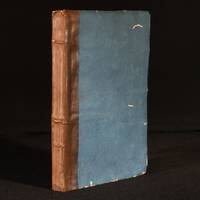
1724mon0001623080In Florence 1724. Hardcover. Good. . The boards are stained and bumped/scuffed.The binding is firm and there are no loose pages.The edges are grubby.Text is clear with foxing/tanning. In Florence hardcover
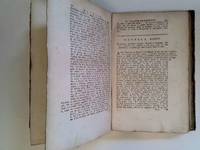
1724957P40Firenze: Not Stated 1724. Leather. Good. 9" by 5.5". None. An anthology of the short stories of Franco Sacchetti one of the most counterfeited works of the century. One of the pirated editions published in the same year as the true first with the false 'Firenze' imprint the work likely having been printed in Naples. This was an incredibly popular work when first published and was oft-pirated being one of the most counterfeited books of the eighteenth century. In the original Italian.Volume II only of a total of two volumes.The short stories of Franco Sacchetti a prolific author who wrote 300 short stories during his life though today on 223 survived which had been printed in this work. Of particular renowned is his masterpiece 'Trecentonovelle' which rivals Boccaccio's writing.Bookplate of the poet Luigi Strano to the front paste down. In a quarter calf binding with paper to the boards. Externally generally smart with some rubbing and loss to the boards. Light bumping to the extremities. Spine is faded and lightly rubbed. A few light marks to the boards. Two bookplates to the front paste down. Internally firmly bound. Pages are lightly age-toned with scattered spots. Good Not Stated hardcover
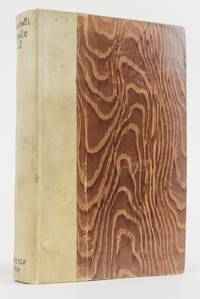
1724000632Firenze Florence 1724. Three Quarters Vellum. Fine. 8 49 240 230 18 pp. Collection of 258 stories from Medieval Italy. Stories vary from being mere anecdotes jokes arguments and rebuttals playlets to short stories along the lines of Boccaccio who was roughly his contemporary about 15 years older. De Sanctis the seminal critic of Italian literature considered Sacchetti "the true echo of his time" which was not necessarily meant as flattery. The contemporary vellum and red title label on the spine have minor soilage. The binding is tight and the leaves generally clean with minimal soilage. Overall near fine or fine. <br/><br/> hardcover books
17241385904Firenze Florence: N.p. 1724. Hardcover. Octavo 8 49 1 238 2 230 18 pages. In Good condition. Bound in later quarter vellum with paste paper over cloth boards and handwritten titling to spine. Slight discoloration to vellum of spine. Moderate chipping and splitting to paper covering cloth particularly to edges of boards and where paper and vellum overlap; light plus bumping and chipping to corners. Text block with light plus age toning and scattered foxing. Ink annotation to rear free endpaper. Two parts bound in a single volume with separate title pages for each part. TG Consignment. 1385904. Special Collections - Downstairs. [N.p.] hardcover
172518286Florence; 1725. contemporary quarter calf over marbled boards. Armorial bookplates on pastedowns; former owner's blind-embossed name and address stamp on front free endpaper; some minor worming; clean and sound. 8vo. hardcover
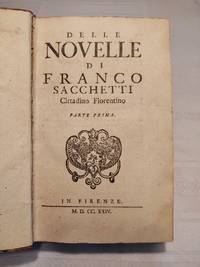
1724dellenovelleFlorence 1724. First Edition. binding tight some slight yellow. 1st Edition of Delle Novelle di Franco Sacchetti rare 1724. Collection of short stories by Franco Sacchetti published in Florence. Illustrated titles and fine typography. Rebound in 3/4 leather containing both Tome I and II estimate that it was rebound in the 1920's in Italy very fine job with marble ends. Notes on front end paper and rear end paper by prior owners. hardcover
1782252594Paris 1782. First edition first issue. Engraved frontispiece. 158 pp. 8vo. Original pink paper wrappers lightly worn and soiled. A few light scattered stains but generally quite clean and fresh inside. Very good and in original condition. In a half morocco and cloth slipcase. First edition first issue. Engraved frontispiece. 158 pp. 8vo. Authorship of this work is uncertain but Howes theorizes that one Captain Walsh is the author. Whoever wrote it served as an officer in the Comte d'Estaing's squadron and is highly critical of his conduct. This work describes the operations of the French fleet in 1778-79 beginning with the departure from Toulon and covering the blockade of the British at New York; the planned but aborted naval battle off Newport; the encounter with the British fleet under Admiral John Byron; and finally the attack on Savannah Georgia. This is one of the best sources for the Savannah attack. An important Revolutionary naval item here present in the first edition first issue of the text. Clark I:234; Howes E198; Sabin 23033. De Renne I:224 unknown books
179417471Lisboa Lisbon Antonio Rodrigues Galhardo 1794 1794. Paperback. Fair. G HB splits at side of top sp light damp staining on early pages & last page but not too obtrusive. A repressed book fore runner of Freud which was apparently the first portugese work on medicine of the mind. <br/> <br/> Lisboa Lisbon Antonio Rodrigues Galhardo 1794 paperback
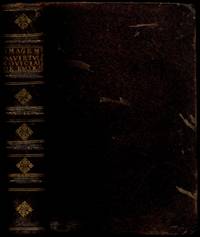
1714CA1215<p>18886 pages with title in red and black woodcut head-pieces and initials and index. Folio 11 3/4" x 8" bound in contemporary calf spine in gilt. Earliest OCLC copy found was 1719.</p><p>Antonio Franco's work as a history of the Society in that era was typical among others in extolling those fellow Jesuits who died as martyrs during or on their way to missions in Brazil. Perhaps viewed now as a glorified euro-centric perspective the work nonetheless features in the important <i>Bibliographia Brasiliana</i> by Borba de Moraes 1.318. It also deals with the formation structure of the novitiate of the Jesuit school at Évora Portugal which became a model for many other Schools in Portugal Brazil and island territories.</p><p>Father António Franco reveals a historical and critical consciousness at a time when hagiography literary genre in which include his edifying lives begins to assert itself as a critical science. The study also proposes a reading of <i>Imagem da virtude</i></p><p><i><br /></i>In the context of spiritual pedagogy of the Society that not only values an edifying view of history and historiography but also the spiritual principle of <i>imitatio sanctorum</i></p><p><b>Condition: </b></p><p>A few pages with light damp-staining lower fore-edge corner a few very small worm holes to title no text loss endpapers and pastedowns spine gilt rubbed leather scuffed else very good.</p> Officina Real Deslandesiana, hardcover
1787252583London i.e. Paris 1787. xxiv xlviii 344 pp. Later roan spine gilt. Modern bookplate on front pastedown. Negligible foxing. Very good plus. xxiv xlviii 344 pp. Advocates of French-American Commerce. A highly important work of political economy published in Paris under a false imprint and designed to stimulate investment in the United States by the French. Brissot was one of the most pro-American French thinkers of the period; he later wrote a well-known work on his American travels and later died in the Terror. This work seeks to enlighten the French and American public about the possibilities for mutually beneficial investments. Dedicated to the American Congress and the "friends of America in both worlds" it reviews a number of economic issues such as balance of trade the superior benefits of French manufactures for American markets why French wines and oils were better than any that could be produced in the U.S. and a broad range of specific products. Various American products ranging from rice to furs are then discussed. In the end the authors include a prospectus for their proposed "Societe Gallo-Americaine." Claviere and Brissot worked together on a number of political tracts and both believed that the example of America's fledgling democracy held the key to France's future9. Howes C464; Kress B1169; Goldsmiths 13307; ESTC T109594; Sabin 13516 unknown books
1719R300114502NO REAL COLLEGIO DAS ARTES DA COMPANHIA DE JESUS. 1719. In-4. Relié plein cuir. Bon état, Couv. convenable, Dos à nerfs, Intérieur frais. 856 pages + 785 pages - ouvrages essentiellement en Portugais - textes sur deux colonnes - quelques bandeaux, lettrines et culs de lampe en noir et blanc - dos à 5 nerfs - titre et tomaison dorés sur le dos - ouvrages en bon état - 7 photos disponibles .. . . . Classification Dewey : 840.05-XVIII ème siècle
176739389Paris: Briasson 1767. 8vo 3 vols. 7 11/16 x 4 5/8 inches. 36 571; 6 656; 6 290 286 1 pp. 30 engraved plates some folding. Contemporary half calf and marbled boards spines in six compartments with raised bands ruled and lettered in gilt with armorial crests in two compartments red edges.<br/> <br/>First and only edition of this comprehensive catalog of the Parisian curiosity collection of Pedro Dávila.<br/> <br/>Pedro Franco Dávila was born in Guayaquil in present-day Peru and studied natural sciences in Lima before moving to Paris in 1740. He took an interest in collecting around that time and over the course of 20 years he amassed the largest collection of natural history specimens in all of Paris. He sought to preserve it by establishing an institution in Spain but after King Carlos III rejected his request Dávila was forced to put the collection up for auction to settle the debts he incurred in building it. The Dávila catalogue as it became known was prepared as a sale catalogue when he sold the collection off in Paris prior to returning to his native Peru. Considering the size of the collection the sale became one of the major auction events of that time period and the catalogue was distributed widely in Paris London Amsterdam Rotterdam and Basel. The catalogue describes 8096 mineral specimens from a broad range of places including Canada Mexico and Paraguay. It further describes over 12000 prints and engravings 1741 original artworks 441 maps plus various scientific instruments and precious stones. It also lists 5253 shells 600 preserved animals 101 plants 3915 fossils 154 bezoars and calculi and 402 books. "Dávila had already written many descriptions but it was his introduction through Balthasar Sage to the young Romé de l'Isle that created this remarkable record of the collection. Romé de l'Isle took the existing material added considerably to the mineralogical descriptions and put the catalog into publishable form. In this task he was assisted by Abbé Duguat who helped with the mineralogical descriptions and Abbé Gua de Malves 1712-1786 who described the shells. Through their efforts two volumes describing natural history specimens were produced one of which was entirely devoted to minerals. In addition a third volume written by Romé de l'Isle probably with assistance from Pierre Remy describes the fossils artwork and books. "The published catalog provides a detailed insight into his collection his special tastes and preferences. The major value of the collection lay in its superb mineral specimens many of which were finely crystallized examples. Romé de l'Isle fully described the many fine mineralogical specimens which included examples of native silver from Norway cassiterite from the Dutch East Indies crocoite from Siberia pyrite from Columbia and calcite from Saxony etc." The Mineralogical Record. Dávila was able to make more than enough to pay off his creditors and subsequently began to amass a second collection. Within three years in October 1771 King Carlos III agreed to accept this second collection and Dávila became the founder and first director of the Royal Cabinet of Natural History of Madrid now known as the National Museum of Natural Sciences where his specimens are still located today.<br/> <br/>Nissen ZBI 1050; Wilson 209; Conlon 67:1238; Sinkankas 1594. Briasson unknown books