RICHARD NIXONBiblio.com
3 739 résultats
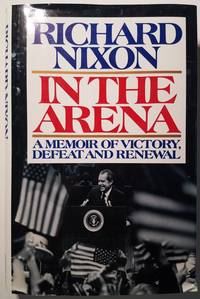
4161RICHARD NIXON 1913-1994. Nixon was the Thirty-Seventh President. SB. 384pg. No date. Yorba Linda. In The Arena signed Richard Nixon on a Presidential book plate that has been attached to the first free endpage. The book is in very fine condition. unknown
19912092902137404596Bungeishunju 1991. Soft Cover. Fine. Number of books: 1 book Bungeishunju paperback
1985310217New York: Arbor House 1985. First Edition; First Printing. Hardcover. Very Good in a Very Good dust jacket. Foxing on text block edges and spine. ; 240 pages. Arbor House hardcover
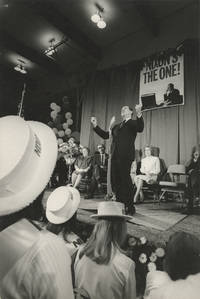
1968162793N.p.: N.p. 1968. Vintage oversize borderless satin finish photograph of US President Richard Nixon-unusually animated-surrounded by supporters on the night of the 1968 presidential election. Stamp of photographer Erich Hartmann on the verso. <br /> <br /> From the archive of the PIX Agency an American photo house that acted as an intermediary between emigre photographers as well as those still living in Europe and the American magazine and newspaper market between 1935-1969. <br /> <br /> 7.75 x 11.75 inches archivally mounted in a white mat measuring 14 x 18 inches. Near Fine. N.p. unknown
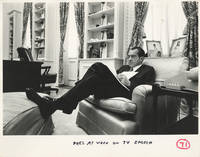
1970162936N.p.: N.p. 1970. Vintage oversize satin finish photograph of President Richard Nixon working on a television speech in the Executive Office Building on October 7 1970. Stamp of photographer Fred J. Maroon on the verso along with annotations in manuscript ink and pencil.<br /> <br /> Fred J. Maroon worked in fashion travel portraiture and architectural photography but is perhaps best remembered today for his photographs of Washington DC. His photographs of Nixon spanning the period before during and after the Watergate scandal are considered the definitive visual document of the Nixon presidency and were the subject of a photo book "The Nixon Years 1969-1974 White House to Watergate" published by Abbeville Press in 1999. <br /> <br /> From the archive of the PIX Agency an American photo house that acted as an intermediary between emigre photographers as well as those still living in Europe and the American magazine and newspaper market between 1935-1969. <br /> <br /> 14 x 11 inches archivally matted in a 20 x 16 inch 8-ply white mat. Near Fine with annotations in manuscript ink on the bottom margin of the recto noting a caption "Pres. at work on TV speech" and a collation number 71. N.p. unknown
1967152020New York: N.p. 1967. Vintage borderless photograph of Richard Nixon playing the piano in 1967. With the stamp of photographer Philippe Halsman on the verso along with manuscript pencil annotations regarding cropping. <br /> <br /> Russian-born Halsman began working as a photographer in Paris in the 1930s later moving to the US and producing reportage and covers for many major American magazines including a substantial 101 covers for Life magazine. Halsman became well known in his later career for his "jump pictures" a playful series capturing mid-century celebrities such as Marilyn Monroe the Ford family the Duke and Duchess of Windsor and Maria Felix in the act of jumping for the camera. <br /> <br /> 10.5 x 11.25 inches. Near Fine. N.p. unknown
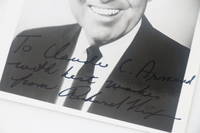
196888252s. l.: s. n. 1968. Fine. s. n. s. l. s.d. 1968 10.50 x 12.50 cm une feuille Original photograph depicting Richard Nixon smiling. Autograph inscription signed by Richard Nixon in the lower margin of the photograph to Claude Armand. We include an envelope addressed to the dedicatee with printed address stamp of Richard Nixon in New York. Provenance: from the collection of the great autograph collector Claude Armand. s. n. unknown
1969713822/01/1969. <div class=""first""><p><strong><big>I</big>n February 1953 Henry Cabot Lodge was named U.S. Ambassador to the United Nations by President Eisenhower with his office elevated to Cabinet level rank. </strong>The position then was high profile and Lodge often engaged in debates with the UN representatives of the Soviet Union that were broadcast or covered on television. On the front lines in the Cold War in 1959 he escorted Soviet leader Nikita Khrushchev on a highly-publicized tour of the United States. Lodge left the ambassadorship during the election of 1960 to run for Vice President on the Republican ticket headed by Richard Nixon. Nixon selected Lodge because the latter had made a name for himself at the United Nations as a foreign-policy expert.</p><p>President Kennedy appointed Lodge to the position of Ambassador to South Vietnam which showed the import U.S. policymakers were coming to place on that nation. Lodge held the post from 1963 to 1964 and again from 1965 to 1967. As ambassador there Lodge supported President Johnson's decision to escalate American involvement in the Vietnam War believing that a Communist takeover in the South would be disastrous for U.S. foreign policy goals.</p><blockquote><p>The original appointment of <em>“Henry Cabot Lodge of Massachusettsâ€</em>_as <em>“Ambassador to head the United States Delegation at the Paris Meetings on Vietnam.â€</em></p></blockquote></div><p><!--break--></p><p>President Johnson and American military leaders had long insisted that the Vietnam War was going well and that they could see the light at the end of the tunnel. But in the aftermath of the Tet Offensive in February 1968 when the Communists were able to initiate coordinated attacks on all the regional capitals throughout Vietnam even in the American compound in Saigon itself Secretary of Defense Clark Clifford issued a report to the President in mid-March that the United States could not win the war. Johnson was stunned and he in turn stunned a nationwide audience on March 311968 announcing he would cease bombing north of the 20th parallel initiate peace talks to end the war and not seek renomination or reelection in 1968. The peace talks commenced in Paris on May 10 1968 with W. Averill Harriman leading the U.S. delegation.</p><p>From the outset the talks were fraught with difficulties. The U.S. insisted on mutual withdrawal of American and North Vietnamese forces which would leave the Saigon government in control. The North Vietnamese refused to negotiate anything until all bombing of North Vietnam was halted. When the U.S. finally agreed to that condition the Johnson administration was unable to persuade cajole or coerce South Vietnam and its leader President Thieu to participate unless it was recognized as a legitimate party by its foes. It was alleged at the time that both candidates in the 1968 election were using the talks as a political football with Hubert Humphrey seeking to appeal to pro-peace voters by insisting that the South Vietnamese participate and more germanely with Nixon leading the South Vietnamese to understand that his administration would give them a better deal if they would continue to delay. Formal negotiations would not begin until January 18 1969 two days before Nixon took office.</p><p>In the immediate aftermath of the 1968 election it seems that Lodge was Nixon’s foremost advisor on Vietnam. He urged Nixon to appoint a man of stature to negotiate in Paris and warned him away from a trip to Saigon for strategic reasons. Nixon adopted these suggestions. In fact on January 5 1969 fifteen days before his inauguration President-elect Nixon named Lodge himself to succeed Harriman as chief U.S. negotiator at the Paris talks. This signaled that Nixon was likely to take a hard line in the talks considering Lodge’s background as a proponent of American policy in Vietnam as promulgated by President Johnson and his chief military commander Gen. William Westmoreland.</p><p><strong>Document Signed</strong> as President Washington January 22 1969 just two days after his inauguration being the original appointment of <em>“Henry Cabot Lodge of Massachusettsâ€</em>_as <em>“Ambassador to head the United States Delegation at the Paris Meetings on Vietnam.â€</em> The wording here is highly politically indicative showing that Nixon avoided using the terms “peaceâ€_“talks†“negotiations†or “war.†These were simply “Meetings on Vietnam†nothing more to be implied. The document is countersigned by Secretary of State William P. Rogers.</p><p>On January 25 the first fully attended meeting of the formal Paris peace talks was held. Ambassador Lodge urged an immediate restoration of a genuine Demilitarized Zone as the first ""practical move toward peace."" He also suggested a mutual withdrawal of ""external"" military forces and an early release of prisoners of war. Tran Buu Kiem and Xuan Thuy heads of the National Liberation Front and North Vietnamese delegations respectively refused Lodge's proposals and condemned American ""aggression.""</p><p>Meanwhile Henry Kissinger Nixon’s National Security Advisor developed a two-track policy whereunder the Paris negotiators would discuss military matters while the real political decisions would be made privately out of the public eye by the leadership in Washington and Hanoi directly. This would avoid public pressure from all directions while also preventing the junior partners on either side South Vietnam and the National Liberation Front from exercising power to preclude a deal from happening. Nixon liked the idea and determined that political negotiations would emanate from the White House. So as Lodge continued treating with the North Vietnamese in Paris starting in early August Kissinger was secretly meeting with North Vietnam’s Le Duc Tho. As the summer turned to fall however Kissinger’s approaches to Hanoi failed to elicit an acceptable response and Nixon adopted a get tough policy to force an accommodation on his terms. In early October the President told Lodge to break off the talks by staging a walk-out at the October 23 plenary session. On the appointed day Lodge insisted that the talks be adjourned which they were immediately. Lodge himself had not favored this action and he suggested that the President use him as a personal intermediary to Hanoi’s leaders who were frequently in Paris. Nixon declined.</p><p>The only official public negotiations to end the Vietnam War were over never to resume. Nixon went directly to Camp David to work on a foreign policy address to the nation which he delivered on November 3. Dubbed the Silent Majority speech in it he asked the American people to support his decision to continue the war until the North Vietnamese would accept “honorable†peace terms. On November 20 1969 seeing no role remaining for a peace negotiator Lodge resigned. The war did not end until January 23 1973 four years and one day after Nixon had appointed Lodge to help end the conflict.</p> unknown
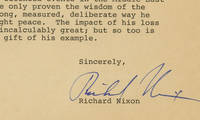
2145512/10/82. <p><strong>Nixon had himself played a key role in aiding the launch of the peace process mediating the Sinai I disengagement agreement between Egypt and Israel in 1974</strong></p><p>Israel and Egypt with its Arab allies had been engaged in hostilities for three decades and this resulted in four wars in twenty four years. The hatreds in the region were fierce and the constant conflicts seemed interminable. The last of these the Yom Kippur War in October 1973 was launched by the Arabs as a surprise and they had initial successes before Israel emerged victorious. Egyptian President Anwar el-Sadat’s own brother was killed in that war. No one foresaw peace as a possibility.</p><p>But President Sadat saw the wars as a disastrous drag on the Egyptian economy and knew that they stood as a barrier to its receiving aid from the United States and many NATO countries. They also tended to throw the Middle East into the arms of the Russians whom Sadat distrusted. Sadat had no intention of allowing Egypt to become a Soviet satellite.</p><p>Despite friction with his Syrian allies Sadat signed the Sinai I 1974 and Sinai II 1975 disengagement agreements with Israel which stated that the conflicts between the countries ""shall not be resolved by military force but by peaceful means†and led to the partial withdrawal of Israeli forces in the Sinai the creation of a U.N. buffer zone in their place and the implementation of multiple U.S. stations in the Sinai. The also secured for Egypt large foreign assistance commitments. The first of these agreements were mediated by President Richard M. Nixon and U.S. Secretary of State Henry Kissinger and the second by President Gerald R. Ford and Kissinger who with thus played key roles in aiding the launch of the peace process.</p><p>Jimmy Carter became President of the United States on January 20 1977. Israeli and Arab resistance was slowing Sadat’s hoped-for progress so on November 9 1977 Sadat made a stunning dramatic gesture one that left the world in shock: He would personally journey to Jerusalem to address the Israeli Knesset parliament to seek a permanent peace settlement between Israel and Egypt! The Israeli government led by Prime Minister Menachem Begin rose to the occasion and ignoring those who saw Sadat’s move as some kind of trick cordially invited him to address the Knesset in a message passed to Sadat via the US ambassador to Egypt. This was something of a surprise as Begin had a reputation as a hard-liner and some expected him to reject Sadat’s overture. On November 19 1977 Sadat arrived for the groundbreaking three-day visit which launched the first peace process between Israel and an Arab state. He met with Begin and spoke before Israel’s parliament as the world looked on in utter disbelief and glued to the television. The astonished approving reaction of ordinary Israelis and Egyptians who watched Sadat and Begin on live television was itself of importance. The sight of the two leaders facing each other in open honest debate changed attitudes at the street levels of both countries. Much of the change came from Sadat's choice of words. “The October War†he said “should be the last war.â€</p><p>The visit was however met with outrage in much of the Arab world. Despite this Sadat continued to pursue peace with Israel. However a reciprocal visit by Begin was unsuccessful and no progress was made toward peace. Then Rosalynn Carter the U.S. first lady suggested to her husband President Carter that he invite Sadat and Begin to Camp David where the relative privacy and seclusion might provide a setting for a breakthrough.</p><p>Both Sadat and Begin trusted the United States to be an honest broker and the two leaders accepted Carter’s invitation. The summit began on September 5 1978 and lasted for 13 days. Carter preferred that the three men work together in private sessions in a small office at Aspen his cabin at Camp David. Carter compiled a document that encompassed a resolution of the major issues presented the proposals to each leader in separate meetings assessed their comments and redrafted the manuscript some two dozen times shuttling the manuscript back and forth for their review. The Camp David Accords signed on September 17 were the first peace agreement between the state of Israel and one of its Arab neighbors and laid the groundwork for diplomatic and commercial relations.</p><p>In a ceremony at the White House on March 26 1979 Sadat and Begin signed the historic peace treaty; it was considered the diplomatic triumph of the the era. President Carter oversaw the signing and untold millions watched on television. The peace treaty formally ended the state of war that had existed between the two countries. Israel agreed to fully withdraw from Sinai and Egypt promised to establish normal diplomatic relations between the two countries and open the Suez Canal to Israeli ships which until then had been banned from the waterway. These provisions were duly carried out. Sadat was vilified for this in many Arab quarters and Egypt was expelled from the Arab League but Sadat was determined to end hostilities and move into a better future. He was well aware that his courage might well cost him his life as he received death threats and some predicted his assassination.</p><p>For their achievement Sadat and Begin were jointly awarded the 1978 Nobel Prize for Peace. Then on October 6 1981 extremists assassinated Sadat in Cairo. He is widely recognized today as a martyr to peace and when we hear the phrase “blessed are the peacemakers†his image immediately springs to mind. Despite the tragedy the peace process continued without Sadat and in 1982 Egypt formally established diplomatic relations with Israel. This led to among many other benefits increased tourism in the region.</p><p>Nixon who with Kissinger got this process going wrote this letter to Mrs. Sadat saying her husband is immortal. <strong>Typed letter signed</strong> on Nixon’s letterhead October 12 1982 with salutation in his hand to Sadat’s widow Jihan el-Sadat on the occasion of the honoring of President Sadat by the American Society of Travel Agents as Sadat’s efforts for peace did so much for tourism the region. He was to be awarded its 1st International Peace and Tourism Award. “I am honored to join in this tribute to Egypt’s great President and also to you his great First Lady.</p><p>“Men are mortal but the spirit of a man of peace is immortal because it lives on in the millions he has inspired. President Sadat was such a man. In the year since his voice was silenced events in the Middle East have only proven the wisdom of the strong measured deliberate way he sought peace. The impact of his loss is incalculably great; but so too is the gift of his example.â€</p><p>Donald Reynolds was executive director of the American Tourism Society later the American Society of Travel Agents. Under his leadership ATSA facilitated travel to Russia and the newly independent republics of the USSR and later expanded its outreach to the Middle East. His efforts in Egypt brought him in contact with Mrs. Sadat and they became friends. She gave this letter to him and we obtained it from his heirs. It has never before been offered for sale.</p> unknown
1973129891973. Official US House of Representatives Ticket to Richard Nixon's 1973 Presidential Inauguration. 2" x 4" blue card with a vertical red line down the center of the card. The card reads "January Twentieth 1973 Inauguration Ceremonies admit bearer to Preferred Standing Room Area Only Capitol Ground Preferred Standing Room HOUSE." Includes the printed signatures of Howard W. Cannon and Marlan W. Cook Co-Chairmen Committee on Arrangements. The back of the card reads "This ticket to be presented only at Independence and New Jersey Avenues H-414." Card is in excellent condition. unknown
1973129901973. Official US Senate Ticket to Richard Nixon's 1973 Presidential Inauguration. 2" x 4" yellow card. The card reads "January Twentieth 1973 Inauguration Ceremonies admit bearer to Preferred Standing Room Area Only Capitol Ground Preferred Standing Room SENATE." Includes the printed signatures of Howard W. Cannon and Marlan W. Cook Co-Chairmen Committee on Arrangements. The back of the card reads "This ticket to be presented only at Constitution and Delaware Avenues F-937." Card is in excellent condition. comes with Official 2 1/2" x 3" White House entrance card. Printed on card stock with the White House printed in yellow in the background. The card reads "Please present this card with identification at The East Entrance The White House Not Transferable." In excellent condition. unknown
1983009115New York: Privately Printed 1983. First Printing. . Hardcover. Fine/Very Good Plus. Signed by author on free front end paper. Edgewear at corners and spine of jacket else fine. <br/> <br/> Privately Printed hardcover
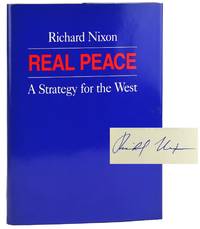
1983007408New York: Privately Printed 1983. First Edition 1st Printing. . Hardcover. Fine/Very Good. Signed by President Richard Nixon on free front end paper. True first edition first printing privately printed by Nixon. Jacket has one inch tear and associated creasing at top corner near spine and edgewear. <br/> <br/> Privately Printed hardcover
1983023420Privately Published 1983. Book. Fine. Hardcover. Signed by Authors. 1st Edition. Signed by author on half title page. This is one of 1000 copies published for private distribution with a slip giving Nixon's address as 26 Federal Plaza New York City detailing that this is a limited edition before the first trade. Red lettering on spine is slightly faded otherwise this is a beautiful copy. Privately Published Hardcover
198347569New York 1983. Very Good/Very Good. New York: Publisher Not Identified 1983. First Edition. Octavo 21.5cm. Unclipped dust jacket. Publisher's blue cloth. 106 pp. Dust jacket has some minor smudging and edge wear; no tears no chips. Binding sound. Corners square. Pages are clean and unmarked. Signed without inscription on front free endpaper by Richard Nixon. unknown
19831270140410Privately Printed 1983. Hardcover. Very Good. May have limited writing in cover pages. Pages are unmarked. ~ ThriftBooks: Read More Spend Less.Dust jacket placed in mylar for preservation. Clean cover boards unmarked pages. Binding is tight. This book shows minimal sign of wear to the cover binding or pages. Dust jacket condition is Good. This copy is the First Printing of the published work. Secure packaging for safe delivery.Dust jacket quality is not guaranteed. Privately Printed hardcover
1983HVD-19981-A-0Richard Nixon. Very Good in Good dust jacket. 1983. Hardcover. Signed by Author; Signed by Nixon! Great overall condition. Minor cosmetic wear. No major blemishes. No writing.; - We're committed to your satisfaction. We offer free returns and respond promptly to all inquiries. Your item will be carefully wrapped in bubble wrap and securely boxed. All orders ship on the same or next business day. Buy with confidence. . Richard Nixon hardcover
1983SKU1017330<p>Privately Printed 1983-01-01. Hardcover. Very Good. 9x6x1. Signed privately printed hardcover limited edition w/ DJ 1983. Book is Fine w/ clean text binding so tight whoever owned it obviously couldn't be bothered to read it. DJ is VG minus w/ light corner wear scuffing to rear fold closed tear to top of front panel by spine. Signed by author on ffep w/ tipped in limited private edition statement. Free delivery confirmation.</p> Privately Printed hardcover
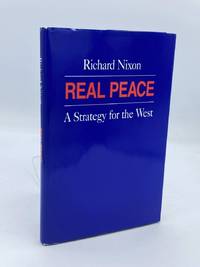
198322407Says New YORK on Title Pg But No Publisher Name Mentioned Privately Printed 1983. HBDJ OP SIGNED by Richard Nixon Stated 1st printing Sept. 1983 light rub Scuff & tiny Chips extremities DJ blue cloth tweed with gold gilt lettering to spine Cover NF/NF-. 106 pgs Binding is Octavo Interior nice tight Clean Blue DJ with red & white Lettering. Signed by Author. First Edition. Hard Cover. Says New YORK on Title Pg But No Publisher Name Mentioned, Privately Printed hardcover
5895Warner Bks. HBDJ STATED 1st edition May 1980 OP Index 341 pgs minor rub DJ VG/VG. Signed by Author. First Edition. Hard Cover. Very Good/Very Good. Warner Bks hardcover
21387Office of the Vice President Washington. 22 December 1958 envelope with facsimile signature. 1p 4to. In fair condition lightly aged folded twice with staple holes to one corner. In envelope carrying facsimile of Nixon's signature and printed 'Office of the Vice President Washington' with typed address to 'Mr. Hugh Burnett The British Broadcasting Corporation Lime Grove London W. 12 England'. The letter carries a good strong signature in black ink with the merest of smudges coming outwards from the left-hand side. Nixon begins by thanking Burnett for his note of 1 December and wishes to tell him 'how much I enjoyed having the opportunity to appear on BBC's “Press Conference.â€' He reports that 'members of my staff who were with us in London felt they had never seen a better production. Several who have been with me during campaigns when I appear more frequently on television said that this was the best picture they had seen of me!' He considers his 'brief visit to London' to be 'one of the most memorable trips in all of our travels of the past five years and you may be sure that both Mrs. Nixon and I are hopeful that we shall have the opportunity to return to England again in the future.' Burnett is best-remembered as producer of the groundbreaking BBC TV series of interviews by John Freeman 'Face to Face'. Office of the Vice President, Washington. 22 December 1958, envelope with facsimile signature. unknown
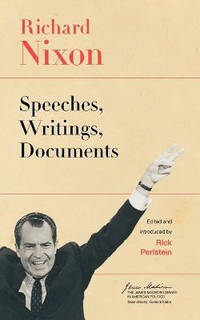
B9780691136998Paperback / softback. New. A collection of Richard Nixon's America's most controversial president important writings that demonstrates why he has had such a profound impact on American life. It includes some of the famous addresses in American history from Nixon's 'Checkers' speech and 'Last Press Conference' to the 'Silent Majority' speech and White House farewell. paperback
1996mon0003688266Easton Press 1996T. leather_bound. Like New. . 6-volume set. SIGNED by Richard Nixon authentic signature not an autopen on the limitation page of volume 6. This set number 517 of 1500. A set in Fine condition. Bound in full leather with raised bands gilt decoration all edges gilt silk moire endpapers satin ribbon bookmarks. No bookplates attached. Easton Press hardcover
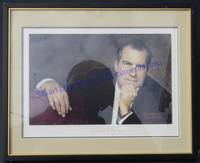
6859RICHARD NIXON 1913-1994. Nixon was the Thirty-Seventh President. PS. 12 x 9. No date. No place. A photograph signed Richard Nixon in red ink on the lower margin. The image is a reproduction of the famous Norman Rockwell painting of Nixon. The photograph is in mint condition and is professionally framed. unknown
1973129841973. Nixon and Agnew 1973 Presidential inaugural Ball ticket. Ticket # 8798 measures 7" x 3" and includes a gold seal that says "Inauguration of President and Vice President". The ticket stub reads "The Inaugural Ball John F. Kennedy Center for the Performing Arts 2700 F Street Northwest Saturday Evening January 20 1973 Nine O'Clock Washington D.C. Black Tie." The ticket itself reads "1973 Inaugural Ball Admit One John F. Kennedy Center for the Performing Arts Enter from Hall of States This ticket must be presented at entrance Good only at location specified." Also includes a ticket "to be exchanged at Ball for ONE Inaugural ball favor." In excellent condition. unknown