Spitzner, Johann ErnstBiblio.com
429 résultats
3337383491.Gpaperback. Good. Access codes and supplements are not guaranteed with used items. May be an ex-library book. paperback
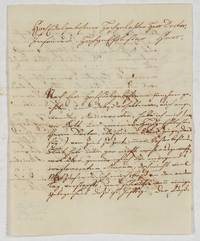
1741705801741. Loschwitz 14.XI.1741. 3 Seiten. Quart-Doppelblatt. Johann Ernst Vigilantius eines Pfarrers Sohn und Enkel dann auch selbst Pastor in Laßwiß der böhmischen Brüdergemeinde schreibt um Rat an einen namentlich genannten Hochwohlgeborenen Doctor über eine Kräuter-Thee Therapie. Notizen zu Vigilantius: "Ursinus reiste bald zu seinem egiment kam aber am 21. Januar 1742 mit Johann Ernst Viglantius aus Laßwitz bei Polnisch-Lissa wieder der an diesem tage die Vormittagspredigt hielt während Ursinus den Nachmittagsgottesdienst wahrnahm." Die Hofkirche p.19. In: Die evangelischen Kirchen in Breslau Breslain August 1909. "Die entscheidende Zäsur die die Wiederbelebung des schlesischen Reformiertentums überhaupt erst ermöglichte stellt die Eroberung des größten Teils des Oderlandes durch Friedrich II. von Preußen 1740/41 dar14. Im August 1741 wenige Tage nachdem die Breslauer dem neuen Herrscher feierlich gehuldigt hatten konnte die wiedererstandene reformierte Gemeinde in Schlesiens Hauptstadt ihren ersten öffentlichen Gottesdienst feiern15 den ersten reformierten Gottesdienst in Schlesien überhaupt seit dem Tod des letzten schlesischen Piasten Georg Wilhelm von Liegnitz-Brieg 1675. Seit 1742 verfügte die Gemeinde in dem aus dem großpolnischen Laßwitz nach Breslau berufenen Prediger Johann Ernst Vigilantius auch über einen ständigen Seelsorger dem in dieser Funktion der Titel eines Königlichen Hofpredigers verliehen wurde. Nachdem sich anfängliche Gerüchte der König werde der Breslauer reformierten Gemeinde die Elftausend-Jungfrauen-Kirche überlassen nicht bewahrheitet hatten mussten die Gottesdienste zunächst provisorisch im Generalsteueramtshaus gehalten werden. Der Bitte um Überlassung eines Grundstücks für den Bau eines eigenen Gotteshauses wurde erst 1747 entsprochen. Die Einweihung der von Baudirektor Friedrich Arnold entworfenen Kirche wegen ihrer unmittelbaren Nähe zum Breslauer Stadtschloss später dann Hofkirche genannt folgte drei Jahre später am 27. September 1750. Sie war von nun an die Parochialkirche der über das Stadtgebiet und die Vororte verstreuten Breslauer Reformierten." Roland Gehrke Zwischen kirchenrechtlicher Autonomie und konfessioneller Assimilierung. Die Haltung der schlesischen Reformierten zur Altpreußischen Union von 1817. Reformierte Prediger auf der Altar-Kanzel Mehr als zwei Jahrhunderte nach den ersten lutherischen Reformatoren betrat nun auch ein reformierter Prediger die Kanzel. Neben den Gründergestalten Heß Moibanus und Nadus wird man sich den Namen des Johann Ernst Vigilantius einzuprägen haben. Er kam aus Polen hatte in Frankfurt an der Oder studiert und dort bereits an der Evangelisch-reformierten Kirche gepredigt. Dann berief ihn die Brüder-Unität als Prediger der Gemeinde zu Laßwitz in Großpolen. Von dort führte ihn der Weg nach Breslau. Daselbst aber existierte 1742 noch keine reformierte Kirche. Also predigte er in dem für die Zwecke der Reformierten hergerichteten Amtshaus. Seine Antrittspredigt hat sich erhalten da sie sogleich 1742 zum Druck gelangte. Ihr Titel: >Die Sendung und Erhaltung öffentlicher Lehrer als eine der grösten Wohlthaten des gros sen Gottes<. Sie ist naturgemäß ein Dokument eigener Art ist ihr doch die sie ist naturgemäß ein Dokument eigener Art ist ihr doch die Dominsel und Bischöfe Kirchen und Prediger Freude über den Einzug des Reformiertentums in die schlesische Hauptstadt durchgängig anzumerken. unknown
1379669731.Ghardcover. Good. Access codes and supplements are not guaranteed with used items. May be an ex-library book. hardcover
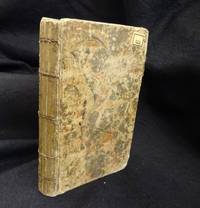
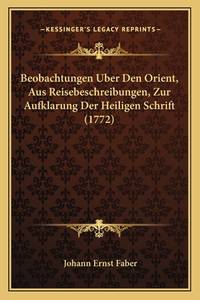
17737897BB1773. Halle Johann Jacob Curt 1773. 8°. Gest. Titelvignette 8 Bl. 456 2 S. Halblederband der Zeit mit Rückenvergoldung stärker berieben bestoßen oberer Rücken etwas eingerissen. Vorderer Einbandspiegel mit altem Bibliotheks-Exlibris. Titelblatt mit durchgestrichenerm altem Namenszug. Einzelne Seiten geringfügig stock- oder wasserfleckig. Sonst innen sehr sauber und gut erhalten. Einzige Ausgabe. - MNE I 216. Fürst I 265. ADB VI 496. - Das unvollendet gebliebene Werk Fabers 1745-1774 eines der verdienstvollsten Orientalisten seiner Zeit über die "verschiedenen Wohnarten" der Juden über die Entwicklung der Bauformen die Verwendung von Marmor Stein und Holz Gestaltung der Säulen und Gärten über Kultgegenstände und Möbel. unknown
EBzz0053Halle Johann Jakob Curt 1773. 8°. Titelbl. 7 Bl. Widm. Vorrede Inhalt 456 S. 1 Bl. Errata. Mit einer gest. Titelvignette. Marmorierter Ppbd. d. Zt. Rücken fehlt Kanten sehr stark berieben Ecken grob beschädigt Etik. auf vorderem Buchdeckel Vorsätze fleckig u. angestaubt Vorderer fliegender Vorsatz m. Ausschnitt Titelbl. teilw. aus Bindung gelöst Handschriftlicher Vermerk Mehr nicht erschienen auf Titelbl. Papier teilw. stärker gebräunt. MNE I 216; Freimann 174. Halle, Johann Jakob Curt 1773. unknown
alb2ee663af0bd974c6Arutyunov S.A. Minich and other actors. In Russian /Arutyunov S.A. Minikh i drugie deystvuyushchie litsa. M. The Two Captains 2012. You are welcome to reach out to us for a detailed description of the copies currently available. Delivery of this book may take longer than usual including extended processing and pre-shipping time, no expedited shipping is available. Please advise us if you have a set date or a deadline to receive your order.SKUalb2ee663af0bd974c6
alb2ee663af0bd974c6M. The Two Captains 2012. You are welcome to reach out to us for a detailed description of the copies currently available. Delivery of this book may take longer than usual including extended processing and pre-shipping time no expedited shipping is available. Please advise us if you have a set date or a deadline to receive your order. SKUalb2ee663af0bd974c6 unknown
20191-374774124XInktank publishing 2019. Paperback. New. 370 pages. German language. 8.27x5.83x0.82 inches. Inktank publishing paperback
374774124X.Gpaperback. Good. Access codes and supplements are not guaranteed with used items. May be an ex-library book. paperback
124575193X.Gpaperback. Good. Access codes and supplements are not guaranteed with used items. May be an ex-library book. paperback
3741161535.Gpaperback. Good. Access codes and supplements are not guaranteed with used items. May be an ex-library book. paperback
1165348276.Gpaperback. Good. Access codes and supplements are not guaranteed with used items. May be an ex-library book. paperback
1104039516.Gpaperback. Good. Access codes and supplements are not guaranteed with used items. May be an ex-library book. paperback
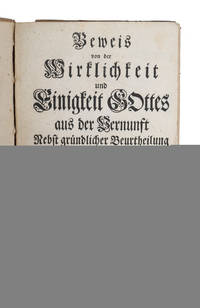
174862323Jena, Woitwe, 1748. 8vo. In contemporary half calf. Binding with wear. A few holes to spine. Hinges a bit weak. Previous owner's name to title-page and lower outer corner of title-page with loss of paper (not affecting text), otherwise internally nice and clean. (16), 533, (1) pp.
174862323Jena Woitwe 1748. 8vo. In contemporary half calf. Binding with wear. A few holes to spine. Hinges a bit weak. Previous owner's name to title-page and lower outer corner of title-page with loss of paper not affecting text otherwise internally nice and clean. 16 533 1 pp. <br/><br/><em>First edition of this exceedingly rare philosophical treatise aiming to demonstrate the existence and unity of God through rational argumentation – a fine early example of Scandinavian Enlightenment philosophy. In this work Gunnerus critiques and builds upon traditional arguments for God's existence such as those by Anselm and Descartes. He uses a logical method referencing thinkers like Wolff Leibniz Darjes and Descartes as well as critics of Wolffian philosophy including Joachim Lange and Christian August Crusius. “Although recognized by scholars of eighteenth-century Danish-Norwegian cultural and political history as an influential figure in the Norwegian Enlightenment with impressive transnational connections Johan Ernst Gunnerus 1718– 1773 receives scant mention outside the Norwegian discourse in discussions on the siècle des lumières. His influence and accomplishments especially in the context of eighteenth-century ecclesiastical politics as well as his scholarly explorations in diverse disciplines distinguish him as one of the founding fathers of modern Norwegian culture. Born in Christiania the son of a physician Gunnerus’ intellectual preoccupation extended beyond theology.2 In line with the decree issued by King Christian VI in 1741 that all Danish-Norwegian theology students study at the University of Halle Germany which was a centre of multiple influences such as the Protestant Reformation Pietism and German Enlightenment Gunnerus also attended lectures on natural history and law upon enrolling at the university in 1742. In 1744 he moved to Jena where he graduated worked as a tutor and eventually in 1753 became an adjunct there at the Department of Philosophy. However within a year he left for Denmark where he first became a pastor then appointed professor in Copenhagen and eventually bishop in Norway at a time when the entire country had a total of only four bishops and 480 pastors.3 From 1758 to 1773 Gunnerus served as bishop in Trondheim and became in 1760 one of the founders of the Royal Norwegian Society of Sciences and Letters. In all these areas he maintained close contact with diverse circles of Continental scholars and not just with those he had known during his time in Halle and Jena. As such he can be considered an important agent of cultural transfer between Norway and mainland Europe and vice versa.†Stengel Johan Ernst Gunnerus and the Quest for the Soul in the Eighteenth Century. Exhibited as no. 40 in the Danish Bibliophile Association's 60s Anniversary Exhibition. </em> unknown
1017761248.Ghardcover. Good. Access codes and supplements are not guaranteed with used items. May be an ex-library book. hardcover
101776607X.Gpaperback. Good. Access codes and supplements are not guaranteed with used items. May be an ex-library book. paperback
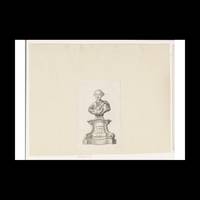
1510162Contentum Ltd. Loose sheet. New. High-quality art print based on an original work from the Rijksmuseum. Created in the 18th century 1749. Professionally printed on premium fine-art paper Museum Etching museum quality in size A3. The artwork is printed with a white border museum-style presentation. Contentum Ltd. unknown
1510165Contentum Ltd. Loose sheet. New. High-quality art print based on an original work from the Rijksmuseum. Created in the 18th century 1749. Professionally printed on premium fine-art paper Museum Etching museum quality in size A2. The artwork is printed with a white border museum-style presentation. Contentum Ltd. unknown
1510163Contentum Ltd. Loose sheet. New. High-quality art print based on an original work from the Rijksmuseum. Created in the 18th century 1749. Professionally printed on premium fine-art paper Photo Matt Fibre in size A2. The artwork is printed with a white border museum-style presentation. Contentum Ltd. unknown
1510164Contentum Ltd. Loose sheet. New. High-quality art print based on an original work from the Rijksmuseum. Created in the 18th century 1749. Professionally printed on premium fine-art paper Photo Rag Bright White premium quality in size A2. The artwork is printed with a white border museum-style presentation. Contentum Ltd. unknown
1175954675.Gpaperback. Good. Access codes and supplements are not guaranteed with used items. May be an ex-library book. paperback
2010DADAX116103692XKessinger Publishing 2010-04-18. paperback. New. 6.00x1.12x9.00. Buy with confidence. Excellent Customer Service & Return policy. Kessinger Publishing paperback
1168485193.Gpaperback. Good. Access codes and supplements are not guaranteed with used items. May be an ex-library book. paperback
1142317684.Gpaperback. Good. Access codes and supplements are not guaranteed with used items. May be an ex-library book. paperback