14 résultats
191523929New York City N.Y.: Not Published 1915. John Huston Finley 1863 - 1940 American educator and journalist ".selected as president of the City College of New York CCNY whose board of trustees was dominated by Democrats. Backed by these trustees Finley performed at CCNY a transformation similar to the one he had earlier carried out at Knox College except that in New York there was a greater vocational component to the curricular changes he helped initiate. Also the relocation of CCNY's main center from East Twenty-third Street to its neo-Gothic campus in upper Manhattan came about during Finley's presidency. He worked tirelessly to raise CCNY's status to stimulate student pride and to fight off budget reductions demanded by parsimonius trustees and state officials. Not yet a college known for its student radicalism pre-World War I CCNY and its largely Jewish student body basked in its president's benign presence. Personal warmth and accessibility were Finley's main assets." Marvin E. Gettleman in the ANB; approx. 4" x 5" overall size; edge-chipped at top left corner and right border with short closed tear just into the subjects jacket back at closest point; fair to good condition overall. . Photograph. Not Bound. Good. Not Published Paperback books
19252096New York: The Macmillan Company 1925. First Edition First Printing. <br /><br />Small 8vo 7 5/8 x 5 1/4 inches; 195 x 130 mm 352 pages in publisher's red cloth lacking the dust jacket.A collection of 55 articles from 1923-24 on a wide variety of topics such as Fascism British politics race relations and much more. <br /><br />CONDITION: Rubbing to spine ends some darkening to spine titles and some dust to the top edge. A Very Good copy lacking the dust jacket. The Macmillan Company hardcover books
19272332New York: Sun Printing and Publishing Association 1927. Octavo 8 1/2 x 5 1/2 inches; 215 x 140 mm 11 1 pages in stapled wrappers. <br /><br />A short history of The Sun founded in New York by Benjamin H. Day in 1833. The Sun was a trendsetter in American journalism according to the media historian Edwin Emery. "Journalism began a new epoch on September 3 1833 with the appearance of a strange little newspaper The New York Sun It Shines for ALL" he writes in The Press and America: An Interpretive History of the Mass Media. "Most of the material was trivial flippant -- but highly readable. Most important it was cheap. Within six months the Sun had a circulation of around 8000 which was nearly twice that of its nearest rival." <br /><br />The Sun was sold in the street for only a penny and appealed especially to working-class readers with its mix of human-interest stories and emphasis on clear lively sometimes exaggerated storytelling. It was also notable for relying largely on advertising rather than subscriptions for its revenue. <br /><br />"An Outline of The Sun" features numerous photographs of key people at The Sun through the years including the great editor Charles A. Dana who led the paper and was its owner for 20 years. Its editorial cartoonist Rube Goldberg won the Pulitzer Prize in 1948. But perhaps its most famous moment came in 1897 with the publication of a letter from a young girl wanting to know if there is a Santa Claus. That led to one of the most renowned newspaper editorials ever commonly known as "Yes Virginia there is a Santa Claus." Oddly though the pamphlet doesn't mention it. <br /><br />The Sun continued to publish until 1950 when it was folded into the New York World-Telegram. <br /><br />OCLC shows only 2 institutional holdings at Columbia and the New York Historical Society. None in commerce. RARE. <br /><br />A short but interesting look at a famous American newspaper known for its emphasis on human-interest storytelling. <br /><br />CONDITION: Some soiling to the wrappers upper corners bumped upper part of wrappers pulled away from staple small split at bottom of spine. Clean bright and unmarked on the inside pages. About Very Good. <br /><br /> Sun Printing and Publishing Association books
1969181290Jefferson City MO: The Curators of Lincoln University and the Faculty of the Department of Journalism 1969. Paperback. Softcover item: unpaginated about 20p. vignette portraits of award winners and brief vitae staplebound 8.5x5.5 inch plain printed wraps; clean sound very good copy. Starting in 1949 Lincoln commenced presenting Citations of Merit to "contributors to the field of journalism among Negroes. The Curators of Lincoln University and the Faculty of the Department of Journalism paperback books
194646302Camp Cooke CA 1946. 1st printing of the divers issues. Printed self-wrappers. Modest wear with the occasional chip/short split along a fold. Age-toning to paper. Folded into quarters. Overall Very Good. 30 issues 2 duplicates ~ 4 pages each 8 columns per page. Illustrated with half-tone b/w photographic images. Comics ~ 3 strips p. 4. 22" x 17-1/2" <br/><br/>In 1941 the United States Army sought more and better training centers for the rapid development of its armored and infantry forces. In March 1941 the Army acquired approximately 86000 acres of open ranch lands along the Central Coast of California between Lompoc and Santa Maria. Most of the land was purchased. Smaller parcels were obtained either by lease license or as easements. With its flat plateau surrounding hills numerous canyons and relative remoteness from populated areas the Army was convinced it had found the ideal training location. Construction of the Army camp began in September 1941. Although its completion was still months away the Army activated the camp on 5 October and named it Camp Cooke in honor of Major General Phillip St. George Cooke a decorated cavalry officer whose career spanned 50 years 1827 - 1873. Although the construction of Camp Cooke continued well into 1942 troop training did not wait. The 5th Armored Division rolled into camp in February and March and the steady roar of its tanks and artillery soon became part of the daily scene. From then until the end of the war other armored and infantry divisions kept up the din before they too left for overseas duty. Besides the 5th Division the 6th 11th 13th and 20th Armored Divisions as well as the 86th and 97th Infantry Divisions and the 2d Filipino Infantry Regiment were all stationed at Cooke at varying times during the war. Also trained at Cooke were an assortment of anti-aircraft artillery combat engineer ordnance and hospital units. Over 400 separate and distinct outfits passed through Camp Cooke. A maximum security army disciplinary barracks was constructed on post property in 1946. Confined to the facility were military prisoners from throughout the Army. When Camp Cooke closed in June 1946 From August 1950 to February 1953 Camp Cooke served as a training installation for units slated for combat in Korea and as a summer training base for many other reserve units. On 1 February 1953 the camp was again inactivated. The disciplinary barracks meanwhile was transferred to the U.S. Bureau of Prisons to house civilian offenders in August 1959. Today it is known as the United States Penitentiary Lompoc. Wiki An invaluable source for local history at the end of World War II. the copy has the usual camp activities but also includes such informative pieces as "Camp Cooke History . Here's Chapter 2" Vol V - Number 3 March 29 1946. unknown books
1938674Philadelphia: Macrae-Smith-Company 1938. First Edition. <br /><br />8vo 8 1/4 x 5 3/4 inches; 210 x 145 mm 268 pages in yellow cloth with a pictorial dust jacket. <br /><br />An unusual book aimed at guys who want to go from copy boy to ace reporter. Unusual in the sense that it combines both fiction and nonfiction. We follow Jerry a likable copy boy on a New Jersey daily who puts up with coarse and frankly awful editors and pressmen but then gets his big chance to be a reporter. <br /><br />Journalists will enjoy the depiction of Matt Hale the city editor who communicates primarily through growling screaming and banging his fist on his desk. Very entertaining; most journalists have known editors like Matt Hale. Illustrated with real newsroom and technical photographs of the day. SCARCE especially in dust jacket. <br /><br />CONDITION: Light toning to page edges heavier toning to paste downs but clean and unmarked. The pictorial dust jacket has several shallow chips and tears including a 1 1/2" tear with creasing to top edge of front panel affecting "O" in "COPY." Overall a Very Good copy. Macrae-Smith-Company hardcover books
200538676Amherst:: Prometheus Books. Near Fine in Near Fine dust jacket. 2005. Hardcover. 1591023432 . First printing. About fine in like dust jacket. . Prometheus Books, hardcover books
19727550London: Andre Deutsch 1972. 1st edition. Hardback. Dust jacket. NF prior owner sig on ffep/NF. 320 pp including index 8vo. <br/><br/> Andre Deutsch hardcover books
19997204Columbia: University of South Carolina Press. Fine in Fine dust jacket. 1999. Hardcover. 1570032432 . First printing. Fine in a fine dust jacket. . University of South Carolina Press hardcover books
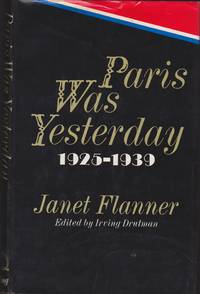
19722291New York: The Viking Press 1972. Third Printing. Small Quarto 9 1/2 x 6 inches; 240 x 150 mm xxiv 232 pages in black cloth titles to spine red top stain in a printed dust jacket. <br /><br />A letter inscribed by Janet Flanner is taped to the front end paper: "For Adele with friendly recollections and gratitude for a long memory. Faithfully Janet Flanner November 13 - '72." The letter is on Ritz Hotel Paris stationery. <br /><br />A collection of Flanner's articles from The New Yorker for 1925-1939. Flanner 1892-1978 used the pseudonym Genêt and wrote on a wide variety of political and cultural topics. This collection edited by Irving Drutman has pieces on Josephine Baker Marlene Dietrich Mae West Sarah Bernhardt Picasso Gertrude Stein's art collection lurid murder affairs Paul Signac gambling the gathering clouds of war in the late 1930s and much more. <br /><br />An engrossing and entertaining look at Paris between the wars by a young journalist who wrote a fortnightly "Letter From Paris" for The New Yorker. <br /><br />CONDITION: Letter from Flanner taped to front end paper slight lean to spine minor rubbing to cloth internally clean and unmarked. The dust jacket's upper panel has some creases a short closed tear and a couple small nicks to the top edge as well as some foxing to the verso of the jacket. Overall Very Good. <br /><br /> The Viking Press hardcover books
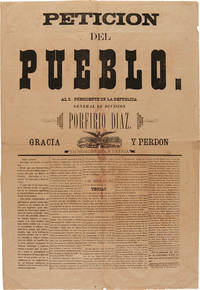
1890WRCAM55735N.p. but Puebla: Tip. Rinconada de Manzanares 1890. Broadside 23 1/2 x 15 3/4 inches printed in five columns with masthead showing a version of Mexico's coat of arms with eagle holding rattlesnake perched on crossed pikes above a cannon. Uniformly toned. Old folds and wrinkles short splits and minor loss at crossfolds mild staining. Overall good plus. An apparently-unrecorded broadside from Mexico printed during the reign of President Porfirio DÃÂaz who served a total of thirty- one years as the chief executive and effectively the dictator of Mexico. As with other dictatorial regimes DÃÂaz had a contentious and sometimes violent relationship with the press. He is known to have very occasionally condoned if not initiated the murder and imprisonment of journalists though he also often courted journalists to give them the impression that he was on their side expecting support in return. As a result Diaz often favored imprisonment over the outright assassination of journalists. During his dictatorship DÃÂaz sent numerous dissident politicians and journalists to the prisons of Belén or San Juan de Ulúa though being sent to the former was widely considered tantamount to a death sentence anyway. Journalists and political enemies were just two groups subject to DÃÂaz's theory of rule - that cruel means though unfortunate were justified by the end result of national progress. <br> <br> The present broadside calls for clemency from DÃÂaz in his dealings with imprisoned journalists and politicians. The author of the broadside mentions past injustices related to journalists and political prisoners. In the first column the text mentions Ignacio Ramirez and his pen name "el Nigromante;" Ramirez was a liberal writer and thinker who often defended the rights of indigenous peoples in Mexico. Here the author accuses the conservative party of trying to intimidate Ramirez and many others like him by putting "the hand of an enraged hitman on the neck of the liberal journalist." a rough translation. The text also references the Third Battle of Puebla fought on April 2 1867 and won by Porfirio DÃÂaz. At the conclusion of that battle instead of executing the imperialist Mexican prisoners DÃÂaz released them after they signed a promise not to take up further arms against the Mexican republic. The text appeals to DÃÂaz's demonstrated sense of mercy and reads in part and in English translation: <br> <br> "We the members of the working class know well and have witnessed your energetic courage in the battlefields as an intrepid and worthy son of Mars but now also this time we do not demand but we beg to have the happiness and satisfaction to see and admire him as a hero of clemency for imprisoned journalists.and more so for his afflicted families who at this moment endure the crying and perhaps even the misery and fatal consequences of that prison in which the heads of those anguished families reside." The text also calls for clemency or pardons for a long list of political prisoners. The names of the prisoners held at Belén occupy the last column-and-a-half of the broadside. At the conclusion of the text there is a notice that indicates the petitioners have 4000 signatures in their favor for the demands made here. <br> <br> OCLC is silent on this broadside. It is at least an exceedingly rare if not a unique surviving example of the political tensions between President DÃÂaz and his political opponents and journalists in Mexico at the end of the 19th century and a powerful and important entry in the ever-present struggle for the freedom of the press. Tip. Rinconada de Manzanares unknown books
200428279NY: Verso. Fine in Fine dust jacket. 2004. Hardcover. 1844670198 . First printing. Fine in a fine dust jacket. . Verso hardcover books
199832003Lawrence KS: University Press of Kansas 1998. 1st edition. Hardback. Green dust jacket. A Nr Fine copy in a similar dust jacket. xi 3 362 pp including Index. Illustrated from photographs. Maps. 8vo. <br/><br/> University Press of Kansas hardcover books
19405810New York: Harcourt Brace & Co 1940. Hardback. Dust jacket. VG/VG some edgewear/pc. 414 pp including index. 8vo. <br/><br/>The story of newspaper journalism by then the asst managing editor for the New York Times. Harcourt Brace & Co hardcover books