Ragguaglio delle Antichità e Rarità che si conservano nella Galleria Mediceo-Imperiale di Firenze. Parte I all published Opera Di Giuseppe Bianchi Custode Della Medesima…
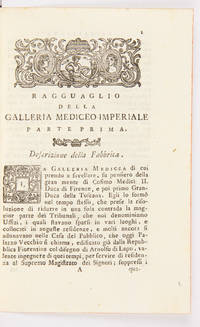
17594188<p>Florence: Nella stamperia Imperiale 1759</p><p>Octavo: 19 x 14.3 cm. p. xiii i 236 1 errata; Collation: a8 -a8 blank A-P8 -P8 blank Complete.<br /></p><p>FIRST EDITION.</p><p>A crisp bright copy in original three-quarter calf and speckled paper over boards spine with floral ornaments. The text is adorned with attractive woodcut initials and headpieces.</p><p>First edition of the first guide to one of the world's most important museums. This guide to the Medici collections of the Uffizi Gallery was written by the museum's first custodian who had been appointed after the gallery's conversion to a public institution under the terms established by the last of the Medici the Palatine Electrix Anna Maria Ludovica in 1737. The custodian Giuseppe Bianchi is a notorious figure. He was later found to have robbed the Uffizi of works of precious metal which he melted down and sold. He was condemned to exile for his perfidy. See Barrochi and Bertelà "Danni e furti di Giuseppe Bianchi in Galleria Labyrinthos 13/16 1988-89 321-336.</p><p>Bianchi's guide published in the same year that the British Museum opened to the public is an important record of the disposition and scope of the newly "public" collections in the period prior to their dramatic reorganization by Grand Duke Pietro Leopoldo of Lorraine 1780-82. In some instances the notices in the guide are the earliest extant record for some works in the collections. The portable and scholarly guide is similar in format and composition to Pasquale Massi's 1792 guide to the Vatican Museums which Bianchi's guide predates by a generation.</p><p>Bianchi prefaces his tour with a history of the construction of the Uffizi palace designed and begun by Vasari in 1560 and completed –following Vasari's design- by Alfonso Parigi and Bernardo Buontalenti in 1581. This is followed by a description of the various elements that make up the entire palace complex. </p><p>The formal guide to the galleries begins with a detailed description of the decorative program of the frescoed ceilings and the series of portraits that line the walls beneath them. This is followed by descriptions and commentaries on each of the 62 statues and 92 busts housed in the galleries in this period. Francesco I was the first Medici to add ancient marbles to the newly completed Uffizi and these ancient sculptures were juxtaposed with contemporary Renaissance masterpieces. Thus we find in Bianchi's guide the famous Medici Venus the Niobe group Bandonelli's Laocöon and Michelangelo's Bacchus. The sarcophagus of Hippolytus is absent since it was still in the Palazzo Medici Riccardi in 1759.</p><p>Next Bianchi takes us into the Camera dei Pittori. Yet here he is unable to give a comprehensive discussion. This is due in large part to the sheer size of the collection but also to the fact that the painting collection has changed so much over the years some of the paintings having been transferred to the Pitti Palace others that formerly hung in the Palace having come to the Gallery and others still having been given as gifts to great lords or used to decorate villas. Moreover the paintings are in many media: oil tempera fresco and encaustic. Bianchi decides to focus on the collection of artist self-portraits which are divided into the three principal schools arrived at by the consensus of the most famous scholars of the art of painting: Romana Lombarda and Oltramontana. Here we find the famous self-portrait of Raphael.</p><p>From here we pause briefly in the Camera delle Porcellane before entering the Camera degl' Idoli with its collection of 300 Greek Roman Etruscan and Egyptian bronzes which Bianchi considers in detail. Next we enter the Camera delle Arti where we find paintings by Raphael Andrea del Sarto Leonardo Botticelli Mantegna and Fra Angelico. In the Camera de' Fiamminghi are housed 140 paintings by northern European artists: Albrecht Dürer Lucas Cranach Van Dyck Brueghel and Callot among others. </p><p>The German Cabinet:</p><p>The center of the Camera delle Arti is occupied by a wondrous machine for which Bianchi provides a two-page description. It is a magnificent octagonal cabinet over nine feet tall incorporating a clock a pneumatic organ and moving figures in silver. The architectural details are all composed of granatiglia an ebony-like luxury hardwood and the surfaces of the cabinet are inlaid with precious stone including lapis jasper and verde antico. The cabinet is adorned with painted scenes of the Old and New Testaments which are rendered so minutely and with such fine skill that they are believed to be by the school of Brueghel. Within the cabinet is a machine that rotates showing four scenes: birds and arabesques executed in stone-inlay; a wax relief of the deposition "the work of the immortal Buonarroti"; an amber relief of Jesus and the Apostles; and an amber crucifixion scene. The final ornament of the machine is a mirror box that produces an infinite number of reflections. Bianchi tells us that the cabinet was made in Germany "around a century ago" and was purchased by Grand Duke Ferdinando II 1610-1670.</p><p>The sixth camera houses mathematical instruments and a pair of celestial and terrestrial globes. Among the marvels here are an enormous magnet and a huge burning mirror. It was with the addition of the mathematical and scientific collections that the Uffizi began to take on the aspect of a wunderkammer.</p><p>Next we enter the heart of the museum the Tribuna the octagonal room that houses the most important treasures of the Uffizi. Bianchi begins with individual descriptions of the 14 marble statues among them the Medici Venus the Wrestlers the Dancing Satyr the Arrotino and the infant Hercules. After a brief description of the room itself designed by Bernardo Buontalenti for Ferdinando III Bianchi lists the artists whose paintings adorn the room: Correggio Titian Veronese Parmigianino and above all Raphael. There is also a detailed description of the famous table of pietre dure. </p><p>Leaving the Tribuna we come to the Camera dell' Ermafrodita the focal point of which is the hermaphrodite in Parian marble acquired by Ferdinando II from the Ludovisi Collection. Our tour concludes with brief visits to the room of medals the arsenal and the room of the ciborium with the incomplete parts of that structure created by Buontalenti for the Medici mausoleum in San Lorenzo.</p><p>Cicognara 4202; Murray Museums: their history and their use I 241; Schlosser 516. Literature: Florida Forestieri in Galleria: visitatori direttori e custodi agli Uffizi dal 1769 al 1785</p> Nella stamperia Imperiale, books
Liber Antiquus · États-Unis6 500,00 $US≈ 5 499,65 €