30 résultats
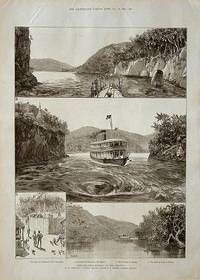
161859049Illustrated London News. October 161886. Sheet from the Illustrated London News showing four engravings of scenes along the Chindwin. 1. The Hpai-yai Whirlpool below Kalaymyo. 2. Shooting the Shoay-gyee Whirlpools. 3. The Stockade at Kendat. 4. The Military Camp at Mingin. There is half a column of text on the reverse of the sheet entitled from Sketches from Burmah. . Illustrated London News. unknown
1680052334Inebolu -Kastamonu Bolu Sanjak: AH: 1096 1680. Soft cover. New. Original document sealed 'Abdürrahim'. Original manuscript written on a special paper with 'ahar'. Chipped extremities. Slightly foxing. Some stains. 16x11 cm. In Ottoman script. A 17th century Ottoman document about sales of a waqf land belongs to Sultan Bayezid-i Veli in Ineboluto Saban Dede. <br/> <br/> AH: 1096 paperback
1692052326Inebolu -Kastamonu Bolu Sanjak: AH: 1108 1692. Soft cover. Very Good. Original document sealed 'Abdüsseyyid'. Original manuscript written on a special paper with 'ahar'. Chipped extremities. Slightly foxing. Some stains. 32x15 cm. In Ottoman script. A 17th century law document including a traditional language in its period. A case about a debt claim between non-Muslim Greek citizen Andriye bin Lefter and muslim-Turkish citizen Mustafa Bise bin Mehmed. AH 1108 = AD 1692. 28 lines text and 3 lines names. Full. <br/> <br/> AH: 1108 paperback
1638234CLAELZ/Apud Elzevirios Lugd. Batav. Elzevier Leiden: 1638. 1638 pp. 8 336 8 Title engraved by Duysend. 24mo. 129 x 73 mm. Lightly damp stained. Later full dark brown morocco gilt binding. This rare variant edition has the uncorrected errors in pagination but the engraved title has the correct S.P.Q.R. Old collector's manuscript note relating to this edition is attached. Florus was a Roman historian and poet. This is his Epitome of Roman History. Florus was said to have addressed the well-known lines to Hadrian beginning "Ego nolo Caesar esse" I do not wish to be a Caesar which provoked Hadrian's satirical parody "I do not wish to be a Florus" quoted by Spartianus. This important edition was edited by the great "monarch and tyrant of literature" Claude Salmasius 1593-1653. The Dutch family of Elzevier Elzevir; Elsevier were the foremost printers of their time. They produced a vast variety of well printed scholarly and popular books; many in a very small handy format. Louis Elzevier the founder of the firm produced his first book in Leiden in 1583. The 'golden age' of Elzevier printing was between 1620 and 1680. The Elzevier dynasty probably produced their last publication in 1770. Brunet II:1311; Dibdin II:10; Willems 467. RARE. SMALL BOX 2 Language: eng. Hardcover. Very Good. Apud Elzevirios, Lugd. Batav. (Elzevier, Leiden): 1638. hardcover
16441385129Various publishers 1644-1645. Hardcover. 18mo Three volumes bound as one. In Good plus condition. Spine is cream without print. Boards in cream vellum. Spine has raised bands with string binding visible at hinges light toning/shelfwear to vellum light wear to spine caps and corners. Text block has library stamp on verso of first title page small stain to fore edge light age-toning to paper. Text in German gothic/fraktur print.<br /> <br /> CONTENTS: 1 Pupillen schilt; das ist Gründtliche Aussfüerung wie vermüg der Rechten die Pupillen und Minderiährigen auch ihre haab und güetter zubeschutzen und dess erlittnen schadens sowol vor-als nach ihrer Vogtbarheit Widerumb zuentledigen / durch Johann Wendle Michael Wagner 1644 407 pages - 2 Weit darvon ist gut fürm Schuß. Das ist: Ein nützliches nothwendiges und annemliches Tractätlein. Wider alle bevorab aber muthwillige oder doch sonsten ohnnötige Rechtfertigungen umb itziger unruhiger Zeit und Leut willen ernstmüthig an Tag gegeben / durch Georgen am Wald und Conradum Pertam Christian Siegesfrieden Franckfurt am Mann 1645 344 pages - 3 Regenten Spiegel : gerichtet Auff alle und jede Obrigkeiten hohes- und niedriges Standes/ worauff Sie fürnemlich zusehen/ wann sie Christlich und nützlich regieren wollen / durch M. Urbanum Titium Clemens Berger Wittemberg 1644 377 pages.<br /> <br /> <p>NOTE: Shelved in Netdesk office Case #3. 1385129. FP New Rockville Stock. Various publishers hardcover
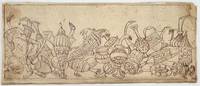
169025001690. Pen and brown ink on cream laid paper 3 x 8 inches 76 x 230 mm the full sheet. In good condition with some edge wear and losses at all but the lower right corner. Adhered to a 19th century laid paper matrix at the corners. During Medici festivals it was common to have a credenza-a massive tiered sideboard displaying hundreds of pieces of silver and gold plate to signal the wealth of the family to visiting dignitaries. These objects are piled together in a "horror vacui" style filling all available space which suggests that they are either meant to be seen as a pile of "spoils" or riches on a parade float. This image may also be a pattern sheet for an engraver. unknown
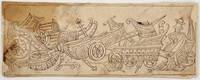
169025011690. Pen and brown ink on cream laid paper 3 x 8 inches 76 x 230 mm the full sheet. In good condition with some edge wear and losses at all but the lower right corner. Adhered to a 19th century laid paper matrix at the corners. On the verso is a similar decorative design in brown ink. This work is a classic example of an "apparato" design. In the 16th and 17th centuries artists were frequently commissioned to design ephemeral architecture and "festival machines" for royal entries weddings or religious processions. These festival machines were often made of temporary materials like wood plaster and gilded papier-mâché to be used once during a city-wide celebration and then dismantled. This image may also be a pattern sheet for an engraver. unknown
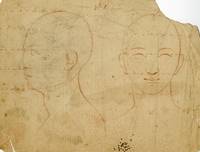
170013721700. Red crayon on lightweight laid paper with a partial Pro Patria watermark with Hollandia and a rampant lion 5 5/8 x 7 1/2 inches 142 x 190 mm the full sheet. Scattered surface soiling staining and light handling wear. There is a cluster of ink dots in the lower margin of the period an edge tear at the lower left corner and a corner loss at the upper right corner. unknown
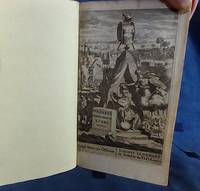
1691V75117Leiden: Jordani Lugtmans & Joann du Justo Vultejo interprete. Pancratius Maasvicius recensuit Isaaci Casauboni nec non suas notas adjecitivie 1691. Hardcover. Very Good. copperplate engraved pictorial title woodcut printer's mark & a few decirated small initials. Octavo modern taupe boards with printed spine label lower corner very sl.bumped All edges rouge 12p=extra engr.title title dedication To reader etc 832pp 40pp=index In Ancient Greek & Latin parallel columns throughout. Work divided into 8 books. First four words of title translated from the Ancient Greek. Recent pages added after endpage and before frontispeice 3 on each side. Five page dedication at beginning mentioning the likley transcriber of this edition Pancratius Maasvicius. Maasvicius is also credited on titlepage alongside Vultejus and Casaubon. Vultejus transcribed the 1549 Basel edition of the work whilst Casaubon the 1589 Lyon version. Overall very clean and tight. A manual of strategy and war taken from the most ancient histories down to his own time. These are sources many of which have since been lost making this an important original source. Polyaenus drew on the Roman-Parthian Wars of the mid 2nd century AD dedicating the work to Marcus Aurelius and his co-emperor Lucius Verus who were engaged in the conflict. This is the 2nd edition of the Greco-Latin work the first published in Lyon in 1589. The first latin editon was published in Basel in 1549. "One of the rarer editions in the "Cum notis variorum" series" Ebert 17681. Jordani Lugtmans & Joann du Justo Vultejo interprete. Pancratius Maasvicius recensuit, Isaaci Casauboni, nec non suas, notas adj hardcover
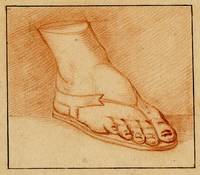
170013751700. Red chalk on cream laid paper 6 3/8 x 7 inches 160 x 176 mm the full sheet. In very good condition with minor toning and some modern notations in pencil on the verso as well as a rudimentary sketch of the top of a foot with toes also in red chalk. unknown
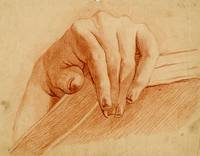
170013741700. Red chalk on cream laid paper 7 1/4 x 9 3/8 inches 182 x 236 mm the full sheet. In very good condition with minor toning and two small nicks in the top sheet edge. Some modern notations in pencil on the verso as well as one early inscription with the numeral "10" ink in the top left corner verso. A beautiful study of a dainty hand. unknown
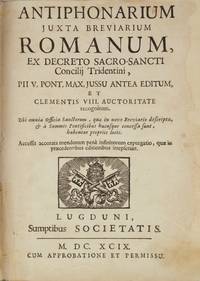
169941146Lugduni Sumptibus Societatis: Ex Typographia Petri Valfray in vico Mercatorio sub signo Coronæ Aureæ . Cum Approbation et Permissu 1699. Small quarto. Full contemporary dark brown mottled calf with raised bands on spine in decorative compartments gilt dark red leather label gilt marbled edges. 1f. recto title with woodcut armorial device incorporating crown and keys verso blank 1f. Index "Approbatio" "Permissio" 304 lxxxviii 19 i blank pp. Typeset with neumatic notation on 4-line staves scored for solo voice.<br /> <br /> With engraved armorial bookplate by T. Dupont of French writer and book collector A. Kuhnholtz-Lordat 1820-1893 to front pastedown.<br /> <br /> Binding slightly worn and bumped. Browned; occasional very minor staining foxing dampstaining and soiling. OCLC 805034285 956360819.<br /> <br /> A collection of antiphons and other sung parts of the Divine Office. [Ex Typographia Petri Valfray, in vico Mercatorio, sub signo Coronæ Aureæ] ... Cum Approbation et Permissu unknown
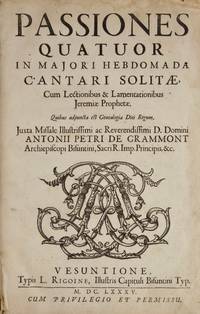
168541147Vesuntione Besançon: Typis L. Rigoine Illustris Capituli Bisuntini Typ 1685. Folio. Full contemporary dark tan speckled calf. 1f. recto title with striking woodcut geometric-floral device verso blank 3-131 i blank pp.<br /> <br /> With neumatic notation typeset on 4-line staves throughout scored for solo voice. <br /> <br /> Binding worn rubbed bumped; upper board quite warped; upper approximately 1/2" of head of spine lacking. Occasional minor staining worming and dampstaining; minor loss to upper outer corners and gutter of first several leaves. OCLC 1119128101. <br /> <br /> "The story of the Crucifixion as recorded in the Gospels of Matthew xxvi-xxvii Mark xiv-xv Luke xxii-xxiii and John xviii-xix. In the Roman liturgy the Passion texts are recited as Gospel lessons during Mass on Palm Sunday Matthew Tuesday of Holy Week Mark Wednesday of Holy Week Luke and Good Friday John. At a very early date special lesson tones were developed for reciting the Passion and polyphonic settings of its texts have been made since the 15th century." Kurt von Fischer and Werner Braun in Grove Music Online<br /> <br /> "Along with the great responsories the Lamentations are musically the most important texts of Tenebrae ." Günther Massenkeil in Grove Music Online. Typis L. Rigoine, Illustris Capituli Bisuntini Typ unknown
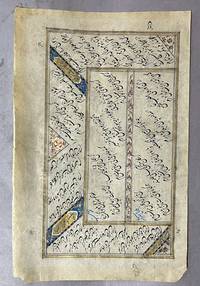
16500071451650. No Binding. Good. Single manuscript leaf size approx. 217 x 133 mm in Persian written on both recto and verso in elegant black nasta'liq script on buff paper. The text is arranged in ruled panels with a central vertical floral divider and enlivened by diagonal gilt cartouches and triangular cornerpieces illumintated in gold deep blue and polychrome floral decoration. The text is composed in refined Persian literary prose with rhythmic cadence consistent with ethical and didactic writing in the tradition of Sa'di of Shiraz and is very likely drawn from the Golestan or a closely related classical prose work. The confident calligraphy and balanced design are characteristic of Safavid-period book production intended for cultivated private readership. The illuminated cartouches with reserved script together with the delicate floral ornamentation reflect a mature Safavid aesthetic while later marginal or interlinear annotations in blue attest to continued reading and use. Condition is consistent with age and use. The paper shows overall toning and surface wear with areas of rubbing and discoloration including a noticeable rubbed patch affecting text on one side. Minor losses at lower corners and abrasions. Gold and pigments remain largely intact and visually effective. The calligraphy throughout remains clear and legible. Preserved as a single detached leaf. Ships unmounted and unframed <br/> <br/> unknown
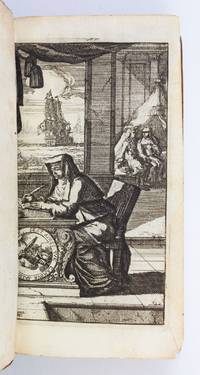
1693ST19567-153La Haye: Abraham de Hondt & Jacob van Ellinkhuysen 1693. Translated by Guilleragues. 140 x 75 mm. 5 1/2 x 3". 346 pp. <br/> Attractive contemporary speckled calf raised bands spine gilt in compartments with central gilt tool surrounded by gilt rules and tendrils gilt lettering all edges speckled red expert repairs to spine ends and perhaps to corners. With woodcut initials tailpieces and frontispiece of a nun at a writing desk. Front pastedown with ink signature of Martin Bowes. Brunet III 1031; see also: Barbier II 1286. Joints and corners a little worn but the binding otherwise in excellent condition; just a hint of browning along a couple edges but A REMARKABLY BRIGHT FRESH AND CLEAN COPY INTERNALLY.<br/> <br/> This is a collection of passionate love letters purportedly written by a Portuguese nun Mariana Alcoforado to her French lover Noël Bouton de Chamilly. First published in 1669 the letters express profound longing heartbreak and emotional intensity. Although the work originally included just five letters the racy content raised quite a sensation and the book proved so popular that it went through several expanded editions that included newly "discovered" missives. The present edition includes a total of 12 epistles by our nun and 11 responses from her lover as well as another series of "tender and passionate" love letters between a couple referred to only as "la présidente F. à M. Le baron de B." Though the original work is now widely believed to be a piece of fiction written by the supposed translator French diplomat Gabriel Joseph de Lavergne viscomte de Guilleragues 1628-84 it is still considered to be a very important epistolary novel providing insight into the emotional landscape of the time and influencing numerous adaptations and imitations in literature. Some importance of the work can be seen in the fact that copies of the first edition consistently bring substantial prices at auction more than $25000 three times since 2010. The early ownership inscription on the pastedown belongs to Martin Bowes 1670-1726 a barrister and fellow of the Royal Society. Abraham de Hondt & Jacob van Ellinkhuysen unknown
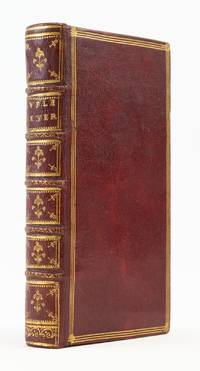
1643ST19567-147Lvgd. Batavorvm Leyden: Ex Officina Elzeviriana 1643. Second Elzevier Edition. 132 x 75 mm. 5 1/4 x 3". 1 p.l. 3-312 315-329 9 pp. <br/> FINE CONTEMPORARY BURGUNDY MOROCCO covers with gilt triple ruled border spine gilt in compartments with broad and stippled bands fleuron cornerpieces and floral centerpiece marbled endpapers turn-ins and all edges gilt. Woodcut initials headpieces and tailpiece engraved title page depicting St. Martin slicing his cloak in two with his sword to share with the beggar. Front pastedown with a cardinal's large 17th century engraved armorial bookplate rotated and trimmed to fit. Front pastedown and free endpaper with the morocco bookplates of Mortimer L. Schiff and of H. V. Ingram respectively. Initial blank and last leaf each with small ownership stamp that at rear of C. H. F. Curnillon that at front hard to decipher though perhaps reading "EBH." Willems 560; Rahir 552. ◆A few instances of light foxing and other trivial imperfections internally but A REMARKABLY WELL-PRESERVED COPY the binding bright and scarcely worn and the text very fresh and clean with virtually no signs of use.<br/> <br/> This is a most appealing little book containing the works of Severus the fourth century ecclesiastical historian who gave up great wealth in exchange for Christian seclusion and holy exercises and who became an ardent follower of St. Martin of Tours. Our volume includes Severus' most famous work his "Life of St. Martin" with its unforgettable pictures of this much venerated saint whose compassionate life includes the famous episode in which Martin cuts his cloak in half to share it with a beggar. Along with the "Life" are the "Dialogi Duo" which contains a reasoned review of the then prevailing bitter ecclesiastical feuds and provides information about these controversies not supplied from any other source. Also included is Severus' "Sacred History" a less original work summarizing events from creation to his own day but one much used in the Middle Ages when the author's correct and limpid Latin was greatly admired. Willems says this is the second Elzevier edition containing the same material as the 1638 edition but with the added continuation of the sacred history by Johannes Sleidanus 1506-56; Willems adds that the printing is "beautifully executed." This is a particularly lovely copy with distinguished provenance: it was previously in the library of the distinguished American bibliophile Mortimer Schiff 1877-1931 whose collection included works by great printers important illustrated books works printed on vellum and fine and historic bindings; it was later owned by H. V. Ingram a collector of fine bindings in the mold of Schiff a large number of whose books Ingram subsequently possessed. Ex Officina Elzeviriana unknown
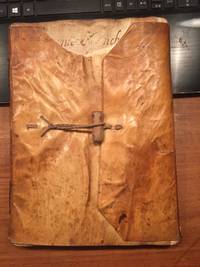
1663Bostonbookfair1Manuscript. 17th century 1663-1695<br /><p>Spanish church register of the village of Montánchez is a municipality located in the province of Cáceres Extremadura Spain. Written in several hands on paper. Folio 29 x 22 cm approx. 135 leaves. Characteristic limp vellum binding. Damage to top cover. First leaves wormed else good.</p>
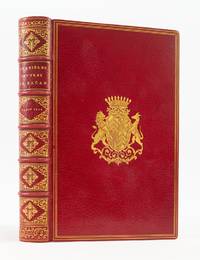
1660ST19567-160Paris: Chez Pierre Lamy 1660. FIRST EDITION. 179 x 120 mm. 7 x 4 3/4". 10 p.l. 496 35 1 pp. <br/> EXTREMELY FINE 19TH CENTURY RED MOROCCO BY HARDY stamp-signed in gilt on front turn-in covers with gilt coat of arms and French fillet border raised bands compartments ruled in gilt and with elegant gilt floral and foliate tooling gilt lettering gilt dentelles all edges gilt. Front free endpaper with bookplate of poet Auguste P. Garnier 1885-1966. Tchemerzine IX 332. ◆Trivial imperfections only: A VERY FINE COPY INSIDE AND OUT.<br/> <br/> In a very handsome binding by one of the most widely sought-after binders of the turn of the 20th century this is a beautifully preserved volume of verse by a founding member of the Académie française. A protégé of Malherbe Honorat de Bueil Seigneur de Racan 1589-1670 is primarily known for his elegant pastoral and religious poetry which as Britannica notes succeeds at "preserving the elegiac lyricism of an earlier age and foreshadowing the gentle melancholy of Alphonse de Lamartine." According to Tchemerzine the present work is "the most complete edition of Racan's religious works" and is in large part composed of his verse interpretations of the Psalms. The Hardy atelier produced luxurious volumes many of them armorial for a range of 19th century connoisseurs. Although we have not been able to identify the coat of arms on the covers the crown with pearls indicates that the owner bore the title of "Comte." Among other connections in the bibliopegic world Henri Hardy employed Jean Marius Michel as a gilder near the start of his career; he also worked with Charles Meunier and Émile Mercier before meeting Robert Hoe in Paris and agreeing to come to New York in early 1896 to serve as foreman of the newly established Club Bindery. In 1917 Hardy along with his compatriots Leon Maillard and Gaston Pilon formed the French Binders with the stated intention of "bringing together distinguished members of the craft to afford them opportunity to work under the most advantageous conditions." The present item is an excellent example of Hardy's earlier work is in outstanding condition inside and out and makes an excellent impression on the shelf. The bookplate on the flyleaf indicates that it was once owned by the French poet Auguste P. Garnier 1885-1966 who later ran the Garnier publishing house established by his family in 1833. Chez Pierre Lamy unknown
167037119Paris 1670. Fine large engraving drawn and engraved by Chauveau. Signed by the artist in the plate at lower right. With letterpress text below the image describing the scene. Extracted from Perrault Charles: Course de Testes et de Baques fait par le Roy et par les Princes en l'Année 1662."<br /> <br /> The image depicts two elegantly-costumed performers a drummer and a trumpeter both on horseback.<br /> <br /> Image size 210 x 260 mm sheet size 538 x 368 mm. On quality laid paper. A fine impression. <br /> <br /> Occasional minor spotting; creased at upper right blank corner. The festival celebrating Maria Teresa wife of King Louis XIV consisted of various entertainments including equestrian ballets processions and dramatic/musical performances with music composed largely by Lully. unknown
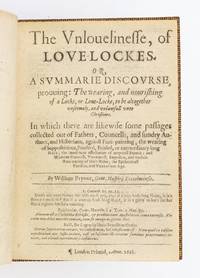
1628ST17855London: n.p. 1628. FIRST EDITION the issue with "needes" in the second line on D2. 184 x 137 mm. 7 1/4 x 5 3/8". 12 p.l. including the initial blank 63 1 pp. pp. 41-48 misnumbered 33-40. <br/> Red crushed morocco by Riviere stamp-signed on front turn-in title and date on front cover raised bands titling in two spine panels gilt edges front joint rather noticeably repaired. In a custom-made folding cloth box with leather label and fleece lining. Front pastedown with book label of Arbury Library; blank with contemporary inscription of Julian Leigh see below for both. STC 20477; ESTC S115447. Rear joint cracked with consequent slight looseness leaves probably washed and resized because extremely fresh and at the same time a shade less than white.<br/> <br/> This is an early work by the Puritan lawyer and indefatigable pamphleteer William Prynne 1600-69 who had a very great deal of advice mostly unsolicited and unwelcomed for the fair sex. In the text here he rails against many things including "face-painting; the wearing of supposititious poudred frizled or extraordinary long haire; the inordinate affectation of corporall beautie; and womens mannish unaturall impudent and unchristian cutting of their haire." While the work can be viewed as a moral diatribe to us it is illuminating as social history talking as it does about the dress and grooming of persons of quality and the responses these evoked in the first half of the 17th century. Prynne graduated from Oriel College Oxford in 1621 became a student at Lincoln's Inn and before long began producing pamphlets that occupy more than 250 entries in STC and Wing. Our work is a forerunner to one of his most infamous and ill-timed works "Historio-mastix" in which he vigorously denounced female actors appearing on the stage--at the same moment Queen Henrietta Maria was preparing a masque to present at court. This misstep led to a conviction for sedition and his sentence included a £5000 fine life imprisonment and the removal of his ears. His later pamphlets were not noticeably less inflammatory and these led to a further sedition charge as well as more disfigurement including a slit nose and a brand on his cheek announcing him as a seditious liar. Our copy is recorded as lot #271 of Sotheby's "Catalogue of Rare and Valuable Books Selected from the Ancient & Celebrated Library at Arbury Hall Warwickshire the Property of Sir Francis Newdigate-Newdegate" 1920. The earliest recorded owner however is an ancestor of Sir Francis: the 17th century gentlewoman whose name is variously given as Juliana or Julian Leigh bap. 1610 d. 1685. She was the daughter of Sir Francis Leigh of Newnham Regis Warwickshire and the granddaughter of Thomas Egerton Viscount Brackley who was Lord High Chancellor of England. In 1632 she married Sir Richard Newdigate 1st Baronet 1602-1678 of Arbury Hall who became Lord Chief Justice. Notably Newdigate was an exact contemporary of Prynne at Oxford and they were both admitted to the bar in 1628 the year our "Love-Lockes" was printed. It is certain that Newdigate and Prynne were well acquainted as together on behalf of the crown they famously prosecuted leaders of the Irish rebellion in 1644 and 1645 resulting in multiple executions for high treason. n.p. unknown
1606SE262<p>4o 220x159 mm. Collation: 4 A-H4. 8 64 pp. On the title-page woodcut coat of arms of the dedicatee Francesco Borghese as Captain General of the Saint Roman Church surmounted by a coronet. Woodcut decorated initials and tailpieces. Contemporary gilt-tooled vellum. Covers within a double fillet with Borghese's coat arms at the centre. Small heraldic dragons at each inner corner. Holes for ties at the foredges. Smooth spine decorated with alternating heraldic dragons and eagles. Minor losses small marginal stain to the lower cover. A very good copy in its original binding. Some light scattered foxing and staining.<br />Provenance: Francesco Borghese 1556-1620 brother of Pope Paul V and Captain General of the Saint Roman Church armorial binding.<br /><br />First edition of this important work likely Palazzolo's presentation copy to the dedicatee of the work itself Francesco Borghese whose coat of arms is stamped on its fine binding.<br />Francesco Borghese Duke of Rignano was the younger brother of Camillo who had been elected Pope as Paul V on 16 May 1605. Since his ascent to St Peter's throne the pope had vigorously fought for the development and reinforcement of the Papal Army and named his brother Generale di Santa Romana Chiesa i.e. Captain General of the Saint Roman Church. In this context the Milanese nobleman Cesare Palazzolo – Generale collaterale i.e. the general inspector for the papal armed forces – was commissioned with the redaction of the present work which contains not only the outlines of the reform but above all its theoretical justification. The work traces the spiritual basis of the disciplined soldier and re-defines military duties in terms of Christian piety. The soldiers of the Pope should be not only well organized and courageous but also disciplined and devoted. The pattern of conduct proposed by Palazzolo is thus dual natured both military and religious. <br />As noted Palazzolo dedicates his book to Francesco Borghese whose coat of arms as Captain General of the Saint Roman Church stands out on the title-page. <br />The handsome gilt-tooled vellum binding was executed – as the gold-tooling clearly attests – in the most renowned and sought-after workshop then active in Rome that run by the Soresini binders who worked for the papal court as well as other high-profile clients from the 1590s to ca. 1630. Credit for this particular binding may belong to Baldassare Soresini who was so active for the Borghese family that he was known as the 'Borghese Binder'. The choice of such a refined atelier could therefore reveal Palazzolo's intention of offering this copy to an outstanding recipient as indeed Francesco Borghese was.</p><p>STC 17th century Italian 642; G. Vianini Tolomei "I ferri e le botteghe dei legatori" Legatura romana barocca. 1565-1700 pp. 31-2 and pls. i-ii; G. Brunelli Soldati del papa. Politica militare e nobiltà nello Stato della Chiesa 1560-1644 Rome 2003 ad indicem; Idem "Cultura politica e mentalità burocratica nei carteggi dell'organizzazione militare pontificia 1560-1800" A. Jamme – O. Poncet eds. Offices écrits et papauté xiiie- xviie siècles Rome 2007 pp. 301-310.</p> Luigi Zannetti
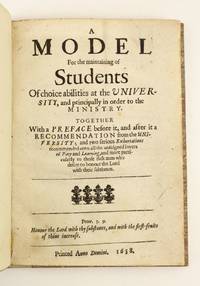
1658ST16442s.l.: s.n. Printed Anno Domini 1658. FIRST EDITION. 190 x 135 mm. 7 1/2 x 5 3/8". 3 p.l. 14 pp. complete. <br/> 20th century vellum-backed marbled boards flat spine with vertical titling. Front pastedown with bookplate of the Fox Pointe Collection. Wing P-2842B; ESTC R207754. ◆Text lightly washed and pressed but still crisp faint foxing to lower edge of title page otherwise a fine fresh copy in an unworn binding.<br/> <br/> Written by an opinionated English cleric this is an extraordinarily rare pamphlet proposing an unusual fund to support young 17th century scholars. According to DNB the scheme outlined in the present work was meant "to support the university studies of young men of promise seeking entry into the ministry." The plan "was approved by John Worthington and Anthony Tuckney and had the support also of John Arrowsmith DD Ralph Cudworth William Dillingham DD and Benjamin Whichcote. The fund raised about £900 and it appears that William Sherlock afterwards dean of St Paul's received assistance from this fund during his studies at Peterhouse Cambridge until 1660 when he graduated BA. Those entrusted with administering the fund sent Poole regular reports on students interviewed and the ratings they had received in philosophy logic and languages. The scheme was abandoned at the Restoration." Poole 1624 - 79 was the author of a number of controversialist pamphlets on subjects ranging from Unitarianism to preaching by lay persons before undertaking his major work: a synthesis of critical biblical commentaries "Synopsis criticorum aliorumque sacrae scripturae interpretum." This is one of his scarcest writings: ESTC lists seven copies two in North America while ABPC and RBH record just two copies at auction. s.n. Printed Anno Domini unknown
1683ST20461-2Paris: Pierre le Petit 1683. 203 x 127 mm. 8 x 5". 4 p.l. first blank xxxii 629 3 pp. <br/> REGAL CONTEMPORARY RED MOROCCO GILT covers with French fillet border central field semé with alternating fleur-de-lys and Louis XIV's stylized "L" topped with a crown raised bands spine compartments with crowned "L" at center oblique fleur-de-lys at corners marbled endpapers olive green morocco label all edges gilt. Printer's device on title page and four engraved plates depicting the Entry into Jerusalem the Crucifixion the Descent into Hell and the Resurrection. Front pastedown with morocco bookplate of Hans Fürstenberg; verso of front free endpaper with book label of the Fondation Fürstenberg. USTC 6098649. For the binding: Olivier Pl. 2493 Fer no. 8. Top inner corner of covers a shade darker but apparently not from moisture boards tending to splay slightly corners a bit bumped endpapers with offsetting from binder's glue but the binding lustrous with very little wear to the joints and generally pleasing. About a quarter of the leaves with small faint dampstain at upper gutter intermittent minor browning and foxing more pronounced on a couple of quires other unserious signs of devout use but the text with nothing approaching a fatal defect.<br/> <br/> Bound for a distinguished library--and perhaps for a member of the French royal household--and with an illustrious modern provenance this is a pleasing copy of a 17th century Parisian edition of the Office of Holy Week. The attractive engravings that accompany these paschal hours demonstrate the lush graceful style that distinguished the fine late baroque printmakers. The scenes of the Crucifixion and Resurrection were engraved by Jean Morin ca. 1605-50 whose innovation of combining engraving and etching on the same plate ushered in a new popular style of printmaking and the depiction of the Entry into Jerusalem by Flemish artist Peter Paul Bouche fl. ca. 1685-1702 is especially pleasing. But the story of this volume is its period binding. The owner who commissioned the binding may well have been a member of the noted Lamoignon family whose celebrated library was built over several generations but particularly by Chrétien-François de Lamoignon I 1644-1709 a cultivated man of letters and friend to writers such as Boileau and Racine. The "L" surmounted by a crown appears typically on the family bindings though normally accompanied by the same cypher stamped in the margin of the third leaf of text a stamp that is not present here. The impressive library was sold to bookseller Thomas Payne and auctioned off in 1791-92. Equally or really unequally the repeating motif of Louis XIV's crowned "L" monogram could well indicate that this was the property of royalty. We have not been able to identify its specific owner but this style of semis was not uncommon for royal bindings; the Russian National Library has two late 17th century examples with Louis XIV's own arms over an identical ground. According to Olivier the semis repetition alternating the monarch's initial with a fleur-de-lys or with a specific royal's cipher became popular during the reign of Louis XIII and continued under his successors; "the result for royal bindings is a sort of uniformity in the ornamentation which seems to reflect in the field of art the unification and centralization of France." Our binding's crisp precise tooling has survived beautifully despite apparent dedicated devotional use by its early owner. Our copy is further distinguished by coming from the collection of Hans or Jean Fürstenberg 1890-1982 a bibliophile of refined discrimination who assembled one of the great collections of the 20th century and whose books were noted for their outstanding condition. He put together one of the finest collections of 18th century French books ever assembled and his library contained a discriminating selection of bindings from other periods such as the present example. Pierre le Petit unknown
1651ST19567-214Paris: Chez F. Mazot 1651. 172 x 110 mm. 6 3/4 x 4 1/4". 3 34 leaves 35-39 1 pp. 12 leaves. <br/> Fine old contemporary red morocco covers panelled with gilt fillets with flowering urn cornerpieces raised bands the spine densely gilt in compartments with scrolls and dots two clasps marbled endpapers all edges gilt. ENGRAVED THROUGHOUT WITH 38 FULL-PAGE ILLUSTRATIONS consisting of one portrait two allegorical religious scenes including title and 35 illustrations of the Holy Eucharist plus 44 PAGES OF ENGRAVED TEXT 37 of these with text flanked by full-length figures of saints accompanied by other religious symbols at head and foot of page six framed with vignettes of angels the Madonna or scenes from the life of David one page with text only. Contemporary ink inscription to the lower margin of the title page reading "In Archui. vitr." Endleaf with engraved armorial bookplate of Viscount Strathallan; front pastedown with the bookplate of John Evelyn. Duportal pp. 244-45; Brunet V 624; Graesse VI 4. Trivial rubbing to the extremities leather straps slightly worn but holding strong but A SUPERB COPY exceptionally clean fresh and bright internally and in its solid and unsophisticated and still very pleasing binding.<br/> <br/> This is a particularly attractive copy of a sumptuously illustrated prayer book in its especially appealing original 17th century binding. According to Duportal it is "One of three important publications whose engravings reveal the trend characteristic of religious illustrations in France between 1601 and 1660." The work opens with a dedication to Charles d'Aubespine Marquis de Châteauneuf 1580-1653 with a full-page portrait by Guillame de Gheyn b. 1610. Then the bulk of the book is made up of two groups of plates. Those in the first group appear primarily on the rectos and contain prayers in Latin and French flanked by pairs of saints; gaps in the prayers are filled by naturalistic flowers insects and birds. Many of these plates also include a scene or two in miniature depicting the life of the saints or a vignette of angels. Just two of these engravings are signed "J. Collin" but they all appear to be in the same hand and demonstrate an impressive level of finesse and delicacy with emotive graceful saints depicted with sure light lines. Duportal notes that our artist had a "talent charmant" and that well-executed dry-points of this type are quite rare in French books of the period. The second group of engravings appear on the versos and depict the performance of a part of the Mass beneath a cloud in which appears a relevant scene from the life of Christ. They are all unsigned and clearly by a different hand with more rustic features--possibly "copies of originals published abroad" according to Duportal. The book concludes with text framed by gamboling putti and scenes from the life of Christ and facing full-page bust portraits followed by the Penitential Psalms each with elaborate illustrated frames depicting scenes from the life of David. Copies of this work can be found with varying numbers of leaves and engravings but the present item seems to be an early edition as it contains the earlier state of the engravings on the versos before they were substantially reworked and it does not contain the "Privilege du Roy" with the date 1652 or 1653. Our copy comes from the books assembled by the famous diarist John Evelyn 1620-1706 a library that Quaritch's dictionary of English book collectors calls "a noble collection." De Ricci says that the finest books from the library bear Evelyn's monogram as ours does and this bookplate brings with it the expectation of remarkably fine contemporary condition. This copy also has the bookplate of Viscount Strathallan possibly William Drummond 1810-86 Conservative MP and the second to hold the family title following the reversal of the attainder put in place after his family's participation in the Jacobite uprising. Chez F. Mazot unknown
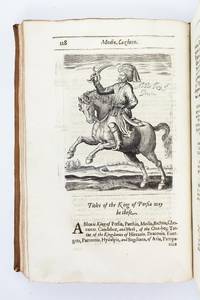
1634ST20186London: printed by William Stansby and Jacob Bloome 1634. FIRST EDITION. 290 x 195 mm. 11 1/2 x 7 3/4". 6 p.l. 225 15 pp. <br/> Contemporary sprinkled calf raised bands traces of old paper label to spine pastedowns lifted to reveal leather bands and manuscript document fragments used as sewing guards all edges sprinkled red expert repair to rear joint. With additional engraved title page featuring two figures of Persian dignitaries and three small travel vignettes signed at foot by William Marshall and 36 engravings in the text the majority vignettes but one full-page and nine more than half a page tall. Front endpaper with ink armorial stamp of Sir Walter John Trevelyan 8th Baronet of Nettlecombe and High Sheriff of Cornwall. Price inked in a contemporary hand to the front endpaper. Sabin 31471; STC 13190.3; ESTC S92948. Front board a bit splayed covers with three old dampstains and a few scars and tiny wormholes but a very pleasing original binding with almost no wear to the joints. A very few marginal smudges made during printing other quite trivial imperfections but AN ESPECIALLY FRESH BRIGHT AND CLEAN COPY INTERNALLY with rich impressions of the engravings.<br/> <br/> This is a contemporary copy in remarkably fresh internal condition of an important and entertaining account of the travels of a 17th century Englishman in exotic Asian and African territories particularly Persia. It is significant both for the ways it is accurate and for the ways it is fictitious. Sir Thomas Herbert 1606-82 left for Persia on a diplomatic mission to Shah Abbas in 1626 as part of the entourage of Sir Dodmore Cotton. The mission was not successful: Cotton and the mission's other leader Sir Robert Shirley both died in 1628 leaving their retinue at loose ends with the increasingly unimpressed Shah. Herbert made a slow return to England traveling through a large portion of Asia and Africa and even sailing up the coast of North America. He finally returned to England in 1630; four years later he published this account of his adventures. The text describes meetings with people of many cultures as well as encounters with exotic animals including the dodo flamingoes and flying fish. Herbert's accounts are of great importance for their details of early Asian travel by Westerners. At the same time the author was unable to resist the urge to embellish a good story and according to DNB gave implicitly first-person accounts of places he had not in fact visited. One such detour into the fanciful comes in the chapter involving the author's apparent visit to America. In it Herbert discusses the belief that the mythical Welsh king Madoc ap Owen-Gwyned had settled in North America in the 9th century for which he provides linguistic evidence that Sabin calls "entirely fanciful." DNB tells us that "this segment was apparently included to please the earl of Pembroke's own Welsh nationalist fancies. It also continued to help fuel various theories about Madoc's colonies and Welsh Indians in North America until the early years of the nineteenth century." Herbert's tale is profusely illustrated by William Marshall fl. 1617-49 with engravings that are sometimes more imaginative than accurate see for example the depiction of the shark on page 6 or the penguin on page 13. Despite these rather amusing inaccuracies the illustrations are lively and detailed providing a sense of the awe the early readers must have felt when imagining foreign places. Our copy in a period binding with part of a manuscript ledger used in the binding process visible is from the library of Walter John 1866-1933 8th baronet Trevelyan who as his inkstamp suggests served as High Sheriff of Cornwall from 1906-07. printed by William Stansby, and Jacob Bloome unknown