30 résultats
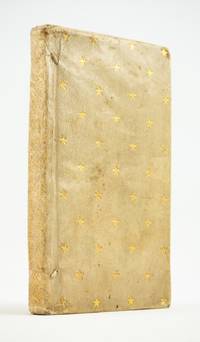
1689ST20606Bordeaux: Pierre Abegou Jean Martel 1689. 156 x 89 mm. 6 1/8 x 3 1/2". 14 p.l. 95 1 80 pp. With a life of the author. <br/> APPROPRIATELY CELESTIAL CONTEMPORARY VELLUM SPRINKLED WITH GILT STARS on covers flat spine densely tooled with repeating Gascon-style fleurette. Two section titles with an excellent woodcut depicting Nostradamus surrounded by the instruments of his trade woodcut tailpieces of stars and moon. Front pastedown with pencilled name and annotations of Nostradamus scholar Daniel Ruzo de los Heros. USTC 6163254. Minor soiling and three small brown stains to covers first quire and last two quires a bit browned due to paper quality one leaf with horizontal crease partially obscuring a line of text though still legible other isolated imperfections but an excellent copy nevertheless the text clean and fresh and the curious binding shining with gilt and showing almost no wear.<br/> <br/> In a particularly charming star-studded binding this is an excellent copy of Nostradamus' famous prophecies which has been part of two major Nostradamus collections. The famous astrologer and physician Michel de Nostre-Dame known as Nostradamus 1503-66 caused a sensation with the publication of his "Centuries" in 1555 a collection of predictions written in nearly impenetrable quatrains that has enjoyed a certain measure of popularity ever since. Published in Bordeaux in 1698 our edition contains the 942 surviving predictions together with a brief biography of Nostradamus. Our copy is distinguished by a strikingly appropriate contemporary "reliure parlante"--a binding designed to mirror the contents of the book it covers; in this case the field of shimmering gilt stars perfectly suits the subject of reading the heavens and wonderfully complements the celestial woodcuts in the book. This copy has been part of two notable libraries of Nostradamus material. Former owner Daniel Ruzo de los Heros 1900-91 was a Peruvian scholar and eccentric whose wide-ranging career included serving as district mayor of Miraflores in Lima publishing numerous works on the possible man-made nature of the geologic formations in Marcahuasi and most relevant here collecting a wealth of Nostradamus material. His 1970 work "El Testamento Autentico de Nostradamus" includes his theories on Nostradamus' prophecies along with a bibliography of published editions of Nostradamus' works including many from his own library; the present copy is not included suggesting it was a later addition to Ruzo's collection. The extensive pencil notations on the front pastedown include Ruzo's cryptographical interpretations of Nostradamus' verses--including an anagram of "Nostradamus" as "Mandat Russo" roughly translated from the Spanish as a "command made by Russo" which Ruzo has further marked with his own name to ensure no one could miss the joke. The present copy subsequently passed into the library of Elmar R. Gruber b. 1955 psychologist researcher and noted collector of mediumistic art. His esoteric research led to an interest in Nostradamus and he built a significant collection of Nostradamus material culminating in his 2003 publication "Nostradamus: Sein Leben sein Werk und die wahre Bedeutung seiner Prophezeiungen.". Pierre Abegou, Jean Martel unknown
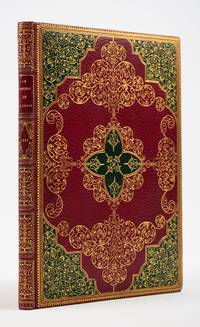
1651ST20278Paris: Chez F. Mazot 1651. 172 x 118 mm. 6 3/4 x 4 3/4". 3 34 leaves 35-39 1 pp. 2 leaves. <br/> LOVELY CRIMSON CRUSHED MOROCCO GILT AND ONLAID BY CAPÉ stamp-signed on front turn-in covers with onlaid green morocco cornerpieces and central quatrefoil all filled and surrounded by delicate pointillé tooling in floral and paisley designs raised bands spine compartments tooled in pointillé gilt lettering richly gilt turn-ins marbled endpapers all edges gilt. In a felt-lined morocco-lipped marbled paper slipcase. ENGRAVED THROUGHOUT WITH 38 FULL-PAGE ILLUSTRATIONS consisting of one portrait two allegorical religious scenes including title and 35 illustrations of the Holy Eucharist 40 pages of engraved text 37 of these with text flanked by full-length figures of saints accompanied by other religious symbols at head and foot of page two framed with vignettes of angels or the Madonna one page with text only. Front pastedown with "A W F" book label of bookseller Adrian Fluhmann. Duportal "Étude sur les livres à figures" pp. 244-45; Brunet V 624; Graesse VI 4; Leaves perhaps very lightly washed and pressed but an extremely fresh clean copy IN A SPARKLING BINDING.<br/> <br/> Covered by a luxurious binding by Capé this is a particularly attractive copy of a sumptuously illustrated prayer book composed entirely of engraved plates. According to Duportal it is "One of three important publications whose engravings reveal the trend characteristic of religious illustrations in France between 1601 and 1660." The work opens with a dedication to Charles d'Aubespine Marquis de Châteauneuf 1580-1653 with a full-page portrait by Guillame de Gheyn b. 1610. The bulk of the book is made up of two groups of plates. Those in the first group appearing primarily on the rectos contain prayers in Latin and French flanked by pairs of saints; gaps in the prayers are filled by naturalistic flowers insects and birds. Many of these plates also include a scene or two in miniature depicting the life of one or both of the saints or a vignette of angels. While just two of these engravings are signed "J. Collin" they all appear to be in the same hand which demonstrates an impressive level of finesse and delicacy depicting graceful figures with sure light lines. Duportal notes that this artist had a "talent charmant" and that well-executed dry-points of this type are quite rare in French books of the period. The second group of engravings appear strictly on the versos and depict the performance of a part of the Mass beneath a cloud in which appears a relevant scene from the life of Christ. They are all unsigned and clearly by a different hand with more rustic features--possibly "copies of originals published abroad" according to Duportal. The book concludes with two leaves of text framed by gamboling putti and the Virgin. Copies of this work can be found with varying numbers of leaves and engravings apparently the result of multiple reprintings with added material produced between 1651-53 but the present item can be distinguished as an early if not the very first edition as it does not contain "Privilege du Roy" dated 1652 or 1653. Furthermore our copy also contains the earliest state of the plates without the "I N R I" initials on the cross found on the title page and with the earlier state of the verso engravings before they were substantially reworked. Our edition seems to be quite rare with OCLC finding just one other copy with the same sequence of contents at the Bibliothèque Sainte-Genevieve. The stunning binding by Capé looks just as fresh and lustrous as the day it left its workshop. One of the most distinguished binders in France in the middle years of the 19th century Capé d. 1867 was especially well known for the delicacy of his work--which can be appreciated to full effect in the present example. He was the binder to the Empress Eugénie and Béraldi calls him "the Bozérian of the second Empire." This is precisely the kind of book our former owner the discriminating connoisseur-bookseller Fluhmann would have owned. Chez F. Mazot unknown
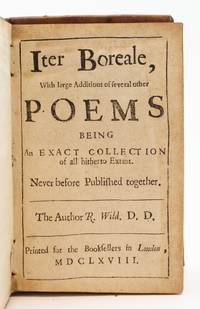
1668ST19030London: Printed for the Booksellers in London 1668. First Complete Edition Fourth Edition overall. 145 x 90 mm. 5 3/4 x 3 1/2". 1 p.l. blank 3-122 pp. 3 leaves table and final blank. <br/> Contemporary sheep covers ruled in blind smooth spine early paper label with gilt titling. Front blank with the ink ownership inscription of John Drinkwater; inside lower board with the book label of Michael Curtis Phillips. Hayward "English Poetry" 121 this copy; Grolier Club "Wither to Prior" 976; Wing W2136; ESTC R7135. ◆Covers with light scuffing bottom leather thong of two broken but the text block quite secure at the top pastedowns lifted but the insubstantial binding still in remarkably good original condition; internally A VERY FINE COPY especially clean fresh and bright.<br/> <br/> From the library of Richard Jennings noted for the outstanding condition of his books this is an especially fresh and extraordinarily well-preserved copy of poems by a Puritan divine known for his surprisingly biting wit. Dryden dubbed Robert Wild 1609-79 "the Wither of the City" after hearing the Financial District's workers' enthusiastic reception of the title poem here which celebrates General Monck's successful campaign to restore Charles II to the throne: "I have seen them reading it in the midst of 'Change so vehemently that they lost their bargains by their candles' ends." Our collection contains several of Wild's most notable works including "The Recantation of a Penitent Proteus" satirizing Puritan clergy who had conformed to the Anglican Church; "The Loyal Nonconformist" professing his loyalty to the monarchy but maintaining his Puritan religious views; and "The Fair Quarrel" an attack on the 1665 Five Mile Act designed to drive nonconformist ministers out of their parishes. Wild was something of a paradox: he could preach a hellfire Puritan sermon but also write verse sufficiently scandalous to be mistakenly attributed to the notorious libertine John Wilmot Earl of Rochester. Our volume was loaned by Richard Jennings for the celebrated 1947 London Exhibition of First and Early Editions of English Poetry catalogued by John Hayward. It would not be reasonable to expect to find a finer unrestored contemporaneous copy of this imprint. Printed for the Booksellers in London unknown
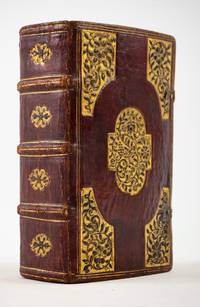
1622ST20888Munich: N. Henricus 1622. First Edition in German. 160 x 100 mm. 6 1/4 x 4". 16 p.l. 699 3 pp. Translated from the Latin by Sebastian Äntzenhover. <br/> UNUSUAL AND QUITE BEAUTIFUL CONTEMPORARY GERMAN DARK RED MOROCCO GILT covers with gilt fillet border central panel with onlaid corner pieces and centerpiece of black morocco stamped in relief to an Ottoman-inspired design of flowering vines raised bands spine panels with gilt centerpiece two leather straps with silver clasps and catches all edges gilt. Title page with engraving of the Tower of Babel. Top half inch of title page cut away to remove owner inscription. VD17 12:103845E; USTC 2019170. A touch of bowing to boards spine a little crackled joints and extremities a bit rubbed occasional small round marginal marks apparently made with wax! and presumably meant to indicate textual importance other trivial imperfections but an excellent copy clean and fresh in an unrestored binding with lustrous boards glistening with gilt.<br/> <br/> This rare work on sinning through the use of wicked words is offered here in a lovely binding that is quite out of the ordinary for its time and place and that may well have a very noble provenance. "Spiritual Tongues: That is a Salutary Treatise Concerning the Poisonous Tongue of Man--How to Guard Against and Remedy It" is an examination of the sins committed through speaking written by Munich Jesuit Johannes Pelecyus 1545–1623 and first printed in Latin in 1620. Pelecyus addresses the evils of gossip slander indiscretion cursing mocking and other injurious speech. The first part of the work is a general overview of the topic from a theological standpoint while the second part is a more practical guide to types of harmful speech and specific remedies for avoiding and correcting these offenses. Pelecyus concludes with a poem "The Devil's Disease and its Remedy." The binding here is remarkable in terms of its material makeup and the conjectural origin of its design. In the first part of the 17th century morocco was not commonly used by German binders who preferred sturdier pigskin particularly for treatises like this which could be expected to see much use poisonous tongues have long been a fact of life and in need of being frequently read about. Morocco was generally reserved for presentation copies or ceremonial liturgical works. In addition to the material the decoration here is unusually lavish for a text of this sort with onlays gilt adornment and silver clasps that required time and skill from the artisan and considerable expense for the patron. Significantly the lovely relief centerpiece design on the boards here also appears on the covers of a Book of Hours originally created for Holy Roman Emperor Maximilian I 1459-1519. That volume was later acquired by another similarly named owner Duke Maximilian I of Bavaria and is now to be found in the Bavarian State Library: shelfmark BSB 2 L.impr.membr. 64. It is certainly well within the realm of possibility that our later Maximilian 1573-1651 could have owned the present poisoned tongue volume and had it dressed in its elaborate morocco attire in imitation of the original binding design on the emperor’s prayer book. Whoever was responsible for the binding they surely did extremely fine work and no doubt for an elite clientele. One other curious feature of this volume is the series of round wax dollops made in the margins which an owner the fastidious second Maximilian has used to mark passages of interest in the text. While they don't materially affect the value of the volume they are intriguing in that they inevitably call up images for us of a careful early reader systematically marking with some kind of unknown implement the parts of the text that seemed important. "Spiritual Tongues" is a rare work: USTC and OCLC find just four copies outside Germany none of them in North America and we could trace just one copy sold at auction. N. Henricus unknown
1690BB005<p><b>L'ARMESSIN II</b> Nicolas de 1632–1694</p><p><b><i>Habits des Metiers et Professions</i></b>. </p><p>Paris: chez N. de L'Armessin ou chez la Veuve de N. de l'Armessin Rue St. Jacques à la Pomme d'Or N.d. <i>circa</i> 1690–1695.</p><p>4to. 62 ff. last two plates with restoration; bound in green morocco gilt second-half of the 19th century signed Chambolle-Duru.</p><p>A remarkable collection of 62 engraved copperplates representing the earliest impressions of fantastic figures composed of the tools or attributes of their trades created and produced about 1690 onwards thru 1694 enhanced at the time with brilliant hand-coloring silver and gold paint. These prints are a marvel of inventiveness showing the inspiration and influence of the 16th century painter Giuseppe Arcimboldo 1527-1593 who chiefly imagined only heads now extended and re-invented for the Court of Louis XIV. </p><p>Amongst the most famous prints of the late 17th century their printing history is rather complicated. Nicolas I de Larmessin or L'Armessin 1632-1694 designed engraved and published approximately 62 plates in his lifetime. His widow Marie Bertrand added 14 plates from his unfinished designs and his younger brother Nicolas II c.1645-1725 engraved a further 21 plates from 1695 to 1720s. All of the prints were individually published with re-engravings in reverse by the younger brother which often simplified these earlier designs by omitting background details. Altogether it has been suggested that a total of 97 images were eventually issued. </p><p>From the Beauvillain library ex-libris by Jouas. Colas 1779 Lipperheide 1971.</p> chez N. de L'Armessin [or for 7 sheets] ou chez la Veuve de N. de l'Armessin, rue St Jacques, à la Pomme d'Or, circa circa hardcover