31 résultats
1751D11029Prague: Typis Universitatis Carolo-Ferdinand. Societat. Jesu ad S. Clem. 1751. First Edition. Hardcover. Very Good. Very rare Czech Jesuit imprint of Gottschlich’s ‘Viator per Fidem’ incorporating his dissertational work on dogma and exercising faith and published by Prague’s Clementinum Jesuit College in 1751. 8vo 165 x 100mm. 2 342 2 index. Title spreading over three pages with the dated Prague imprint below the line on first. Dedicated to Prokop Adalbert Count Czernin of Chudenices 1726-1777 head of one of the oldest and most influential Bohemian noble families. Woodcut initial and frieze at p. 1 vignette at p. 342 of angel holding bannered trumpet inscribed AD MAIOREM DEI GLORIAM. Contemporary calf spine with five raised bands; light edgewear faint foxing mostly in hinges and margins not severe and otherwise a clean copy. First edition of this extremely rare Czech Jesuit title Viator Per Fidem. which literally translates to “Traveler’s Faith.” One copy located in the National Library of the Czech Republic and digitally available through GoogleBooks. Another copy in the Deutsche Nationalbibliothek classified as a theology dissertation. By explanation of the unusually lengthy title the book was written by Carolus Gottschlich as a part of his University research; the dogmatic work examined faith issues and their resolutions. Gottschlich was a Jesuit and university professor of humanities philosophy and theology. Little is known about his connection to the Clementinum although it can be surmised that he spent some part of his teaching career here which gained him access to the Jesuit College press. Gottschlich and his research contributors are almost all but forgotten to history. <br/><br/>Prague University was put under Jesuit administration in 1620 and eventually merged with the Clementinum in 1653 to form the Karl-Ferdinand University. From at least the middle of the 17th century the Jesuits kept a stronghold on higher education and the publishing industry in Prague. University rectors at Karl-Ferdinand University ruthlessly controlled the written word and imposed strict censorship on books which lasted well into the reforms of Joseph II in the 1780s. Gottschlich’s title is a rare survival given the fraught 18th-century publishing arena of Bohemian lands. The Viator per Fidem represents the lasting effects of Catholic patriotism and the significance of Jesuit influence on book publishing a significant part of Czech literary heritage. Typis Universitatis Carolo-Ferdinand. Societat. Jesu ad S. Clem. hardcover books
1785EPL107London 1785. Paperback. Near Fine. Printed scripts of Syriac Armenian Arabic Samaritan Gothic Coptic Ethiopic Etruscan Saxon etc. Variations of English Greek and Hebrew and a leaf of floral devices with music and ship imprints on verso. Interesting specimen for those interested in typographic history. Size: 401 x 255mm. <br/><br/> paperback books
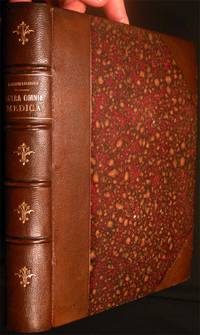
1781D8826Venice / Naples: Antonio Graziosi / Per Vincenzo Mazzola-Vocola 1788 / 1781. Hardcover. Very Good. Morandis rare treatise on operative midwifery with Rastrellis even rarer work on wisdom and morals. MORANDI Antonio fl. 18th century. Trattato Universale Teorico e Pratico dei Parti necessario alle mammane ai chirurghi ed ai medici. Venice: Antonio Graziosi 1788. 8vo 190 x 120mm. v-xxx 399 pages; lacks 2 blanks at beginning. Bound with: RASTRELLI Giovanni Ranieri. Documenti morali e civili da un padre diretti al suo figlio. Naples: Per Vincenzo Mazzola-Vocola 1781. xii 80 pages. Oval portrait of Rastrelli signed by Joseph Tronus. Woodcut chapter head- and tail-pieces throughout. Near contemporary Italian vellum edges speckled; contents clean only some slight foxing at front and back of volume. Few lines of contents written in Italian script on front free endpaper and signed G. Viparelli on title. <br/><br/>The rise of obstetrics in the early modern period had a mixed effect on midwifery. Some midwives clung to their traditional ways. Others embraced the new science and sought retraining. National policies also shaped the contours of midwifery practice. Overall the art of midwifery could no longer be considered a subdivision of medicine but must be regarded as a branch of surgery requiring a thorough knowledge of surgical principles. The title of this work does not indicate its comprehensiveness; it is more than an operative midwifery for it includes much that belongs to a general treatise on the subject. Rastrellis work and portrait cannot be found elsewhere suggesting it is commonly an addition to texts and the title translated is a moral and civil work directed by a father to his son. Rastrelli was a noted poet in the latter half of the 18th century. While both parts are exceedingly rare the first is only located at the Wellcome Library and the Biblioteca della Fondazione Biblioteca San Bernandino in Italy. Antonio Graziosi / Per Vincenzo Mazzola-Vocola hardcover books
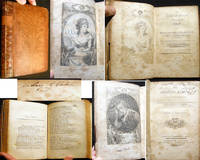
179323161Boston Massachusetts: Belknap and Ball 1793. 12 324 2 pages contents at back; including a portrait of Della Crusca and another of Anna Matilda both engraved by Sam. Hill Boston; 2 title pages one which describes this as the First American Edition from the Fourth London Edition; mostly short poetic pieces originally edited by Edward Topham; credited to Robert Merry Hannah Cowley Miles Peter Andrews Edward Jerningham others; printed at the Apollo Press Boston; approximately 4 1/2" x 6 3/4" size; previous ownership name-stamp of Mary G. Clark; bound in full contemporary polished tree-calf leather; spine with gilt decorations; much edge tips wear rubbing to boards worn binding split in half; lacks title label on spine; no front free blank endpaper; portraits darkened with the tissue guard of Anna Matilda having a tracing of the figure in line; some foxing soil and discoloration of leaves; in good condition. First American Edition. Leather. Good. Belknap and Ball books
179122592London: J.W. Tomkins 1791. Very good. Stipple engraved plate image size 19.5 x 25 cm. mounted on board. J.W. Tomkins unknown books
179429828London: Anthy. Milteno 1794. St. Caecilia is seated at an organ with an open music book above the keyboard; two cherubs sing from a music book to her right. <br/><br/>The model for the painting was the singer/actress Mrs. Richard Brinsley Sheridan née Elizabeth Ann Linley 1754-1792 daughter of the composer and conductor Thomas Linley 1733-1795. <br/><br/>370 x 280 mm. Printed on wove paper.<br/><br/>Some wear; minor chips tears and soiling to edges with remnants of former mount to upper right edge; some creasing; old paper repairs to verso; trimmed to just within plate impression. Anthy. Milteno unknown books
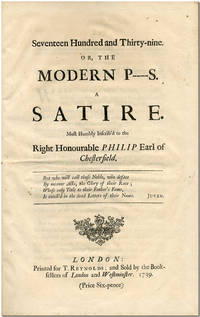
1739WRCLIT64483London: Printed for T. Reynolds 1739. 8pp. Folio. Later boards. Some pencil annotations in the text boards a bit soiled otherwise very good. First edition. An anonymous poem on the modern peers identified by Foxon as possibly by the same author as BRITANNIA'S PRECUATION 1741 and THE HIBERNIAN POLITICIANS 1740 someone "possibly named Gardiner." FOXON S354. ROTHSCHILD 221. ESTC T4631. Printed for T. Reynolds hardcover books
175929663Paris: Basan 1759. 385 x 260 mm. Printed on laid paper. <br/><br/>The outdoor scene with trees and statuary depicts Caroline and Charlotte daughters of Frédéric Sluyter performing in a production of Pygmalion at the Schouwberg Theatre in Amsterdam. The dancer at left is on her right foot with arms outstretched costumed in a dress with a low rounded neckline pointed waistline and a wide panniered skirt; the dancer at right is on her left foot with arms outstretched wearing male attire including cocked hat frock coat with stiff flared skirt breeches and heeless shoes. <br/><br/>Browned; small stain to lower right corner. Scarce. NYPL: b12155632. BM 1854 0614.342.<br/><br/>Caroline and Charlotte Frédéric were part of a troupe of child performers active in Amsterdam in the 1760s. Basan unknown books
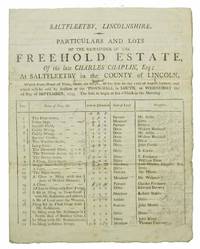
179542915Louth 1795. White rag paper bottom and fore-edge deckled. Black printed text. Two fold lines; occasional loss to fold lines minimally affecting text; light general wear and toning. VG. Bifolium. 2 unnumbered pages of printed text; title printed to verso of second leaf else second leaf blank. 9-3/4" x 7-5/8" <br/><br/>Auction catalogue from the 1795 sale of 38 lots of the freehold estate owned by the late Charles Chaplin Esq. with manuscript prices and related notes in pencil and ink in a contemporary hand throughout. Occasional pencil notations and markings correct the printed acreage estimates of some lots. The Chaplins were members of the upper gentry and influential landowners in Lincolnshire. When the Louth Navigation -- a canal running from Louth in Lincolnshire to Tetney Haven at the mouth of the Humber -- was completed in 1770 Charles Chaplin managed to secure a 99 year lease of the tolls despite the terms of the canal's Act of Parliament limiting such leases to just seven years. The Louth Navigation Trust per the Louth Canal website notes that control and management of the tolls became "virtually hereditary" and led to considerable commercial opposition to the Chaplins and their political influence by the 1820s. The catalog includes columns for "Names of Plots &c."; "Acres by Estimation"; "State of Land"; and "Occupiers." Anyone wishing to view the premises is encouraged to apply to one Mr. J. Curtis of Saltfleetry. unknown books
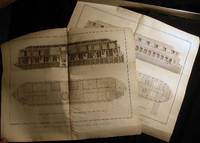
177225506European Origin: Various 1772. These two plates only from the Encyclopedie of Diderot; depicts the public bathing facilities with women's and men's sections. Approx. 15 1/2" x 18 1/2" size overall; double-page plates. Old center-fold lines; light edge tips wear couple of tiny spots; top corner chipped away a little; in very good condition. Art. Not Bound. Very Good. Various paperback books
1735D6963Venice: ex Typographia Balleoniana 1735. Hardcover. Very Good. Folio 375 x 240mm. xxiv 572pp. 4 208pp. Title in red and black with ornamental device of the muses. Diagrams interspersed numerous ornamental initials and head-and tail-pieces. Preface by Jacopo Grando. Contemporary vellum lacking plate joints splitting intermittent foxing. Ownership inscription A. Docinelli A. M. D. 1864 on title and also Di Giorgio Bonelli da Mondovi. P.P. Pictorial wood-engraved ex-libris by Leo Wyatt for Lord Norwich on pastedown. <br/><br/>Complete medical works of Rivière. The complete medical works of Lazare Rivière 1589-1655 professor at Montpellier consists of the Institutiones medicae together with the Praxeos medicae and an additional 17 parts on the head the sense organs the teeth the thorax and abdomen the joints womens illnesses and fevers. Also included are 400 observations by the author approximately 250 communicated to him by fellow physicians and finally the Arcana a collection of secrets giving the chemical formulae for a large number of preparations together with their medicinal properties. At the end separately paginated is added a treatise on the symptoms cause and cure of respiratory problems by Fabrizio Bartoletti 1586-1630. Rivière was the first to introduce the therapy of using metallic compounds internally known as the spagiric or paracelsian-specific method and the first to note aortic constriction. Rivières work was instrumental in the French Renaissance of medicine. ex Typographia Balleoniana hardcover books
179138981791. 13 x 9 inches. Dark brown body colour on prepared paper. Inscribed "N.2.Stück" and "am 9ten Aprill 1791--nach der Natur gezeichnet von JEW" ink collector's stamp "Linel-Smlg. No." followed by pencilled number "1046" all on verso. Provenance: Linel ink collector's stamp on verso.<br/> <br/>A high quality image that clearly is drawn from life as the inscription claims. The artist's use of a dark prepared ground recalls the work of Barbara Regina Dietsch and her family. A search of Nissen's index of artists reveals one possible name: the Swiss artist Johann Emmanuel Wyss 1782-1837. However the maturity and assurance shown in the present drawing would seem to rule him out: he could have been no older than nine in April 1791. unknown books
179227105A Gand: Chez P.F. De Goesin Imprimeur De Sa Majeste Pour Le Comte De Flandre 1792. 2 1 blank 2 161 1 pages. With two folding charts of temperature measurements and of the length of time of previous ice ages. Text in French; as is also a bound-in manuscript note in ink regarding a meteorological observation made 1798-99; not signed. Contents regarding the historical progression of ice ages and theories of their prediction and periodicity. Title page with the small oval stamp 'Ex Libris de Cayrol': collector Louis Nicolas Jean Joachim de Cayrol 1775-1859 French political & military figure; also with small previous owner stamp of collector George R. Brush; M.D. in the U.S. Navy; a surgeon & medical inspector from 1861-1894. Volume approx. 5 1/4" x 8 3/4" size. bound in marbled paper covered boards red textured cloth spine; gilt spine titles marbled endpapers. Some edge tips wear & rubbing to the binding; couple of tiny chips to the surface of the spine cloth; a few leaves with dampstain in bottom gutter; in very good condition. First Edition. Hard Cover. Very Good. Chez P.F. De Goesin, Imprimeur De Sa Majeste, Pour Le Comte De Flandre hardcover books
172026935Lugduni Batavorum: Samuelem Luchtmans 1720. 64 215 57 pages; title page printed in red & black; a few woodcut initial ornaments & tailpieces; Latin text throughout. Title page with the small previous ownership stamp of collector Dr. George R. Brush U.S. Navy; served as a surgeon and medical inspector from 1861-1894. Approx. 5" x 7 1/2" size; bound in green marbled cover boards dark green morocco leather spine gilt decorated and with gilt spine titles; marbled endpapers. Some edge tips wear and rubbing to the cover base of spine covering scraped; contents fresh and clean and in very good condition. First Edition. Illustration. Very Good. Samuelem Luchtmans paperback books
1744D4448France 1744. Hardcover. Very Good. Manuscript book on paper in French. c.1744. 8vo 166 x 106mm. 8 355pp. written in brown ink in a clear humanist script with some calligraphic aspects between framed pages in a single column of approximately 28 lines headings in Roman majuscules. With 89 full-page diagrams and technical illustrations of sundial construction and usage and other supporting images three are on plates and two of which are folding at rear. Contemporary mottled calf spine gilt in compartments labeled Gnomonique on gilt red morocco lettering piece marbled endpapers & edges; edges uniformly toned occasional stains; expertly rebacked preserving the original spine somewhat worn. Full contents listed on first 6 pages for this expertly executed and comprehensive compendium on the sundial. The objective of this manual is to enable the 18th century audience to understand the operating principle of sundials by describing the construction and manipulation of different forms of sundials including the planet-sundial moon-clock celestial houses-clock polar-clock ancient Babylonian and Jewish clocks as well as the construction of quadrants and astronomical tables. The suns position in the sky has always been an obvious means to keep track of time. The use of shadows of sticks cast by the sun were a natural means of indicating the time of day by the direction of the shadow and the time of year by its length. Although town squares began constructing clocks beginning somewhere in the 14th century sundials remained in the picture well into the 18th century. Mechanical clocks were expensive and could be found only in the most noble of homes. They were also more of a curiosity at first; most people still used their sundials or just estimated the time of day by the height of the sun in the sky. In 1777 when the French General Lafayette wanted to express his admiration for his ally and friend General George Washington during the American Revolution he chose a silver Explorer sundial as his gift. But by the close of the 18th century clocks and watches began to supersede sundials. They had one huge advantage- they worked all day long and were not dependent on weather. However they were also notoriously unreliable- telling time only approximately within an hour and needing to be reset frequently of course with the help of a sundial. Although the work of this study is anonymous an ownership entry at the foot of the title helps to date the work: Hic est Thorridon Rectoris Laurentii Moussault 1744. This wide-ranging study of the sundial appears at a time when the mechanical clock was on its way into popular fashion. A unique scholarly work that may well be one of the last close studies of such an ancient and important time-telling tool. <br/><br/> hardcover books
175727045Venetiis: Laurentium Basilium 1757. 22 536; 591-621 pagination mis-numbered content consecutive 1 pages Catalogus Laurentium Basilium. Frontispiece portrait illustration of the author; woodcut title chapter & tailpiece ornaments. Latin text with occasional Greek. The works of Hermann Boerhaave 1668 - 1738 Dutch physician associated with the Univ. of Leiden; appointed ".the chair of practical medicine and in this capacity he had the merit of introducing the modern system of clinical instruction. Four years later he was appointed also to the chair of chemistry." see Encyc. Brit. 11th ed. Including: Institutiones medicae; Aphorismi de cognoscendis et curandis morbis; Libellus de materie medica; De lue aphrodisiaca sive venerea; Atrocis nec descripti prius morbi historia; Atrocis rarissimique morbi historia altera; De fabrica glandularum in corpore humano; De mercurio experimenta; Orationes octo; De utilitate explorandorum in aegris excrementorum ut signorum; Introductio in praxin clinicam; Praelectiones de calculo; De distinctione mentis a corpore; Horti Ludguno-Batavi descriptio. Title page with the owner name-stamp of collector George R. Brush M.D. U.S. Navy; in service as a surgeon & medical inspector from 1861-1894 and with his small number-ticket on front endpaper. Approx. 7 1/4" x 9 1/2" size bound in later 19th century marbled-paper covered boards dark brown leather corners & spine gilt fleuron decorations & titles marbled endpapers. A little edge tips wear and rubbing to the binding; frontispiece illustration laid-down; first few leaves with a few tiny wormholes no loss to text; front endpapers with surface paper scrapes at bottom edges; an ink name below the portrait; block strongly bound; in very good condition. . First Edtion Thus. Leather. Very Good. Laurentium Basilium books
1701WRCLIT74727London: Printed by W. Norton for Edw. Pawlett 1701. 2267-3388pp. Small octavo. Contemporary black morocco elaborately decorated in blind with a variety of devices within ruled frames colorful pastepaper endleaves. Text framed in red. Extremities a bit rubbed some browning; a good copy the binding attractive and sound. An extract from Pawlett's edition of THE WHOLE DUTY OF MAN with separate title-leaf but with register and pagination contiguous with the larger work. ESTC locates one copy of the complete work at Cornell. The extraction and binding most likely represents a personal choice by the original purchaser for ease of use. ESTC N35761. Printed [by W. Norton] for Edw. Pawlett unknown books
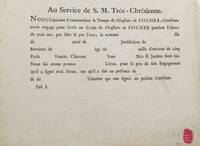
176028380France 1760. 1 vols. ca. 10 1/2 x 16 inches unfolded. Broadside. Folded some discoloration and marginal spotting else very good. 1 vols. ca. 10 1/2 x 16 inches unfolded. An unaccomplished form giving pertinent information including name son of native of jurisdiction of province of age that size is in the area of 5 feet hair eyes and that not and legs are well-made and the salary promised. unknown books
179728174Birmingham England 1797. Oblong quarto. 7 1/2 x 11 inches. 143 engraved plates 13 folding on laid paper priced throughout in manuscript. Period calf-backed marbled paper covered boards<br/> <br/>Provenance: W. G. & Co. inscription on front endpaper<br/> <br/>A rarely encountered pattern book or trade catalogue of 18th century English furniture hardware including drawer pulls keyholes hinges locks castors bolts watch stands and more.<br/> <br/>By 1770 over thirty different brass foundries operated in Birmingham England making it the epicenter of furniture hardware design in the last quarter of the 18th century. At roughly the same period trade catalogues like the present began to be issued by both furniture and hardware makers alike. Although most of the brass foundry trade catalogues of this early period have no indication of the foundry the present pattern book is inscribed W. G. & Co. on the front pastedown. In all nearly 1000 designs are shown on the 143 plates from rather simple hinges and hooks to incredibly ornate pulls knockers watchstands etc. Although no engravers's names are identified it has been suggested that the foundries themselves produced such plates utilizing the talents of their own craftsmen who by their very occupation would have been highly skilled at etching on metal. Such pattern books "illustrate the beginning of what was then a new movement in the conditions of the crafts namely the growth of the organised factory as a means of production and distribution as compared with the earlier limitation of these functions to the efforts of individuals" Young.<br/> <br/>Cf. Hummel Charles F. "Samuel Rowland Fishers Catalogue of English Hardware." Winterthur Portfolio Vol 1 1964: 188-197; cf. Symonds R. W. "An Eighteenth-Century English Brassfounders Catalogue." Magazine Antiques Feb. 1931: 102-105; Young W. A. comp. Old English pattern books of the metal trades: a descriptive catalogue of the collection in the V&A Museum. London: HMSO 1913. unknown books
1709JC14459Amsterdam: Ex officina Wetsteniana 1709. Hardcover. Very Good. Small 4to 200 x 155mm. 32 index 728pp. Signatures: 1star-4star4 A-Z4 Aa-Zz4 Aaa-Zzz4 Aaaa-Yyyy4. Full-page engraved half-title of scene of busy hospital room with patients reclining in beds in background and ailing patient treated by group of physicians with herbs and bottled medicines. Title printed in red and black. Preface by Swiss editor and physician Johann Conrad Amman 1669-1724. Period half vellum blind stamped with arabesque to covers backed in calf of gilt-stamped spine with red morocco lettering label: AURELIANI DE MORBIS; binding slightly rubbed with few spots internally clean and complete. <br/><br/>Though Caelius Aurelius was a Latin translator of ancient Greek medical manuscripts philologists often discuss his work as if he was the original author. He was born in Sicca Numidia now in Algeria with a dubious start but almost certainly flourished as a Greco-Roman physician in the mid-fifth century. Caelius Aurelius is known by his Latin medical writings especially this translation of a now lost Greek medical textbook on diseases written by Soran of Ephesos and titled De Morbis Acutis & Chronicis or On Acute and Chronic Diseases. Both authors are considered to be the primary representatives of the secta methodici or Methodist school a Greek school of medicine whose texts gave access to and crucially reconstructed the rich medical teachings of the ancient world. The work De Morbis Acutis & Chronicis consists of two parts. The first part deals with fourteen acute diseases in three books and the second consists of five books and covers forty-four chronic diseases. This is widely regarded as the best edition of the Caelius Aureliuss work edited by Johann Conrad Amman and published in Amsterdam by Jacob de Wetstein in 1709; it was reprinted in 1722 1755 and 1759. This edition contains valuable annotations and a Lexicon Caelianum by the Dutch physician Theodorus Janssonius van Almeloveen 1657-1712. Aldus first published it in 1547 in a collection titled Medici Antiqui Omnes. This text is one of the most valuable in the field of pathology not only for describing a grant range of diseases including sections on psychiatry and neurology and their treatments famously prescribing sun-baths for chronic affections but that it also contains the foundation of contemporary Latin medical terminology rooted in the Greek language. Rare first edition far more common is the Amsterdam edition of 1722. Ex officina Wetsteniana hardcover books
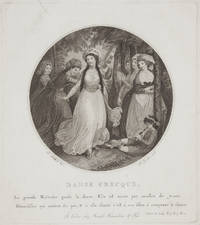
180029670Venise: Joseph Remondini & Fils 1800. 285 x 250 mm. wide margins. <br/><br/>A scene inspired by the letters of Lady May Wortley Montague 1689-1762 whose writings "address and challenge the hindering contemporary social attitudes towards women and their intellectual and social growth." Wikipedia. <br/><br/>Minor soiling.<br/><br/>A very good impression on laid paper. Rare. No copies located in the online catalogues of the Austrian National Library the Albertina the British Museum or the Victoria & Albert Museum. Joseph Remondini & Fils unknown books
1764KC8048Venice: Remondini 1764. Hardcover. Very Good. Folio 315 x 240mm. 38pp. I-XXXVIII. Finely printed with decorative chapter headings and tail-pieces. Engraved printerÂ’s device of Remondini depicting bishop with putti carrying crozier and miter. Engraved vignette of muses on dedication page. Decorative paper covered boards; some minor soiling or staining joint repaired on title verso lacking first and last blanks otherwise complete and in good form with good wide margins. <br/><br/>Collection of poetic essays in song of Sister Maria Theresa Crocefissa 1645-1699 an Augustinian nun from Venice known for her long orations printed by the Remondini press. In the 16th century Venice was the marketplace of the world. Its location on the lagoon and its unique connections with the sea distinguished it as a cosmopolitan center among the great cities of the Renaissance. In this larger context commerce and trade played a central role in the development and achievements of music printing. The subject of this work is poems written as canzones and sonettoes or songs and little songs of Sister Maria Crocefissa. From an early age Maria Crocefissa was devoted to long poetic orations. Soon she was also engaged in self-punitive actions including wearing a hairshirt. At the age of 23 she experienced her first religious ecstasies. During these periods of trance some lasting well over a week she regressed into a childlike state that left her completely paralyzed. The presence of Maria Crocefissa in her Augustinian convent of San Girolamo brought about a series of supernatural episodes and mysterious sightings which interested the public. While she was still alive her papers were widely published. This particular title of her poems addressed to Girolama Gaudio is of utmost rarity not located in a contemporary library collection or market worldwide. From the Remondini press who by the second half of the 18th century were employing more than a thousand people in the Bassano del Grappa with hundreds of others busy in their local paper mills and selling their products in scores of countries making them perhaps the biggest publishers in Europe. Between 1751 and 1790 Remondini were granted more licenses for books than all the other Venice booksellers put together. Printed matter was a luxury and the Remondini press was known to employ refined typographical features to suit the tastes of buyers. In this work attention is paid to the decorative elements initials and layout of each page. Remondini hardcover books
1755D200Madrid: En la Imprenta del Mercurio 1755. First Edition. Hardcover. Very Good. 4to 318 x 496mm. 23 331pp. Contemporary limp vellum; text block loose from vellum front-free endpaper inscribed with date 1788 and creased spine damaged hinges loose. First Edition. Trincados important history of the popes kings and emperors of Rome Constantinople Germany France England and of many Spanish regions including Aragon Castile León Navarra and Castile. The Compendio historic also includes a significant description of the famous conquistador Cortès 1485-1547. The text is dedicated to entrepreneur Juan Fernandez de Isla y Alvear 1709-1788 and the dedication lists the works of Don Juan. The introduction in the Compendio provides valuable information on the contemporary economic history of the region of Cantabria Included are mention of the foundation of the shipyard Guarnizo and the opening of roads in the province to bring wood to build ships and establish factories in china soap paper flour and brandy. This is the first of seven editions that came out in the second half of the 18th century. <br/><br/> En la Imprenta del Mercurio hardcover books
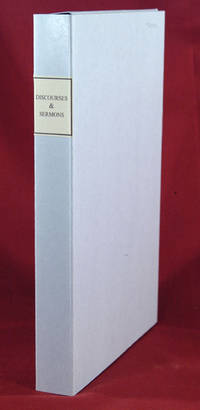
1796824001796. SERMONS AMERICAN - 18TH CENTURY A COLLECTION OF FIVE SERMONS INCLUDING A DIRGE AND A MONODY BY VARIOUS AUTHORS. All published in eastern Massachusetts Boston and Salem 1767-1796. Detailed descriptions of the sermons in this volume appear below. Small quarto: 21 cm. 175 pp. in total. Four of five half-titles are present. Early ownership of Charles Lowell in three of the sermons. Text leaves are mostly clean but for the last sermon which is lightly foxed and lightly toned throughout and the paper quality is very good overall. A few leaves in the first sermon show slight wear at the top-edge but nothing serious and one leaf has marginal loss at top fore-corner without loss of text. In a handsome modern binding of marbled boards with a black calf shelfback in fine condition. TUCKER John. Ministers of the Gospel as spiritual Guides to their people to be remembered by them after their Decease; and to their good Instructions and Example to be followed. Two discourses occasioned by the death of the Rev. Mr. John Lowell late pastor of the Congregational Church in Newbury-Port; who departed this life May 15th 1767. In the 64th year of his age. Delivered to the Christian society there on the Lord's Day June 7th after his decease. By John Tucker A. M. Pastor of the First Church in Newbury. Boston New-England: Printed by Thomas & John Fleet for Bulkeley Emerson of Newbury-Port 1767. 36 pp. Ownership of Charles Lowell in pencil on half-title and in ink on title-page. Evans 10791 Sabin 97317. THACHER Peter and Thomas Welsh. A Sermon Preached at Charlestown June 19 1796 and occasioned by the sudden death of the Honourable Nathaniel Gorham Esquire aet. 59. By Peter Thacher D.D. Minister of a Church in Boston. And An Eulogy Delivered June 29 1796 at the Meeting-House in Charlestown in the Commonwealth of Massachusetts in memory of the Honourable Nathaniel Gorham Esquire who died June 11 1796. By Doctor Thomas Welsh Member of the American Academy of Arts and Sciences and Fellow of the Massachusetts Medical Society. Boston: Printed by Samuel Hall. 1796. 251151 pp. The final page is a "A Dirge to the Memory of the Honourable Nathaniel Gorham Esq. by the Rev. Thaddeus Mason Harris set to Music by Mr. Olifer Holden" printing only the lyrics but no. unknown books
1780SAV109Paris: Imprimerie de Didot l'aîné collection d'auteurs français pour Monseigneur le Comte d'Artois 1780. Hardcover. Good. 1780-1781. Sixteen volumes pocket 18mo 133 x 74mm. Printed on fine laid paper. Uniformly bound in contemporary mottled French calf ruled in gilt with olive morocco lettering labels marbled endpapers gilt edges. This beautiful miniature set was executed at the solitary expense of the Count d'Artois 1757-1830 later Charles X of France and numbered in full 64 volumes; the aim of which collected various sets of French works in verse and prose. Influential Enlightenment writers were thus compiled here many of them French female authors and limited to an overall printing of 100 copies by the famed printer Didot of Paris. Consisting: 1 DE LA FAYETTE Madame 1634-1693. "Zayde." 1780. 3 vols. 156 135 and 166pp. A classic novel with stories on the political social and cultural communities of early modern Spain. 2 DAUCORT Claude Godard d'Aucour 1768-1826. "Le Berceau de la France." 1780. 2 vols. 175 and 152pp. Rare first published in 1744 as a history of French civilization. 3 RICCOBONI Marie-Jeanne 1714-1792. "l'Histoire d'Aloïse de Livarot." 1780. 77pp. 4RICCOBONI Marie-Jeanne 1714-1792. "Les Amours de Roger et de Gertrude." 1780. 79pp. 5 DUCLOS Charles Pinot 1704-1772. “Ismene and Ismenias. Roman Grec." 1780. 115pp. 6 TRESSAN Comte de 1705-1783. "Le Prince Gerard Comte de Nevers et la Belle Euriant sa mie." 1780. 171pp. 7 TRESSAN Comte de 1705-1783. "Histoire du petit Jehan de Saint." 1780. 182pp. 8TRESSAN Comte de 1705-1783. "Histoire de Tristan de Léonois." 1781. 212pp.9 DUCLOS Charles Pinot 1704-1772. "Confessions du comte de ." 1781. 2 vols. 129 and 128pp. First published in 1742 a popular "portrait gallery" of the illustrious French. 10 TENCIN Claudine Guérin de 1682-1749. "Le Siege de Calais.” 1781. 2 vols. 122 and 126pp. First published anonymously in 1739. 11ARNAUD François-Thomas-Marie de Baculard d' 1718-1805. “Sargines.” 1781. 130pp. Good. Only light edgewear and some bumped corners slightest spots otherwise crisp and clean interior. The Count d'Artois friend to Marie Antoinette and lover of the arts sought to stimulate a renewal in fiction with the printing of this collection of novels in 35 titles. The overall collection of 64 volumes was printed from 1781 to 1784 and edited by the order of Louis XVI. Just two years later the French monarchy would be in crisis; bankrupt and facing various political upheavals in the years leading up to the Revolution. This surviving set dates from the time of relative peace before upheaval and before the Count later reigned as Charles X in the post-Revolution era in 1824. These survive as early relics of the French monarch's cultural interests and endeavors. François-Ambroise Didot printed no more than 100 copies as a whole impression; 60 with the arms of the prince and at least 40 were on common paper without the Count’s heraldry as in these while others were produced on vellum See Ebert 4938. These works are extremely neatly printed on laid paper and stand as a precursor to Didot’s prolific typographic and printing career. Complete copies of the Count d’Artois’s collection are of utmost rarity; these portative sixteen make up an excellent union. Brunet 19413. <br/><br/>The Count d'Artois friend to Marie Antoinette and lover of the arts sought to stimulate a renewal in fiction with the printing of this collection of novels in 35 titles. The overall collection of 64 volumes was printed from 1781 to 1784 and edited by the order of Louis XVI. Just two years later the French monarchy would be in crisis; bankrupt and facing various political upheavals in the years leading up to the Revolution. This surviving set dates from the time of relative peace before upheaval and before the Count later reigned as Charles X in the post-Revolution era in 1824. These survive as early relics of the French monarch's cultural interests and endeavors. François-Ambroise Didot printed no more than 100 copies as a whole impression; 60 with the arms of the prince and at least 40 were on common paper without the Count’s heraldry as in these while others were produced on vellum See Ebert 4938. These works are extremely neatly printed on laid paper and stand as a precursor to Didot’s prolific typographic and printing career. Complete copies of the Count d’Artois’s collection are of utmost rarity; these portative sixteen make up an excellent union. Brunet 19413. Imprimerie de Didot l'aîné (collection d'auteurs français pour Monseigneur le Comte d'Artois) hardcover books