ANCILLON, Charles. (eunuques)MareMagnum

10 résultats
In 12mo (cm. 14,9); legatura del ’900 in marocchino blu/viola a 4 nervi con tit. e data in oro al dorso; pp. (20) 187 (1) mal numerate (163). Margine superiore un po’ corto. Dedicato a Mr. Bayle da C. D’Ollincan (anagramma di C. Ancillon). Barbier,IV p. 780. Gay, III, p. 1239. PRIMA edizione.
90821Vigot Frères, Coll. les Perversions Sexuelles, 1908, 295 p., broché, haut et bas du dos légèrement émoussés, dos en partie décollé, intérieur propre.
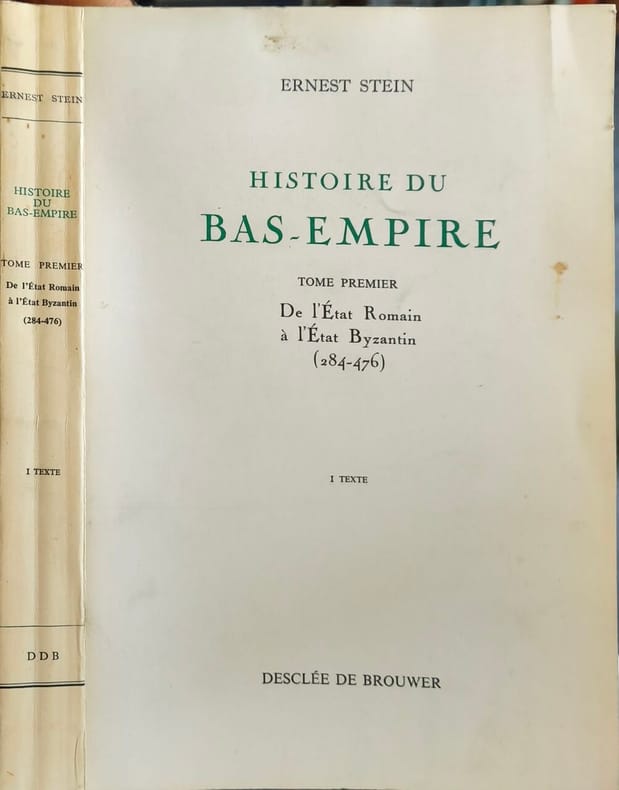
195916654Desclée de Brouwer 1959 406 pages in8. 1959. broché. 406 pages. L'ouvrage en deux volumes d'Ernest Stein publié chez Desclée de Brouwer en 1959 offre une analyse approfondie du Bas-Empire romain et de l'Empire byzantin. Il est fréquemment cité dans des travaux académiques sur l'Antiquité tardive notamment pour ses études sur les eunuques et la situation linguistique après la conquête
49063Nouvelle série - 2e année - N° 38 - 22 août 1923 - Journal illustrée - Paraît le mercredi - Format journal de 6 pages
198075936Stuttgart : Klett-Cotta 1980. 236 S. ; 24 cm Leinen 0
198216862Reinbek, Rowohlt, 1982. Broschur, 8°, 317 S.; -leicht berieben, Papier gebräunt, gutes Exemplar.
20141034393Würzburg : Ergon, 2014. 390 S. Originalbroschur.
1846136638Paris, Paulin, 1846. VI, 471 Seiten. 16 cm. Leinenband der Zeit mit blindgeprägtem Supralibros.
Very Good Turkish, Ottoman (1500-1928) Original manuscript document signed and sealed with stamps and 'pençe' on a special paper with 'akhar'. (Period value is '3 gurush'). 38x27 cm. In Ottoman script (Turkish with Arabic letters). 1 p. Repaired with tape on the verso. Text in Turkish "Haremeyn-i Muhteremeyn hazine-i behiyyesine mazbut evkaftan Sehzade Sultan Mehmed tabeserah hazretlerinin evkaf-i serifeleri müstagalatindan Üssküdar muzafaatindan Kartal nahiyyesine tabi Heybeliada'da kâin yeldegirmeni hakkinda.". It includes waqf processing in the early westernization period of the Ottoman Empire related to a windmill in Halki Island and an Armenian citizen who was its last owner. It's processed from 1275 to 1277 [1856-1858 AD]. Armenian annotations on verso. Signed with 'pençe' has no 'Beyze' ad 'Keshide' in its calligraphic style 'Muzaffer' [i.e. Triumphant]. The Kizlar Agasi (qizlar aghasi, literally, Agha of the girls), was the chief eunuch off th Ottoman Imperial harem. Although the title may have been applied to the head of the palace harem eunuchs from the empire's early years, the formal office, known as The agha-yi Darüssaade (or, Dar al-Sa'ada), literally "Commander of the Abode Felicity", dates to 996/1588, when Sultan Murad III (r. 1574-1595) transferred the supervision of the Evkâfü'l-Haremeyn (Awkâf al-Haramayn, the imperial pious foundations for the Muslim holy cities of Mecca and Medina) to the head of harem eunuchs from the chief of the eunuchs who guarded the sultan's privy chamber in Topkapi Palace's third court. Until the 14th/19th century, the post was always attached to the supervision of the Evkâfü'l-Haremeyn. Most holders of the office, like most harem eunuchs generally, were Habesî (Habashi, Abyssinian), which in this case was a broad designation encompassing much of the Horn of Africa. (Source: Brill, Encyclopedia of Islam). In the 19th century, agha-yi darussade worked on waqf works.