446 résultats
15763Paris, Plon (coll. "Le roman des grandes existences"), 1927. In-8°, 283p. Broché.
5261P., Plon (Collection "Le Roman des Grandes Existence"), 1927, in 12, broché, V-283 pages
55028P., Plon (Collection "Le Roman des Grandes Existence"), 1927, in 12, broché, V-283 pages ; des rousseurs ; couvetrure fanée.
190966487Lucien Gougy, éditeur 1909 In-8, reliure demi-chagrin cerise, dos à nerfs ornés de roulettes dorées, 45 pp. Coin de pied coupé en pages de garde, intérieur très frais. Exemplaire bien relié.
179543413Maret, an III 1795 Petit in-8, plein veau ép., dos lisse, filets dorés, 408 pp. Quelques rousseurs, brunissures et effrangements. Coiffe arrachée en pied, coins un peu émoussés. Bon exemplaire.
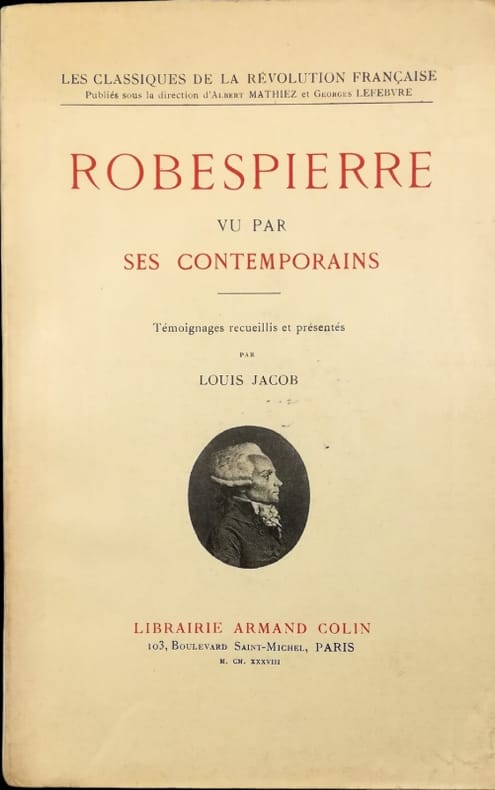
19382307Armand Colin, 1938, in-8°, 225 pp, index, broché, un portrait en médaillon au 1er plat, bon état (Coll. Les Classiques de la Révolution française)
1946210901946 Paris, NRF, Gallimard (Collection "Leurs figures"), 1946, fort in 8° broché, 763 pages ; couverture illustrée en couleurs.
39218P., Nilsson, 1932, in 12 broché, 125 pages.
43348P., Club Français du Livre, 1956, in 8° reliure pleine toile brique de léditeur, 318 pages ; illustrations hors-texte ; complet de la planche dépliante de carte.
46823Genève, Editions Vernoy, 1979, petit in 8° reliure simili maroquin de léditeur, jaquette illustrée, 405 pages ; illustrations hors-texte.
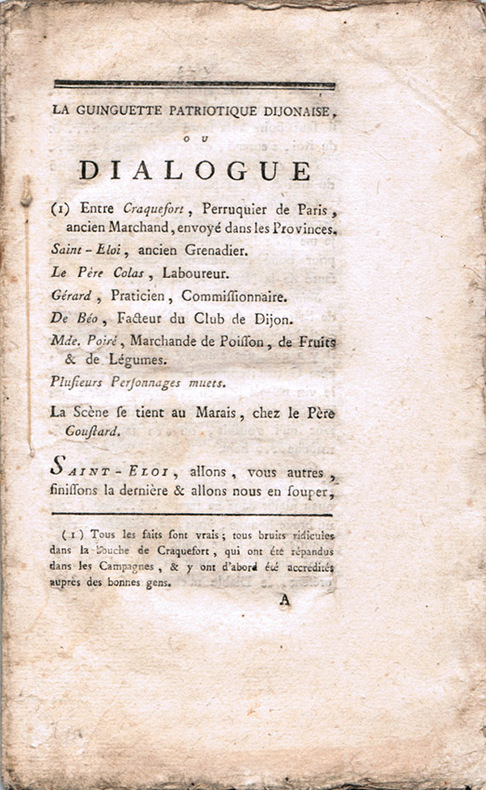
179122131791 Sl [Dijon], sn, sd [1791 ?]. 22 x 13,5 cm, in-8, 38 pp. - 1 f. bl., 3 cahiers cousus sans couverture, tel que paru.
1795639451795 Paris, Imprimerie Nationale des Lois, an IIIe de la République [1795], in 8°relié demi-veau fauve, dos lisse orné, 408 pages ; plats cartonnés légèrement frottés.
1851GF206621851 Lithographie en noir et bistre - Format 18,5 x 12 cm environ sur une feuille de papier fort de 25,5 x 16 cm - Paris vers 1850 -
1987LFA-126739804N° 30 (Janvier 1987) 66 pages, format 205 x 285 mm, illustré, broché couverture couleurs, bon état
179224497Paris MERCURE FRANCAIS 1792 -in-12 broché un journal (original d'époque), broché blanc in-douze Editeur (paperback duodecimo editor)(19 x 11,5 cm), dos muet, couverture imprimée en noir (en partie manquante), brochure d'origine non rognée, texte imprimé sur papier vergé ligné et filigrané, sans illustrations (no illustration), manque de papier au dos sur la couverture, pagination (18ff. chiffrées de la page 1 à la page 36 et 36 ff. chiffrées de la page 1 à la page 72, Journal du samedi 6 Octobre 1792 (n°40) Paris MERCURE FRANCAIS Editeur,
179224502Paris MERCURE FRANCAIS 1792 -in-12 broché un journal (original d'époque), broché blanc in-douze Editeur (paperback duodecimo editor)(19 x 11,5 cm), dos muet, couverture imprimée en noir (manquante), brochure d'origine non rognée, texte imprimé sur papier velin ligné et filigrané, sans illustrations (no illustration), traces de mouillures claires, pagination (12ff. chiffrées de la page 25 à la page 48 et 36 ff. chiffrées de la page 73 à la page 144, Journal du samedi 10 Novembre 1792 (n°45) Paris MERCURE FRANCAIS Editeur,
1837641Mit Beziehung auf die neueste Zeit dargestellt von einem Wahrheitsfreunde. Leipzig, F. A. Brockhaus, 1837. 8°. XVI, 212 S., 1 Bl. Eingehängt in einen alten Halblederband mit goldgeprägtem Rückentitel.
200816531Paris, Jes compagny, 1987 ; in-4, 48 pp., cartonnage de l'éditeur. Eo éraflure des coin.
1245915940.Gpaperback. Good. Access codes and supplements are not guaranteed with used items. May be an ex-library book. paperback
18377829ALeipzig, F. A. Brockhaus, 1837. XVI Seiten, 212 (2) Seiten. Pappband der Zeit.
198757921987 Bologna, Editrice CLUEB, 1987. Atti della ricerca sulla Letteratura Francese della Rivoluzione, diretta da Ruggero Campagnoli. Secondo Seminarion Internazionale, 5-8 novembre 1986. In-8 broché, 355 pp. Articles EN ITALIEN et EN FRANCAIS. Ex dono sur la première page. Bon état.
10649Caen. Le Roy. An III. 1 vol. in-8, demi-maroquin vert, dos lisse orné. [2] ff. ; XVI pp. ; 116 pp.
179418583Paris: de l'Imprimerie Nationale 1794. 8vo. Disbound. 6 pages. 8vo. In an effort to combat atheism Robespierre and others of the National Convention scheduled a Fête de l'Être Suprême on 8 June 1794 the culmination of which was to be the symbolic destruction of the statue of Atheism by fire and the emergence of Wisdom from the remains. Unfortunately the figure of Wisdom was so badly smeared in soot that the audience laughed. This was his speech to inspire the people and to assure them of the Supreme Being and of his support of their notable cause. M & W IV 29526-40 de l'Imprimerie Nationale unknown
18575Paris: de l'Iprimerie de Pierre-Jacques Duplain. 8vo. Disbound. 32 pages. 8vo. Robespierre's very strong speech denouncing actions of the Convention and speaking of the role of slander in the Revolution and expounding on the need for the Revolution. A speech given to the Société des Amis de la Liberté et de l'Egalité formerly the Brissotins now the Jacobins the 29 October 1792 in Paris whose president was Danton vice president-LaFaye; deputies Le Peletier and Bentabole and Le Fort Moernne and Simonne as secretaries. M & W IV 29526-64 de l'Iprimerie de Pierre-Jacques Duplain unknown
179018573Paris: De l'Imprimerie de L. Potier de Lille 1790. 8vo. Disbound. 19 pages. 8vo. Following Robespierre's election in 1789 a strong campagne to discredit and denigrate Robespierre in the eyes of the populace that had elected him took place. It was quite effective and Robespierre was even warned not to return to his area for fear of physical attack. This campagne was credited a great deal to Brios de Beaumetz the elder in the Council of Artois and his son also Brios de Beaumetz a member of the Assembly with Robespierre. Robespierre decided that these attacks should not go unanswered and the present pamphlet is part of the response. He was strongly attacked for a comment saying that most of the people of Artois did not pay enough taxes. This was picked up by Beaumetz and widely circulated causing great discord and greater loss of popularity. What this related to was the decision of the Assembly in October 1789 to adopt conditions for being a candidate for election or an elector and basing it upon the amount of direct tax paid by the individual. Robespierre had pointed out that only the rich in Artois paid direct taxes and the most of the population there paid duty or indirect taxes and would therefore be excluded from the electoral process. This is explained in this pamphlet which includes a letter of good conduct by other Artois delegates to the Assembly Fleury Du Buisson Boucher Payen de Croix Brassart and Charles de Lameth. M & W IV 29526-18 De l'Imprimerie de L. Potier de Lille unknown