1 682 résultats
1756018550Avignon 1756-58. Quattro parti in cinque volumi in 12°. Mezza pelle del tempo. Dorso a nervi ornato e dorato doppio tassello di titolo e tomagione. Paginazioni: Vol 1: 431pp.-1. Frontespizio inciso. Vol 2: 578pp.-1. Vol 3: 577pp.-1. Vol 4: 8-285pp. Vol 5: 2-313pp-1-150pp. 7pp numerate 145-150 e una per Fautes à corriger che ripetono con modifiche le ultime 7pp del testo. Prima edizione in 12° dello stesso anno di quella in 4° delle prime quattro parti dellopera fondamentale del movimento fisiocratico. Una 5° e 6° parte vennero poi pubblicate nel 1760. Eccezionale la presenza al termine della quarta parte Questions interessantes. delle pagine di modifica del testo pagg. 145-150 che ad opera del legatore o nelle tirature successive sono quasi sempre integrate sopprimendo le ultime sei pagine dello stampato originale. unknown
1901111025948WASHINGTON & LONDON: M. WALTER DUNNE PUBLISHER 1901. Book. Very Good. Hardcover. 8vo - over 7¾ - 9¾" tall. Green cover with paper title on spine and gilt top edge. Gutter binding crack at the copyright page. Some soil on the rear cover and light soil on the rear endpapers. 385 pages. M. WALTER DUNNE, PUBLISHER Hardcover
59276Avignon 1756 edition originale In-4 vi-156-218-216pp. grande vignette gravee en frontispice errata in-fine quelques rares rousseurs reliure plein veau de l'epoque dos orne a nerfs avec piece de titre Nb-0308 unknown
1792CLL-389Paris, Le Jay, 1792 In-8 de (2) ff., 174 pp., (1) f., maroquin rouge, encadrements de filets dorés sur les plats avec fleurons aux angles, dos à nerfs orné de caissons de fleurons dorés, coupes et bordures décorées, tranches dorées (Andrieux).
178385830De l'imprimerie du Vatican | Rome [Neuchâtel] 1783 | 13 x 20.70 cm | relié
21930Bruxelles 1785 in 8 (20,5x13,5) 1 volume reliure plein veau moucheté fauve de l'époque, dos à nerfs très orné, pièce de titre de maroquin rouge, tranches teintées rouge, faux-titre, titre, 117 pages. Relié à la suite du même: 1°/ DOUTES SUR LA LIBERTÉ DE L'ESCAUT, Réclamée à l'Empereur; sur les Causes et les Conséquences probables de cette Réclamation (Londres, Chez G. Faden [1785]) VI et 168 pages, XL, et carte gravée dépliante. Relié à la suite du même: 2°/ LETTRE REMISE A FRÉDÉRIC-GUILLAUME II, Roi régnant de Prusse, Le jour de son Avénement au Trône (Berlin, 1787) 50 pages. Relié à la suite du même: 3°/ LETTRE SUR L'INVASION DES PROVINCES-UNIES, A M. le Comte de Mirabeau, et sa réponse (Bruxelles, 1787) 16 pages. Très bel exemplaire ( Photographies sur demande / We can send pictures of this book on simple request )
16010Berlin, s.n., 1787 [suivi de: ] Londres, s.n., 1787. In-8, 91-304 pp., veau marbré brun de l'époque, dos lisse orné de caissons dorés, pièce de titre rouge, tranches rouges (épidermures, coiffe supérieure manquante, petites rousseurs de la page de titre).
17880046951788 Londres, sans nom d'éditeur, 1788. Fort volume in-quarto (216 X 270 mm) basane fauve marbrée, dos cinq nerfs filetés, caissons dorés ornés, guirlandes dorées en queue et tête, pièce de titre maroquin grenat, coupes et coifes filetées, tranches rouges (reliure de l'époque) ; (2) ff. de titre et avis des éditeurs, 424 pages, 93 planches. Epidermures sur les plats,
1760EIRéo[MI72Paris: 1760. 1760. 12mo. pp. vi 426 2. modern bds. Published the same year as the first edition in quarto format. Mirabeau's strong criticisms of French methods of finance and taxation in this work particularly his attacks on the tax-farmers led to his temporary imprisonment and banishment from Paris. "It is not as might be supposed a mere plea for the Impôt Unique. It proposes a reorganization of financial administrative machinery the abolition of the Fermes a reduction in taxation upon salt with the object of increasing the total yield and a special tax upon tobacco farms. The Domaine the post and the Mint were to be further sources of revenue. Many just and valuable remarks on taxation are scattered throughout the volume and entitle the author to rank as one of the earliest important writers on the subject." Palgrave Einaudi 3946. Goldsmiths' 9603. Higgs 2298. Kress 5884. cfCioranescu II 45631. cfStourm pp. 100-101. cfTchemerzine VIII 285. Palgrave II pp. 774-78. F. [Paris]: 1760. unknown
17921266Paris, J.B. Garnery ; Strasbourg, Treuttel ; Londres, de Boffe ; 1792, an 3e de la liberté ; quatre tomes, in-8 ; plein veau moucheté bronze, dos lisses, faux nerfs de grecques dorées, fleurons dorés dans les caissons, pièces de titre de maroquin bordeaux et de tomaison sur pièces rondes du même cuir, cerclées d'un motif décoratif doré, triple filet doré d'encadrement sur les plats (reliure de l'époque) ; (2) ff., 44 pp. (Discours préliminaire), 436 pp. ; (2) ff., 452 pp. ; (2) ff., 600 pp. ; (2) ff., 356 pp., (2) ff. catalogue de Garnery, libraire et portrait gravé de Mirabeau en frontispice du T.I.
98096Rotterdam/ Paris 1789. 8vo. Engr. portrait 4 139; engr. portrait 4 viii 148;4 xv blank 127 pp. Stain in upper margins in part one and two paper repair p. 116 in part one. Contemporary half calf gilt spines with red labels and marbled paper boards red marbled edges. The two portrait are of Fredric II and Catharine the Great. Behind the first part is a new titelpage with â€Letters d’un voyageur anglois†behind the third part is â€Essai sur la secte des illuminés†by Jean Pierre Louis de Luchet or La Roche du Maine Marquis de Luchet with a separate extra title leaf. Several editions of both works were published in 1789 at least five of â€Essaiâ€. Mirabeau’s â€Histoire secrete†was first printed in Alençon and made a scandal and was banned immediately after its publication. In the present edition the half-title and the title pages to part one and two are printed on different paper than the rest probably a titel-auflage. Luchet 1740-92 was a French officer journalist and librarian. In ’Essai sur la Secte des Illumines’ â€he denounces the leaders of the Bavarian Illuminati whom he accused of controlling Freemasonryâ€. hardcover
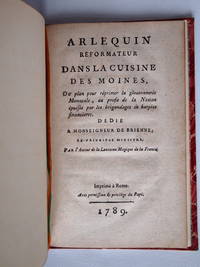
178956166Imprimé à Rome Rome: S. n. 1789. Fine. S. n. Imprimé à Rome Rome 1789 13 x 19 cm relié The rare first edition probably printed in Paris anonymously by Mirabeau according to the Bibliothèque Nationale de France. Half morocco binding in faded red with long grain from the late 19th century signed L. Lemardeley with a tool at head and tail gilt title rubbing the binding bears the title: Stephan Bordese - Blanc et bleu which indicates that the work has been rebound. Handsome copy. Avis charitable aux moines so that they enrich the state and population by ceasing their gluttony at the expense of the people. The author promises the different monastic orders a monument to their glory if they comply with his prayers. Anticlerical libel violently attacking the monks. Armorial bookplate: Rose. S. n. unknown
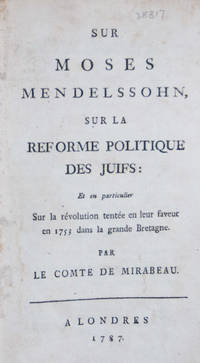
178738317London: NP 1787. First edition. Hardcover. g. Octavo. 68 130pp. Original spotted calf with gold lettering and tooling on spine. Marbled endpapers and paper edges. Decorative head- and tailpieces. Honoré Gabriel Riqueti comte de Mirabeau 1749-1791 was a leader of the early stages of the French revolution. A noble before 1789 Mirabeau was involved in numerous scandals that left his reputation in ruins. However during the early years 1789-91 of the French Revolution he rose to the top and became the voice of the people. A successful orator he was the leader of the moderate position favoring a constitutional monarchy built on the model of Great Britain. Mirabeau became interested in the Jewish question during his visits to Holland in 1776 England in 1784 and Prussia in 1786. Influenced by the enlightened members of the Jewish communities in the capitals of these three countries he was particularly attracted by the image of Moses Mendelssohn. In "Sur Moses Mendelssohn sur la réforme politique des Juifs" a book resulting from the author's journey Mirabeau argued that the faults of the Jews were those of their circumstances. Although his main reason for admiring Mendelssohn was that 'humanity and truth' seemed much clearer to him than 'the dark phantoms of the Talmudists' he did not consider Judaism an immoral faith and he defended it against attacks both old and new. In the course of his argument he repeated Christian Wilhelm von Dohm's assertion that 'the Jew is more of a man than he is a Jew'. Quoting from Turgot and Rousseau in support of his pro-Jewish arguments Mirabeau affirms that history proves that 'the Jews considered as men and as citizens were greatly corrupted only because they were denied their rights'. Like Dohm he advocated preserving some measure of Jewish autonomy a view he developed in his memorandum to Frederick the Great of Prussia "De la monarchie prussienne" 1788 but he envisaged it as a transitory phenomenon; the organized Jewish community would wither away and die as the Jews entered fully into the economic and social life of the majority. Mirabeau continued to work for the emancipation of the Jews as he saw it. In the debate of Dec. 24 1789 he denied Rewbell's assertion that 'they the Jews do not regard themselves as citizens' and followed Clermont-Tonnerre in stating that the very fact that the Jews were requesting equality was proof of their desire to cease being Jewish in any separatist way. Binding rebacked but retaining most of its original spine. Calf darkened and partly cracked along edges. Front hinge starting. Previous owner's annotation in Latin along outer margin of page 68. Text in French. Binding in overall fair interior in very good condition. Moses Mendelssohn 1729-1786 was a German Jewish philosopher to whose ideas the Haskalah the 'Jewish enlightenment' of the eighteenth and nineteenth centuries is indebted. Although himself a practicing orthodox Jew he has been referred to as the father of Reform Judaism. Born to a poor Jewish family in Dessau and originally destined for a rabbinical career Mendelssohn educated himself in German thought and literature and from his writings on philosophy and religion came to be regarded as a leading cultural figure of his time by both Christian and Jewish inhabitants of the Holy Roman Empire. <br /> <br /> Christian Wilhelm von Dohm 1751-1820 was a German historian and political writer. Although a Christian he was a staunch advocate for Jewish emancipation. In 1781 at the suggestion of his friend Moses Mendelssohn Dohm published a two-volume work entitled "Über die Bürgerliche Verbesserung der Juden" On the Civil Improvement of the Jews which argued for Jewish political equality on humanitarian grounds. It was widely praised by the Jewish communities in Berlin Halberstadt and Surinam. <br /> <br /> Stanislas Marie Adélaïde comte de Clermont-Tonnerre 1757-1792 was a French military officer and a politician during the French Revolution. He was twice elected president of the National Constituent Assembly where he advocated a moderate liberal policy especially in the matter of removing restrictions for the Jews and Protestants. NP hardcover
1787D19716London 1787. First Edition . Hardcover. Near Fine. London: 1787. Half red morocco with gilt spine and marbled paper over boards. The most notable titled rebel to espouse the cause of political liberty and to hold office in Revolutionary France Count Mirabeau was also among the most distinguished advocates of Jewish emancipation in his troubled country. In this book published two years before the fall of the Bastille he turns the blazing intensity of the Enlightenment on the views of Moses Mendelssohn a man he greatly admired. Mirabeau draws strong philosophical similarities between Mendelssohn in Prussia and another heroic iconoclast Thomas Jefferson in Virginia. <br /> <br /> <br/><br/> hardcover
1933140191933 Vincennes, Aux éditions du Donjon, s.d. [P., Maurice Duflou, 1933], 1 vol. petit in-8° (205 x 142 mm) broché sous couverture vert pâle rempliée, imprimée en vert, de 170 pp. (1) f. (justificatif). Dos légèrement plissé, rares taches pâles marginales, bel exemplaire.
243837A Amsterdam et se trouve à Paris, chez Lacombe, 1769 2 parties en 2 vol. in-12, VIII-XVI pp., 366 pp. et (2)-387 pp., basane fauve, dos à nerfs orné, tranches cailloutées (reliure de l'époque). Mouillure au tome, travail de ver dans le même volume, qqs épid., coins usés.
1558Aix ; Rome [fausse adresse] ; s. l. ; Berlin [Paris] ; Nancy ; s. l. ; s. l. ; Amsterdam [Paris] : chez la veuve J. David, & E. David, imprimeurs ; apud Laurentem Carabioni, in via Sancta [fausse adresse] ; s. n. ; aux dépens de la compagnie ; chez les héritiers de N. Baltazard, imprimeur-librairie du Collège ; s. n. ; s. n. ; chez Abraham Root, 1765 ; 1750 ; 1755 ; 1751 ; s. d. ; 1716 ; s. d. (1764) ; 1765. TRÈS HUMBLES REMONTRANCES AU ROI ET À VOLTAIRE
HIS203MTome 1 : Avec un frontispice de Frédéric Le Grand : 1788 / 431 pages. Tome 2 : 1788 / 320 pages. Tome 3 : 1788 / 484 pages. Tome 4 : 1ere Partie : 1788 / 356 pages. Tome 4 : 2eme Partie : 1788 / 637 pages. Tome 5 : 1788 / 423 pages. Tome 6 : 1788 / 535 pages. Tome 7 : 1788 / 451 pages. Reliés Veau marbré d'époque. Editions
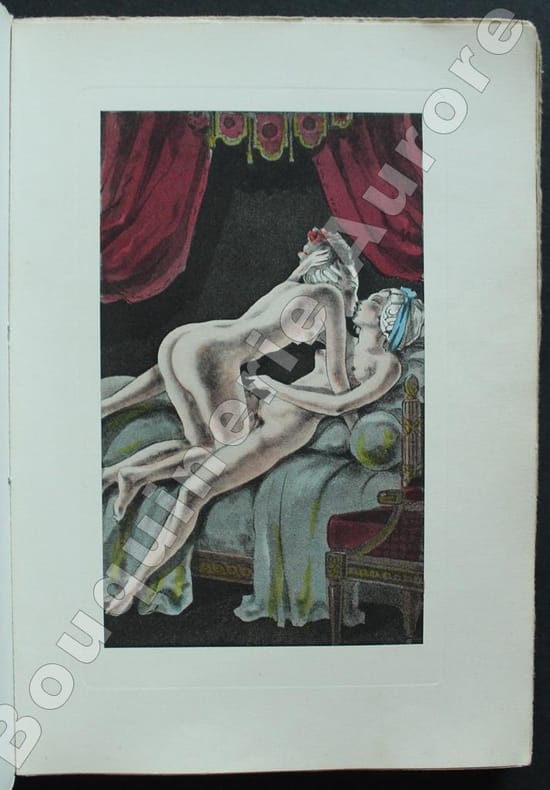
1950111689Sans lieu Aux Editions du Priape d'argent [Vialetay] 1950 circa 1 vol. en feuilles in-4, en feuilles, couverture rempliée, chemise et étui, 116 + (4) pp. Premier tirage de cette illustration érotique comprenant 12 gravures coloriées attribuées à Suzanne Ballivet. Un des 24 exemplaires numérotés sur Rives à la forme, comprenant un croquis original, une suite en bistre sur Rives, une suite en noir sur Annam et une double suite des remarques. On joint 4 dessins amateurs en noir, libres et naïfs, dont 3 à double page (l'un ayant pour sujet Blanche-Neige et les sept nains). Etui légèrement fendillé, sans gravité. Sinon exemplaire en bonne condition. Dutel, 2333.
20483Paris, A. Auffray et A. Guyot puis Delaunay, 1834-1835. 8 vol. in-8, XX-439 pp. 2 pl. + III-417 pp. 3 pl. + VII-479 pp. + VII-506 pp. 1 pl. + IV-423 pp. + VII-456 pp. + VII-430 pp. 1 pl. +VIII-624 pp., demi-basane havane, dos long orné de filets dorés et à froid, tranches mouchetées (épidermures, 6 mors fendus, quelques rousseurs et taches, pâle mouillure marginale au 4e vol.).
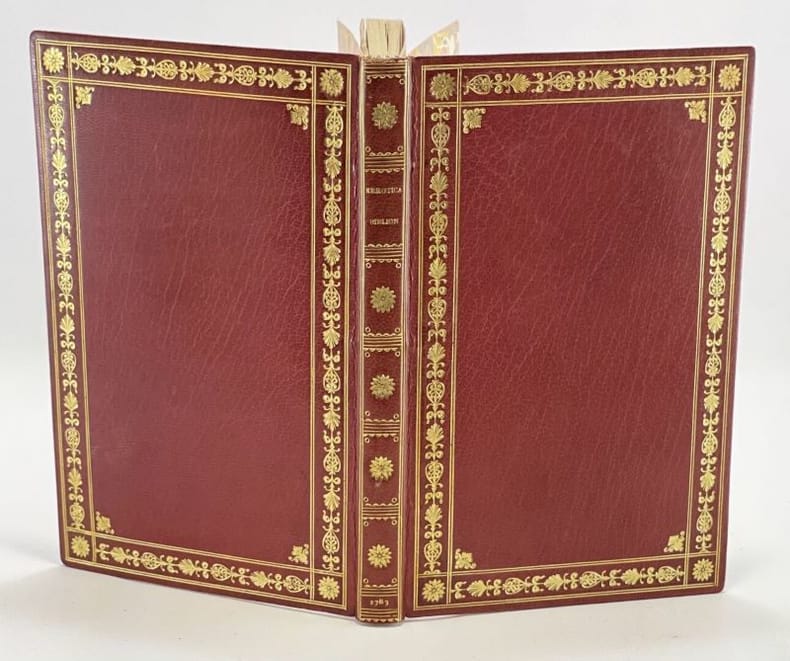
4494Rome, de l'imprimerie du Vatican, MDCCLXXXIII [1783]. 20,2 x 13 cm, iv-192 p. Relié, plein maroquin cerise poli, encadrements de filets doubles et motifs floraux sur les plats, dos lisse avec titre, millésime, jeu de filets et fleurons dorés, roulettes sur les coupes, contre-plats bordés du même cuir avec ornement de feuilles, toutes tranches dorées. Reliure signée G. Dubois d'Enghien. Contrefaçon en 192 pages de l'édition originale parue la même année, qui aurait été imprimée à Neuchâtel, le manuscrit original ayant été vendu à trois imprimeurs de cette ville qui le publièrent simultanément. Cet ouvrage fut rédigé par Mirabeau durant son emprisonnement au donjon de Vincennes entre 1777 et 1780. A Rome, l'ouvrage fut mis à l'index le 2 juillet 1794. Le décret qui le condamne en traduit le titre grec ainsi : Erotika Biblion, id est : Amatoria Bibliorum. L'Errotika Biblion est divisé en onze chapitres dont les titres sont masqués par des titres en hébreu ou en grec : Anagogie ; l'Anélytroïde ; l'Ischa ; la Toproïde, le Thalaba ; l'Anandryne ; l'Akropodie ; Kadhésch ; Béhémah ; l'Anoscopie ; la Linguanmanie. Une vignette de titre figurant plusieurs attributs artistiques et scientifiques. Petite restauration en page de titre sinon très bon état général. Gay, II ; Pia, I, 413 ; Peignot, I, 321 ; Kearney, p. 80 ; Conlon, 83, 1468.
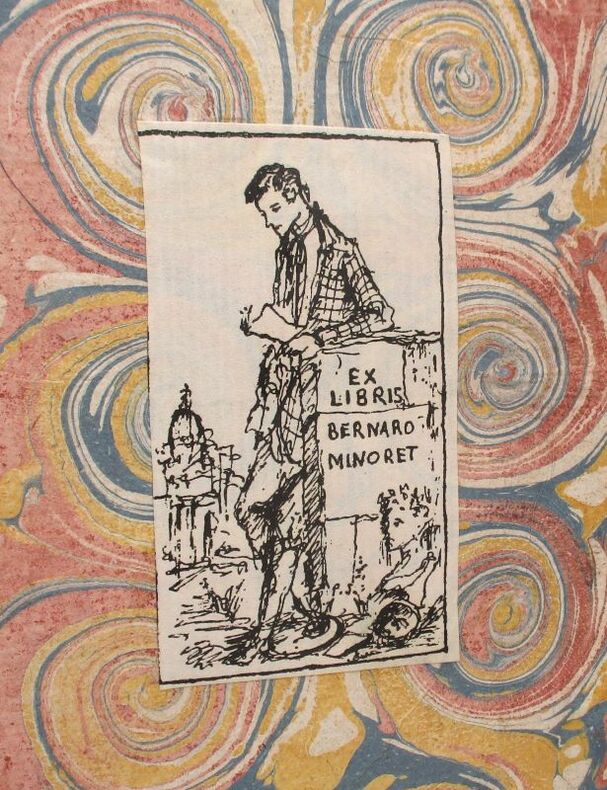
1888009929Londres: No Publisher 1888. Book. Near Fine. Hardcover. 12mo - over 6¾" - 7¾" tall. "Edition revue sur celle de 1783." Title page date 1783-1888. 208 pp. SCARCE OCLC locates a single copy at the Bibliotheque Nationale de France. Bound in contemporary half morocco over marbled boards a single gilt flower in each compartment back marbled end papers top gilt. Near Fine tiny rubs at edges small chip rear board to marbled paper a bit of scattered toning at end papers only. Mirabeau's libertine novel of 1783 in which he presented his ideas on free trade under the guise of an erotic tale. No Publisher Hardcover
17841Publisher unknown 1784.<br /><br />Mirabeau's classic and important work against injustice and the exercise of arbitrary and absolute power. Widely read at the time it added fuel to the fire of the coming French Revolution. This 1784 edition includes the second part of this famous work dealing with life in prison which was to be destroyed by the Prussian authorities at the request of the French government and may be considered rare. This edition also includes L'Éspion Dévalisé by Baudouin de Guémadeuc attributed to Mirabeau. 630 pages. 20 cm x 12.5 cm x 4 cm. Contemporary French calf binding; no foxing on the great majority of pages. Unknown hardcover