96 résultats
179118566Paris: Chez Petit & Maugi 1791. 8vo. Modern wrappers. 30 pages. Some light spotting. 8vo. In the introduction the editor voices his strongly anti-Jacobin sentiments- "traitez les jacobins comme on traite les fous et le bonheur pourra renaître en France." The author writes warning the people of the falseness behind the "liberties" touted to the people. M & W III 24413 Chez Petit [&] Maugi unknown
1776002061Londres 1776. Seconde edition augmentée et corrigée par l'Editeur de cet ouvrage. Un volume in 8o di VIII-2-308 pagine. Legatura coeva in piena pelle dorso liscio ornato e dorato angoli un po' usati. Seconda edizione molto più corretta della prima del saggio di Mirabeau che polemizza con Rousseau e le sue tesi ma in realtà attacca le monarchie del tempo e il dispotismo. Difesa della proprietà privata dellistruzione pubblica del contratto sociale: il re nest autre chose que le salarié de létat. Ined 3188. unknown
178954453Kiøbenhavn Hegelunds Forlag 1789. Samtidigt helldrbd. i flammet kalv med overdådig rygforgyldning. Rygtitel fornyet forgyldt. 4460 pp. Trykt på skrivepapir. <br/><br/><em>Første danske udgave </em> unknown
1760EIRéo[MI72Paris: 1760. 1760. 12mo. pp. vi 426 2. modern bds. Published the same year as the first edition in quarto format. Mirabeau's strong criticisms of French methods of finance and taxation in this work particularly his attacks on the tax-farmers led to his temporary imprisonment and banishment from Paris. "It is not as might be supposed a mere plea for the Impôt Unique. It proposes a reorganization of financial administrative machinery the abolition of the Fermes a reduction in taxation upon salt with the object of increasing the total yield and a special tax upon tobacco farms. The Domaine the post and the Mint were to be further sources of revenue. Many just and valuable remarks on taxation are scattered throughout the volume and entitle the author to rank as one of the earliest important writers on the subject." Palgrave Einaudi 3946. Goldsmiths' 9603. Higgs 2298. Kress 5884. cfCioranescu II 45631. cfStourm pp. 100-101. cfTchemerzine VIII 285. Palgrave II pp. 774-78. F. [Paris]: 1760. unknown
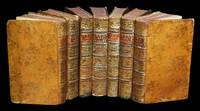
1760304661760. A Hambourg chez ChrÂŽtien HÂŽrold 1760 - S.l. s.ÂŽ. 1761. 8 parties reliÂŽes en 7 vol. au format in-12 168 x 102 mm de 2 ff. n.fol. 308 pp. et 1 f. n.fol. ; 2 ff. n.fol. 426 pp. et 1 f. n.fol. ; 422 pp. et 1 f. n.fol. ; 2 ff. n.fol. et 336 pp. ; 2 ff. n.fol. vi - 281 pp. 2 ff. n.fol. et 1 f. bl. ; 2 ff. n.fol. et 205 pp. ; 2 ff. n.fol. 192 pp. et 2 ff. n.fol. ; 2 ff. n.fol. et 104 pp. ; viii - 422 pp. Reliures uniformes de l'ÂŽpoque de pleine basane glacÂŽe et marbrÂŽe blonde filet gras vertical ˆ froid portÂŽ sur chacun des plats dos ˆ nerfs ornÂŽs de filets gras ˆ froid caissons d'encadrement dorÂŽs important dÂŽcor fleuronnÂŽ dorÂŽ piÂces de titre de maroquin vieux-rouge titre dorÂŽ tomaison dorÂŽe palette dorÂŽe en tÂte et queue jeu de petits filets obliques dorÂŽs sur les coupes tranches saumon. Ensemble complet de ses 8 parties ; ici reliÂŽes en 7 volumes. A la fin du dernier a ÂŽtÂŽ reliÂŽ - sans page de titre - La ThÂŽorie de l'imp™t de Mirabeau. Ouvrage en outre complet de ses 6 tableaux dÂŽpliants. Primitivement paru en un volume ˆ Avignon en 1759 les derniÂres cinq autres parties qui composent cet ensemble parurent de 1758 ˆ 1760. En effet lorsque Mirabeau publia le prÂŽsent ouvrage il ne connaissait pas encore Quesnay. Ce dernier fut vivement impressionnÂŽ par L'Ami des hommes et trÂs rapidement de leur rencontre naquit l'ÂŽcole Physiocratique et les trois autres parties de l'Ami des Hommes seront le rÂŽsultat de la collaboration des deux hommes. Principal propagateur des doctrines ÂŽconomiques en France Riquetti propose ici un traitÂŽ fondamental pour la physiocratie alors naissante en partie inspirÂŽ de FranÂois Quesnay. On y trouve ici ÂŽnoncÂŽs des principes comme le primat de lÕagriculture et la condamnation de la finance du luxe et de la Ç cupiditÂŽ È dans un monde sous la conduite de propriÂŽtaires et dÕun ÇÊroi pasteurÊÈ. Aussi d'aprÂs l'auteur ''la vraie richesse ne consiste que dans la population. Or la population dÂŽpend de sa subsistance et la subsistance ne se tire que de l'agriculture. Ainsi pour ce physiocrate convaincu tout dÂŽpend de l'agriculture : elle reste le premier des arts. Mirabeau se rangera derriÂre l'idÂŽe que Ç Plus vous faites rapporter ˆ la terre et plus vous la peuplez È''. Riquetti comprit avec quelques autres la vÂŽritable nature du paysan franÂais sa dÂŽvotion ˆ la terre et sa persÂŽvÂŽrance ˆ endurer un travail dur et ÂŽreintant pour en obtenir une parcelle.Ê Le paysan nՎtait pas pauvre par paresse mais parce que le dÂŽcouragement de ne jamais rien obtenir le conduisait ˆ baisser les bras au milieu de beaucoup de contraintes. Il travaillerait toujours dur pour son propre intÂŽrÂt. Il fallait donc lui faciliter lÕaccÂs ˆ la propriÂŽtÂŽ rurale en supprimant les causes de son dÂŽcouragement.Ê En outre Mirabeau souligna le besoin dÕun traitement rural de lÕassistance publique convaincu quÕil ÂŽtait de la supÂŽrioritÂŽ de lÕagriculture sur toutes les autres formes de richesse. Les villes lui paraissaient comme des excroissances ÂŽconomiques sources de luxe qui rÂŽpandait son pouvoir de corruption sur les campagnes environnantes. Barbier I Dictionnaire des ouvrages anonymes 133 - Brunet III Manuel du libraire et de l'amateur de livres 1739 - Cioranescu II Bibliographie de la littÂŽrature franÂaise du XVIIIÂme siÂcle 45626 - TchÂŽmerzine VIII Bibliographie d'ÂŽditions d'auteurs franÂais 283 - QuÂŽrard VI La France littÂŽraire p. 154. Angles ÂŽlimÂŽs. Quelques abrasions ou petits manques superficiels affectant les plats. Quelques coiffes arasÂŽes. Dos prÂŽsentant un ÂŽclat lÂŽgÂrement altÂŽrÂŽ. Quelques rousseurs et feuillets parfois oxydÂŽs. Petite dÂŽchirure en marge d'une page de titre. Du reste bonne condition. b42961 unknown
178228463Londres Neuchâtel 1782. First Edition. Wrappers. vii 1 240pp. Contemporary gray wrappers with handwritten label affixed to the spine panel all edges uncut. Of particular interest are two chapters: chapter XVII titled Lettre du Comte de Chanmburg écrite de Rome au baron de Hohendorff commandant des troupes Hessoises en Amérique is attributed to Benjamin Franklin and appears here in book form for the first time The Papers of Benjamin Franklin Vol. 23 eds. William B. Willcox and Douglas M. Arnold 1983 p. 480; chapter XVI titled Avis aux Hessois & autres peuples de l'Allemagne vendus par leurs princes à L'Angleterre written by Honoré Gabriel Riqueti comte de Mirabeau and published originally as a pamphlet in 1777 is a call to Hessian mercenaries to join with the Americans in the overthrow of tyranny. Other sections are dedicated to bull fighting economics etc. Three ink stains to the front cover one of which barely affects the fore edge small worm hole to the margin of two of the leaves authors' names in pencil on the verso of the front cover. Internally fairly clean. About very good. ; Octavo. unknown
178385830Rome Neuchâtel Neuchâtel: De l'imprimerie du Vatican 1783. Fine. De l'imprimerie du Vatican Rome Neuchâtel Neuchâtel 1783 13 x 20.70 cm relié First edition. Bound with Reymond La Bataille d'Austerlitz poème dramatique en cinq actes Riom 1806; Huvier des Fontenelles La Targétade comédie un peu burlesque parodie d'Athalie de Racine de Racine 1791; de Bonnay La Prise des Annonciades n.p. n.d.; Abbé de Vermond La Cour plénière Héroï-tragi-comédie Paris 1788; Aymé Déportation et naufrage de J.J. Aymé Paris n.d.; Jourgniac de Saint-Médard Mon agonie de trente-huit heures Paris 1806. Contemporary beige half calf binding ochre paper boards smooth spine deep green morocco title-piece gilt title gilt stamped motifs. Some chafing to the boards scattered foxing. A few brown spots on the title page of La Prise des annonciades. Illustrated with a vignette on the title page of Errotika. Collection written by Mirabeau imprisoned in Vincennes at the same time as the Marquis de Sade. Various curiosities are culled from ancient writings relating to sexual practices such as onanism tribalism sodomy nymphomania etc. : ""The author in addition to the talent of perfectly mastering ancient languages writes very well in his own joking lightly and often drawing on Voltaire's style: in the very dirty pictures he sometimes presents he always uses honest or technical expressions: besides he seems well versed in the art of voluptuousness"" contemporary 18th century review quoted in Gay-Lem. II 151. According to the legend the book was relentlessly censored by the authorities and only fourteen copies of the first edition had survived - an estimate which seems to be quite inaccurate. After a second edition in 1792 the book was prohibited and included in the papal index. Another edition was destroyed in 1826 by the Royal Court of Paris and two further prosecutions were brought in 1856 and 1868 for ""outrage à la morale publique et aux bonnes murs"". The text was notably published by Guillaume Apollinaire along with other writings by Mirabeau in his 1910 edition in the Bibliothèque des Curieux series. De l'imprimerie du Vatican hardcover
1792elala1480Paris: Le Jay 1792. 1792. 8vo. pp. 1 p.l. 176. Uncut in original wrs. joints split edges chipped wrs. stained scattered light foxing. A curious erotic work by the famous French orator and statesman. It was written during his imprisonment by a lettre de cachet in the castle of Vincennes in 1777 for having run off with another mans wife Marie Thérèse de Monnier his Sophie as he called her. He was condemned to death for rape and abduction but his eloquence in pleading his case resulted in the annulment of the sentence. The Errotika Biblion presents a comparison of the sexual mores of the ancient Greeks Romans and Hebrews with discussion of onanism bestiality incest pederasty lesbianism &c. Barbier II 172. Gay III 205-209. Quérard VI 257. cfCioranescu 45134. Paris: Le Jay, 1792. unknown
1776184025Londres.: No publisher. 1776. 2nd edition. 8vo. Contemporary quarter calf over marbled boards gilt spine title. Very good cover chipped at upper foredge otherwise a tight fresh copy. 20.5x12x2 cm. French text. Mirabeau denounces arbitrary royal power - ""Despotism is not a form of government . if it were so it would be criminal brigandage against which all men must unite."" Mirabeau is noted for his oratory and his statesmanship during the French Revolution. This is his first published work. weight: 0.8 lb. No publisher. hardcover
1789008991No Place: No Publisher 1789. Book. Very Good. Hardcover. First Edition. 8vo - over 7¾" - 9¾" tall. xvii 318 376 pp. Collated complete. Two volumes bound in contemporary marbled calf the backs ruled in gilt with gilt devices the covers gilt ruled framing delicate gilt floral scrolls marbled end papers. Very Good the boards rubbed scattered light toning. First edition of this scandalous anonymously published book which was condemned to be burned after it caused embarrassment to the French court. Uncommon in such lovely condition. No Publisher Hardcover
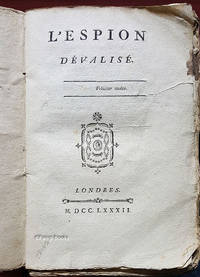
1789FIRst[MI10Alençon: Malassis le jeune 1789. 1789. 2 Volumes. 8vo. pp. 2 p.l. xvii 318; 2 p.l. 376 102 Correspondence Pour Servir De Suite. Potsdam: 1789. with half-titles. contemporary mottled calf rubbed joints cracked. armorial bookplate of Richard Howard. First Edition. Mirabeau's secret mission to the Court of Prussia in 1786-87 was a diplomatic failure and his anonymously published account was condemned by French law. Martin & Walter 24476. Stewart 1845. cfCioranescu 45214 citing incorrect date. 1st Edition. Hardcover. Very Good. [Alençon: Malassis le jeune], 1789. Hardcover
17588067Paris 1758. Second Edition of parts I-III first Edition of part IV. 8 192; 2 266 4; 6 264; 8 278 81pp. 2 vols. 4to. Contemporary mottled calf with gilt spines red morocco labels; covers a bit rubbed spine extremities and corners worn with slight chipping otherwise a very good copy internally crisp and clean. Frontispiece lacking as is often the case. Bookplates of A. de Seville. Second Edition of parts I-III first Edition of part IV. 8 192; 2 266 4; 6 264; 8 278 81pp. 2 vols. 4to. A work of fundamental importance whose appearance created a sensation throughout Europe was widely translated and reprinted and earned its author an international reputation "greater than that of any other economist before or after not excluding Adam Smith or Karl Marx." Schumpeter p. 175n Mirabeau argues that wealth is the product of population -- in particular agriculture -- and that a large populartion is desirable that religious toleration free enterprise a more equitable system of taxation and distribution of wealth were necessary components of a vital economy. The first three parts appeared in 1756; by 1758 Mirabeau had fallen under the influence of Quesnay and issued the fourth part in which the latter's influence is very much felt. The two between them it may be said founded the school of the physiocrats. A fifth and sixth part were added in 1760. Kress 5735; Higgs 1631; Goldsmith 9317 unknown
1758EIRAm[MI39<p>Parts I-III: Avignon: 1756 & Part IV: np: 1758. 1758. 4 Parts in 5 Volumes. 12mo. pp. 431 1; 578 1 leaf; 577 1; 4 p.l. 285; 1 p.l. 313 1 150 1 leaf. engraved frontis. in Vol. I. woodcut initials. An attractive set bound in 19th century tree sheep slight worming to lower front joint of Vol. I & lower front cover of Vol. III. First Duodecimo Edition; originally published in quarto format the same year. Fourth present here fifth and sixth parts containing material by other writers including Quesnay were published in 1758 and 1760. Mirabeau's treatise created a sensation throughout Europe and was widely reprinted and translated earning for its author "though only for a few years a.fame much greater than that of any other economist before or after not excluding Adam Smith or Karl Marx.". Schumpeter p. 175n In it Mirabeau intended to show that agriculture is the great source of subsistence and must be encouraged that a large population is desirable and that religious toleration free trade a more equal distribution of wealth and lower and equitable taxation are needed for the economic improvement of the country. The work attracted the attention of Quesnay and the meeting of the two men led to the formation of the physiocratic school. Quesnay contributed to the continuations including a portion of the fourth part and the Tableau Économique in part six. Goldsmiths' 9093 Vols. I-III. Higgs 1143 & 2160. Kress 5545. Quérard VI 154. Stourm p. 100n. Tchemerzine VIII 750 Vols. I-III. Coquelin & Guillaumin II pp. 190-91. cfEinaudi 3941.</p> [Parts I-III:] Avignon: 1756 & [Part IV:] np: 1758.
1792AQ14462A Paris: Chez F. Buisson 1792. 4 392pp. With half-title. Early twentieth-century calf-backed glazed orange paper boards lettered in gilt. Lightly rubbed sunned library shelf-marks in correction fluid to spine. Bookplate of Bath Reference Library to FEP with their occasional embossed stamps throughout closed tear to C8 just clipping text. The record of the political life of French statesman Emmanuel-Armand de Vignerot du Plessis de Richelieu duc d'Aiguillon 1720-1788 his governorship of Brittany as his service as Minister of Foreign Affairs during the reign of Louis XV. The work is commonly attributed to Honore-Gabriel de Riqueti comte de Mirabeau 1749-1791 with the role of editor assumed by Jean-Louis Giraud Soulavie 1752-1813. . Third edition. 8vo. Chez F. Buisson hardcover
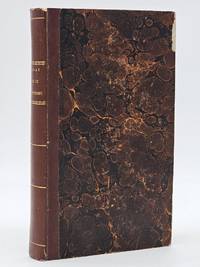
1789BCG150061789. 2 Volumes Bound as One; Ouvrage Posthume; Blue library buckram with gold spine title; A good ex library copy; 318 & 376 pages. Size: 4.75"x7.75". Hardcover. Hardcover
178957115Paris Chez Baudouin Imprimeur de l'Assamblée Nationale 1789. 8vo. Bound in an exquisite later red half morocco with gilt spine. Top edge gilt. 1 f. title-page 8 pp. "Déclaration des droits de l'Homme en société" 6 pp. "Articles de Constitution" 1 f. "Réponse du Roi" 1 f. blank. Woodcut head-pieces. Title-page slightly bowned otherwise in excellent condition. A truly excellent copy. <br/><br/><em>The exceedingly scarce true first printing in an incredibly rare form of off-print/separate printing of one of the most important and influential documents in the history of mankind namely the French Human Rights Declaration containing also the articles for the first French Constitution. This groundbreaking publication constitutes a monumental change in the structure of the human world providing all citizens with individual rights that we now take for granted. This monument of humanist thought appeared in the "Procès verbal de l'Assemblée Nationale" copies of which are also very difficult to obtain. There however the two parts appeared without a title-page and without the final blank which together constitute a form of wrappers for this off-print/separate printing of which only five or six other copies are known and which is present in merely one or two libraries world-wide. As far as we now only one other copy has been on the private market and that did not have the blank back wrapper. This exceedingly rare separate printing of the Human Rights Declaration with the Constitution was intended for the inner circle of those participating in its creation and was limited to a very restricted number of copies - all of which will have been owned by the creators of the Declaration. This epochal document is just as important today as it was when it was formulated during the French Revolution in 1789 and since 2003 the Declaration has been listed in the UNESCO Memory of World Register - "This fundamental legacy of the French Revolution formed the basis of the United Nations Declaration of 1948 and is of universal value". Few other documents in the history of mankind has done as much to determine the way we live and think the way Western societies are structured and governed and few other documents have had such a direct impact upon our constitutional rights and the way we view ourselves and others in society. It is here that we find the formulation of liberty and equality upon which so much of Western political and moral thought is based - that all "men are born and remain free and equal in rights" Article 1 which were specified as the rights of liberty private property the inviolability of the person and resistance to oppression Article 2; that all citizens were equal before the law and were to have the right to participate in legislation directly or indirectly Article 6; no one was to be arrested without a judicial order Article 7; Freedom of religion Article 10 and freedom of speech Article 11 were safeguarded within the bounds of public "order" and "law" etc. etc.The content of the document that were to change the Western world for good emerged largely from the ideals of the Enlightenment. "The sources of the Declaration included the major thinkers of the French Enlightenment such as Montesquieu who had urged the separation of powers and Jean-Jacques Rousseau who wrote of general will-the concept that the state represents the general will of the citizens. The idea that the individual must be safeguarded against arbitrary police or judicial action was anticipated by the 18th-century parlements as well as by writers such as Voltaire. French jurists and economists such as the physiocrats had insisted on the inviolability of private property." Encycl. Britt.The key drafts were prepared by Lafayette working at times with Thomas Jefferson. In August 1789 Honoré Mirabeau played a central role in conceptualizing and drafting the Declaration. On August 26 1789 in the midst of The French Revolution the last article of the Declaration was adopted by the National Constituent Assembly as the first step towards a constitution for France. "In 1789 the people of France brought about the abolishment of the absolute monarchy and set the stage for the establishment of the first French Republic. Just six weeks after the storming of the Bastille and barely three weeks after the abolition of feudalism the Declaration of the Rights of Man and of the Citizen French: La Déclaration des Droits de l'Homme et du Citoyen was adopted by the National Constituent Assembly as the first step toward writing a constitution for the Republic of France.The Declaration proclaims that all citizens are to be guaranteed the rights of "liberty property security and resistance to oppression." It argues that the need for law derives from the fact that ".the exercise of the natural rights of each man has only those borders which assure other members of the society the enjoyment of these same rights." Thus the Declaration sees law as an "expression of the general will" intended to promote this equality of rights and to forbid "only actions harmful to the society." www.humanrights.com. This sensational document became the crowning achievement of the French Revolution; it came to accelerate the overthrow of the "Ancien Régime" and sowed the seed of an extremely radical re-ordering of society. The Declaration interchanged the pre-revolutionary division of society -in the clergy the aristocracy and the common people- with a general equality - "All the citizens being equal in the eyes of the law are equally admissible to all public dignities places and employments according to their capacity and without distinction other than that of their virtues and of their talents" From Article VI upon which today's society is still based. It is hard to imagine a work that is more important to the foundation of the society that we live in today. </em> unknown
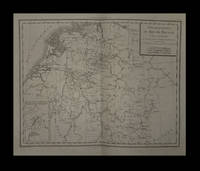
1788260481788. A Londres s.ÂŽ. Lejay 1788. Un fort vol. au format in-folio 433 x 277 mm de 3 ff. n.fol. 10 cartes gravÂŽes sur double-page 93 planches gravÂŽes tableaux et 1 f. bl. Ne subsiste plus de la reliure que le carton des plats. Important atlas au format in-4 comportant 10 sur 10 grandes cartes gravÂŽes sur double-page dressÂŽes par Mentelle Pays-Bas autrichiens Tyrol BohÂme-Moravie Etats entre la BaviÂre et la BohÂme Carte gÂŽnÂŽrale d'Allemagne Monarchie prussienne ˆ l'orient de Weser Possessions du roi de Prusse ˆ l'ouest du Weser Carte de la Haute-Saxe et de la Lusace Haut et Bas-Rhin BaviÂre. L'ouvrage recÂle en outre 93 sur 93 planches gravÂŽes dont double-pages ainsi que de nombreux tableaux dont dÂŽpliants. ''La parution de cet ouvrage fit faire banqueroute au libraire Lejay''. in QuÂŽrard. QuÂŽrard VI La France littÂŽraire p. 158. Petit travail de ver affectant les fonds de cahiers des feuillets liminaires ainsi que plus lÂŽgÂrement des cartes. L'une prÂŽsente des plissures une autre un petit manque angulaire ; une derniÂre des rousseurs. Chacune une discrÂte cerne marginale. Deux tableaux manquants. Plusieurs feuillets dÂŽsolidarisÂŽs. Quelques petites altÂŽrations ÂŽparses dans le corps d'ouvrage. Du reste belle condition. b42961 unknown
1783d912.999eA Rome De l'Imprimerie Du Vatican 1783. FRENCH TEXT. LACKS PRELIMINARY LEAVES. This text runs from page 1 ANAGOGIE to page 192 Table. A frontispiece of later date title page and page iii-iv Avis are supplied in photocopy. Some loss to leading margin of first leaf and one or two others no text loss. Else nice clean tight text. Text has been fitted with new endpapers and rebound many years ago in Half brown leather and marbled boards. Spine with raised bands is simply lettered EROTICA BIBLION. A handsome binding. Hardback. Good/No DW. A Rome De l'Imprimerie Du Vatican Hardcover
1789jc005.584Editeur non précisé 1789. Old full leather Gold on burgundy title lablel. FRENCH TEXT. 175 and 208 pages. NOT ILLUSTRATED. Slight old wornm tracks mostly to covers. "ex librie Bassompierre" written verso front endpaper. Minor creasing and spotting to text. Else Book is in very good condition with minor signs of wear and/or age. Hardback. VG/No DW. Editeur non précisé Hardcover
1789183453No place.: No publisher. 1789. Contemporary half speckled calf over speckled boards. red spine label with gilt title. Corners light bumped light foxing otherwise a very good tight copy. 8vo. 18x11 cm. French text. Scarce edition of the correspondence of Mirabeau denouncing the corrupt Prussian court. The book was censored by the French government hence the anonymous author and publisher. weight: 0.6 lb. No publisher. hardcover
178930088s. l. Paris ou Londres London: S. n. 1789. Fine. S. n. s. l. Paris ou Londres London 1789 13.50 x 21.50 cm broché Reprint of the first edition also published in 1789. A second volume of these portraits would appear a little later. In original wrappers. Title page margins worn. The work is a series of portraits with a key at the end of the book to identify them; it includes Necker Guillotin Sieyès. Luchet also participated in writing some of these portraits. S. n. unknown
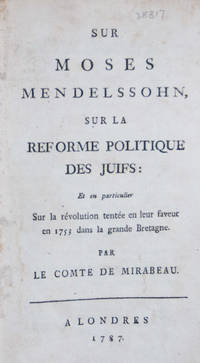
178738317London: NP 1787. First edition. Hardcover. g. Octavo. 68 130pp. Original spotted calf with gold lettering and tooling on spine. Marbled endpapers and paper edges. Decorative head- and tailpieces. Honoré Gabriel Riqueti comte de Mirabeau 1749-1791 was a leader of the early stages of the French revolution. A noble before 1789 Mirabeau was involved in numerous scandals that left his reputation in ruins. However during the early years 1789-91 of the French Revolution he rose to the top and became the voice of the people. A successful orator he was the leader of the moderate position favoring a constitutional monarchy built on the model of Great Britain. Mirabeau became interested in the Jewish question during his visits to Holland in 1776 England in 1784 and Prussia in 1786. Influenced by the enlightened members of the Jewish communities in the capitals of these three countries he was particularly attracted by the image of Moses Mendelssohn. In "Sur Moses Mendelssohn sur la réforme politique des Juifs" a book resulting from the author's journey Mirabeau argued that the faults of the Jews were those of their circumstances. Although his main reason for admiring Mendelssohn was that 'humanity and truth' seemed much clearer to him than 'the dark phantoms of the Talmudists' he did not consider Judaism an immoral faith and he defended it against attacks both old and new. In the course of his argument he repeated Christian Wilhelm von Dohm's assertion that 'the Jew is more of a man than he is a Jew'. Quoting from Turgot and Rousseau in support of his pro-Jewish arguments Mirabeau affirms that history proves that 'the Jews considered as men and as citizens were greatly corrupted only because they were denied their rights'. Like Dohm he advocated preserving some measure of Jewish autonomy a view he developed in his memorandum to Frederick the Great of Prussia "De la monarchie prussienne" 1788 but he envisaged it as a transitory phenomenon; the organized Jewish community would wither away and die as the Jews entered fully into the economic and social life of the majority. Mirabeau continued to work for the emancipation of the Jews as he saw it. In the debate of Dec. 24 1789 he denied Rewbell's assertion that 'they the Jews do not regard themselves as citizens' and followed Clermont-Tonnerre in stating that the very fact that the Jews were requesting equality was proof of their desire to cease being Jewish in any separatist way. Binding rebacked but retaining most of its original spine. Calf darkened and partly cracked along edges. Front hinge starting. Previous owner's annotation in Latin along outer margin of page 68. Text in French. Binding in overall fair interior in very good condition. Moses Mendelssohn 1729-1786 was a German Jewish philosopher to whose ideas the Haskalah the 'Jewish enlightenment' of the eighteenth and nineteenth centuries is indebted. Although himself a practicing orthodox Jew he has been referred to as the father of Reform Judaism. Born to a poor Jewish family in Dessau and originally destined for a rabbinical career Mendelssohn educated himself in German thought and literature and from his writings on philosophy and religion came to be regarded as a leading cultural figure of his time by both Christian and Jewish inhabitants of the Holy Roman Empire. <br /> <br /> Christian Wilhelm von Dohm 1751-1820 was a German historian and political writer. Although a Christian he was a staunch advocate for Jewish emancipation. In 1781 at the suggestion of his friend Moses Mendelssohn Dohm published a two-volume work entitled "Über die Bürgerliche Verbesserung der Juden" On the Civil Improvement of the Jews which argued for Jewish political equality on humanitarian grounds. It was widely praised by the Jewish communities in Berlin Halberstadt and Surinam. <br /> <br /> Stanislas Marie Adélaïde comte de Clermont-Tonnerre 1757-1792 was a French military officer and a politician during the French Revolution. He was twice elected president of the National Constituent Assembly where he advocated a moderate liberal policy especially in the matter of removing restrictions for the Jews and Protestants. NP hardcover
1785751L23London: W Faden 1785. First edition. Leather. Very Good. 9" by 5.5". Not Stated. A very scarce English language edition of this political writing regarding the free navigation of the Scheld. Written by one of the leaders of the early stages of the French revolution Honore Gabriel Riqueti. ESTC reference no: T83504. A very scarce work This translation is of Mirabeau's 'Doutes sur la liberte de l'Escaut reclamee par l'empereur'. Engraved vignette to the title page. With the folding map which has been rebacked with linen. Bookplate of the City of Westminster to the front pastedown. The Scheldt river flows through northern France Western Belgium and southwestern part of the Netherlands with its mouth at the North Sea. Access to this river was the subject of the brief Kettle War of 1784 and during the French Revolution. This book looks at this issue of access to the river. In a half morocco binding. Externally generally smart. Patches of rubbing to the spine and extremities. Small loss to the head and tail of spine. Bookplate to the front pastedown. Internally firmly bound. Pages are bright. A few chips to the title page and to a2 and A1. Pages are clean. Very Good W Faden hardcover
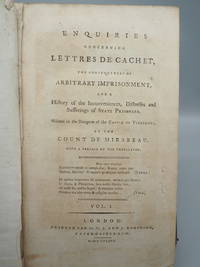
1787C181678London: G. G. J. and J. Robinson 1787. Hardcover Hardcover. Very Good. Vol. 1. only. Bound in full contemporary leather worn with front board detached otherwise very good. G. G. J. and J. Robinson, hardcover
179032925Paris: Bureau de la collection historique des Mémoires relatifs au règne de Louis XV. 1790. Fine. Bureau de la collection historique des Mémoires relatifs au règne de Louis XV. Paris 1790 12.50 x 21 cm relié First edition. Posthumous publication by Soulavie. Contemporary full sheep binding. Smooth spine decorated with double gilt fillets title-labels headcaps worn joints rubbed numerous scuffs corners slightly bumped. Emmanuel Armand de Vignerot du Plessis de Richelieu duc d'Aiguillon was appointed governor of Brittany in 1753; until 1770 he was in open war with the Parliament of Brittany appointed by the king in a regional state that desired above all to preserve its privileges. Louis XV had to intervene several times in agreement with the duc d'Aiguillon. The memoirs record the numerous intrigues at court to destroy the duc d'Aiguillon. A final memoir concerns Louis XV's beautification projects in Nantes and Paris. Bureau de la collection historique des Mémoires relatifs au règne de Louis XV. unknown