1 681 résultats
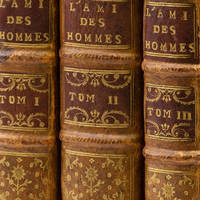
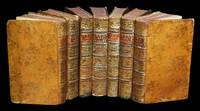
1760304661760. A Hambourg chez ChrÂŽtien HÂŽrold 1760 - S.l. s.ÂŽ. 1761. 8 parties reliÂŽes en 7 vol. au format in-12 168 x 102 mm de 2 ff. n.fol. 308 pp. et 1 f. n.fol. ; 2 ff. n.fol. 426 pp. et 1 f. n.fol. ; 422 pp. et 1 f. n.fol. ; 2 ff. n.fol. et 336 pp. ; 2 ff. n.fol. vi - 281 pp. 2 ff. n.fol. et 1 f. bl. ; 2 ff. n.fol. et 205 pp. ; 2 ff. n.fol. 192 pp. et 2 ff. n.fol. ; 2 ff. n.fol. et 104 pp. ; viii - 422 pp. Reliures uniformes de l'ÂŽpoque de pleine basane glacÂŽe et marbrÂŽe blonde filet gras vertical ˆ froid portÂŽ sur chacun des plats dos ˆ nerfs ornÂŽs de filets gras ˆ froid caissons d'encadrement dorÂŽs important dÂŽcor fleuronnÂŽ dorÂŽ piÂces de titre de maroquin vieux-rouge titre dorÂŽ tomaison dorÂŽe palette dorÂŽe en tÂte et queue jeu de petits filets obliques dorÂŽs sur les coupes tranches saumon. Ensemble complet de ses 8 parties ; ici reliÂŽes en 7 volumes. A la fin du dernier a ÂŽtÂŽ reliÂŽ - sans page de titre - La ThÂŽorie de l'imp™t de Mirabeau. Ouvrage en outre complet de ses 6 tableaux dÂŽpliants. Primitivement paru en un volume ˆ Avignon en 1759 les derniÂres cinq autres parties qui composent cet ensemble parurent de 1758 ˆ 1760. En effet lorsque Mirabeau publia le prÂŽsent ouvrage il ne connaissait pas encore Quesnay. Ce dernier fut vivement impressionnÂŽ par L'Ami des hommes et trÂs rapidement de leur rencontre naquit l'ÂŽcole Physiocratique et les trois autres parties de l'Ami des Hommes seront le rÂŽsultat de la collaboration des deux hommes. Principal propagateur des doctrines ÂŽconomiques en France Riquetti propose ici un traitÂŽ fondamental pour la physiocratie alors naissante en partie inspirÂŽ de FranÂois Quesnay. On y trouve ici ÂŽnoncÂŽs des principes comme le primat de lÕagriculture et la condamnation de la finance du luxe et de la Ç cupiditÂŽ È dans un monde sous la conduite de propriÂŽtaires et dÕun ÇÊroi pasteurÊÈ. Aussi d'aprÂs l'auteur ''la vraie richesse ne consiste que dans la population. Or la population dÂŽpend de sa subsistance et la subsistance ne se tire que de l'agriculture. Ainsi pour ce physiocrate convaincu tout dÂŽpend de l'agriculture : elle reste le premier des arts. Mirabeau se rangera derriÂre l'idÂŽe que Ç Plus vous faites rapporter ˆ la terre et plus vous la peuplez È''. Riquetti comprit avec quelques autres la vÂŽritable nature du paysan franÂais sa dÂŽvotion ˆ la terre et sa persÂŽvÂŽrance ˆ endurer un travail dur et ÂŽreintant pour en obtenir une parcelle.Ê Le paysan nՎtait pas pauvre par paresse mais parce que le dÂŽcouragement de ne jamais rien obtenir le conduisait ˆ baisser les bras au milieu de beaucoup de contraintes. Il travaillerait toujours dur pour son propre intÂŽrÂt. Il fallait donc lui faciliter lÕaccÂs ˆ la propriÂŽtÂŽ rurale en supprimant les causes de son dÂŽcouragement.Ê En outre Mirabeau souligna le besoin dÕun traitement rural de lÕassistance publique convaincu quÕil ÂŽtait de la supÂŽrioritÂŽ de lÕagriculture sur toutes les autres formes de richesse. Les villes lui paraissaient comme des excroissances ÂŽconomiques sources de luxe qui rÂŽpandait son pouvoir de corruption sur les campagnes environnantes. Barbier I Dictionnaire des ouvrages anonymes 133 - Brunet III Manuel du libraire et de l'amateur de livres 1739 - Cioranescu II Bibliographie de la littÂŽrature franÂaise du XVIIIÂme siÂcle 45626 - TchÂŽmerzine VIII Bibliographie d'ÂŽditions d'auteurs franÂais 283 - QuÂŽrard VI La France littÂŽraire p. 154. Angles ÂŽlimÂŽs. Quelques abrasions ou petits manques superficiels affectant les plats. Quelques coiffes arasÂŽes. Dos prÂŽsentant un ÂŽclat lÂŽgÂrement altÂŽrÂŽ. Quelques rousseurs et feuillets parfois oxydÂŽs. Petite dÂŽchirure en marge d'une page de titre. Du reste bonne condition. b42961 unknown
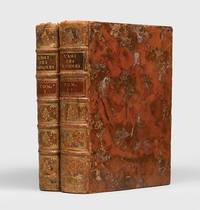
17588067Paris 1758. Second Edition of parts I-III first Edition of part IV. 8 192; 2 266 4; 6 264; 8 278 81pp. 2 vols. 4to. Contemporary mottled calf with gilt spines red morocco labels; covers a bit rubbed spine extremities and corners worn with slight chipping otherwise a very good copy internally crisp and clean. Frontispiece lacking as is often the case. Bookplates of A. de Seville. Second Edition of parts I-III first Edition of part IV. 8 192; 2 266 4; 6 264; 8 278 81pp. 2 vols. 4to. A work of fundamental importance whose appearance created a sensation throughout Europe was widely translated and reprinted and earned its author an international reputation "greater than that of any other economist before or after not excluding Adam Smith or Karl Marx." Schumpeter p. 175n Mirabeau argues that wealth is the product of population -- in particular agriculture -- and that a large populartion is desirable that religious toleration free enterprise a more equitable system of taxation and distribution of wealth were necessary components of a vital economy. The first three parts appeared in 1756; by 1758 Mirabeau had fallen under the influence of Quesnay and issued the fourth part in which the latter's influence is very much felt. The two between them it may be said founded the school of the physiocrats. A fifth and sixth part were added in 1760. Kress 5735; Higgs 1631; Goldsmith 9317 unknown
1758EIRAm[MI39<p>Parts I-III: Avignon: 1756 & Part IV: np: 1758. 1758. 4 Parts in 5 Volumes. 12mo. pp. 431 1; 578 1 leaf; 577 1; 4 p.l. 285; 1 p.l. 313 1 150 1 leaf. engraved frontis. in Vol. I. woodcut initials. An attractive set bound in 19th century tree sheep slight worming to lower front joint of Vol. I & lower front cover of Vol. III. First Duodecimo Edition; originally published in quarto format the same year. Fourth present here fifth and sixth parts containing material by other writers including Quesnay were published in 1758 and 1760. Mirabeau's treatise created a sensation throughout Europe and was widely reprinted and translated earning for its author "though only for a few years a.fame much greater than that of any other economist before or after not excluding Adam Smith or Karl Marx.". Schumpeter p. 175n In it Mirabeau intended to show that agriculture is the great source of subsistence and must be encouraged that a large population is desirable and that religious toleration free trade a more equal distribution of wealth and lower and equitable taxation are needed for the economic improvement of the country. The work attracted the attention of Quesnay and the meeting of the two men led to the formation of the physiocratic school. Quesnay contributed to the continuations including a portion of the fourth part and the Tableau Économique in part six. Goldsmiths' 9093 Vols. I-III. Higgs 1143 & 2160. Kress 5545. Quérard VI 154. Stourm p. 100n. Tchemerzine VIII 750 Vols. I-III. Coquelin & Guillaumin II pp. 190-91. cfEinaudi 3941.</p> [Parts I-III:] Avignon: 1756 & [Part IV:] np: 1758.
1021914223.Gpaperback. Good. Access codes and supplements are not guaranteed with used items. May be an ex-library book. paperback
0270286187.Ghardcover. Good. Access codes and supplements are not guaranteed with used items. May be an ex-library book. hardcover
1017588813.Ghardcover. Good. Access codes and supplements are not guaranteed with used items. May be an ex-library book. hardcover
1018063064.Ghardcover. Good. Access codes and supplements are not guaranteed with used items. May be an ex-library book. hardcover
1018464395.Ghardcover. Good. Access codes and supplements are not guaranteed with used items. May be an ex-library book. hardcover
1018469494.Gpaperback. Good. Access codes and supplements are not guaranteed with used items. May be an ex-library book. paperback
2009DADAX1104776464Kessinger Publishing 2009-07-17. paperback. New. 6.00x1.09x9.00. Buy with confidence. Excellent Customer Service & Return policy. Kessinger Publishing paperback
1756131625Avignon: n.p. 1756-60. The first public appearance of Quesnay's Tableau économique First edition of all six parts containing the first public appearance of Quesnay's Tableau économique. The first to follow Quesnay in the foundation of the Physiocratic circle Mirabeau was familiar with and influenced by Cantillon's theories. As well as fully articulating the principles that were to mark the school of physiocrats and expounding their implications regarding population agriculture and commerce the Ami des Hommes contained a reproduction of Quesnay's Tableau économique vol. VI previously published separately in very small numbers in 1758 and 1759. Mirabeau's reproduction made the essay obtainable thus bringing the founding document of the school of physiocrats to the attention of a wide public. "This remarkable treatise created the greatest sensation throughout the whole of Europe. It is said to have gone through forty editions and was translated into several languages. Its anonymous author soon discovered became the idol of the day and was generally referred to by the soubriquet which he had chosen for the title of his book" Palgrave II p. 775. Following the publication of the first three parts Mirabeau made the acquaintance of Quesnay who had been greatly impressed by his book. "Mirabeau now became the fervent admirer of Quesnay and between them they founded the school of the Physiocrats" ibid. In 1758 a fourth part was published in which Quesnay's influence is clearly visible. The remaining two parts were published in 1760. The final part is of particular importance as it contains the first obtainable appearance of Quesnay's Tableau économique which was previously published separately in tiny numbers in 1758 and 1759. An English translation was first published in 1766. 6 parts in 2 vols quarto 246 x 188 mm. Contemporary French mottled calf spines ruled and decorated gilt in compartments all edges red. Joints and extremities expertly restored scattered foxing to contents; a handsome copy. Einaudi 3941; Goldsmiths' 9092; Higgs 1143 1631 & 2160; INED 3194; Kress 5543 & 5736; Mattioli 2426 2428 & 2429. unknown
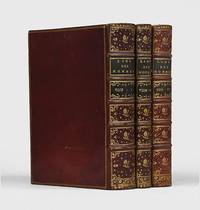
1758153197Avignon: no publisher 1758-60. The first public appearance of Quesnay's Tableau Économique First complete edition of all six parts containing the first public appearance of Quesnay's Tableau Économique; a superb copy in contemporary French red morocco very uncommon thus. The first to follow Quesnay in the foundation of the Physiocratic circle Mirabeau was familiar with and influenced by Cantillon's theories. As well as fully articulating the principles that were to mark the school of physiocrats and expounding their implications regarding population agriculture and commerce the Ami de l'Homme contained a reproduction of Quesnay's Tableau Économique vol. 6 previously published separately in very small numbers in 1758 and 1759. Mirabeau's reproduction made the essay obtainable thus bringing the founding document of the school of physiocrats to the attention of a wide public. "This remarkable treatise created the greatest sensation throughout the whole of Europe. It is said to have gone through forty editions and was translated into several languages. Its anonymous author soon discovered became the idol of the day and was generally referred to by the soubriquet which he had chosen for the title of his book" Palgrave II p. 775. Following the publication of the first three parts Mirabeau made the acquaintance of Quesnay who had been greatly impressed by his book. "Mirabeau now became the fervent admirer of Quesnay and between them they founded the school of the Physiocrats" ibid. With this new edition of the first three parts a fourth part was published in 1758 in which Quesnay's influence is clearly visible. The remaining two parts were published in 1760. The final part is of particular importance as it contains the first obtainable appearance of Quesnay's Tableau Économique which was previously published separately in tiny numbers in 1758 and 1759. An English translation was first published in 1766. 6 parts in 3 vols quarto 252 x 195 mm. Engraved frontispiece in part I engraved head- and tailpieces initials. Contemporary French red morocco spines elaborately decorated gilt in compartments twin green morocco labels raised bands triple gilt rule border to sides gilt inner dentelles marbled endpapers gilt edges green silk ribbon bookmarkers. Authorship attribution to first title in ink in an early hand. Bar a few trivial marks to sides the binding in beautiful condition corners a touch rubbed; vast majority of contents bright crisp and clean with very occasional spotting third volume with some light browning and foxing; loss to lower corners of leaves vol. 1 Hh2 and vol. 3 Aa3 not affecting text; patch of dampstain to last two leaves and final blank of vol. 2. A near-fine set. Einaudi 3941; Goldsmiths' 9317; Higgs 1628 1631; INED 3194; Kress 5735 & 5736; Mattioli 2427 2428 2429 & 2430. hardcover
1760322182Paris 1760. First complete edition. Frontispiece. 192; 266 4; 6 263 1; 6 1-278; 80; viii 1-167 1; 279 5pp. Six parts in three volumes. 3 vols. 4to. Contemporary mottled french calf gilt spines red edges. Some wear at edges and joints. First complete edition. Frontispiece. 192; 266 4; 6 263 1; 6 1-278; 80; viii 1-167 1; 279 5pp. Six parts in three volumes. 3 vols. 4to. The first three parts constituting L'Ami des Hommes were first published by Mirabeau in 1756 before his meeting with Quesnay and his conversion to the physiocratic theses. In 1758 the work was reissued as a new edition with a fourth part added and in 1760 the fifth and sixth parts. Thus the present edition is the first complete one.<br /> <br /> Notably the final volume of the work includes Quesnay's Tableau Economique the first work attempting to describe the workings of the economy in an analytical way. Portions of Quesnay's work had been privately printed in a few copies only at the palace at Versailles in 1758 and 1759 but is here more widely and fully published.<br /> <br /> An important work on economic thought and political theory. Higgs 1628; Goldsmiths 9317; Kress 5735 unknown
59276Avignon 1756 edition originale In-4 vi-156-218-216pp. grande vignette gravee en frontispice errata in-fine quelques rares rousseurs reliure plein veau de l'epoque dos orne a nerfs avec piece de titre Nb-0308 unknown
1104776464.Gpaperback. Good. Access codes and supplements are not guaranteed with used items. May be an ex-library book. paperback
1166065731.Gpaperback. Good. Access codes and supplements are not guaranteed with used items. May be an ex-library book. paperback
2011339332.Gpaperback. Good. Access codes and supplements are not guaranteed with used items. May be an ex-library book. paperback
2011339340.Gpaperback. Good. Access codes and supplements are not guaranteed with used items. May be an ex-library book. paperback
2011339359.Gpaperback. Good. Access codes and supplements are not guaranteed with used items. May be an ex-library book. paperback
2679Avignon: n.p. 1756. Hardcover. Good. Duodecimo. Three volumes. I: 431 ipp.; II: 578pp.; III: 577 iiipp. Contemporary calf repaired. With a frontispiece to volume one. Higgs 1143 Kress 5544 Goldsmiths 9093. <br/> <br/> Avignon: n.p., 1756 hardcover
0243472633.Gpaperback. Good. Access codes and supplements are not guaranteed with used items. May be an ex-library book. paperback
0266718388.Gpaperback. Good. Access codes and supplements are not guaranteed with used items. May be an ex-library book. paperback
0282285717.Gpaperback. Good. Access codes and supplements are not guaranteed with used items. May be an ex-library book. paperback
0282341846.Gpaperback. Good. Access codes and supplements are not guaranteed with used items. May be an ex-library book. paperback
0365872903.Gpaperback. Good. Access codes and supplements are not guaranteed with used items. May be an ex-library book. paperback