12 213 résultats
195933045Colombia:: Banco De La Republica Departamento De Investigaciones Economicas. G/NONE. 1959. Softcover. Four-volume set in softbound format; cover wear ranges from light to moderate with light soil scratching/scuffing on volume 4. Pages tight clean unmarked. Volume 1 covers aspectos fisico y geografico; volume 2 aspectos politico humano y administrativo; volume 3 fuentes de energia-recursos mineros y forestales-sistemas de comunicaciones; volume 4 aspectos agropecuarios y su fundamento ecologico. Many maps some in color. Measures bit over 11 x 15 inches. ; . Banco De La Republica, Departamento De Investigaciones Economicas. paperback
19322091502135500092Not Available 1932. Soft Cover. Fine. Number of pages: 338 25 pages Size: 16 x 23 cm Not Available paperback
0265750725.Ghardcover. Good. Access codes and supplements are not guaranteed with used items. May be an ex-library book. hardcover
1527720764.Gpaperback. Good. Access codes and supplements are not guaranteed with used items. May be an ex-library book. paperback
0876639155New. New. Satisfaction Guaranteed or your money back. unknown
1975Q-0876639155Universe Books 1975-03-01. Paperback. New. In shrink wrap. Looks like an interesting title! Universe Books paperback
1928307203Selbstverlag des Bergischen Fabrikanten-Vereins Remscheid 1928. Hardcover Leinen mit Schutzumschlag Zustand: Keine Beschädigungen keine Eintragungen fleckig jeweils ein ExLibris im Buchdeckel. Rücken Ecken Kanten gut. Die Schutzumschläge haben Gebrauchsspuren und kleine Risse. Selbstverlag des Bergischen Fabrikanten-Vereins Remscheid, hardcover
196113773Melbourne Australia: University of Adelaide. Fine. 1961. First Edition. Hardcover. Usual xlib marks. Appear unread. A total of 19 issues. ; Ex-Library; Small 4to 9" - 11" tall . University of Adelaide hardcover
189211726Sydney Australia: Charles Potter. Very Good with no dust jacket. 1892. First Edition. Softcover. Spine is wearing/splitting at the bottom. All plates maps & charts present and very good to fine. Wraps are soiled/faded with some staining to the back. Still a nice copy of a very fragile book. ; 8vo 8" - 9" tall; 67plates pages . Charles Potter paperback
19873706751Oxford Clarendon Press 1987. This is an ex-library book and may have the usual library/used-book markings inside.This book has hardback covers. In good all round condition. No dust jacket. Library sticker on front cover. Please note the Image in this listing is a stock photo and may not match the covers of the actual item400grams ISBN:019828540X Oxford Clarendon Press hardcover
2005103a4680Canada: SMB 2005. Book. Very Good. Paperback. First Edition. 8vo - over 7¾" - 9¾" tall. 337 pages. Index. "Every 11 minutes on average someone in B.C. is injured or killed in an auto accident. Become an advocate for yourself. Know your legal rights. Learn what help is available through public and private sources. The information you need is in this book." - from back cover. "This carefully researched book guides you through the intricacies of what happens after a motor vehicle accident and is a must for everyone in British Columbia. Franklin's experiences as a severely injured pedestrian coupled with her skills as a widely-known writer have enabled her to present complex material in an easily accessible and highly readable manner." - C. Paul Peel Psychologist. Clean and unmarked with light wear. A quality copy. SMB Paperback
1873035656London: Longmans Green Reader And Dyer 1873. 1st Edition 1st Printing. Hardcover. Good. Vi 313 2 Pp Author's Catalog At Rear. Green Pebbled Cloth Gilt Brown Endpapers. First Issue With Error And No Errata Sheet. Wear Spine Gilt Clear But Not Brilliant A Few Points Of Fraying At Corners. No Names Or Marks. Hinge Cracked Before Last Free Endpaper. Bookbinder's Ticket On Rear Pastedown Burn & Co. <br/> <br/> Longmans, Green, Reader, And Dyer hardcover
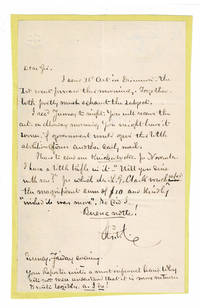
1860100131<p>Oct. 1860. Oct. 1860. Very good. - Over 115 words penned on 8 inch high by 4-7/8 inch wide creamy white paper with an embossed mark at top left. The abolitionist journalist C.T. Congdon writes that "I send the IIe Act in Disunion - the Ist went forward this morning. Together both pretty much exhaust the subject". He goes on to bemoan the delay "you might have it sooner if government would give this little abolition town another daily mail." He asks the recipient to please send him the "Knickerbocker for November. I have a little trifle in it - 'Will you dine with me'." Closing with the wishes "Buena notte!" Congdon signs himself with an abbreviated signature which one can only guess is "ChTC" and concludes with a postcript about the illegibility of another reporter's handwriting. The letter is mounted with glue from the verso onto a 8-1/4 inch high by 5-1/4 inch wide yellow paper. It is identified in an unknown hand on the verso: "C. T. Congdon / Oct 1860". Very good.</p><p>The journalist poet and abolitionist Charles Taber Congdon 1821-1891 started his career by cleaning floors and delivering newspapers for the New Bedford Courrier. He went on to work as a reporter for the Daily Register and an editor at Daily Bulletin and the Daily Mercury before Horace Greeley personally invited him to come work at the New York Tribune in 1857. He came to be known as "Greeley's right hand man" and was listed by Louis Star as one of the Tribune reporters who "lived to destroy slavery root and branch". While working at the Tribune Congdon also published articles in "Vanity Fair" the "North American Review" and the "Knickerbocker Magazine". Congdon published recollections as well as poetry including "The Warning of War" in 1862.</p><p>RARE.</p> [Oct. 1860].
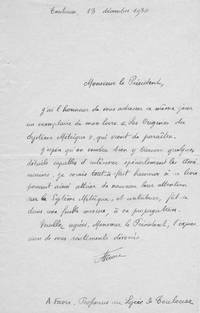
193034087Toulouse France: December 13 1930. 1930. Very good. - 79 words penned in black ink on the 1st side of a sheet of cream paper folded once to form 4 sides 8-1/2 inches high by 6 inches wide. Signed "A Favre". There is some very light soiling & some tiny marks to the blank 4th side. Folded twice for mailing. Near fine. <p>In this letter written in French Favre presents a copy of his book advocating the spread of the metric system Paris: Les Presses Universitaires de France 1930 to the president of an institution. He hopes that it will be of particular interest to the Americans. "J'ai l'honneur de vous adresser ce meme jour un exemplaire de mon livre 'Les Origines du Systeme Metrique' qui vient de paraitre. J'espere qu'on voudra bien y trouver quelques details capable d'interesser specialement les Americains." Favre identifies himself in the letter as a teacher at a high school in Toulouse. Toulouse [France]: December 13, 1930. unknown
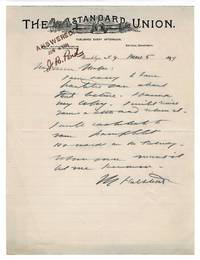
1894101010<p>Brooklyn NY June 5 1894. 1894. Very good. - Over 40 words in pencil on 10-1/2 inch high by 8 inch wide "The Standard Union" newspaper stationery. Apologizing about a lecture the American newspaper editor and war correspondent Murat Halstead offers to contribute an essay to the American impressario and lecture manager James B. Pond's pamphlet "I will contribute to your pamphlet 100 words on McKelway. When you receive it let me know." Signed "M. Halstead". Folded for mailing with minor creases and slight darkening along the bottom edge. Very good.</p><p>The American newspaper editor and magazine writer Murat Halstead 1829-1908 was a war correspondent during 3 wars. He started his career writing for "The Hamilton Intelligencer" and "The Roseville Democrat" at 18 years of age and went on to contribute to several other newspapers. He bought interest in the paper while working as a local reporter for Cincinnati's "Commercial". Halstead reported on several battles during the Civil War and was a war correspondent during the Franco-Prussian War. He took over controlling interest in the "Commercial" and became president of the company when the "Cincinnati Gazette" merged with his paper. Moving to Brooklyn in 1890 he edited the "Standard Union". He went to the Philippines as a war correspondent at the start of the Spanish-American War.</p><p>The article which Halstead mentions in his letter is about St. Clair McKelway the editor of "The Brooklyn Daily Eagle". Halstead's own paper the "Standard Union" was also in Brooklyn.</p> Brooklyn, NY, June 5, 1894.
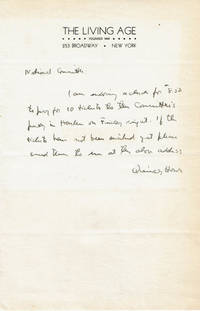
193096221New York: circa 1930s. 1930s. Very good. - 39 words penned on an 8-1/2 inch high by 5-1/2 inch wide sheet of The Living Age letterhead. Signed "Quincy Howe". The right edge & top edge of the letterhead are slightly darkened. Pieces of tape adhere to the verso where the item was removed from an album. Folded 3 times for mailing. Very good. <p>Howe writes to an unidentified committee about tickets to the committe's upcoming party in Harlem. Howe was an editor for The Living Age from 1923 to 1929 when the magazine was sold. After the sale the new owner rehired Howe as Editor-in-Chief.<p>An advocacy journalist in the tradition of New England liberalism Quincy Howe 1900-1977 helped bring food to striking miners in Harlan County Ky in 1932; opposed restriction of immigration; and was active in prison reform. As a director of the American Civil Liberties Union from 1932 to 1940 he fought against censorship. But it was in foreign policy matters that Howe drew the most attention in the thirties. A critic of dictatorships of the left and the right he was sympathetic to the rising nationalist movements in the colonial empires of the Old World. He was a member of the left-wing American League against War and Fascism. In his writings of that time he stressed the dangers of American intervention in another world war. New York: circa [1930s]. unknown
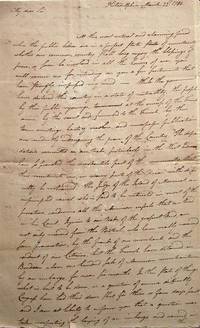
27780Folio two pages inscribed on a four page bi-folium paper browned some paper loss on integral address leaf else in good legible condition. Letter from John W. Kittera Federalist member of Congress from Lancaster Pennsylvania to Jasper Yeates 1745-1817 jurist and justice of the Pennsylvania Supreme Court also from Lancaster in which Kittera relates some of the growing tensions arising from the Proclamation of Neutrality in 1793 after the declaration of war by France against Great Britain and the extension of the wars of the French Revolution into a greater maritime war and the resultant seizure of American shipping by the British as well as the French. " At this most critical and alarming period when the public bodies are in a perfect state of uncertainty whether our common country shall long enjoy the blessings of peace or soon be involved in all the horrors of war you will excuse me for intruding on you a few sentiments that have strongly impressed my mind. - While the government have declared this country in a state of neutrality the people by their public rejoicings at the success of the French arms by the secret aid furnished to the French by their town meetings hasty resolves and newspaper publications are evidently endangering the peace of the Country. The depredations committed on our trade particularly in the West Indies have so provoked the mercantile part of the community that their resentments can in many parts of the Union with difficulty be restrained. The Judge of the island of Montserrat an unprincipled rascal who is said to be interested in most of the privateers condemns all the American vessels that are tried in his Court. Injuries to our trade of the grossest kind are not only received from the British who have really received some provocation by the frauds of our merchants and the conduct of our Citizens but the French have detained in Bordeau above one hundred sale of American merchantmen by an imbargo for near six months. sic In this State of things what is best to be done is a question of immense difficulty. Congress have had their doors shut for three or four days past and I am at liberty to inform you that a question was taken respecting the laying of an imbargo sic and carried in the negative by a small majority. At first I confess I felt favorably disposed towards the measure but on the discussion changed my sentiments. I never saw Congress reduced to so many difficulties - You have seen the resolves of our town meeting. Dallas and Swanart harangued the crowd from the State House window and received a general huzza at the conclusion of each resolution. One drunken sailor had the assurance to say No for which he had two of his ribs broken and otherways much abused. But few of the respectable Citizens attended another meeting is to be had this evening. The mob at New York assembled on Sunday week entered the Roman Chapel playing the time of Caira drove the priest from the altar & the worshippers from the Church. These violent measures are productions of the worst of all evils and if instead of intrusting the management of the government in the hands of the Representatives of the people designing men are thus frequently to assemble the people to legislate for themselves the objection made by Despots to a republican form of government that it is good in theory but bad in practice is a good objection. Those things are particularly improper at a time like the present. Excuse the freedom of these sentiments." For further information on Kittera and Yeates see: Dictionary of American Biography vol. x part two p. 606 Who Was Who in America Historical Volume pp. 297; 601 <br /><br />
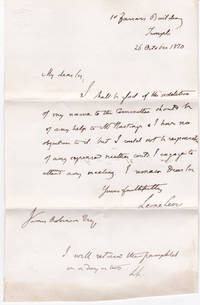
187035631London: 26 October 1870. 1870. Very good. - 55 words penned in black ink on a 6-3/4 inch high by 4-3/8 inch wide sheet of light gray paper with the papermaker's device embossed in blind at top left. Signed "Leone Levi". There is offsetting to the bottom edge caused by a glue stain & paper remnant on the verso where the letter has been removed from an album. Folded 3 times for mailing. Very good. <p>Levi writes to a James Robinson that he is willing to have his name added to a committee as long as he does not have to be responsible for any expenses or attend any meetings.<p>Leone Levi 1821-1888 was a British political economist born to a Jewish family in Italy. He moved to England at a young age was converted to Christianity and became a member of the English bar in 1859. Much of his time and energy was spent on organizing chambers of commerce and in 1850 he published "Commercial Law of the World". He urged the benefits that would result from an international commercial code and his suggestions led to the passage of acts in 1858 which made the mercantile laws of Britain uniform in many respects. Among his other publications was "History of British Commerce and of the Economic Progress of the British Nation from 1863 to 1870". [London]: 26 October 1870. unknown
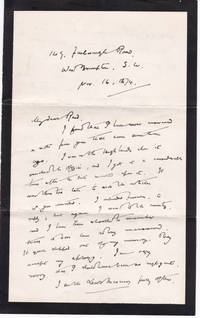
187435633London: November 16 1874. 1874. Very good. - Letter penned in black ink & filling both sides of a sheet of black-bordered 7 inch high by 4-3/8 inch wide cream paper. Signed "James Macdonell". Folded twice for mailing. Very good. <p>Macdonell writes to Thomas Wemyss Reid editor of the Leeds Mercury. He apologizes at length for not having answered a note from Reid which arrived while Macdonell was away in the Highlands. He goes on to describe his current busy life as a journalist mentioning "I am also gathering the material for a big book" probably his book on France. "But I have almost abandoned the hope of being able to write anything of that kind until I shall have freed myself from the shackles of my journalism."<p>Scottish journalist James Macdonell 1841-1879 began by writing for the Aberdeen Free Press in his native city and at the age of 22 became editor of the Northern Daily Express. He moved to London in 1865 to take up a staff position at the Daily Telegraph which he held until 1875 serving as special correspondent in France in 1870 and 1871. He became a leader writer on the Times of London in 1873. His posthumous "France since the First Empire" was incomplete at his death but yielded insights into the French politics of his time. [London]: November 16, 1874. unknown
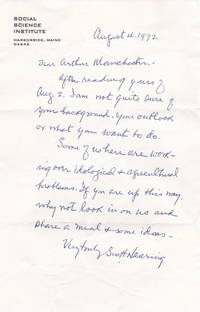
197234750Harborside ME: August 4th 1972. 1972. Very good. - Letter penned in blue ink and filling most of one side of a sheet of Social Science Institute letterhead 8-1/2 inches high by 5-3/8 inches wide. Signed "Scott Nearing". There is some light creasing to the paper. Folded twice for mailing. Together with the mailing envelope addressed in an unknown hand. Very good. <p>Nearing is replying to an Arthur W. Manchester in Boston inviting him to visit the Institute. "Some of us here are working on idological & agricutural problems. If you are up this way why not look in on us and share a meal & some ideas - ".<p>Scott Nearing 1883-1983 was a radical economist educator writer political activist and an advocate of simple living. Harborside, ME: August 4th, 1972. unknown
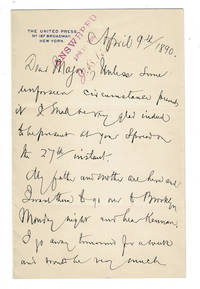
1890100212<p>New York April 9th 1890. 1890. Very good. - Two pages consisting of over 80 words penned on 2 faces of 8-1/8 inch high by 5-1/4 inch wide "The United Press" stationery with an integral attached leaf. In his letter addressed to American impressario and lecture manager Major James B. Pond Phillips informs him that "unless some unforeseen circumstance presents it I shall be very glad indeed to be present at your spread on the 27th instant." He writes that his mother and father are visiting and that he wants "them to go over to Brooklyn Monday night and hear Kennan" and asks Pond for the particulars regarding where "Kennan is to hold forth". Signed with his rapidly scribbled signature. Folded for mailing Pond has stamped that he has answered at the top left of the first page. Very good.</p><p>The American journalist telegrapher and inventor Walter P. Phillips 1846-1920 expanded telegraph codes with his Phillips Code which allowed for brevity by making use of such abbreviations as POTUS and SCOTUS. He was managing editor of the Providence Morning Herald and subsequently editor of the Providence Morning Star before becoming the head of The United Press.</p><p>George Kennan 1845-1924 to whose lecture Phillips refers was an American explorer noted for his travels in the Kamchatka and Caucasus regions of the Russian Empire.</p> New York, April 9th, 1890.
185935713New York: January 15 1859. 1859. Very good. - 34 words penned in black ink on a cream sheet of 9-3/4 inch high by 7-5/8 inch wide sheet of Times Office letterhead with a handsome engraving of the Times building at top left. Signed "W. J. Raymond". The bottom edge of the letter is slightly darkened with some light creasing. Once mounted into an album with paper remnants adhering to the corners of an integral attached blank leaf. A couple of small chips are torn from the corners of the blank. Folded 3 times for mailing. Very good. <p>Raymond writes agreeing to an exchange with another publication: "We shall be very happy to send you our semi-weekly Edition in Exchange for the W. & R. We would send the Daily but for the fact that our Exchange list is already inconveniently large."<p>Henry Jarvis Raymond 1820-1869 was an American journalist and politician and co-founder of the New York Times. Between 1841 and 1851 he worked as a journalist and associate editor for various newspapers including Horace Greeley's New York Tribune and James Watson Webb's Courier and Enquirer. In 1851 Raymond convinced George Jones who had also worked at the Tribune to become his partner and publish a new paper that would report the news in a neutral manner. They co-founded the New York Times and Raymond edited the paper until his death. Raymond was a member of the New York State Assembly in 1850 and 1851 and was elected Speaker in 1851. A member of the Whig party's northern radical anti-slavery wing he was nominated for Lieutenant Governor of New York in 1854 over Horace Greeley. He was elected and served from 1855 to 1856. Raymond has sometimes been called "the godfather of the Republican Party". He played a prominent role in the party's formation and drafted the Address to the People adopted by the Republican organizing convention in 1856. New York: January 15, 1859. unknown
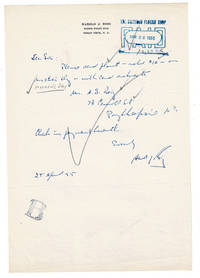
1955100157<p>Great Neck New York April 25 1955. 1955. Very good. - Over 20 words penned on his personal 10-1/2 inch high by 7-1/4 inch wide stationery. Harold J. Roig requests that The Saltford Flower Shop "Please send plant - incl. $10 - on Mother's Day - with card enclosed." Signed "Harold J Roig". The flower shop's stamp dated April 28th indicates that the order was paid for and there are several pencil markings including "Mother's Day" penciled in capital letters by the store. Near fine.</p><p>The American businessman Harold J. Roig 1886-1972 was Vice Chairman of the W.R. Grace & Co. by the time he retired in 1950. He'd first joined this international industrial company as counsel in 1915 and organized its legal department. A graduate of Cornell and Columbia Law School he was a member of numerous associations and several exchanges. He was a member and secretary of the Government agency that regulated the supplies of Chilean nitrate of soda during WWI and following the war was put in charge of Grace's Chilean nitrate sales. He took part in establishing Grace National Bank. In his role with Grace he was a pioneer in commercial aviation in South America being instrumental in the establishment of Panagra Pan American Grace Airways which flew the first U.S. certified route to Buenos Aires by way of South America's West Coast.</p> Great Neck, New York, April 25, 1955.
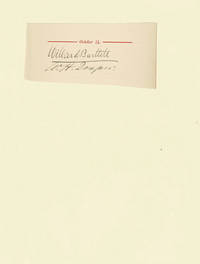
99630<p>October 14. . Fine. - William H. Draper and Willard Bartlett's autographs penned on a 2 inch high by 4-1/4 inch wide piece of paper clipped from a daily birthday book calendar with the date "October 14" printed in red above their signature. Signed in full "Willard Bartlett" and "W.H. Draper". Several lines from an inspirational poem are printed in black on the verso. Near fine.</p><p>Willard Bartlett 1846-1925 practiced law in partnership with Elihu Root from 1869 until his election to the bench. In November 1907 he was elected to a 14-year term on the New York Court of Appeals the state's highest court. He was Chief Judge on the court from 1914 to 1916.</p><p>William Henry Draper 1830-1901 graduated from the College of physicians and surgeons in 1855. In 1869 he became clinical professor of diseases of the eye and ear in the College of physicians and surgeons which chair he held until 1880 when he was appointed professor of clinical medicine In 1886 Dr. Draper became president of the New York Academy of Medicine. He contributed numerous professional papers to medical journals.</p> October 14.
2012611235New Jersey: FT Press 2012. Hard cover with unclipped dust jacket both in very good condition. Light shelf and handling wear to DJ including minor creasing to edges tiny closed tear to rear foot. Boards in fine condition content is 'as unread'. CN. Hardcover. Very Good/Very Good. FT Press Hardcover