Women Employment PhotographyBiblio.com
210 résultats
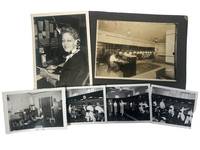
1900200911900. Telephone operator photo archive circa 1900 to 1958 documents women's labor within telephone exchange systems showing how urban communications depended on trained female operators seated at switchboards connecting calls handling information and maintaining the human infrastructure behind early and mid twentieth century telephone service. The material documents telephone communication labor through photographs of switchboard rooms operators wearing headsets plug boards supervisory presence and grouped clerical activity revealing how connection work operated in practice before automated dialing fully displaced manual exchange work. The archive supports research into women's wage labor communications history gendered office work New York telephone service and the disciplined workplace culture that positioned young women as the public voice and operational center of the telephone network.<br /> The archive consists of six black-and-white photographs including five silver gelatin photographs and one early albumen photograph with images measuring from approximately 3.5 x 4.25 inches to 7 x 9 inches. The date range appears to extend from the early twentieth century to 1958 based on the later dated images. Several photographs show women seated in tight rows facing large switchboards wearing heavy headsets with horn mouthpieces and working among dense arrangements of cords and plugs. The early albumen photograph shows a row of women facing the switchboards while a female supervisor watches over the room indicating both the gendered hierarchy and procedural discipline of the exchange floor. One image shows an operator turning toward the camera with a plug in hand smiling while gesturing toward the board. Four smaller photographs dated 1958 show teams of women moving between boards and a small group with paperwork behind the operating area; pencil inscriptions on the versos identify the location as New York.<br /> The photographs are valuable because they make visible the labor system behind telephone service: rows of operators standardized equipment supervisors paperwork and the coordinated manual routing of calls. They also record the gendered character of communications work in which women's voices posture speed and manner were made part of the service itself. Light handling wear minor edge wear and expected age toning; images remain crisp with equipment and personnel details clearly visible; overall very good. Strong women's labor and communications history archive documenting the human operation of telephone exchange systems across the first half of the twentieth century and into the postwar period. unknown
19542092902143800092Japan Public Employment Security Association Hokkaido Branch Kaboro City 1954. Soft Cover. Fine. Number of books: 2 Japan Public Employment Security Association Hokkaido Branch (Kaboro City) paperback
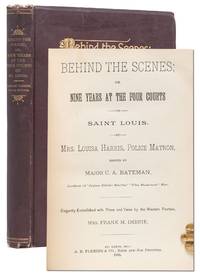
18936644St. Louis: A. R. Fleming & Co 1893. First edition. Very Good. Original publisher's cloth binding with gilt to spine and front board. Brown coated endpapers. Some wear to corners and head and tail of spine. Some staining to covers and corresponding dampstaining to corners of endpapers. A very good copy internally clean and unmarked. Collating viii 9-220: complete including frontis. The first book published by a policewoman in America.<br /> <br /> Despite assumptions to the contrary "women have served in organized law enforcement in the U.S. almost from the beginning. The first police departments in America were established in the 19th century and in 1845 women began working as matrons in New York City jails" Smith. The practice rapidly spread across the country where police forces needed assistance in supervising female prisoners and dealing with the specific challenges faced by this population. Women's clubs -- particularly the American Female Moral Reform Society and the Women's Christian Temperance Union -- urged recognition for the widespread violence perpetrated on female prisoners and called for meaningful change. "It was these women's groups that fought for these distinctly female positions demanding there was a need for women to take care of women.and they provided police departments with funds for paid matron positions until the government could be convinced of the necessity of having women in the police force" Maiorano.<br /> <br /> Louisa Harris having served in the prisons and courts of Missouri for nearly a decade became the first of these women to publish about her experience. The resulting narrative reflects an awareness of the social forces that put women at a disadvantage driving them toward arrests or recidivism. Domestic violence poverty and the stigma placed on sex work all do damage to women; and according to Harris these women should not be treated as or placed with violent offenders when they could with proper assistance find safety or build more secure lives. This is the motivation for Harris' memoir. In the introduction she explains that while she hesitated to publish the book which might in some readers awaken a "morbid curiosity" she ultimately moved ahead because "I reasoned that if the world knew more about the unfortunate and their revolting experiences together with the causes that promote misfortune there might be more true sympathy exhibited.While I have from personal observation become familiar with so-called criminals I have had the opportunity to learn many of the causes of the committal of crimes. The law seldom recognizes the palliating influences but humanity should." Harris calls for reforming the handling of juvenile offenders advocates for therapeutic programs for young women and taps into a number of other systemic issues of concern within policing today. Very Good. A. R. Fleming & Co unknown
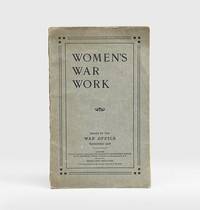
1916183494London: Chiswick Press 1916. First edition of this illustrated government publication promoting women's wartime employment. Women's War Work contains a detailed list of several hundred roles left vacant by men that women successfully fulfilled. Several of these are demonstrated by characterful photographs which show women employed in a range of professions including the postal service factories breweries and shops. The War Office recruited women into the workplace to maintain productivity produce munitions and ensure that as many men as possible were available for the Armed Forces. By July 1916 it was estimated that 750000 women across Britain had taken up such work and the War Office produced Women's War Work in September to further increase their numbers. The preface asserts that employers who had women in their workface would "readily admit that the results achieved by the temporary employment of women far exceed their original estimates and even so are capable of much further extension" p. 5. Women's contributions to the war effort drastically changed public perception of their capabilities and helped women over 30 to achieve enfranchisement in 1918. Provenance: from the collection of the suffrage historian Elizabeth Crawford. Quarto. 72 black and white photographs. Drab paper wrappers front and rear cover printed in black. Library sticker of the Women's Service Library and withdrawal stamp on front inside cover former shelfmark to front cover in pencil former bookseller's price to half-title. Spine repaired loss to ends wrappers lightly toned extremities a little creased extending to outer leaves at bottom corner occasional light finger-soiling to contents but otherwise clean: a very good copy of a fragile publication. unknown
20122092902140700156Japan Map Center 2012. Soft Cover. Fine. Size: B5 Number of books: 2 Japan Map Center paperback
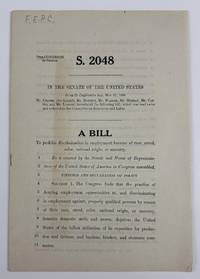
19445698Washington DC 1944. Very good. 16pp. Gathered signatures stapled. Minor creasing light discoloration to outer leaves. Pencil note on last page reads "From Natl Council for a Permanent FEPC Wash DC." A rare slip-bill printing of Senator Dennis Chavez's first attempt at legislation intended "to prohibit discrimination in employment because of race creed color national origin or ancestry." New Mexico Senator Dennis Chavez 1888-1962 was a lawyer and only the second Mexican-American to serve in the United States Senate. The present document represents a critical moment in Chavez's career in the Senate which occurred near the end of World War II. Chavez saw the need to protect fair employment practices for minorities returning home from war or for those who had worked in the defense industry during the conflict. FDR's Executive Orders 8802 which forbid discrimination in hiring practices within the defense industry and 9346 which created a five-member Fair Employment Practices Committee FEPC to ensure fairness helped during the war but were only a temporary fix. During its three-year run Senator Chavez reported hundreds of cases of discrimination to the FEPC with regard to unfair hiring practices wage differentials and discrimination in public accommodations but he wanted a more permanent and broader-ranging solution.<br /> <br /> The present document is Senator Chavez's first shot across the bow. In it he proposes to end employment discrimination across the whole of American life through the establishment of a permanent Federal Employment Practices Commission. In addition to defining the composition and other details of the commission membership salaries reporting duties location of offices etc. the bill stipulates that the commission's chief duty is the "Prohibition of Unfair Employment Practices" defines the commission's investigative powers gives it authority to make or change regulations to align with this act requires non-discriminatory language in government contracts stipulates penalties for persons resisting impeding or interfering with the commission's work and so forth. Of course Chavez's bill did not pass into law in 1944. Through a series of procedural gymnastics including a Senate filibuster opponents killed the bill a few different times in the years to come. When Chavez finally withdrew his bill following a failed cloture vote in February 1946 he commented that it was only the beginning of the struggle for civil rights and that the country would indeed move forward.<br /> <br /> In his article entitled "Dennis Chavez and the National Agenda: 1933-1946" Roy Lujan concludes: "Chavez's failure in civil rights legislation may be attributed to the fact that his vision and goals were too far-reaching. In the mid 1940s the United States was not ready to accept civil rights. Many people throughout the country and some of his Senate colleagues could not or would not recognize or correct discriminatory practices. Nevertheless through Chavez's fight for civil rights legislation he challenged southerners longstanding control of the Senate on this issue. Chavez's strong commitment to fight racial intolerance laid the groundwork and encouraged and inspired other congressmen to introduce civil rights legislation which finally came to pass under the Lyndon Johnson administration. In 1964 twenty years after Chavez first introduced his bill to create a permanent Fair Employment Practices Commission Congress invoked cloture to cut off debate after a fifty-seven-day southern-run filibuster and then enacted the 1964 Civil Rights Act. A provision of that act prohibits employers and labor unions from discriminating because of race color sex religion or national origin." <br /> <br /> Sadly Chavez died in 1962 and thus did not live to see many of the ideas in the present document passed into law as part of the Civil Rights Act of 1964. The present document defines what could have been.twenty years earlier. <br /> <br /> Roy Lujan: "Dennis Chavez and the National Agenda: 1933-1946" New Mexico Historical Review Vol. 74 No. 1 1999 pp.55-74. unknown
2020sun0000001782Center for Education & Employmen 2020T. paperback. Good. 1.2500 in x 9.0000 in x 6.0000 in. Used books may not include access codes or one time use codes. Proven Seller with Excellent Customer Service. Choose expedited shipping and get it FAST. 20 Center for Education & Employmen paperback
2020sun0000005580Center for Education & Employmen 2020T. paperback. Good. 1.2500 in x 9.0000 in x 6.0000 in. Used books may not include access codes or one time use codes. Proven Seller with Excellent Customer Service. Choose expedited shipping and get it FAST. Center for Education & Employmen paperback
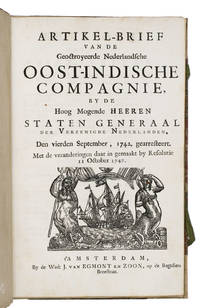
1747ABC_47930Amsterdam 1747. Folio. Wed. J. van Egmont en Zoon Contemporary half vellum sewn on 3 vellum tapes laced through the joints marbled paper over boards with a heart shaped printed title-label on the front board green ties. With a woodcut printer's device on the title page and 2 decorated woodcut initials in the text. 2 2 blank 53 3 blank pp. Very rare work with the terms of employment of the Vereenigde Oost-Indische Compagnie VOC. It contains 121 clauses with rules of conduct and an extra chapter with formularies of oaths. This second revised edition was published after some changes had been made to the rules in 1747. This VOC publication is very rare. It is available in just a few libraries and we have only been able to trace one other copy in sales records of the past 100 years.The clauses deal with everything an employee of the VOC could face during employment. They explain exactly who is in charge how to deal with religion on board of the ships when and how payment of wages takes place what the VOC pays in case of injury or death how to climb in rank rations on the ships the repercussions of illegal trading and the rights of former employees. The VOC struggled with staff shortages throughout the 18th century but the situation became especially dire from 1744 onwards. This was in part because the VOC was not known to be a good employer. The present publication can likely be seen as an attempt by the VOC to improve its image as an employer and attract more staff.With an additional loose large square title-label added before the front flyleaf and with the blindstamp of a previous owner "Gulden Passer - Labores et Constantia - HV" on the front and back free flyleaves. As usual the title has been extended with a slip-cancel mounted under the title partially covering the printers device. The edges of the boards are slightly scuffed. The front endpapers the title page and following blank leaf have been reinforced in the gutter with paper the endpapers are slightly browned with a small brown stain on the title-page and first blank leaf. Overall in very good condition.l Landwehr VOC 940; STCN 17341558X 6 copies; WorldCat 48255045 1200508712 7 copies; cf. Schimmel R. De VOC als werkgever. Een vergelijkend onderzoek naar de invloed van de VOC op maritieme arbeidsmarkten in Azië master thesis 2023. hardcover
19542091202132802401Employment Security Bureau Ministry of Labor 1954. Soft Cover. Fine. Number of pages: 394 pages Size: 25cm Number of books: 1 Employment Security Bureau, Ministry of Labor paperback