210 résultats
1900182761900. Imperial size albumen portraits of faculty and graduates from the medical class at Iowa State University. 1900. Large photo measures 18 x 22 inches. 36 subjects. 27 wear graduation caps and gowns. Only one graduate is female a Mrs. M. L Nell all the others white and male. Throughout the 19th century women left the country in order to pursue medical degrees and fulfill residency requirements. Fierce advocacy by educational activists led to the integration of some colleges by the turn of the century. Female students like this one would have come in at a significant disadvantage proving her qualifications against skepticism in a field notorious for gender discrimination. The value of female doctors for female patients in particular has been profound. One corner of photographer's board bumped does not affect images or text. Photo of the school's medical building set between student portraits in center. Overall very good condition. unknown
18100Silver gelatin photo of nurses in uniform posed in operating room. C. 1900. Measures 8" x 11" inches. Photo shows 25 women arranged in three rows with 3 men standing behind them. The nurses wear long white smocks over gray dresses with white cuffs and small white hats perched on their heads. Their bodies are turned toward the camera but their gazes wander about the room with some looking directly into the camera but others looking elsewhere. Three men in lab coats with black ties visible beneath stand behind them gazing over the women's heads toward the camera. Surgical equipment in the form of two large metal barrels connected by pipes stand against the wall behind the group in the room with tiled floor and subway tiles running floor to ceiling. Nursing in the early twentieth century was one of the few professional fields available to women though opportunities for advancement were rare. In addition to working with patients nurses were required to change and launder linens prepare meals scrub the floors and order supplies. Still the number of women who became nurses rose rapidly through the early twentieth century. Photo is mounted to black photographer's board with "Compliments of.Massey Ltd 235 Yonge st" on verso. The women's names are written in neat rows in pencil on verso. The women in this photo were pioneers in a field they would come to dominate. unknown
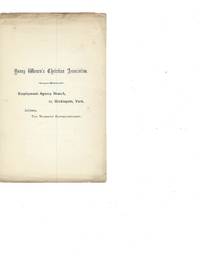
1890164641890. Young Women's Christian Association. Employment Agency Branch. York: Young Women's Christian Association 1890s. This pamphlet In self wrappers details the policies for the Employment Agency Department issued by the Young Women's Christian Association. The World Young Women's Christian Association World YWCA is a movement working for the empowerment leadership and rights of women. Very good. unknown
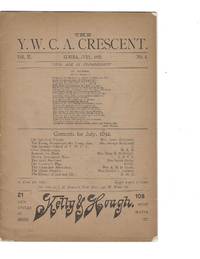
1892164651892. The Y.W.C.A. Crescent. July 1892. Vol. 2 no. 4. Young Women's Christian Association 1892. Newsletter with the slogan "Our Aim is Progress" published by the Young Women's Christian Association. Covers are loose or separated from body of the newsletter. Very good. unknown
1878189841878. Watherston Edward J. The Industrial Employment of Women in France Compared with England. London: Spottiswoods and Co. 1878. French Silk Manufactures and the Industrial Employment of Women. London: Dryden Pres - J Davy and Sons 1879. Both measure 8.5" x 5.25". 16 and 23 pages respectively. The 1878 pamphlet "The Industrial Employment of Women in France." is a comparative analysis of the labor participation rate of women in France and in England. French women were much more integrated into the labor market this study finds even despite the fact that England had a disproportionate demographic surplus of women and an even more developed industrial sector. At the conclusion of the pamphlet Watherston proposes three major steps spur female employment in England based off the French example which are the: "1. Establishment of special training schools for certain trades following a preliminary general education. 2. These training schools. must be made self-supporting within a short time. All pupils must pay a moderate fee for being taught. 3. There should be union of the managers of training schools with all manufacturers wishing to employ female labour. The union must aim both to give employment to women and to advise as to the directions in which it may be sought and into which it may be extended." Watherston lays blame for the poor labor participation rate of English women at the fact that they are barred from major employment sectors such as the railways as well as a private sector which demonstrated no inclination to hire them. He concludes that English women need organization first and foremost and should establish a "Society for the Industrial Employment of Women". <br /> <br /> The second pamphlet focuses on first the history of the French silk industry and later women's employment within it noting the unique advances that the French female silk workers enjoyed. Watherston notes that "Other countries before France made use of female labour but the French were the first who employed not only as we do the hands but also the brains of women. The technical education of female workers took place simultaneously with that of the men and it is to the results of this that not a little of the excellence of the French silk manufactures of the present day is due." Watherston goes on to examine the silk manufacture at Jujurieux which took in young women from a rural underdeveloped region and lodged fed and rigorously trained them in silk production. In both of these pamphlets he highlights and endorses enterprises that transform women into workers often through a process that includes living and training amongst fellow apprentices for years at a time. There is a prevailing belief that women must be engineered into working class subjects through this total immersion but with a confidence that they are technically and intellectually skilled enough should they be properly acclimated. Some minor chipping to left edge 3/4 in. tear on top edge of one pamphlet overall in very good condition. unknown
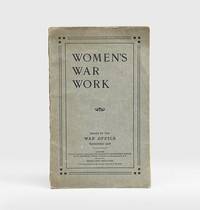
1916183494London: Chiswick Press 1916. First edition of this illustrated government publication promoting women's wartime employment. Women's War Work contains a detailed list of several hundred roles left vacant by men that women successfully fulfilled. Several of these are demonstrated by characterful photographs which show women employed in a range of professions including the postal service factories breweries and shops. The War Office recruited women into the workplace to maintain productivity produce munitions and ensure that as many men as possible were available for the Armed Forces. By July 1916 it was estimated that 750000 women across Britain had taken up such work and the War Office produced Women's War Work in September to further increase their numbers. The preface asserts that employers who had women in their workface would "readily admit that the results achieved by the temporary employment of women far exceed their original estimates and even so are capable of much further extension" p. 5. Women's contributions to the war effort drastically changed public perception of their capabilities and helped women over 30 to achieve enfranchisement in 1918. Provenance: from the collection of the suffrage historian Elizabeth Crawford. Quarto. 72 black and white photographs. Drab paper wrappers front and rear cover printed in black. Library sticker of the Women's Service Library and withdrawal stamp on front inside cover former shelfmark to front cover in pencil former bookseller's price to half-title. Spine repaired loss to ends wrappers lightly toned extremities a little creased extending to outer leaves at bottom corner occasional light finger-soiling to contents but otherwise clean: a very good copy of a fragile publication. unknown
19942083002117803105Working Standards Examination 1994. Soft Cover. Fine. Number of pages: 237p Size: 21cm Working Standards Examination paperback
1919163201919. Women Employment:: This document was created with the intent of finding employment and for women contracted on temporary terms to work in government-appointed positions during World War I. The Committee advised that women have options to become permanent members of the government workforce and be treated equally with male colleagues i.e. equal pay not having additional clerical duties etc. Ministry of Reconstruction. Women's Advisory Committee. Report of the Sub-Committee Appointed to Consider the Position after the War of Women Holding Temporary Appointments in Government Departments. Presented to Parliament by Command of His Majesty. London: Published by his Majesty's Stationery Office 1919.Modern blue card wrappers with paper label. 8 page folio. Very good condition. The sub-committee which wrote this was composed of six women and two men demonstrating the interest and respect for women's work and labor contributions during World War I. unknown
1935189931935. Women's Employment World-War II McConnell Dorothy. Women War and Fascism. New York: The American League Against War and Fascism 1935. 18 pages. Bound in brown cardstock wrappers. Measuring 5.5" x 8". McConnell presents a "protest against the use of women as cheap labor in factories and offices in the U.S. as well as in the fascist states" asserting that "Munitions plants employ women at dangerous tasks with long hours and low wages. Discriminatory laws against women should be defeated and women's wages made equal with men's for equal work". Wrappers are vibrant and unworn. Small penciled inscription on the title page not affecting text. An interesting pamphlet promoting the fight for women's labor safety and equal pay during WWII. Very clean and bright pages in very good condition. unknown
1991x-0792312813Kluwer Academic Pub 1991. Hardcover. New. 1st edition. 182 pages. 9.56x6.52x0.66 inches. Kluwer Academic Pub hardcover