44 résultats
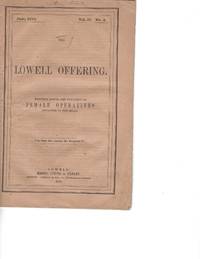
16739Women's Fight for Employment Equality. "Lowell Offering. Written Edited and Published by Female Operatives Employed in the Mills." 1844. Pamphlet. The Lowell Offering was a monthly publication run by women working in the Lowell Textile Mill from 1840-1845. Featuring the women's poetry essays and other literary efforts the magazine gave female factory workers the opportunity to share their creative endeavors; for the women who edited and published the periodical the Lowell Offering also provided demonstrable and employable skills in publishing and journalism. This 1844 edition comes from the penultimate year of the publication. It is the earliest piece in the collection. <br/><br/>Lowell solved the problem of labor at his mills by employing young women between the ages of 15 and 35 who became known as "mill girls". Unlike European industries which had access to "large landless urban populations whose reliance on the wage system gave them few economic choices" American companies had to grapple with a small labor supply because the population was small and most preferred farming their own land and the economic independence that came with it. In order to persuade these young women to work at a mill they were paid in cash once "every week or two weeks". In line with the Boston Associates' worldview the mill girls were encouraged to educate themselves and pursue intellectual activities. They attended free lectures by Ralph Waldo Emerson and John Quincy Adams and read books they borrowed from circulating libraries. They were also encouraged to join "improvement circles" that promoted creative writing and public discussion. unknown books
16565To the Right Honorable Richard Assheton Cross M.P. Secretary of Sate for the Home Department. 4 pages. 8 x 5 in. In this document women workers express fears regarding proposed labor regulations that would limit their ability to earn and would "restrict the paid labour of all women.or even make all married women half-timers." They claim it is unjust treatment that would harm women workers and pit their marriages at odds with their ability to work: "Your Memorialists assert that it is unjust to place restriction son the labour of unmarried women for the presumed protection of married women or mothers and further that any special restrictions upon the labour of married women is practically a penalty imposed on marriage as regards to the woman." Document that reveals the competing priorities for women factory workers between workplace safety and their earning power. Chipping with small losses along top and right edge. Repairs to two tears on page 2. Loss to top left corner. Good condition. unknown books
16577Jessie Boucherett. Legislative Restrictions on Women's Labour. Vigilance Association for the Defence of Personal Rights. Reprinted by kind permission from the "Englishwoman Review." London: Frederick Bell & Co. 1873. First edition. 12 pages. Original paper wrappers. 8 x 5 in. "Another objection is that the Bill confirms the principle that women are not capable of deciding for themselves." This report criticizes regulations proposed to limit the hours that new mothers may work in factories. "It has caused some surprise that Bills framed for so benevolent a purpose should have met with opposition from an unexpected quarter." A major issues Boucherett raises is the fact that there is no social support for married women who cannot work; she reasons that the decrease in hours would leading to "much suffering and some crime" as "it would always be difficult and sometimes impossible for a woman to provide sufficient food for herself and four or five little children." Toning to front cover. Few chips losses along right edge. In good condition. unknown books
16206Women's Employment. Photograph: Original Vintage Gelatin silver print Photograph of Women Civil Servants 1918. Black and white photograph showing a room of over one hundred women seated at crowded desks and tables reading and sifting through piles of letters. 6 x 8 in. Press photo with many handwritten pencil inscriptions in English and Swedish and two stamps. One inscription on center back reads: "The work of the postal censorship. The room where letters to from German prisoners of war are examined". Another line reads: "Engleska postcensuren 1918" or "English postal censorship 1918" in Swedish. Overall good condition with light scattered creasing but a crisp and clear image. An interesting image that shows an one unique way that women's labor and intellectual skills were important to support the war effort of World War I. unknown books
16188Original vintage photograph of a large group of women seamstresses and tailors at their sewing machines in a factory setting. Sepia. Approximately 5" x 8" with back matting. Rows and rows of women sitting in front of sewing machines gaze into the camera. While single women faced barriers to employment wives and mothers confronted prejudice that put their jobs at risk after marriage and childbirth. As women took advantage of expanded access to jobs with the advent of factory lines a new push was made for job security and upward mobility. The women's employment movement first picked up traction in the industrial revolution as women fought to secure fair hours and wages for female factory workers; In the late 1870s and 80s women's organizations lobbied for safe conditions and job protection for married women and mothers; and through the 20th century expansion of skilled female labor including civil service publishing and medicine. Some of the most radical labor organizing in the West happened thanks to women in the textiles industry as women fought to secure prosperity and safety under new work conditions. A beautiful photograph of the spirited women young and old at the front lines of the changing workplace. Baxandall "America's Working Women" p. 94-96 158. Papachristou "Documents of the Women's Movement" p. 126-39. Hunt Oxford Dictionary of National Biography 2004-2005. The Women's Library London School of Economics. Krichmar 2423 2610 2766 2839. unknown books
16265Woman's Work For Woman A Union Illustrated Magazine Published Monthly by the Women's Foreign Missionary Societies of the Presbyterian Church. Vol. XI No. 1. January 1896. New York. 28 pages. Vertical fold down the center of the booklet with soiling on the front and back cover water damage on the top and right edge of the front cover and small losses on the bottom edge of the back cover. Very rare; OCLC locates no other known copies.<br/><br/>Woman's Work for Woman was published from 1890-1904. The magazine contains articles and updates about life in different missionary locations in Asia South America and the Middle East. With most of the submissions by women and with an all women Editorial Committee this magazine is indicative of some of the most acceptable ways for women to participate in public life in the late 19th century. Women were not allowed to participate in Presbyterian church councils or leadership until the mid-twentieth century but working with the Women's Missionary Societies gave new opportunities for writing organizing and leadership positions. In the late 19th century women who sought work outside the home were often criticized for abandoning family and domestic responsibilities but women who pursued religious work did not face this same criticism since they had an altruistic motive. Working on religious causes allowed women agency and independence that they would not be able to access in other occupations. Very rare; OCLC Worldcat locates no known copies at any library or institution. unknown books
16574Women Employment Lucy Wilson. "Women and Legislation." Vigilance Association for the Defence of Personal Rights. June 20 1874. Original paper wrappers. 4 pages. First edition. 8 1/2 x 5 in. A Letter addressed to the Editors of the Leeds Mercury. "These measures all point to one conclusion that motherhood is a crime. The woman who is guilty of it unless.she is rich and independent shall not eat bread for six months thereafter or twelve as the House may determine." In this open letter Wilson decries legislation which would forbid new mothers from working yet fails to provide any public assistance for them to care for their families. "No Act has been passed decreeing that such women shall not suffer cold or hunger or to 'deem that they commit an offence' if they are hungry." Vigilance Association for the Defence of Personal Rights was a British organization dedicated to watching restraining and influencing legislation especially in matters affecting the interests of women and the personal rights and liberties of the people. Small losses along spine. Very good condition. unknown books
16567John Boyd Kinnear. The Right of Women to Labour. Being portions of an essay re-printed by permission form "Woman's Work and Woman's Culture." London: Printed by Frederick Bell & Co. Chelsea S.W. 1873. First edition. 14 pages. Original paper wrappers. 8 x 5 1/4 in. Kinnear a radical Scottish politician and lawyer advocates for the integration of women's labor wherever appropriate: "there are other things which women can do at least as well as men.Then why should women not do it" He brings up the need to defend women workers in the changing atmosphere as they were prevented from "forming effective trade unions to secure their rights" at the same time that increased industrialization was displacing them from factory labor jobs. Very good condition. unknown books
16266Circular of the Working Girls' Society. Bylaws for one of the first organizations in New York that was created specifically to support women workers. Extremely rare.Two very light horizontal fold marks. Light thumb-soiling. 2" tear at bottom of center fold. Very good condition. <br/><br/>The Working Girls' Society was designed to provide space for girls and women to gather take classes and socialize after working hours; it was dedicated to providing working women with a safe and clean space that could help them advance their professional lives. Information in the bylaws related to membership and to members' uses of the organization's library and rooms at 222 West 38th Street. Perks of joining the society the club even include special vacation benefits and discounted train tickets. An extremely rare early document that details the social communities which developed around a larger urban female workforce in the late 19th century. Extremely scarce OCLC Worldcat lists no other known copies of this document in any institution of library worldwide. unknown books
16568Bessie Rayner Parkes. The Market for Educated Female Labor. 1859. First Edition. 8 1/4 x 5 in. Unbound. 6 pages missing last 2 pages. No other copies in institutional or library collection in the US according to OCLC Worldcat. "The daughter may may marry but her husband may die.or be too poor to support her and her children; let her at least be trained beforehand to some possible way of getting her bread." Bessie Rayner Parkes one of the most prominent women's rights activist of her day writes that girls and young women must receive an education or a useful trade in the same way that boys do. "We lay it down as a primary social law conceded by all political economists that a father ought to provide for all his children or give them the means of providing for themselves." She emphasizes how common it is for middle-class women to join the workforce: "Probably every person present has a female relative or intimate friend whom trade-failure the exigencies of a numerous household or the early death of husband or father has compelled to this course; it is the experience of every family." An argument for the importance of skilled and educated women in the work force their place in the market and the challenges that they faced. Repairs to top right corner and right edge of page 1. Small repair to left edge page 6. Good condition. unknown books
19422638New York: National Association of Manufacturers 1942. 20p. wraps. National Association of Manufacturers unknown books
16457The Association of Assistant Mistresses in Public Secondary Schools. Memorandum and Articles of Association. London: Printed by Charles North The Blackheath Press S.E. 1897. This was a document published for the Association of Assistant Mistresses a trade union representing female teachers in British secondary schools. Ex-library copy with stamp and pencil writing on the first page. Very good. unknown books
1657119 cent Women Employment The Twenty-First Annual Report of the Society for Promoting the Employment of Women April 1880. London: Printed by John Bale & Sons 1880. First edition. 8 x 5 in. Original paper wrappers. 30 pages. No other copies in institutional or library collections according to OCLC Worldcat. "The Society is formed for promoting the Training of Women and their employment in industrial pursuits." Includes reports on training needed to participate in different sectors of the workforce including wood carving hospital nursing and hairdressing among others. The Society for Promoting the Employment of Women was established in 1859 by women's rights leaders Jessie Boucherett Barbara Bodichon and Adelaide Anne Proctor to promote the training and employment of women. Light pencil marks in margins. Very good condition. No other copies in institutional or library collections according to OCLC Worldcat. unknown books
16569Women Employment J. B. Remarks on the Obstacles to the More General Employment of Women and on the Means of Removing Them. London: Published at the Office fo the English Woman's Journal Company Limited 1860. First edition. 16 pages. Original paper wrappers. 8 1/4 x 5 1/4 in. A pamphlet supporting strategies for the expansion of women's employment opportunities. It outlines current obstacles to women's work such as hostility from male employees: "Women however cannot be employed in England in this manner because of the jealousy of their fellow workmen. If a master were to employ women in any part of the business the whole of his workmen would strike at once." The document also lists sad consequences of the current work climate: "Workhouses were found to be overcrowded with able-bodies females while charities were besieged with women praying to be provided either with employment or bread." Stain to upper left edge front. Toning to last page. Light pencil marks in margin. Very good condition. Only 2 copies held in library or institutions in the US according to OCLC Worldcat. unknown books
193848531Washington: GPO 1938. xi 99p. wraps slightly worn 8.5 x 11 inches neatly ex library. Running title: Unemployment census 1937. GPO unknown books
16205Employment. Photograph: Early 1900s. Sepia photo showing a line of ten women seated in front of filing cabinets busy at work organizing small documents. Photo is in good condition with small loss in upper right corner and green discoloration at lower right edge. 8 ¾ x 7 ¾ in. Good quality with overall fading to image with three faint fingerprints in ink. Photograph verso has stamp from Swedish photographer Erik Holmen along with graphite and blue pencil inscriptions in Swedish. While this photo was taken in the modern age with a phone and electrical lights prominently displayed many of women's job opportunities were gendered and limited to menial tasks. unknown books
16191Women. Photograph: Female Scientist At Work In Laboratory 1910. Large sepia gelatin photograph. Image measures 9" x 7" with a 10"x8" white boarder. Light toning of boarder. Near fine condition. One female scientist sits at a laboratory table amongst her four male colleges. Her expression unlike the others in sidelong and a little wry. Two men in military uniforms stand at attention in the doorway sunshine pours through the window on the left; on the right hand side are shelves stacked with bottles beakers and cotton swabs. Women were discouraged from pursuing a scientific education let alone a career and those who did found their contributions minimized. Despite the obstacles this original period photo is a testimony to the existence of women in the sciences in the first half of the 20th century. unknown books
196313924San Francisco: the Division 1963. Pamphlet. 34p. 8.5x11 inches wraps a bit worn ex library Berkeley Police Department 8.5x11 inches. the Division unknown books
16566The Employment of Married Women in Manufacture. A Paper read at the Social Science Congress held at Norwich October 1873 by Whately Cooke Taylor Esq. London: Frederick Bell & Co. Steam Printers King's Rd. Chelsea 1874. First edition. 12 pages. Original paper wrappers. 8 x 5 1/4 in. "It is at first sign a very humane sentiment no doubt to assert that married women should be relieved from all hard work because of the duties which maternity casts upon them; but when as that the same time you relieve them of some fifteen shillings a-week without providing any substitute you must not be surprised if they themselves do not view your condescension in the same light." In this document many arguments are made against regulating married women factory workers as women working in agriculture and domestic roles did not face the same restrictions. Very good condition. unknown books
79538Mexico D. F.: various government departments various dates. All books and booklets are in coated trade-size wraps clean and sturdy. The eleven related texts as a lot. various government departments unknown books
1709419th c. Women Education Handwritten letter between female friends at different women seminaries. Jan. 19 1855. "Emily" a teacher at Neversink Seminary in Port Jervis NY writes to a friend Anna Atwood in Elmira NY about starting a Literary Society and raising funds for it. 4 pages folded on a single sheet with 1 page of cross-writing. With original Mailing envelope. Atwood was working at Elmira Collegiate Seminary chartered 1853 just as it was being renamed Elmira College later in 1955; it is the oldest college still in existence which as a women's college granted degrees to women that were the equivalent of those given to men. Regarding the changes at Elmira Collegiate Seminary:"I have been thinking that perhaps I should not be able to recognize your Seminary now for I remember your writing to me some time ago of some improvements that had been made. I presume a change would be less apparent in the persons that occupy it; there are some however whom I think I would recognize as friends." <br/><br/>Emily also gives updates on her school Neversink Seminary: "We have just commenced another term of school. Our last closed on the 11th of Jan. We had only a week vacation; just time enough to see the folk at home without making any visits.I must tell you something about our school last term. You will remember it marked an important era in my life. I like teaching very well though I think I have found more pleasure in studying.  I like it so long as I can keep my class interested. Sometime I can easily do this at other times I find it more difficult then it is that I get discouraged and think that it would be easier for me to learn a lesson and recite it myself than to see that a half dozen mischievous girls get theirs. I have a class of little boys in the Infant Department just learning to read. I enjoy teaching them very much for I can easily keep their attention beside it is encouraging to me to watch their improvement. We had last term fifteen family scholars. I think one will seldom find so pleasant a company of girls as were gathered here." She also writes about creating a literary society for her students: "Miss Jennings who is ever planning something for the benefit of the pupils suggested last term that we should form a "Literary Association" whose object should be the improvement of its members in the arts of Reading Writing Criticism and Conversation.".She generally appoints for each evening one young lady to write an essay another a tale another a criticism and another to prepare a review of some book. She also appoints one to recite a piece of poetry and another to read an extract from some book. Two are also appointed to open the discussion of some question; after the discussion has been opened any member has a right to present her arguments. It is in the discussion that the conversational powers are cultivated. The members are called upon for their criticisms upon the compositions as they are read.The meetings have thus far been very pleasant and I think very profitable. At the close of the term the Society gave a public entertainment. An admission was charged that funds might be raised for the purpose of furnishing a reading room with papers periodicals etc. for the benefit of the members of the Society. Beside the money taken in at the door several donations were made to the Society." She adds a few lines on the subjects which she is teaching: "I am going now to commence a course of Historical Reading. I commenced French last term but one teacher who was a German and who also taught music took French.and since then I have not taken it up again though we have a very good teacher." Original crease lines from mailing folds tender. In very good condition. An excellent piece of of history regarding women's education in the United States. unknown books
16576Woman Employment Vigilance Association for the Defence of Personal Rights. "Legislative Restrictions on Women's Labour." Extract Reprinted by kind permission from the "Manchester Examiner and Times" of Saturday June 20th 1874. First edition Extract. 4 pages. Original paper wrappers. 8 1/2 x 5 in. "Who in thousands of cases where there is no helper will assure them and their children bread" This report criticizes a proposed labor bill that would ban women from working in factories for a period of 6 months after having a child. They find fault in the over-regulation of poor women as opposed to women from wealthy families and the fact that there is no social support for married women who cannot work: ".many married women deserted or uncared for by their husbands.no marriage law secures to the wife a share in the earnings of the father of her children." They compel women to raise their voices against this proposed regulation. The Vigilance Association for the Defence of Personal Rights was a British organization dedicated to watching restraining and influencing legislation especially in matters affecting the interests of women and the personal rights and liberties of the people. No institutions or libraries in the US hold a copy of this book according to OCLC Worldcat. . unknown books
199180803Washington: the Commission 1991. 19p. 6x9.5 inches text in Spanish very good pamphlet in stapled tan wraps. the Commission unknown books
199180802Washington: the Commission 1991. 13p. 6x9.5 inches text in Spanish very good pamphlet in stapled green wraps. Includes some information on people with AIDS. the Commission unknown books
2010192688Center for Education & Employment Law 2010-01-01. 4th. Paperback. Very Good. 2010 edition. Dust jacket has minor wear. Pages are clean and unmarked. Center for Education & Employment Law paperback books