MASAYOSHI, MatsukataAntiquariat.de
MASANIELLOLivre Rare Book
la révolution de Naples.1647
8623Rare gravure originale 355x240mm;marge courte, contrecollée sur vergé.
Charbonnel · Bar le Duc, France150,00 €
353 résultats
1899612454Tokio, 1899. XV, 389 S. OLwd.
1901612427Tokio, 1901. XVIII, 256 S. OLwd.
8623Rare gravure originale 355x240mm;marge courte, contrecollée sur vergé.
1905108258Berger Levrault Broché Paris, Berger Levrault 1905. In-4 broché de XIV + 324 + 48 pages. Dos cassé, sinon bon état
Paris, Berger Levrault 1905. In-4 broché de XIV + 324 + 48 pages. Dos cassé, sinon bon état Broché
26200A Aix, Chez André Adibert, Imprimeur du Roi, vis-à-vis le College, 1782. Five works on one volume. 46 pp.; 46 pp.; 31, (1) pp.; 24 pp.; 9, (1) pp. Small folio. Modern boards. None of these items in Conlon. Each work has a very nice engraved head-piece, and the place, name of printer and date are printed in these head-pieces. The head-piece of the fourth work depicts a castle and a house. Deals with the right of tax collecting (tax-farming) by Chabert and the predicted amounts of money to be collected. Chabert won the right to collect the taxes among the members of the guild, and for which right he paid the guild of cobblers, but revenues fell far behind what was predicted/expected. At least one of the reasons was the emigration of vast numbers of "garçons" as a response to measures taken by the guild itself, another the departure of many cobblers after a large fleet had left Marseille. The question here is if Chabert is entitled to discounts or refunds of money he already paid to the guild and if he is to be held accountable for failing to collect the predicted/expected sums of money.The first text is preceded by a handwritten summary of the entire matter of two pages, the second piece has handwritten annotations at the end stating the Chambre de Tournelle affirmed the verdict by arret of 16 july 1782: the second piece finds the guild (the Maîtres Cordonniers) guilty.
2510420 Mars 1745. 20 pp. 4to. Modern boards. Concerning the new taxes on merchandise and the 'centieme denier', the tax of one percent per 100 levied on all movement of property or use of buildings (immeuble). Interesting manuscript, a bit difficult to read due to the handwriting.
7095Paris, Groupe d'action des contribuables parisiens, 1934. In-12, broché.
32 pages. Features: Cover illustration representing the waking up of the old American dances; News Bits; How Deadly Snake Venom is Collected to Save Lives; Peddling U.S. Citizenship Rights - the farce of making American citizens in bunches - forcing a hyphenated allegiance i.e. "Induced Naturalization" should be stopped; Gain, Not Glory, Guides the Chinese Soldier - their military tactics are beginning to change under the impact of modernism (with photos); Dr. Joseph Collins Gives "My Definition of a Freudian" (part 3) - the monstrous doctrine of Freud is further and brilliantly exposed; Researching the Colossus of Rhodes - did this statue bestride the harbor entrance?; Mr. (Henry) Ford's Page - Industry's service is social, and so must be judged; Editorial comments on censorship of pictures sent abroad (after recent Japanese revulsion), concern of Colonel House visiting the Whitehouse, and more; A Shylock Nation? - Here are the facts about American financial support to foreign nations; How Connecticut Handled the Movies - Movie trust faces defeat on taxes and the showing of immoral pictures; The Tichborn Claimant, by Charles J. Finger; Helping the Blind to See - photo-illustrated article shows how boys and girls use their fingers to see; Sidelights on Richard Harris Barham, author of Ingoldsby Legends; The Signers - 56 of 1776 - three from New Hampshire including Dr. Josiah Bartlett, Dr. Matthew Thornton, and Willian Whipple; The "Comeback" of Artist H.L. (Harry Loud) Bridwell; Items read in the papers; Instructions for Waltz dancing, including piano sheet music for "An Old Southern Waltz"; Back cover devoted to excellent Daniel Webster quote about showing the world that an elected government can maintain public liberty. Unmarked with average wear. Binding intact. A sound vintage copy. Book
19133077827Jena, Fischer, 1913. VI, 185 S. OKart.
17357Londres, 1787. 88 pp. 8vo. Modern half morocco. Kress B.1266 (other edition); Goldsmiths 13454 (other edition); Einaudi 3412 (other edition); INED 2915 (other edition); Stourm, pp. 145-146 (other edition). One of three editions from the same year, no priority has been established. The French crown faced bankruptcy when the Controller-General, Calonne, presented a financial scheme to end the crisis. The keystone in his program was a tax to be levied on all property owners without discrimination of estate. Calonne also proposed liberating commerce in grains from all internal tariffs. When Calonne was unable to pass this in the Assembly of Notables, he was replaced by Loménie de Brienne. 'Linguet lent the support of his publicity to the Calonne property tax and published this work just after the Notables had turned down Calonne's master plan. (.....) Linguet viewed it as a means by which the government, provisioned in grains, could compete with entrepreneurs, control the market price of wheat, and in that way guarantee the lives of an impoverished and progressively more restless population of dispossessed persons. Linguet saw the unpopular tax program as a key government stratagem for warding off two spectres: bankruptcy and a people's revolution' (D. Gay Levy, The Ideas and Careers of Simon-Nicolas-Henri Linguet, p. 240). - Name on title.
17358No place, (1788). 2 works in 1 volume. 144, (2) pp.; 12 pp. 8vo. Modern boards. First work: Kress B.1266 (other edition); Goldsmiths 13454 (other edition); Einaudi 3412 (other edition); INED 2915 (other edition); Stourm, pp. 145-146 (other edition). One of three editions from the same year, no priority has been established. The French crown faced bankruptcy when the Controller-General, Calonne, presented a financial schem to end the crisis. The keystone in his program was a tax to be levied on all property owners without discrimination of estate. Calonne also proposed liberating commerce in grains from all internal tariffs. When Calonne was unable to pass this in the Assembly of Notables, he was replaced by Loménie de Brienne. 'Linguet lent the support of his publicity to the Calonne property tax and published this work just after the Notables had turned down Calonne's master plan. (.....) Linguet viewed it as a means by which the government, provisioned in grains, could compete with entrepreneurs, control the market price of wheat, and in that way guarantee the lives of an impoverished and progressively more restless population of dispossessed persons. Linguet saw the unpopular tax program as a key government stratagem for warding off two spectres: bankruptcy and a people's revolution' (D. Gay Levy, The Ideas and Careers of Simon-Nicolas-Henri Linguet, p. 240).Second work: Not in Kress; not in Goldsmiths; not in Einaudi; not in INED; not in Stourm.Calonne's reforms failed, Brienne's attempts failed, and the King gave in, recalled Jacques Necker to face the acute financial crisis, recalled the parlements and annulled all judicial reforms. Linguet answered with number 116 of his Annales again proposing fiscal reform. The parlements answered by ordering this number 116 to be lacerated and burned. The present work is Linguet's protest against these decisions by the parlement. - Inner margin of the first title and last leaf of the second work strengthened.
19303354372Berlin, Heymanns, 1930. 49 S. Mit 8 farbigen Tafeln. OKart.
188010593Paris, Librairie Générale, 1880 ; in-8, broché ; (4), 75 pp., couverture jaune imprimée.
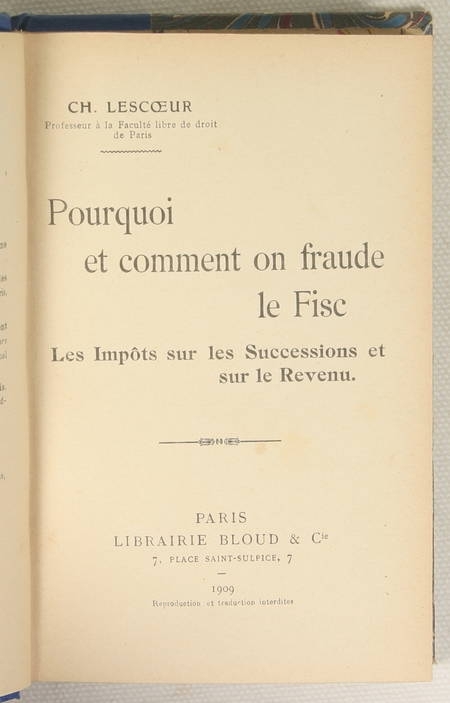
19096495Paris, Librairie Bloud, 1909. 525 g In-12, demi percaline bleue, [2] ff., 277-[3] pp.. Cachet ex-libirs D. Maray. . (Catégories : Impôts, )
190021863Lyon, Imprimerie Emmanuel Vitte, 1900 ; in-8 (274 mm), demi-maroquin à coins vert-malèze, dos à quatre nerfs, tirte doré (reliure de l'époque) ; 210 pp., X illustrations de Rogatien Le Nail gravées sur bois.
5690217e année - N° 821 - Vendredi 13 mars 1936 - 10, rue J.-Récamier. Lyon 6me - grand in-8 broché - revue illustrée
18596A Caen, Chez Gilles le Roi, 1765. (2), 57, (1) pp. 4to. Modern marbled boards. INED 2728; not in Kress; not in Goldsmiths; not in Einaudi; not in Conlon. First edition. 'Mémoire historique et économique exprimant la misère des curés 'portionnaires' et les moyens d'y remédier' (INED). - Two small holes in inner margin of title-page.
1636GF328431636 Paris - Jean Bessin - 1636 - 1 volume in8 de 26 - 639 - 35 pages - Reliure plein vélin d'époque - quelques piqures et rousseurs mais bon exemplaire -
45237P., Juris-Classeurs, sans date, grand in 8° broché, XVIII-185 pages.
pp. (12), 150 [i.e. 251], (1), bel frontespizio inciso su legno, con stemmi e il ritratto dell’autore, e numerosi legni nel testo. Tra p. 214 e 215 inserite 4 carte con una nota manoscritta e alcuni calcoli. Legatura in piena pergamena con titolo manoscritto al dorso. Seconda edizione italiana. rara opera di matematica, interessante specialmente per le parti dedicate all’aritmetica mercantile, alla riscossione dei tributi e al commercio. Vari gli argomenti che vengono trattati, sia di calcolo, che istruzioni per la costruzione di torri, pozzi, strade ecc.; ma anche metodi per misurare le superfici di terreni piani edificabili e zone montuose, calcolare la portata dell’acqua di un fiume, misurare gli edifici; molti i riferimenti agli usi e costumi napoletani. La sua opera dimostra a pieno l’attenzione che la Chiesa iniziava a dimostrare nei confronti dei bisogni della popolazione. Lapazzaia nacque a Monopoli da famiglia oriunda albanese. Matematico e sacerdote, fu canonico della cattedrale di Monopoli e protonotario apostolico. Insegnò matematica e geometria. Morì nel 1564. Smith (Rara) p. 322: «He considers also the rule of three, the rule of five, interest, exchange, partnership, alligation, rule of false, and the extraction of roots». Riccardi VII, 51. Manca ad Adams. Sullo stampatore v. Diz. tip. edit. it. pp. 242-45.
Dans ce prône, l'évêque constitutionnel qui eut l'abbé Grégoire pour élève, défend l'impôt qui, quand c'est la nation qui en règle le système et la distribution « n'est plus une taxe » et met en garde contre une désaffection à l'égard des conquêtes révolutionnaires qui pourrait suivre son introduction: « être esclave n'était que votre malheur. Le redevenir serait votre opprobre et votre crime. Il conclut par ses mots « Malheur au peuple Français, si jamais la constitution prend des nuances qui rassurent et qui apaisent les ennemis de la liberté ». « Même s’il conserve une notice dans la plupart des dictionnaires, le nom d’Adrien Lamourette n’évoque plus grand chose aujourd’hui . Au mieux se rappelle-t-on, en esquissant un sourire, le « baiser Lamourette », cette scène de réconciliation générale des députés provoquée par un discours de Lamourette appelant à l’union autour de la Constitution, lors de la séance du 7 juillet 1792, en plein débat sur la « patrie en danger ». « Le surnom populaire donné à cette scène et, plus généralement, le patronyme même de son auteur, de surcroît un ecclésiastique, n’incitent pas à prendre au sérieux le personnage. Pourtant, au vu de son itinéraire, il apparaît comme ayant joué un rôle non négligeable pendant les premières années de la Révolution » Caroline Chopelin-Blanc, in Annales historiques de la Révolution
191942967- 43 x 60 cm. 4 pages. Replié pour envoi sous bande.
19293628158Greifswald, Bamberg, 1929. 107 S. Kart. (Stempel auf Vorsatz und Titel, Bibliotheks-Rückenschild).