170 résultats
25669Paris Chez Durand / Pissot 1751 in 12 (16,5x10) 1 volume reliure pleine basane fauve marbrée de l'époque, dos à nerfs orné, tranches teintées rouge, 1 faux feuillet non chiffré de table des chapitres, 366 pages, et 3 faux feuillets non chiffrés (approbation et privilege du Roi). Louis-François de Jouy, Avocat au Parlement. Edition originale. Bel exemplaire ( Photographies sur demande / We can send pictures of this book on simple request )
18132A Amsterdam (France), 1764. With engraved frontispiece. 37, (1) pp. 8vo. Modern boards. Kress S.4328; INED 4546; not in Higgs; not in Goldsmiths; not in Einaudi; Weller, Die falschen und fingierten Druckorte, ii, p. 166. First edition. Very sharp pamphlet against the fermiers généraux. The author remained unknown, but 'on avait pourtant arrêté et mis à la Bastille un nommé Darigrand auquel on attribuait l'Antifinancier, qui parait avoir été écrit par la même plume que les Antropophages; mais il fut relâché avant la mise en circulation de ce dernier libelle' (INED). - Title-page and first few leaves browned.
1872LCI-4216Lille Imprimerie Danel 1872 1 Grand in -8 Broché couverture Illustrée 87[p.p]
GF269794 pages in8 - bon état -
22875En France, 1751. 70, (2) pp. 8vo. Modern boards. Conlon S51:11; not in Kress; not in Goldsmiths; not in INED (see 1094 for the work by Chauvelin). The 'Avis de l'Editeur', printed verso title-page states the first manuscript was lost and that it had been necessary to ask the author for another copy of the manuscript. The author did indeed supply another copy of the manuscript but only after he had made considerable changes in the text. This suggests that this is the first printing of the text. The Examen Impartial was written by the Abbé Louis-Philippe Chauvelin in which he argued that, although the clergy was entitled to its special prerogatives, it could not use these to claim total exemption from taxation.According to Conlon a second volume was published in 1753 entitled 'Suite des Lettres Critiques ....'. Conlon also knows of no other edition but the present one as the first publication of this text.
18316No place, 1758. (2), 251, (1) pp. 12mo. Modern half calf, marbled boards, spine with raised bands and gilt lettering. Higgs 1762; not in Kress; not in Goldsmiths; not in Einaudi; not in INED; Conlon 58:388. First edition. Concerning the rights of the Cour des Comptes in matters of taxes and expenditure of the Provence.
14680S.l 1789 in 8 (21,5x14) 1 volume broché sous couverture muette d'attente de l'époque (papier gris), titre, 187 pages et XXIII, non rogné. Bon exemplaire ( Photographies sur demande / We can send pictures of this book on simple request )
23537A Londres, 1787. 24 pp. 8vo. Modern boards, original blind covers preserved. Kress B.1261; Stourm, p. 137; not in Goldsmiths. First edition. On French government finances and especially the taxes on the eve of the revolution. The author also sharply rejects the privileges of the clergy, the class that does not pay taxes, has accumulated an enormous wealth and is yet again exempted from paying taxes. The nobility also has priviliges but the author intelligently observes that the nobility is used to sacrifice and serving the state in various capacities, and, contrary to the clergy, it's position in the state is closely tied to the state itself, in other words, a collapse of the state will have immediate impact on the nobility and their status. It discusses the position of Calonne and the possibilities of reform and the various forms of opposition any reform will provoke from various groups.
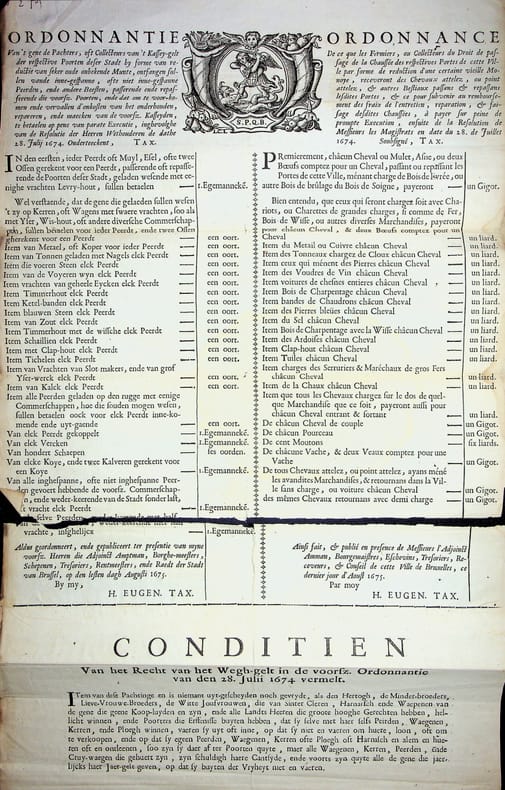
015599[Bruxelles] Placard de l'ordonnance du 28 juillet 1674 sur les taxes sur le transport de marchandise. [Bruxelles], s.n., 1675. In-folio (51.5*31.5cm environ). Placard, en français et en flamand, de la publication de cette ordonnance, le 31 août 1675, avec les montants des taxes suivant les marchandises transportées (les bourgeois de Bruxelles en étaient exemptés) en liard ou en gigot (= 1/2 liard). Belle gravure en tête avec Saint Michel terrassant le dragon et les initiales S.P.Q.B. (Senatus Populusque Bruxellensis i.e. le conseil communal et le peuple de Bruxelles). Mouillure ancienne, placard découpé en deux à un pli avec manques minimes. Rare document. [144]
18329A Paris, Chez Durand Neveu, 1775. (4), 457, (1, blank), (6) pp. 12mo. Contemporary marbled calf, spine gilt with raised bands and gilt lettering, lightly rubbed and shaved along extremities. Goldsmiths 11324; Higgs 6218; not in Kress (citing the 1751 edition 5127); not in Einaudi; not in INED. Last and best edition. Louis-François de Jouy specialized in canonical law and gained a reputation of such high learning that the clergy of France nominated him into one of their councils. The present work is a detailed survey of the history of the Dîme, its various definitions such as the Dîmes ecclésiastiques, the Dîmes inféodées, the Dîmes personelles, etc., etc.
055346Pars Bureau du Journal des Douanes Nationales de France 1791 in 8 (19,5x12) 1 volume reliure basane foncée de l'époque, dos lisse orné, tranches teintées rouge, XXIV et 180 pages, cachet du Bureau du Journal des Douanes Nationales de France, fente sur le plat supérieur. Bon exemplaire
13187Lettre patente du Prince de Chimay donnée à Paris le 12 mai 1722 par laquelle il confère ses pouvoirs et la perception des ses droits au chevalier de Lisogne dans ses terres seigneuriales de Révins et Fumay. Document de 4 pages entièrement manuscrit sur vélin 495 x 360mm . Signature du Prince CHIMAY (sans le sceau) .
17155Londres (Paris?), 1751. 3 parts in 1 volume. (6), 112 pp.; 175 pp.; 171 pp. 12mo. Contemporary marbled calf, spine gilt in compartments, gilt fillet on sides, marbled edges, spine somewhat rubbed, slightly damaged at head and foot. Stourm 81; Conlon 51:499; INED 1094 (one part only); not in Kress; not in Goldsmiths; not in Einaudi. First edition. Legal and historical work dealing with Machault's plans to tax the ecclesiastical properties. The clergy maintained that they were exempt from tax and that whatever they paid was a voluntary gift. Chauvelin maintains that the clergy can not be exempt from taxes if the king thinks he ought to ask a contribution from them. The issue was hotly debated at the time, as the long list of works cited by Stourm shows. The work was condamned, Machault's plans failed and the exempt position of the clergy was maintained upto the revolution.
17615Paris, 1649. 2 volumes in 1. 32 pp.; 32 pp. 4to. Modern boards. Moreau 652; Kress 788; Goldsmiths 1019; INED 4055; not in Einaudi. First edition of this very rare pamphlet offering thoughts on the power of the king in financial matters and on the organisation of the collecting of the taxes. 'Très remarquable pamphlet' (Moreau). See for an elaborate account of the man and his works Dictionnaire de Théologie Catholique, xii, 2e partie, col. 2042-2044. - Very rare, especially with the second part.
183510721Paris, Carilian-Goeury (Corbeil, Bary éditeur et Crété imprimeur), 1835 ; in-8, broché ; (4), 200 pp., couverture bleue imprimée.
17357Londres, 1787. 88 pp. 8vo. Modern half morocco. Kress B.1266 (other edition); Goldsmiths 13454 (other edition); Einaudi 3412 (other edition); INED 2915 (other edition); Stourm, pp. 145-146 (other edition). One of three editions from the same year, no priority has been established. The French crown faced bankruptcy when the Controller-General, Calonne, presented a financial scheme to end the crisis. The keystone in his program was a tax to be levied on all property owners without discrimination of estate. Calonne also proposed liberating commerce in grains from all internal tariffs. When Calonne was unable to pass this in the Assembly of Notables, he was replaced by Loménie de Brienne. 'Linguet lent the support of his publicity to the Calonne property tax and published this work just after the Notables had turned down Calonne's master plan. (.....) Linguet viewed it as a means by which the government, provisioned in grains, could compete with entrepreneurs, control the market price of wheat, and in that way guarantee the lives of an impoverished and progressively more restless population of dispossessed persons. Linguet saw the unpopular tax program as a key government stratagem for warding off two spectres: bankruptcy and a people's revolution' (D. Gay Levy, The Ideas and Careers of Simon-Nicolas-Henri Linguet, p. 240). - Name on title.
26200A Aix, Chez André Adibert, Imprimeur du Roi, vis-à-vis le College, 1782. Five works on one volume. 46 pp.; 46 pp.; 31, (1) pp.; 24 pp.; 9, (1) pp. Small folio. Modern boards. None of these items in Conlon. Each work has a very nice engraved head-piece, and the place, name of printer and date are printed in these head-pieces. The head-piece of the fourth work depicts a castle and a house. Deals with the right of tax collecting (tax-farming) by Chabert and the predicted amounts of money to be collected. Chabert won the right to collect the taxes among the members of the guild, and for which right he paid the guild of cobblers, but revenues fell far behind what was predicted/expected. At least one of the reasons was the emigration of vast numbers of "garçons" as a response to measures taken by the guild itself, another the departure of many cobblers after a large fleet had left Marseille. The question here is if Chabert is entitled to discounts or refunds of money he already paid to the guild and if he is to be held accountable for failing to collect the predicted/expected sums of money.The first text is preceded by a handwritten summary of the entire matter of two pages, the second piece has handwritten annotations at the end stating the Chambre de Tournelle affirmed the verdict by arret of 16 july 1782: the second piece finds the guild (the Maîtres Cordonniers) guilty.
103403A Paris, Par la Compagnie des Libraires Associés, 1768, 1 volume in-12 de 172x105 mm environ, 102 pages, demi maroqui à coins cerise, dos à nerfs portant titre et date dorés, tranche de tête dorée, gardes marbrées. Ex-libris du libraire-éditeur H. Baillière sur le premier contreplat. Petits frottements sur le cuir, sinon bon état.
24695A Paris, De l'Imprimerie Royale, 1785. With three folding tables. (2), 106 pp. 4to. Modern boards. Conlon 85:615; not in Kress; not in Goldsmiths. First edition. Signed at end by Le Roy, Tillet and Desmarest.The contents can be best summarized by giving the drop-head title on page one: Rapport fait à l'Académie, Relativement à l'advis que le Parlement a demandé à cette Académie, par arrêt du 6 Septembre 1793. Sur la contestation qui s'est élevée à Rochefort, au sujet de la taxe du Pain; sur les Expériences qui ont été faites dans cette Ville à ce même sujet, en exécution d'un arrêt du Parlement du 7 Juin 1781; & sur les moyens d'établir le prix juste du Pain, proportionnément à celui du Blé, suivant la quantité de Farines différentes qu'une quantité de livres de Blé peut rendre, & suivant la quantité de Pain que ses Farines doivent donner. - Small brown spot in inner blank margin of title-page, else a fine copy.
26760Paris Chez Durand Neveu, Libraire 1775 in 12 (17,5x10,5) 1 volume reliure plein veau fauve marbré de l'époque, dos lisse orné, pièce de titre de maroquin rouge, tranches marbrées, faux-titre, titre, 457 pages, et 2 faux-feuillets non chiffrés d'approbation in fine, toute petite trace claire sur l'extrémité de la marge supérieure, petite usure au niveau de la coiffe supérieure, supra libris sur le plat supérieur: Lascoux. Nouvelle édition revue, corrigée & considérablement augmentée. Bel exemplaire ( Photographies sur demande / We can send pictures of this book on simple request )
17894A Paris, 1776. (2), 155, (1) pp. 8vo. Contemporary marbled calf, spine gilt in compartments, gilt lettering. Kress 7193; not in Goldsmiths; not in Einaudi; this edition not in INED; Camus 1566; Peinot, Livres Condamnés, i, p. 43 (with wrong date). Third edition, published in the same year as the first edition, the other two having only 48 and 72 pages respectively. Pierre-François Boncerf, French writer on agrarian subjects. While a clerk in the ministry of finance under Turgot he published a pamphlet, Les inconvénients des droits féodaux. According to Palgrave the work was published with the consent of Turgot. In it he attacked the contemporary system of feudal dues as ruinous to those who pay them, of little advantage to its benificiaries and contrary to the principles of freedom. The solemn condemnation of the pamphlet by the parlement of Paris, which the king vetoed, and the ensuing controversy in the press, in which Voltaire took a prominent part, established Boncerf's reputation and resulted in the translation of the work into many European languages. The pages 70-end contain the relevant texts by Montesquieu. The work was first published anonymously, a second edition was published with the pseudonym M. Francaleu.
1631PHO-1968Paris, chez Toussainct Quinet, 1631. In-8 (173x114mm), 7ff.-872pp.-8ff., vélin époque, manque au dos, travail de ver avec atteinte à qlqs lettres sur une trentaine de feuillets, petites rousseurs.
17358No place, (1788). 2 works in 1 volume. 144, (2) pp.; 12 pp. 8vo. Modern boards. First work: Kress B.1266 (other edition); Goldsmiths 13454 (other edition); Einaudi 3412 (other edition); INED 2915 (other edition); Stourm, pp. 145-146 (other edition). One of three editions from the same year, no priority has been established. The French crown faced bankruptcy when the Controller-General, Calonne, presented a financial schem to end the crisis. The keystone in his program was a tax to be levied on all property owners without discrimination of estate. Calonne also proposed liberating commerce in grains from all internal tariffs. When Calonne was unable to pass this in the Assembly of Notables, he was replaced by Loménie de Brienne. 'Linguet lent the support of his publicity to the Calonne property tax and published this work just after the Notables had turned down Calonne's master plan. (.....) Linguet viewed it as a means by which the government, provisioned in grains, could compete with entrepreneurs, control the market price of wheat, and in that way guarantee the lives of an impoverished and progressively more restless population of dispossessed persons. Linguet saw the unpopular tax program as a key government stratagem for warding off two spectres: bankruptcy and a people's revolution' (D. Gay Levy, The Ideas and Careers of Simon-Nicolas-Henri Linguet, p. 240).Second work: Not in Kress; not in Goldsmiths; not in Einaudi; not in INED; not in Stourm.Calonne's reforms failed, Brienne's attempts failed, and the King gave in, recalled Jacques Necker to face the acute financial crisis, recalled the parlements and annulled all judicial reforms. Linguet answered with number 116 of his Annales again proposing fiscal reform. The parlements answered by ordering this number 116 to be lacerated and burned. The present work is Linguet's protest against these decisions by the parlement. - Inner margin of the first title and last leaf of the second work strengthened.
18391A Paris, Chez Valleyre père, 1762. (2), x, (4), 468, (20) pp. 12mo. Contemporary marbled calf, spine gilt with raised bands, red edges, corners very lightly bumped. Kress 6021; INED 2614; Higgs 2669; not in Goldsmiths; not in Einaudi; not in Leblanc; not in Masui; not in Stammhammer, Bibliographie der Finanzwissenschaft; not in Camus; Conlon 62:879. First edition. Historical and legal treatise which studies the dîmes in relation to religion, law and the origins of the monarchy and stating that the dîmes were not, at the outset, due to the church. Edme de la Poix de Fréminville studied law. His main interests were related to feudal questions and his works were of importance. - Occasional light browning. Rare.
83927A Montpellier, Chez la Veuve d'Honoré Pech, 1716, 1 volume de 165x215x35 mm environ, 1 recueil et 37 pièces sur le Languedoc, pleine basane fauve tachetée, dos à 5 nerfs portant titres et dates dorés sur pièce de titre bordeaux, orné de caissons à motifs dorés, tranches rouges. Années 1710, 1697, 1698, 1699, partie manuscrite en milieu de volume (année 1698). Des rousseurs, des pages brunies, quelques notes anciennes à l'encre, frottements sur le cuir, manque de papier sur la première page de titre, ex-libris découpé sur la deuxième garde blanche, bon état pour le reste.