353 résultats
27210A Bruxelles, 1779. xiv, 776, (2, errata, blank), 10 pp. 4to. Contemporary calf, spine gilt with raised bands, red label with gilt lettering, marbled edges, some minor blemishes to binding. Kress B.175; Goldsmiths 11860; Einaudi 207; INED 137; Quérard, La France Littéraire, i, p. 126; Dupin/Camus 954bis, pointing to the fact that this work is only complete with the 10 pages supplement, as is the case here; Le Bucher bibliographique, 114. Very rare only edition and suppressed by the Cour des Aides in February 1779 because it was considered contrary to the authority of the Court, it lacked respect for its decisions and it violated the confidentiality of the decisions. This precious and scarce volume, which was not available on the market and which was suppressed in 1779, contains the work of Malesherbes during his tenure in office at the Cour des Aides, that is, the work of 25 years: the reports of the sessions of the Cour des Aides and the remonstrances. It was published with tacit permission and did not contain, in the first instance, those pleas in which Malerherbes addressed the king in quite frank language. These withheld texts were shortly thereafter nevertheless printed and inserted and they form the indispensible 10 page supplement at the end of the volume.The Court des Aides was suppressed, together with the Parliaments, by Maupeou in his attempt at reform; it played, under Malesherbes, a significient role of opposition to what the Court considered to be "royal arbitrariness" and basically shared the "constitutionalist" ideology common to most members of the Grande Robe. The Court was suppressed in 1771 and re-instated in 1774: Malesherbes was recalled to Paris with the reconstituted Cour des Aides on the accession of Louis XVI; it was at this point that he spearheaded the famous 1775 Remontrances of the cour des aides, which detailed the problems facing the regime and envisioned a total overhaul of fiscal policy. Louis XVI was so impressed with the plan -and fearful for the future of his government- that Malesherbes was appointed minister of the maison du roi in 1775. He held office as a royal minister only nine months; the Court proved intransigent in its opposition to his proposals for fiscal restraint and other reforms, including curtailing the arbitrary issuance of lettres de cachet, and he soon found himself bereft of political support. He resigned together with Turgot in 1776.- Pages 71-72 bound between pages 66-67, and with the pages 71-72 bis present, 457-8 omitted in numbering, numbers 465-66 used twice, but text complete.
pp. (12), 150 [i.e. 251], (1), bel frontespizio inciso su legno, con stemmi e il ritratto dell’autore, e numerosi legni nel testo. Tra p. 214 e 215 inserite 4 carte con una nota manoscritta e alcuni calcoli. Legatura in piena pergamena con titolo manoscritto al dorso. Seconda edizione italiana. rara opera di matematica, interessante specialmente per le parti dedicate all’aritmetica mercantile, alla riscossione dei tributi e al commercio. Vari gli argomenti che vengono trattati, sia di calcolo, che istruzioni per la costruzione di torri, pozzi, strade ecc.; ma anche metodi per misurare le superfici di terreni piani edificabili e zone montuose, calcolare la portata dell’acqua di un fiume, misurare gli edifici; molti i riferimenti agli usi e costumi napoletani. La sua opera dimostra a pieno l’attenzione che la Chiesa iniziava a dimostrare nei confronti dei bisogni della popolazione. Lapazzaia nacque a Monopoli da famiglia oriunda albanese. Matematico e sacerdote, fu canonico della cattedrale di Monopoli e protonotario apostolico. Insegnò matematica e geometria. Morì nel 1564. Smith (Rara) p. 322: «He considers also the rule of three, the rule of five, interest, exchange, partnership, alligation, rule of false, and the extraction of roots». Riccardi VII, 51. Manca ad Adams. Sullo stampatore v. Diz. tip. edit. it. pp. 242-45.
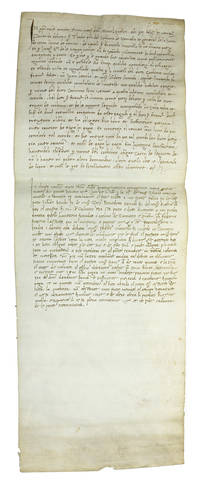
1488ABC_45211Venice 1488. Italian notarial document on vellum 44.5 x 16 cm; text block ca. 27 x 14 cm. Written in two fine cursive hands. A promissory note drawn up by a notary public of the Venetian Republic: Francesco Marcello a Venetian gentleman owed the main commissioner of Venice 3300 ducats for customs taxes in Damascus. The creditor renounces all other claims and Marcello is to pay the debt in 11 annual instalments of 300 ducats beginning the year following the drafting of the document but he was to put up collateral the following month: "Parendo debitor ser Thadio Polo del Cothimo de Damasco et general de la soria de certa suma de denari de i qual ser Francesco Marcello se ne chiama piezo: et per i magnifici siori de le raxon vechie el fo sententiando volontarie in ducati tremillia et trexento per parte. Et perchè per le grande sue adversità come publicamente ognuno intende non è possibele che senza qualche axeveleza el possi pagar et essendo visto et cognossudo questo per li comessi del dicto Cothimo misier Francesco Falier misser Zuan Bembo et misser Benedeto Sanudo azoché scorando el tempo senza qualche conclusion de haverse con qualche habilità a pagar per nome del dicto Cothimo sono venuti a questa ultima conclusion et acordo chel dicto ser Francesco se chiama come piezo debitor per resto de tute raxon de Cothimo et de le uxure seguide computando la sententia tolta ut supra de ducati tremillia et trexento da esser pagadi per el dicto ser Francesco ducati trexento alanno et sia obligato dar bona et sufficiente piezarìa over caution de paga in paga. Et comenza el tempo anno uno da poi concluso tal acordo: et die mexe uno da poi tal acordo dar dicta piezarìa over caution et cussi de paga in paga fin integra satisfatction havendoli isoproducti per nome del Cothimo a pregar Carta de Segurtà de non li haver ni poder altro domandar .". Immediately below this statement is a confirmation by the Damascus consul Giovanni Mocenigo of the obligation to pay the sum of 3300 ducats in 11 annual instalments by the Venetian gentleman Francesco Marcello and his son.A remarkable early Renaissance document concerning a legal agreement set up by the three commissioners of the council of the Venetian court known as the "Quarantia Civil Vecchia" commissioned to oversee the correct collection of the customs tax which was to be paid by merchants on goods imported from or exported to Egypt and Syria.In fine condition. hardcover