170 résultats
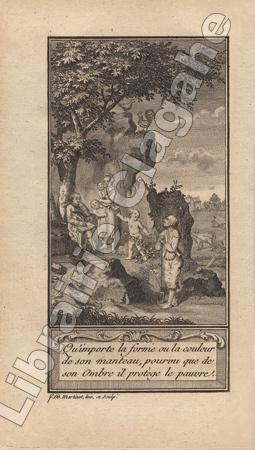
85129Paris, Simon & Nyon, 1785 in-4, 4 pp., vignette.
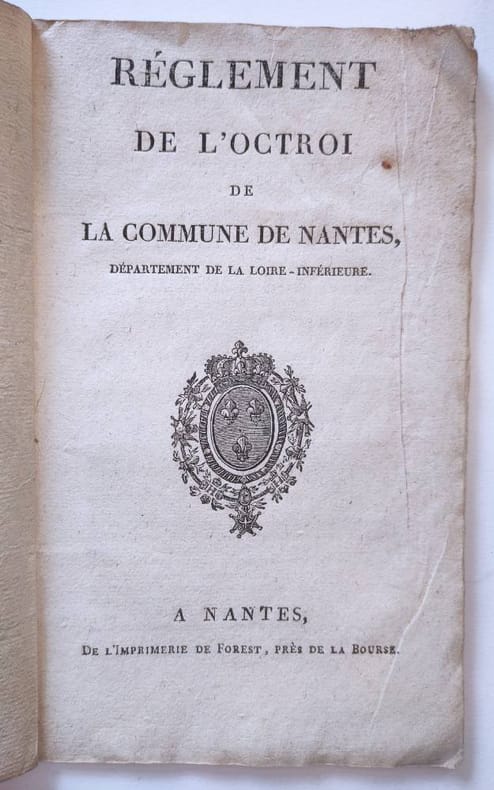
17049De l'Imprimerie de Forest, près de la Bourse Nantes, 1825, plaquette in-12, couverture d'attente de papier bleu, Armes de France gravées au titre, 32pp. Comprend les règles générales de l'octroi ainsi que de précieuses informations sur la ville desservie par de nombreux canaux, la Loire, l'Erdre et la Sèvre. Ce règlement est d'autant moins commun qu'il a été édicté sous le bref règne de Charles X. Trace de mouillure sur les trois derniers feuillets sinon bon état.
ORD-6572Tenu par le Roi à Versailles, le Lundi 6 Août 1787. A Paris, de l'Imprimerie Royale. 1787. In-4 br. sans couverture, vignette gravée sur bois sur le titre, 60pp. Qq. rousseurs, dernière page poussiéreuse.
200605791Colmar, Verlag von Lang und Rafch., 1973 ; in-12, 168 pp., cartonnage de l'éditeur. Aus dem franzosischenubersezt.
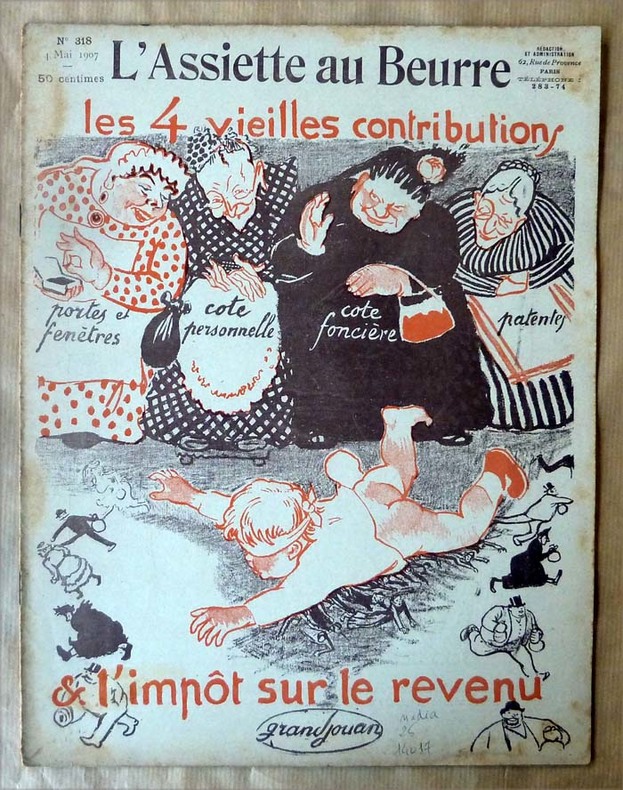
14017paris A la Revue. 4 mai 1907 1 Une revue de format in 4° de 20 pp.; couverture comprise; entièrement illustrée par Grandjouan.
17846769La Haye et Paris, Clousier, 1784 ; deux tomes in-12 ; plein veau marbré, dos lisses ornés, pièces de titre rouges et de tomaison vertes, tranches rouges (reliure de l'époque) ; XVIII, 237 ; 244 pp. et 2 frontispices dessinés et gravés par Martinet.
846Hanoï, Imprimerie d'Extrême-Orient, 1930. 1 plaquette in-8, 28 pp., brochée, enrichie de tableaux, bon état.
1958842251958 Paris, Gonon, 1958, in 8°, cartonnage blanc illustré en couleurs de l'éditeur, 275 pages.
1635GF273751635 Paris - Vitray - 1635 - 1 plaquette in8 brochée de 13 pages - couverture muette en papier rose - quelques pages cornées -
1900273Lyon, Bernoux et Cumin, 1900 ; grand in-8, broché ; 218 pp., 10 planches hors-texte.
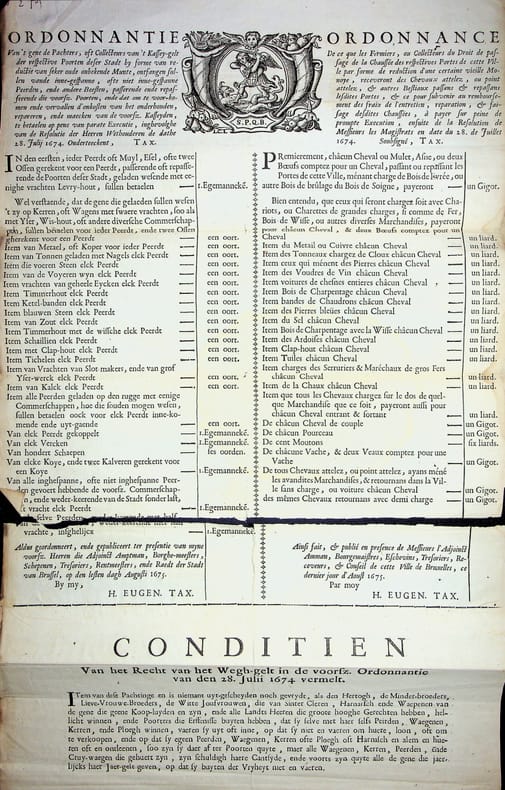
015599[Bruxelles] Placard de l'ordonnance du 28 juillet 1674 sur les taxes sur le transport de marchandise. [Bruxelles], s.n., 1675. In-folio (51.5*31.5cm environ). Placard, en français et en flamand, de la publication de cette ordonnance, le 31 août 1675, avec les montants des taxes suivant les marchandises transportées (les bourgeois de Bruxelles en étaient exemptés) en liard ou en gigot (= 1/2 liard). Belle gravure en tête avec Saint Michel terrassant le dragon et les initiales S.P.Q.B. (Senatus Populusque Bruxellensis i.e. le conseil communal et le peuple de Bruxelles). Mouillure ancienne, placard découpé en deux à un pli avec manques minimes. Rare document. [144]
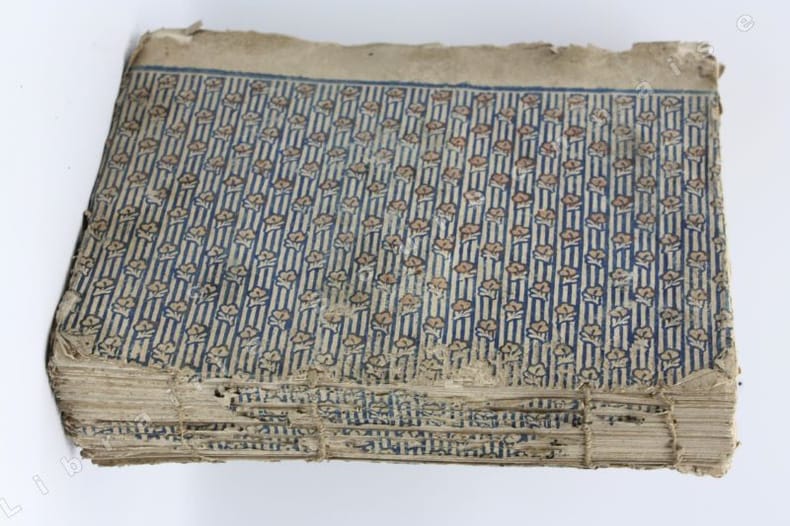
13985Clermont, Antoine Delcros, 1787 ; in-4, broché. 407 pp.-6 pp. (table)-2 ff. (errata). Couverture d'attente de l'époque en papier dominoté, manques au dos. Déchirures marginales sur la couverture. Exemplaire assez frais à grandes marges, non rogné.
14680S.l 1789 in 8 (21,5x14) 1 volume broché sous couverture muette d'attente de l'époque (papier gris), titre, 187 pages et XXIII, non rogné. Bon exemplaire ( Photographies sur demande / We can send pictures of this book on simple request )
191069873Partitions illustrées La SOCIÉTÉ ET SES LUTTES Augor éditeur 1910 approx.
11086Paris, Chez Pierre et Thomas Charpentier; Pièce in-4° de 16 pages, sans couverture telle que parue.
17615Paris, 1649. 2 volumes in 1. 32 pp.; 32 pp. 4to. Modern boards. Moreau 652; Kress 788; Goldsmiths 1019; INED 4055; not in Einaudi. First edition of this very rare pamphlet offering thoughts on the power of the king in financial matters and on the organisation of the collecting of the taxes. 'Très remarquable pamphlet' (Moreau). See for an elaborate account of the man and his works Dictionnaire de Théologie Catholique, xii, 2e partie, col. 2042-2044. - Very rare, especially with the second part.
4571A Soissons, et se trouve à Paris, Chez P.G. Simon, 1764. With woodcut device on title. (2), 76 pp. 8vo. Modern marbled boards, red label with gilt lettering (Laurenchet). Kress 6201; Einaudi 3362; Higgs 3306; Mattioli 1971; INED 2877 (edition 1765); Weulersse, i, xxvii; not in Goldsmiths; Granier, Bibliographie Charitable, 1330; not in Dada. Very rare first edition. Guillaume François Le Trosne (1728-1780) joined the physiocrats in 1764, contributing articles to their journals, and writing works defending their ideas. 'He became one of the most lucid exponents of the physiocratic doctrine; his views express most clearly the evolution of the school. At first an enthusiastic, inflexible adept of the abstract physiocratic system, he nevertheless evidenced a preference for practical questions, as reflected in his La liberté du commerce des grains, toujours utile et jamais nuisible (Paris, 1765).In this work, Le Trosne condemns the vagabond as a parasite on, and an enemy of, society. 'Only in politics did he remain absolutely faithful to absolutism ..... and hostile to democracy, that 'bizarre and monstrous' government which he doubtless pictured in the form of the violent popular demonstrations against the dealer in wheat or as personified by the vagabonds who had set fire to one of the farms of the magistrate' (ESS). Discusses the current situation in France, measures, legal and otherwise, taken to combat or remedy the situation, discusses the distinction to be made between vagabonds and beggars, and discusses possible solutions, one of which is condamning vagabonds to the galleys, and ends with a project for beggars and ways to combat mendicity. 'Ils provoquent le renchérissement de la main-d'oeuvre, car leur oisiveté diminue le nombre des travailleurs; ils favorisent encore l'augmentation des tailles' (INED: They cause the increase of cost of manpower, of labour, as their idleness reduces the number of workers; they rather favor the increase of the "tailles" (a tax)" (our translation)).
18391A Paris, Chez Valleyre père, 1762. (2), x, (4), 468, (20) pp. 12mo. Contemporary marbled calf, spine gilt with raised bands, red edges, corners very lightly bumped. Kress 6021; INED 2614; Higgs 2669; not in Goldsmiths; not in Einaudi; not in Leblanc; not in Masui; not in Stammhammer, Bibliographie der Finanzwissenschaft; not in Camus; Conlon 62:879. First edition. Historical and legal treatise which studies the dîmes in relation to religion, law and the origins of the monarchy and stating that the dîmes were not, at the outset, due to the church. Edme de la Poix de Fréminville studied law. His main interests were related to feudal questions and his works were of importance. - Occasional light browning. Rare.
18071Grenoble, 1708. 49 x 36 cm. Auréole claire sur la partie centrale du document. Tampon "Extraordinaire Dauphiné". Mentions manuscrites des sommes à recouvrer, signatures de Nicolas Prosper Bauyn seigneur d'Angvilliers, Vial, ...Document fixant le montant de l'impôt (montant manuscrit), les dates de recouvrement., contraintes et contraventions en cas de non-paiement.
16499A Londres et se vend à Paris, Chez la veuve Delormel & Fils, 1757. Together 4 works bound in 1 volume. (4), 60, 107, (1) pp.; xxiv, 224 pp.; 109, (1) pp.; 67, (1) pp. and 1 table. 8vo. Contemporary polished calf, spine richly gilt, raised bands, gilt triple fillets on sides, red label with gilt lettering, a very nice copy. First work: Kress 6086-7; Goldsmiths 9873; INED 1276; Higgs 3017. First issue of the first edition. In this vehemently written work, the fermiers-généraux were accused of corruption. It caused the author's imprisonment in the Bastille. The volume was printed by Lambert and distributed by Ormancy, who also were arrested. Four years after its publication the book was still sold secretly at high prices.Second work: Not in Kress; Conlon 75:640 (claiming two volumes).First edition.Of importance for the history of the years preceding the Revolution.Third work: Conlon 82:401.First edition.Fourth work: INED 620; Conlon 57:547.First edition.
16498A La Haye, 1764. Together 3 volumes in 1. (4), 60, 107, (1) pp.; (2), 26 pp.; 24 pp. 8vo. Contemporary marbled calf, spine gilt in compartments, red label with gilt lettering, red edges, lightly worn, some spots. First work: Kress 6086; Goldsmiths 9873; INED 1276; Higgs 3017; Conlon 63:751. First issue of the first edition. In this vehemently written work, the fermiers-généraux were accused of corruption. It caused the author's imprisonment in the Bastille. The volume was printed by Lambert and distributed by Ormancy, who also were arrested. Four years after its publication the book was still sold secretly at high prices. Second work: Not in Kress; Goldsmiths 10025; Higgs 3018; INED 4797; Conlon 63:752.First edition.According to Goldsmiths this is not by Darigrand, but a reply to Darigrand's work, INED also believes this work to be written by another, anonymous, author, Conlon lists it under Darigrand.Third work: Not in Kress; Goldsmiths 10020; Higgs 3268; INED 4778; Conlon 64:441.First edition.Loosely inserted: ARRET de la cour du parlement de Rouen, qui ordonne que la brochure intitulée: Réponse à l'auteur de l'anti-financier, fera lacerée & brulé par l'exécuteur de la Haute-Justice, au pied du grand escalier de palais; enjoint à ceux qui en auroient des exemplaires, de les apporter au Greffe de la Cour, pour y être pareillement lacérés & brulés, &c. Du 9 Avril 1764. (Drop-head title). A Rouen, Chez J.J. le Boullenger, (1764).Not in Kress; Goldsmiths 10017; Higgs 3252.
LFA-126738549Un document format 380 x 355 mm, s.d. (XVIIIe siècle), bon état
17155Londres (Paris?), 1751. 3 parts in 1 volume. (6), 112 pp.; 175 pp.; 171 pp. 12mo. Contemporary marbled calf, spine gilt in compartments, gilt fillet on sides, marbled edges, spine somewhat rubbed, slightly damaged at head and foot. Stourm 81; Conlon 51:499; INED 1094 (one part only); not in Kress; not in Goldsmiths; not in Einaudi. First edition. Legal and historical work dealing with Machault's plans to tax the ecclesiastical properties. The clergy maintained that they were exempt from tax and that whatever they paid was a voluntary gift. Chauvelin maintains that the clergy can not be exempt from taxes if the king thinks he ought to ask a contribution from them. The issue was hotly debated at the time, as the long list of works cited by Stourm shows. The work was condamned, Machault's plans failed and the exempt position of the clergy was maintained upto the revolution.
18836Londres, 1775. 2 volumes in 1. (1), 155, (1) pp.; 275, (3) pp. 8vo. Contemporary marbled calf, spine gilt with raised bands, red morocco label with gilt lettering, small damage to joint at the foot of the volume. First work: Kress 7193; not in Goldsmiths; not in Einaudi; this edition not in INED; cf: Camus 1566; Peinot, Livres Condamnés, i, p. 43 (with wrong date). Third edition, published in the same year as the first edition, first edition with this title. Pierre-François Boncerf, French writer on agrarian subjects. While a clerk in the ministry of finance under Turgot he published a pamphlet, Les inconvénients des droits féodaux. According to Palgrave the work was published with the consent of Turgot. In it he attacked the contemporary system of feudal dues as ruinous to those who pay them, of little advantage to its benificiaries and contrary to the principles of freedom. The solemn condemnation of the pamphlet by the parlement of Paris, which the king vetoed, and the ensuing controversy in the press, in which Voltaire took a prominent part, established Boncerf's reputation and resulted in the translation of the work into many European languages. The pages 70-end contain the relevant texts by Montesquieu. The first edition was published anonymously, the second edition under the assumed name M. Francaleu. Second work: Higgs 6537; INED 3188 (1831 edition); Martin & Walter 24430; not in Goldsmiths (see 11518 for the second edition).First edition. Philosophical and political study on despotism and its effects it pretents to refute the theories of Rousseau while the author in reality attacks straight forward the government. Of actual value seems again his remark 'La nation finit toujours par être plus puissante que le tyran lorsque le pouvoir arbitraire parvenu à son dernier délire a dissous tous les liens de l'opinion et épuisé les ressources que la terre offre à ceux qui la cultivent en liberté. Ainsi les hommes se vengent tôt ou tard.' 'Dans cet insolent libelle, intitulé Essai sur le Despotisme, sous couleur de réfuter les théories de Jean-Jacques sur la bonté naturelle de l'homme, l'auteur s'attaquait de front aux pouvoirs' (Duc de Castries, Mirabeau, p. 105). Important work proclaiming democratic ideas and openly attacking despotism: 'Après cette vue philosophique générale, l'ouvrage s'attaquait seulement au 'despotisme d'un seul'' (Duc de Castries, op.cit)
17894A Paris, 1776. (2), 155, (1) pp. 8vo. Contemporary marbled calf, spine gilt in compartments, gilt lettering. Kress 7193; not in Goldsmiths; not in Einaudi; this edition not in INED; Camus 1566; Peinot, Livres Condamnés, i, p. 43 (with wrong date). Third edition, published in the same year as the first edition, the other two having only 48 and 72 pages respectively. Pierre-François Boncerf, French writer on agrarian subjects. While a clerk in the ministry of finance under Turgot he published a pamphlet, Les inconvénients des droits féodaux. According to Palgrave the work was published with the consent of Turgot. In it he attacked the contemporary system of feudal dues as ruinous to those who pay them, of little advantage to its benificiaries and contrary to the principles of freedom. The solemn condemnation of the pamphlet by the parlement of Paris, which the king vetoed, and the ensuing controversy in the press, in which Voltaire took a prominent part, established Boncerf's reputation and resulted in the translation of the work into many European languages. The pages 70-end contain the relevant texts by Montesquieu. The work was first published anonymously, a second edition was published with the pseudonym M. Francaleu.