4 334 résultats
24854A Londres, Chez Fletcher Gyles, dans Holborn, 1755. (4), 430, (6, Table des Chapitres) pp. 12mo. Contemporary half calf, spine gilt in compartments, gilt lettering, floral ornament in each compartment, green paper covered boards, all edges red. Kress 5423; Goldsmiths 8989; Einaudi 846; INED 933; Higgs 938; En Français dans le Texte, 159; Leblanc 57; Antoin E. Murphy, Richard Cantillon: entrepreneur and economist; T. Hutcheson, Before Adam Smith, pp. 163-178. First edition of Cantillon's great work, 'the most systematic statement of economic principles before Adam Smith's Wealth of Nations' (Roll, p. 121). 'The economic repute of Cantillon, for a time completely obscured by the glory of Adam Smith, can never have rested upon the popularity of his little book, now one of the scarcest works in economic literature .. The influence of the book is evidenced not only by the number but by the distinction of its students, including Gournay, Quesnay, Mirabeau, Turgot, and Adam Smith. It gave birth to Mirabeau's l'Ami des Hommes and apparently suggested much of the Tableau Oeconomique of Quesnay and parts of the Wealth of Nations .. Cantillon avoided, as Jevons has pointed out, the one-sidedness of the Physiocrats; and yet has been marked out as a Physiocrat .. Jevons thought Cantillon wrote 'with the scientific precision of a Cairnes or a Cournot,' and Prof. Marshall refers to his 'thoroughly scientific manner of discussion' .. In France the Essai has been pretty continuously read (see e.g. Ganilh, Des Systèmes d'Economie Politique, 2d. ed. 1821), and so stimulating and suggestive does it remain that its direct influence may be found to be not yet exhausted' (Palgrave, i, pp. 214f). Roll has called this work 'the most systematic statement of economic principles, before the Wealth of Nations' (History of Economic Thought, p. 121).Cantillon, a French banker of Irish extraction, was influenced by Petty, but his own influence was principally felt by the Physiocrat school: Higgs maintains that Quesnay took his fundamental principle of Physiocracy from the Essai. The Essai was written about 1730 and circulated in manuscript. Cantillon died in 1734 and the work was first published in 1755 in French, not in English, as stated on the title.The Essai has been quoted by Smith, Condillac, and Quesnay, plagiarised by Harris and Postlethwayt, and called by Jevons 'more emphatically than any other single work the cradle of political economy'. The work is divided into three sections: a general introduction to political economy, a treatise on currency, and a study of foreign commerce and exchange.'Since the 'discovery' of Cantillon by the English-speaking world following Jevons's enthusiastic article (1881), no less than justice has been done to the merits of the Essay .. Jevons himself noted that Cantillon had presented a treatment of currency, foreign exchanges, banking and credit which, judged against the work of its period, he felt to be 'almost beyond praise' .. It was likewise recognized as early as Jevons that Cantillon had set out the leading ideas of Adam Smith's 'important doctrine concerning wages in different employments' .. and that the Essay contained .. 'an almost complete anticipation of the Malthusian theory of population' (The New Palgrave, i, p. 318). - A very good copy.
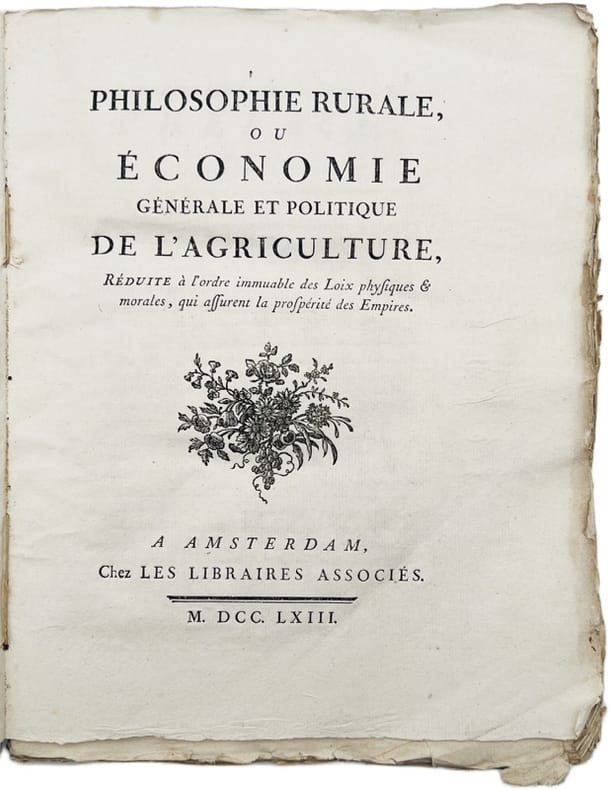
176344659A Amsterdam, chez les Libraires associés, 1763. In-4 broché (275 x 215 mm) de (4)-XXV-(1)-412 pp., 3 tableaux hors texte, couverture de l'époque.
21104No place (Rouen?), 1707. With one folding table. (8), 204, (20) pp. 4to. Contemporary calf, spine gilt with raised bands, gilding faded, a bit rubbed, inner hinge front cover cracked but binding solid. En Français dans le Texte, 134; Bourgeois & André 6702; Stourm 63; Kress 2583; Goldsmiths 4431; McCulloch, p. 342f; Masui, p. 396; Carpenter X (1); this edition not in INED and Einaudi, OCLC and RLIN locate only three copies at Keio, Yale and Minnesota. Very rare first edition, with B4 in cancelled state: on p. 16, a setier is correctly given as weighing 240 pounds, and a notable rarity, of 'an erudite economic work much in advance of its time, and distinguished both by accuracy of method and breadth of view' (Palgrave), 'creditable alike to the heart and the head of its illustrious author' (McCulloch). 'Though the book was published anonymously, and only a few copies issued (for circulation among friends), Vauban had to submit to the mortification of seeing it 'pilloried' by the parliament, while he himself incurred the displeasure of the king (Louis XIV). A few weeks later he died' (Palgrave). The copy of the author himself contained four pages of manuscript in which statements were to be found which could not be printed and in which Vauban, among other things, clearly distinguishes between nobles which have earned their title and position by their actions, whether by their ancestors and by themselves and are an honour to the State, and those who have purchased their titles and are of no use at all to the State. The Projet d'une Dixme Royale is an outstanding work in the field of public finance. Its two most notable features are its understanding of the central role of fiscal policy in economic reform - the result of an exceptionally comprehensive grasp of the economic process - and its use of detailed numerical data to substantiate conclusions. Schumpeter called the work 'unsurpassed, before or after, in the neatness and cogency of the argument ..... Purposefull marshalling of all the available data was the essence of his analysis. Nobody ever understood better the true relation between facts and argument. It is this that makes him an economic classis in the eulogistic sense of the work, and a forerunner of modern tendencies' (Schumpeter, History of Economic analysis, p. 204).According to Boislisle, the first edition was printed in Rouen in 1706 at the initiative of the Abbé de Beaumont (who is actually credited with the authorship of the work by Boisguilbert). Vauban had the sheets bound by the widow of a certain Fétil, and took great pains that the book did not have any public circulation. It was prohibited on 14 February 1707, but apparently the police were only able to seize two copies. To the police, the binder declared she had had 264 copies in total, 12 bound in morocco, the rest in calf. The two copies seized at the Abbé de Beaumont's were described as in 'veau fauve' and marbled parchment. See Arthur Michel de Boislisle, La Proscription du projet de Dime Royale et la mort de Vauban (Mémoire lu à l'Académie des sciences morales et politiques), Paris, 1875. - The folding plate is a very well done xerox on old paper.
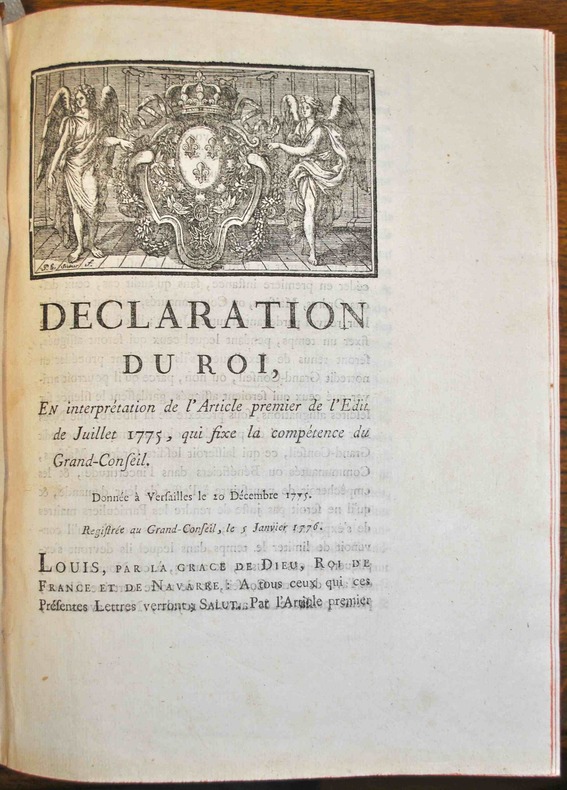
17761699, , 1776. 2 vol. in-4, veau havane marbré, dos orné à nerfs, pièces de titre en maroquin rouge et de tomaison en maroquin citron, tranches rouges (reliure de l'époque).
18439No place, 1758-1760. With engraved frontispiece. 6 parts in 3 volumes. viii, 192 pp.; (2), 266, (4) pp.; (6), 263, (1) pp.; (8), 278, 81, (1) pp.; viii, 167, (1) pp.; (2), 118, (2), 119-279, (5) pp. 4to. Contemporary marbled calf, spines gilt with raised bands, red labels with gilt lettering. Kress 5736; Goldsmiths 9317; Einaudi 3941; INED 3194, 3203, 3206; Higgs 1631 & 2160. Second edition of the first three parts, first edition of the parts IV-VI, constituting the best and most complete edition of the work, and a fundamental physiocratic text. The Ami des Hommes is the fundamental Physiocratic text. 'This remarkable treatise created the greatest sensation throughout the whole of Europe. It is said to have gone through forty editions, and was translated into several languages. Its anonymous author, soon discovered, became the idol of the day, and was generally referred to by the sobriquet which he had chosen for the title of his book ..... After reading the Ami des Hommes (the first three parts, 1756), Quesnay, who agreed with many of the author's opinions, desired to make his acquaintance' (Palgrave, ii, p. 775). Mirabeau now became the fervent admirer of Quesnay, and between them they founded the school of the Physiocrats. In 1758 a fourth part was published in which Quesnay's influence is clearly visible. The final two parts were published in 1760. It is this final part which is of particular importance as it contains the first public appearance of Quesnay's Tableau Economique. There are less than ten copies in the world of either the earlier editions of 1758 or 1759. This work is thus the first obtainable edition of the Tableau Economique. - Very good copy of the rare 4to edition.
171043032Sans lieu, , 1710. Manuscrit in-folio (37,5 x 25 cm) de (24) ff. à l'encre noire, texte encadré, maroquin rouge, dos à nerfs orné à petits fers, triple filet doré d'encadrement sur les plats, tranches dorées (reliure de l'époque).
26435(Paris), 1761. Two works bound in one volume. viii, 336 pp.; viii, 148 pp. 4to. Contemporary polished calf, spine gilt with raised bands, red label with gilt lettering, gilt triple fillet on sides, all edges gilt, a bit rubbed, small damage to head of spine. First work: Kress 5883; Goldsmiths 9602; INED 3209; Higgs 2297; McCulloch 346, Carpenter, Economic Bestsellers, XXI, (2); Einaudi 3946. First edition, the very rare 4to edition. 'Ce fut la première oeuvre vraiment personelle de Mirabeau depuis sa conversion (to Physiocratic doctrines). Le succès en fut très vif. Mirabeau développe les principes de la nouvelle école, avec un franc-parler qui lui attira de nombreux suffrages ..... et le fit emprissoner. Il s'élève nottamment contre les fermiers-généraux, fait une critique sévère du régime fiscal alors en vigueur, et énonce trois conditions nécaissaires à une judicieuse imposition' (INED). The collaboration between Mirabeau and Quesnay seems evident as the Archives Nationales have the manuscript of the text to which lengthy notes by Quesnay have been added. It is one of the principal works of the Physiocratic school and established it in the public eye, which was also due to the ensuing emprisonment of Mirabeau following his very frank manner of expression used in the book. 'Always in strict collaboration with the master, Mirabeau wrote a treatise on one of the major economic problems of the time: the reform of the fiscal system. The Théorie de l'Impot appeared in 1760 and presented one of the Physiocrats' most famous proposals: the single tax on rent' (New Palgrave, iii, p. 870).This is a spirited and able attack on the financial administration of France and especially the Fermiers-généraux, whom Mirabeau regarded as parasites preying upon the vitals of the nation. The work proposes a reorganisation of financial administrative machinery, the abolition of the 'Fermes', a reduction in the taxation upon salt, with the object of increasing the total yield, and a special tax upon tobacco farms. The domaine, the post and the mint were to be further sources of revenue. The author ranks as one of the earliest important writers on taxation. Higgs notes that the book is 'of real importance in the history of financial theory' (Higgs, The Physiocrats, p. 57).Second work: Kress 5963; Goldsmiths 9695; Einaudi 4409; Higgs 3524; INED 3524; Weulersse, i, p. xxvii, all citing the 12mo edition only; Mattioli 2790 (the 4to edition).First edition, the very rare 4to edition.Pesselier was one of the most forceful critics of the physiocrats and here attacks Mirabeau and his Théorie de l'Impôt of the previous year. The work is notable, however, for its affirmation of the characteristically physiocratic doctrine that agriculture holds a priviliged place in the economic system.
176439878A Paris, , 1764. Manuscrit in-8 (14 x 22 cm) de (1)-81 pp. à 24 lignes par page, maroquin rouge, dos à nerfs orné de macles, pièce de titre en maroquin vert, triple filet doré d’encadrement sur les plats, gardes de de papier dominoté, tranches dorées (reliure de l’époque).
172341374A Paris, chez Jacques Estienne, 1723. 2 vol. in-folio de (8)-XXVIII pp. 2002 col. (2) pp. pour le tome I; (4)-1956 col. pour le tome II, maroquin rouge, dos orné à nerfs, triple filet doré sur les plats, armes frappées au centre, tranches dorées sur marbrure (reliure de l'époque).
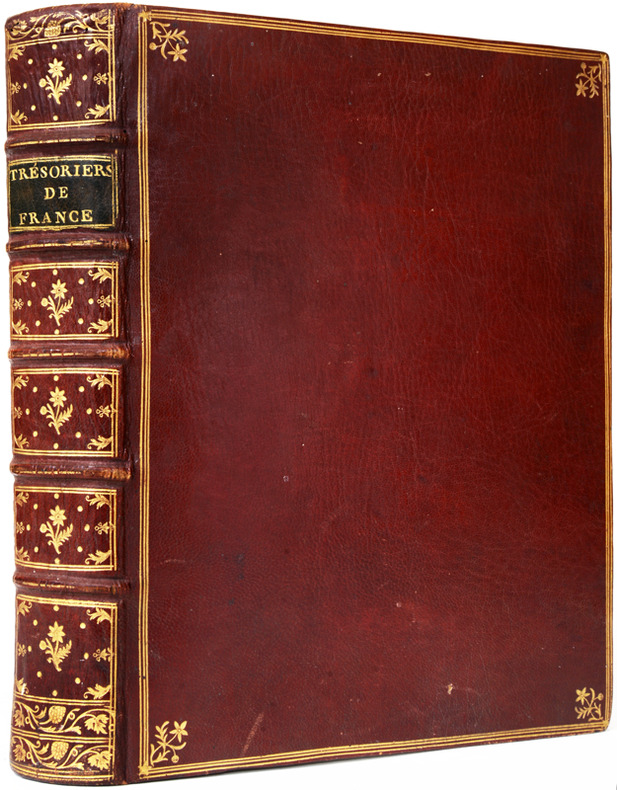
In-4 (253 x 182 mm), plein veau moucheté de l'époque, dos à 5 nerfs ornés de caissons fleuronnés et cloisonnés, pièce de titre de maroquin brique, triple filet doré en encadrement des plats, roulette dorée sur les coupes et coiffes, tranches mouchetées rouges, xlij (titre compris dans la pagination), 414, (2) p. d'approbation, 6 planches dépliantes hors texte. Deuxième édition considérablement augmentée (la première contenait 192 pages). Elle contient de plus que l'originale, entre autres un traité des combinaisons et plusieurs lettres dont l'importante correspondance entre Montmort, Jean et Nicolas Bernoulli (pages 282 à 414) où est exposé le tout premier traitement d’un problème de la théorie des jeux. L'ouvrage est illustré de 6 planches dépliantes hors texte, de 4 gravures en bandeau représentant des joueurs à différents jeux de table, 2 vignettes in texte (backgammon). Marque d'imprimeur sur le titre. Ces représentations d'hommes et des femmes aux tables de jeu, gravées par Sébastien Leclerc, outre leur finesse d'exécution, s'avèrent d'une grande valeur documentaire par leur réalisme. "Le premier ouvrage complet sur la théorie des probabilités, avancée considérable par rapport aux traités de Huygens (1657) et de Pascal (1665). Montmort poursuit de façon magistrale les travaux de Pascal sur la combinatoire et son application à la résolution de problèmes sur les jeux de hasard. Il utilise aussi efficacement les méthodes de récursion et d’analyse pour résoudre des problèmes beaucoup plus complexes que ceux abordés par Huygens. Enfin, il utilise la méthode des séries infinies, comme indiqué par Bernoulli (1690)" (Hald, 'A History of Probability and Statistics and Their Applications before 1750', 2003, p. 290). Pionnier de la théorie des probabilités, Pierre Raymond de Montmort (1678-1719) fut élu à l'Académie des sciences et devint membre de la Royal Society. Il était en relation avec les principaux savants de son temps en France et en Angleterre. L'intérêt de l'ouvrage n'échappa à ses contemporains ni à ses multiples applications pratiques possibles: "arithmétique politique", agriculture, commerce, monnaie (il a été lu par John Law), navigation, démographie, etc. (cf. son éloge par Fontenelle dans le recueil 'Histoire de l'Académie royale des sciences', 1719, vol. I, p. p. 83-93). L'adresse au titre est imprimée sur un papillon qui masque celle du premier éditeur Jacques Quillau. (Brunet, III, 1870. Goldsmiths'-Kress, n°5090.2 suppl.). Cet exemplaire contient, une languette de papier interfoliée à l'époque sur laquelle se trouve une correction manuscrite d'équation complexe (p. 64). Une petite correction manuscrite page 43. Minime trou de ver aux 2 premiers feuillets. Quelques rares rousseurs et petites auréoles claires, qqs feuillets uniformément brunis. Petites traces de restauration à la reliure. Bel exemplaire, très bien relié à l'époque.
39495In-folio (407 x 275 mm), demi-veau brun à coins, dos à 6 nerfs filetés et soulignés d'un filet et d'une roulette dorés, palette en pied, titre de maroquin (reliure XIXe dans le goût de l'époque), (2), 25, (1) pages , (74) planches hors-texte dont la table, 52 pages et une planche hors-texte (n°12), 31 (i.e. 29), 8 et 10 pages, exemplaire non rogné. [Amsterdam], Gedrukt tot waarschouwinge voor de Nakomelingen, in 't noodlottige jaar, 1720-1721.
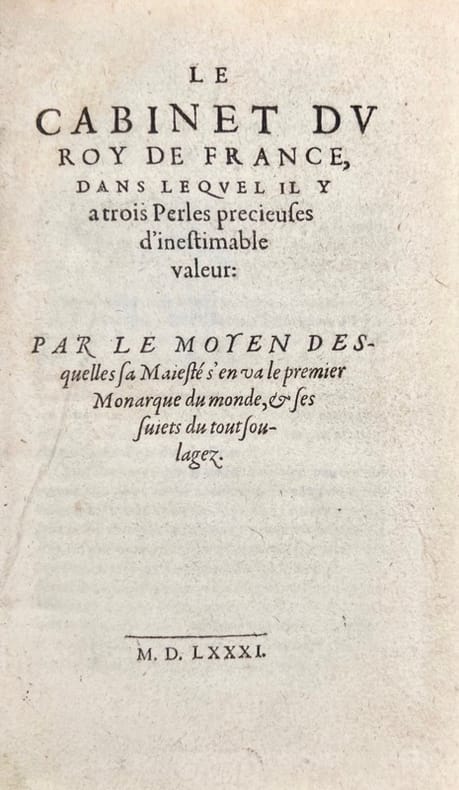
15814047Sans lieu, , 1581. In-8 de (16)-647-(11) pp., vélin dur à recouvrement (reliure de l'époque).
158241451Sans lieu, , 1582. In-8 de (16)-647-(11) pp., maroquin vert, triple filet doré sur les plats, dos richement orné, tranches dorées sur marbrure, roulette intérieure, gardes de papier rose (reliure du XVIIIe siècle).
158143417Sans lieu, , 1581. In-8 de (16)-647-(11) pp., maroquin vert à long grain, dos orné avec décor aux petits fers et aux mille points dans les caissons avec petite pastille mosaïquée rouge, roulette et filets dorés d'encadrement sur les plats, doublure et gardes de moire rose, tranches dorées (Rel. P. Bozérian).
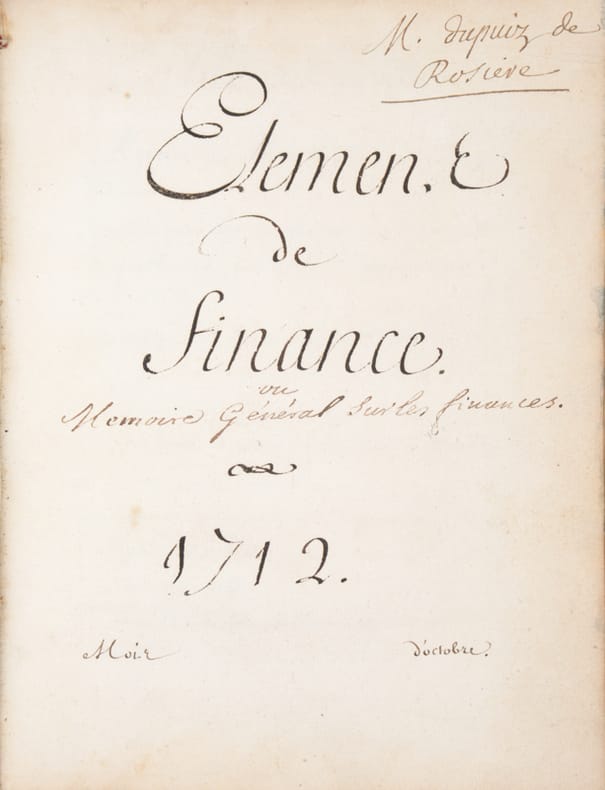
171213791, , 1712. Manuscrit petit in-4 (15 x 20 cm) à 18 lignes par page d'une écriture lisible à l'encre brune de (6)-119 pp. chiffrées 117 (page 35bis), veau brun, dos orné à nerfs, tranches marbrées (reliure de l'époque).
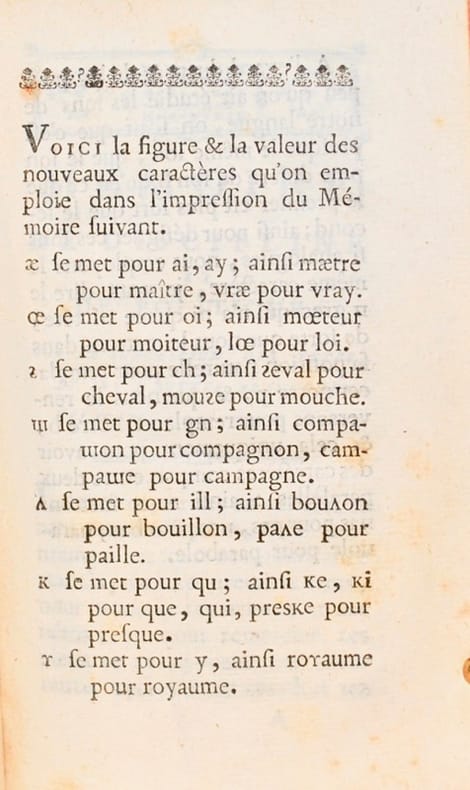
17662609[], [], [1766]. In-12 de (4)-70 pp., maroquin rouge, titre doré en long, filets dorés d'encadrement sur les plats, tranches dorées (Thouvenin).
177641731Nancy, Veuve Leclerc, 1776. 2 parties en 1 vol. in-4 de (16)-349 pp. (2)-358-(16) pp., maroquin rouge, dos orné à nerfs, pièce de titre en maroquin vert, triple filet doré d'encadrement sur les plats, fleurons dans les angles, tranches dorées (reliure de l'époque).
176613973A Paris, , 1766. In-12 de (2)-VI-90 pp., demi-basane brune, dos lisse orné de filets dorés, pièce de titre en maroquin rouge (relié vers 1790).
176840564A Paris, Desaint, 1768-1789. 5 vol. in-4 de (2) ff.-XVI-359 pp. ; X-353 pp. ; (1) f., (1) feuillet numéroté 1 au recto, 2-62 au verso, pp. 63 – 512 ; (1) f., (1) feuillet numéroté 1 au recto, 2 - 344 au verso, pp. 345 - 768, 73 pp. ; (1) f., 609, (1) pp., veau marbré (différentes pour les tomes I et V), dos à nerfs ornés avec pièces de titre de maroquin rouge et de tomaison de maroquin vert tranches marbrées (reliure de l'époque).
1820slnd (entre 1665 et 1715), 2 vol. in-4 de 514 pp. et 321 pp., en plein maroquin rouge. Dos très richement ornés de fleurons aux pointillés, triple listel en encadrement des plats. Aux armes, grattées sous la Révolution, mais très lisibles, de Nicolas Desmaretz (1648-1721), intendant des finances et conseiller d’Etat, un des deux directeurs généraux des finances, puis commandeur et trésorier des ordres de Louis XIV (1713). Nicolas
39272In-8° (197 x 116 mm), veau marbré de l'époque, dos lisse orné de compartiments fleuronnés et cloisonnés, palettes en tête et pied, pièce de titre de maroquin havane, double filet d'encadrement sur les plats, tranches rouges, xvi, 1-128, (8), 129-368 pages, (1) feuillet de "fautes à corriger". Amsterdam, marc-Michel Rey, 1771.
1773393281773 3 volumes grand in-8 (205 x 125 mm), maroquin rouge de lépoque, dos lisses richement ornés de compartiments fleuronnés et cloisonnés, palettes et filets dorés, pièces de titre et de tomaison de maroquin havane, triples filets en encadrement des plats fermés de fleurons dangle, filet doré sur les coupes, dentelle intérieure, contre-plats et gardes de papier dAugsbourg doré et étoilé, viii (faux-titre et titre inclus), viii, 218, (2) pages, (4), 174, (2) pages, (1) f. blanc et (4), 166, (2) pages, (1) feuillet blanc. Londres [i.e. Amsterdam, Marc-Michel Rey], 1773.
177114425A Amsterdam, chez Marc Michel Rey, 1771. In-8 de XVI-368-(9) pp., veau marbré, dos orné à nerfs, pièce de titre en maroquin rouge, tranches rouges (reliure de l'époque).
18441A Londres, Chez J. Nourse, & se trouve à Paris, Chez Desaint, 1767. (2), vii, (1, Fautes à Corriger), 511, (1) pp. 4to. Contemporary marbled calf, spine richly gilt with raised bands, red label with gilt lettering, paper label in upper compartment of spine, marbled edges. Weulersse, i, p. xxviii; Kress 6475; Goldsmiths 10269; Higgs 3979; INED 2794; Einaudi 3307 (the 8vo edition in 2 volumes). First edition, the rare 4to edition. The rare 4to edition by 'the ablest expositor of this (the physiocratic) system' (McCulloch). Adam Smith and Diderot praised it among many others, Catherina II of Russia invited the author to her court, and according to Palgrave, the work was at the time considered more highly than l'Esprit des Loix by some contemporaries. It provoked Voltaire's l'Homme aux quarante écus and Mably's vehement criticism in his Doutes proposés aux Philosophes économistes. Schumpeter lists this work as the second text-book of physiocrat orthodoxy (the first being Mirabeau's Philosophie rurale). - Corners a bit bumped, a large armorial plate on the front paste-down, copy from the Fürstlich-Starhemberg'sche Familien Bibliothek, Schloss Eferding, small stamp on title reading 'Aus Schloss Haus 1893', a very nice copy with large margins.
39235In-8 (157 x 95 mm), veau marbré de lépoque, dos à 5 nerfs, orné de compartiments fleuronnés et cloisonnés, palettes, tranches rouges, 427 p., (5) pages de table. Londres, Fletcher Gyles dans Holborn [i.e. Paris?], 1756.