1 130 résultats
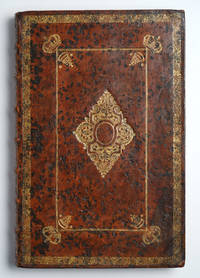
17205138<p><em>The World's first Global Stock Market Bubble Illustrated</em></p><p>STOCK MARKET - THE GREAT MIRROR OF FOLLY. Het groote Tafereel der Dwaasheid.The great mirror of folly showing the rise progress and downfall of the bubble in stocks and windy speculation especially in France England and the Netherlands in the year 1720 being a collection of all the terms and proposals of the incorporated companies. with prints comedies and poems published by various amateurs scoffing at this terrible and deceitful trade. n.p. Amsterdam after 1720.</p><p>Folio pp. ii 25 1 52 26 29-31 thus complete 1 8 10 engraved frontispiece Muller plate No.1 title printed in red and black Cole version 2 text in double columns and 74 engraved plates 2 of them in duplicate mostly double-page and/or folding including maps portraits playing cards broadsides; text a little browned due to paper quality some foxing; plates generally clean and crisp one plate cropped at foremargin with loss of text but not to image; contemporary full mottled panelled calf spine gilt in compartments sides with rich gilt decoration head and tail of spine repaired corners strengthened; a good copy.</p><p>The classic rare literary and pictorial satire on John Law's 'system' and the wild speculation in stocks at that time. As part of Law's well-conceived plan to finance the French national debt funds were raised a portion of which was invested in the 'Compagnie d'Occident' which was given rights to exploit trade in Louisiana and Canada. The underlying plan was sound but unprecedented wild speculation sent the share price rocketing to unrealistic levels. Inevitably the 'bubble' burst; the Company was bankrupted and many investors ruined and the 'Système Law' unfortunately discredited. Law himself had foreseen the developments and had withdrawn funds from the French scheme to invest in the British South Sea affair which was being set up at that time. This 'bubble' also burst in 1720.</p><p>'Rarely does a single volume combine in itself so much economic interest. in neither of these countries France and England however did appear such a stout and extravagant piece as this Dutch volume' Cole p. 1.</p><p>Each copy of this work is unique. The number of plates varies from 60 to 90 though generally around 70 and the order of the text and the plates differs from copy to copy. The present copy has the regular plates 1-23 25 28 30-51 53-68 70 - 73 with 36 and 37 bound in twice in different places as well as the supplementary plates 1 2 4 and 5. This includes the very uncommon 'Register of all the prints' first issue with 47 prints listed and a further one added in ink and a fascinating portrait of Madame Law.</p><p>In addition to the vivid portrayals of the 'wind-trade' and stock market frenzy the double-page folding plate with playing cards known as Aprilkaart 65 and the Magic card 73 are particularly appealing. The special feature of this copy is the etched portrait of Madame Law but not with the usual richly decorated border of scrolls foliage fruits and flowers but surrounded by Callot style figures of dwarves. This border has been used on another print in the collection of de Koninklijke Bibliotheek Den Haag see BM 1868-0808-9693.</p><p>Arthur H. Cole The Great Mirror of Folly 1949; Sperling The South Sea Company 205; Kress 3217; Goldsmiths 5879; Sabin 28932; Lipperheide 3550; see Goetzmann et al The Great Mirror of Folly Finance Culture and the Crash of 1720 2013.</p>
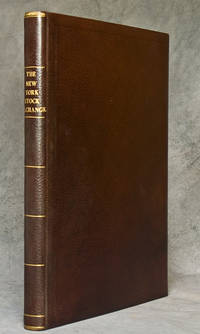
1893244131New York: J.B. Gibson Company 1893. Title page printed in red and black. Illustrated with photographs. Unpaginated 99 pp. 1 vols. 4to. Full brown morocco over bevelled boards in period style silk doublures a.e.g. Professional conservation to a few paper flaws mostly in margins dampstaining to first 12 and last 18 leaves; one leaf with old tear costing a small portion of text; half title and frontispiece inlaid. Fine. Title page printed in red and black. Illustrated with photographs. Unpaginated 99 pp. 1 vols. 4to. Centennial publication comprising a list of officers and committee members a 9-page list of members an anonymous 30-page illustrated "History of the New York Stock Exchange" from its origins in 1792 with list of past presidents with the balance of the volume being illustrated advertisements. These include brokerage firms such as Drexel Morgan Spencer Trask and August Belmont as well as banks Manhattan Company Chemical National Bank Bank of America and other companies such as Manning's Yacht Agency.<br /> <br /> The anonymous author of the "History of the New York Stock Exchange" observes "The New York Stock Exchange is indeed one of the greatest bulwarks against panics that the business community could have." Not in OCLC or in any of the customary catalogues and references J.B. Gibson Company unknown
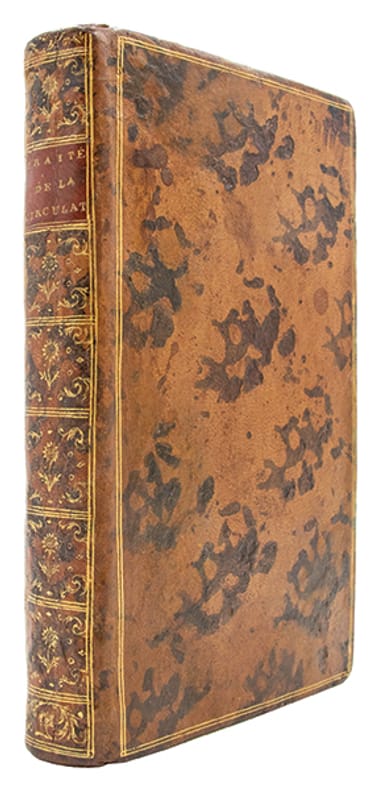
39272In-8° (197 x 116 mm), veau marbré de l'époque, dos lisse orné de compartiments fleuronnés et cloisonnés, palettes en tête et pied, pièce de titre de maroquin havane, double filet d'encadrement sur les plats, tranches rouges, xvi, 1-128, (8), 129-368 pages, (1) feuillet de "fautes à corriger". Amsterdam, marc-Michel Rey, 1771.
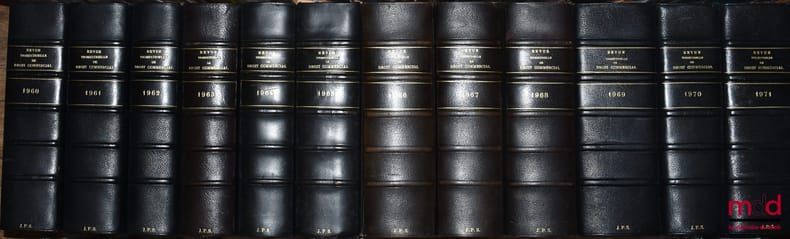
4301, Paris, Dalloz 1960 et s., 41 années en 41 vol. in-8, demi-chargrin ébène, tit. doré sur dos à cinq nerfs orné de filets dorés soulignants, rel. au chiffre «J.P.S.» [Jean-Pierre Sortais], (parfois qq. soulignures ou annotations au crayon), très bon état, int. frais.
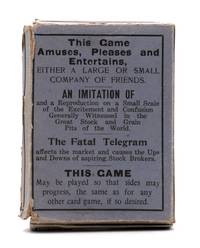
1904325354Topeka Kansas: W. W. Gavitt Printing and Publishing Co 1904. Complete set of 49 playing cards each measuring 3 1/4 by 2 3/8 inches printed on both sides with pictorial rectos printed in red depicting a smoke-spewing locomotive stating within the smoke: "Gavitt's Stock Exchange." with 1903 copyright on each card plus three folded inserts of instructions and ads. Original box. Some splits and creases to box the cards in very fine condition. Complete set of 49 playing cards each measuring 3 1/4 by 2 3/8 inches printed on both sides with pictorial rectos printed in red depicting a smoke-spewing locomotive stating within the smoke: "Gavitt's Stock Exchange." with 1903 copyright on each card plus three folded inserts of instructions and ads. The complete set of 49 cards consisting of one "Telegram" card and 48 broker cards-- broker cards consist of six sets of eight cards each each designated with the name of a different railroad company and it's dollar value e.g. Santa Fe R.R. $250 N.Y. Cent'l R.R. $200 C. B. & Q. R.R. $125 etc. Players exchange the cards i.e. trade stocks in an attempt to corner the market on a particular railroad. Also present with the complete set of 49 cards is the original instruction sheet and three individual sheets printing promotional material about the game and its maker Harry E. Gavitt. All the sheets are folded and housed with the cards in the original grayish-lavender printed box as issued.<br /> <br /> "This game amuses pleases and entertains. An imitation of and a reproduction on a small scale of the excitement and confusion generally witnessed in the great stock and grain pits of the World" from the box. When it was first published 'Gavitt's Stock Exchange' game rose to become one of the best-selling games in America. It is considered by some to be the first "simultaneous action" set game where all the players play in unison. It was also the basis of a similar game 'Pit' first published by Parker Brothers in 1904 which become equally as popular. Uncommon with OCLC locates only three holdings of Gavitt's Stock Exchange: Topeka & Shawnee County Public Library University of Kansas Archives and the Winterthur Museum. W. W. Gavitt Printing and Publishing Co unknown
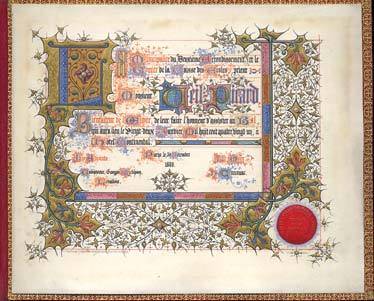
18811235Un feuillet de vélin richement enluminé, cachet de cire rouge " Mairie de la Bourse " sous chemise en plein chagrin bordeaux, " A Monsieur Veil Picard " à froid, roulette dorée d’encadrement sur les plats intérieurs.
114727Série de cinq volumes in-12 de 90 x 150 mm environ comportant 40 textes. Demi-chagrin bleu, dos à quatre nerfs portant titres et tomaisons dorés, gardes marbrées. Intérieur frais et ensemble en bon état malgré les défauts à signaler : un dos insolé, de discrets frottements sur les coins et les coiffes.
1751025780Ch. Ant. Jombert, Paris 1751. 2te corrigierte und erweiterte Auflage Halbleder Gut
Very Good Turkish, Ottoman (1500-1928) Paperback. Minor fading on pages. Otherwise a fine pamphlet. Original red wrappers. Roy. 8vo. (24 x 17 cm). In Ottoman script (Old Turkish in Arabic letters). 12 p. At the introduction of this treatise, the authors state that exchanges are generally divided into two and that these are collective and dispersed types. In other sections, it emphasizes how new the Turkish stock market is compared to the world stock markets and how important it is to make the arrangements carefully in this context. The origin of an organized securities market in Turkey has its roots in the second half of the 19th century. The first securities market in the Ottoman Empire was established in 1866 under the name of "Dersaadet Securities Exchange" following the Crimean War. Dersaadet Exchange also created a medium for European investors who were seeking higher returns in the vast Ottoman markets. Following the proclamation of the Turkish Republic, a new law was enacted in 1929 to reorganize the fledgling capital markets under the new name of "Istanbul Securities and Foreign Exchange Bourse". In this rare pamphlet, argued earlier this reorganization only one year ago from the new law in 1929. Nizameddin Bey was an Ottoman / Turkish clerk of the stock exchange. Mehmed Vehbi Saridal, (1886-1969), was a Turkish / Ottoman politician. He is a graduate of Istanbul Law School and Berlin University Faculty of Philosophy. He was a professor of Turkish Economics and Trade Doctrines and Social Economics. This is the first theoretical book on the reorganizing of the Republican stock exchanges after the collapse of the Ottoman Empire. Turkish National Library 000788854.; Özege 2529.; TBTK 6728.; Not in OCLC. Extremely rare. First and Only Edition.
rel. en demi-chagrin noir, tit. & tom. dorés sur dos à faux nerfs, filets à froid soulignant, et demi-toile à partir de 1930, (des dos frottés, qq. couv. insolées, des épidermures sur 7 vol.), bon état général
In-4, demi-maroquin noir à la Bradel, dos lisse orné de 2 petits fleurons en tête et pied et de filets dorés, titre doré en long (rel. moderne), 16 p. Edition originale in-4°. "Cours à l’usage des députés sur la fonction et l’organisation des banques (…). Lavoisier, à la veille de plaider devant l’Assemblée Nationale le dossier de la Caisse d’Escompte (intervention du 23 novembre 1789), expose les principes de fonctionnement et souligne que la suspension des paiements, intervenue à deux reprises est le fait du gouvernement bien plus que de la Caisse (...). La création d’une grande banque d’Etat, en abaissant le taux d’intérêt de l’argent, favoriserait selon lui le développement de l’agriculture, du commerce et de l’industrie" (J.-P. Poirier, 'Lavoisier', p. 266). (Duveen et Klickstein, 254: "In typical Lavoisier style". Goldsmiths, 'Online Catalogue', n°13961.57. Kress, B.1645). Bel exemplaire très bien relié, très frais, grand de marges.
3 ouvrages reliés en un volume in-8, pleine basane fauve, dos à 5 nerfs soulignés de filets dorés, pièce de titre de maroquin rouge, tranches jaunes (reliure anglaise de l'époque). Rare ensemble des trois contributions de Mirabeau sur la réforme bancaire, reliés ensemble à l’époque. 1- Edition originale de cet ouvrage rédigé avec Etienne Clavière et qui eut un retentissement considérable. Le programme de réforme bancaire lancé par Turgot fut arrêté quand il quitta le gouvernement, et la Caisse d'Escompte obtint un monopole inattendu. L'exclusivité de ses privilèges donna lieu à une crise monétaire d’une ampleur inconnue depuis l’effondrement de la Banque de Law. Mirabeau analyse dans cet essai les conséquences fâcheuses de ce monopole, préconise l'égalité de traitement entre les emprunteurs et énonce les principes qui doivent présider au fonctionnement d'une banque nationale de secours, pour le bien-être général et non l'intérêt de quelques particuliers. L'ouvrage est suivi de pièces justificatives dont l'édit de 1776 instituant la Caisse d'Escompte. (Einaudi 3939. Kress, B.908. Martin & Walter, 24436). 2- Edition originale. "Suite naturelle de mon ouvrage sur la caisse d'escompte" selon Mirabeau. "Il examine les circonstances dans lesquelles la Banque a été créée par le comte de Cabarrus qu'il qualifie de Law espagnol (...). Il pense que cette institution ne peut convenir à l'Espagne et déconseille les nations capitalistes commerçantes de s'y intéresser. L'ouvrage est complété de pièces justificatives" (M. Leblanc, 'De Th. More à Chaptal', n°370). Cet ouvrage fut condamné et supprimé par arrêt du Conseil d'Etat (7 juillet 1785). (Einaudi, 3929. Goldsmiths', 13058. Kress, B.907). 3- Edition originale. Les deux ouvrages de Mirabeau lui attirèrent des haines violentes, notamment celle de Le Couteulx de la Noraye, banquier, qui l'attaqua publiquement. Mirabeau répondit par cette lettre virulente, dans laquelle il développe l'argumentation de ses précédents ouvrages (cf. L. Lumet, 'Oeuvres de Mirabeau', p. 350 sq.). (Goldsmiths, 13060. Kress, B.910). Quelques auréoles. Déchirure aux coins supérieurs des p. 61-64 du III. Très bon exemplaire, préservé dans une solide reliure anglaise de l’époque.
reliure en demi-chagrin bordeaux, tit. & tom. dorés sur dos à 5 nerfs ornés de filets à froid et fleurons dorés, plaçure : 1 vol./an sauf 1968 et 1969 en 2 vol., (marques de bibliothèque, rares dos lég. frottés et/ou insolés), bon état
192819760Nantes 1928 Une Eau-Forte Originale, technique pointe sèche, Format de la cuvette : (27,5 x 32,2 cm), Format de la feuille : 35 x 50 cm sur papier crème, signature manuscrite à la mine de plomb en bas à droite : R. Pinard 1928 + le dessin d'une ancre stylisée (marque du peintre de la Marine), et noté à gauche à la mine de plomb : 5ème Etat 10/10
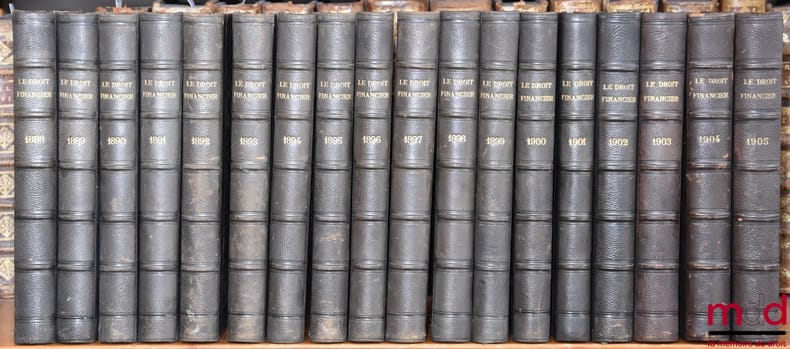
3946, Paris 1888 et s., 52 années en 50 vol., rel. en demi-chagrin noir, tit. & tom. dorés sur dos à faux nerfs, filets à froid soulignant, et demi-toile à partir de 1930, (des dos frottés, qq. couv. insolées, des épidermures sur 7 vol.), bon état général.
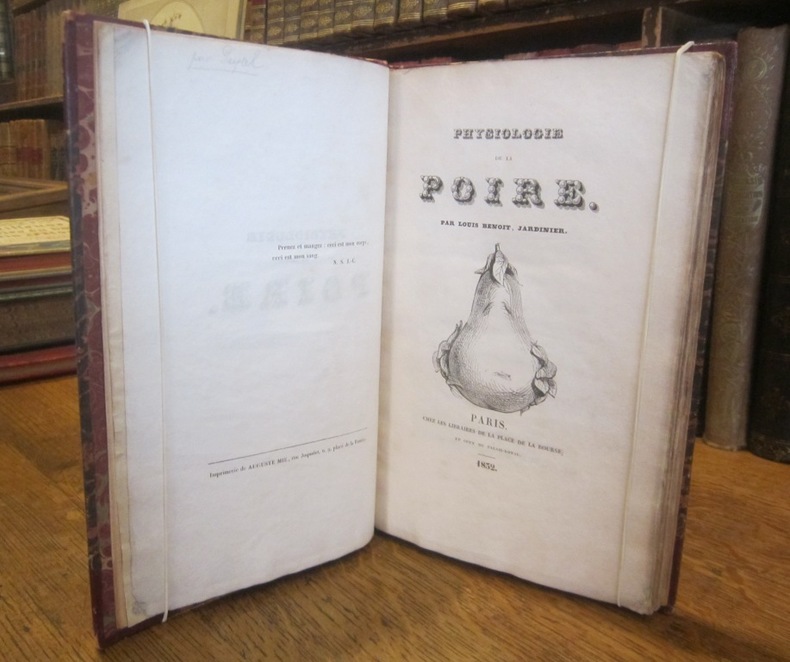
1832002520Paris, Chez les Libraires de la place de la Bourse, 1832
33410In-8, demi-veau à coins de l'époque, dos lisse orné d'un riche décor de filets et palettes dorées, titre doré, (4), 74, (1) p. Paris, Delaunay, 1818.
2 parties en un volume in-4, plein veau marbré de l'époque, dos à nerfs orné de caissons dorés, tranches jaspées, (2), viii, (24), 478 p. et (6), xii, (2), 38, (4), 105, (1), 50 p. Véritable usuel à l'usage des commerçants et négociants, l'ouvrage connut un succès considérable. La première partie contient un dictionnaire des termes de commerce, un guide pour les usagers des banques, les cours de change européens et un "État abrégé des productions & marchandises de toutes les places". La seconde partie, en pagination discontinue, contient un traité de comptabilité en partie double illustré de nombreux exemples et cas pratiques, avec tableaux et illustrations. (Goldsmiths'-Kress, n°10566. Higgs, 'Bibl. of Economics', 4737. De Rover et Stevelinck, 'La comptabilité à travers les âges', n°89. Hausdorfer, 'Accounting bibliography', p. 99. Reymondin, p. 63). Quelques épidermures et petits accrocs à la reliure. Petit cachet ex-libris ancien: "Dumas Gasparin". Bon exemplaire.
361032 parties en un volume in-4, plein veau marbré de l'époque, dos à nerfs orné de caissons dorés, tranches jaspées, (2), viii, (24), 478 p. et (6), xii, (2), 38, (4), 105, (1), 50 p. Lyon, Regnault, 1769.
37838In-4 (238 x 193 mm), demi-maroquin noir à la Bradel, dos lisse orné de 2 petits fleurons en tête et pied et de filets dorés, titre doré en long (rel. moderne), 16 p. Paris, Clousier, 1789.
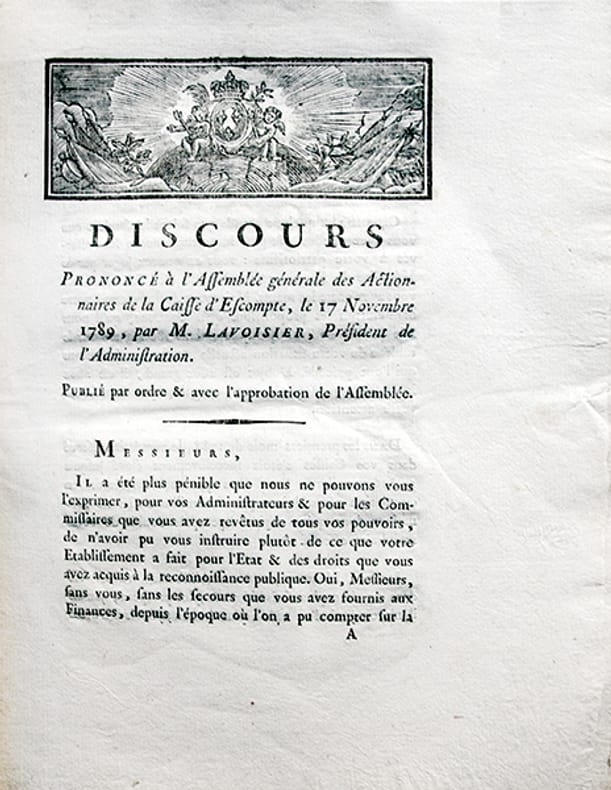
In-4, broché sous couture d'origine, (1) f. de titre, 18 p., entièrement non rogné, en partie non coupé. Edition originale in-4° de cet important document pour l’histoire économique et financière de la Révolution française. Le 17 novembre 1789, Lavoisier présente comme président de la Caisse d'Escompte ce remarquable rapport à l'assemblée générale des actionnaires. Il livre un historique de l’institution, préfiguration de la Banque de France, et dresse un rapport financier, documenté et chiffré qui se voudrait rassurant, tout en mettant en garde contre le danger que représente l’inflation amorcée. Pour juguler cette inflation, il plaide pour une recapitalisation de la Caisse afin de financer l’émission des assignats. Le discours sera suivi d'une décision de l'Assemblée Nationale. "Lavoisier's election to the presidency of the Caisse d'Escompte gives a good idea of the esteem in which he was held by his associates in France. The 'Discours' shows considerable understanding of the economic and financial problems involved" (Duveen & Klickstein, 249). (Goldsmiths, 'Online Catalogue', n° 13961.58. Kress, B.1646. Martin & Walter, III, 19840). Très bon exemplaire, très frais, entièrement non rogné, en partie non coupé, tel que paru.
37572In-4, broché sous couture d'origine, (1) f. de titre, 18 p., entièrement non rogné, en partie non coupé. Paris, Clousier, imprimeur du Roi, 1789.
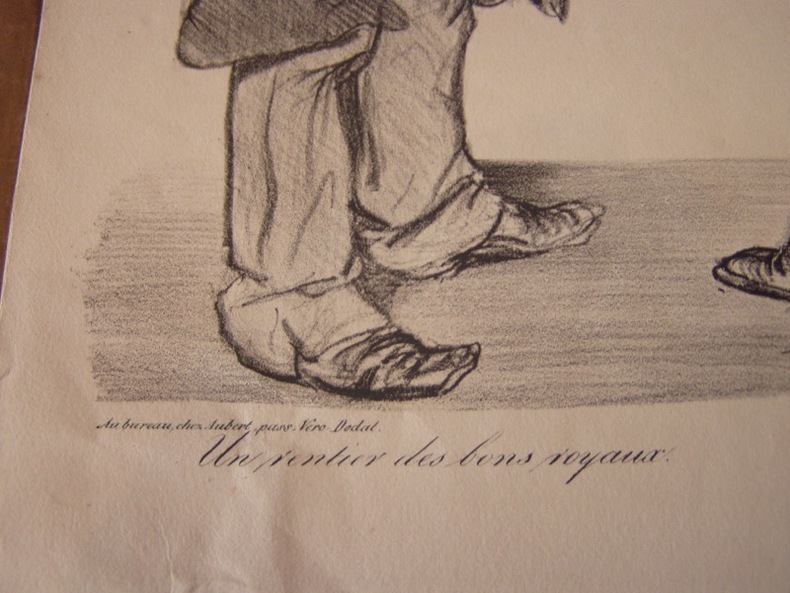
1834251141834 Planche 423 de La Caricature N° 202.La Caricature, 18 septembre 1834. Lithographie originale sur Velin blanc. . Delteil 87. épreuve en noir ; lithographie en noir sur velin blanc pli médian vertical,bon tirage bien noir,petite tache brune en marge - Delteil 87 ,