WIMPFFEN (Alexandre-Stanislas, baron de).Livre Rare Book
299 résultats
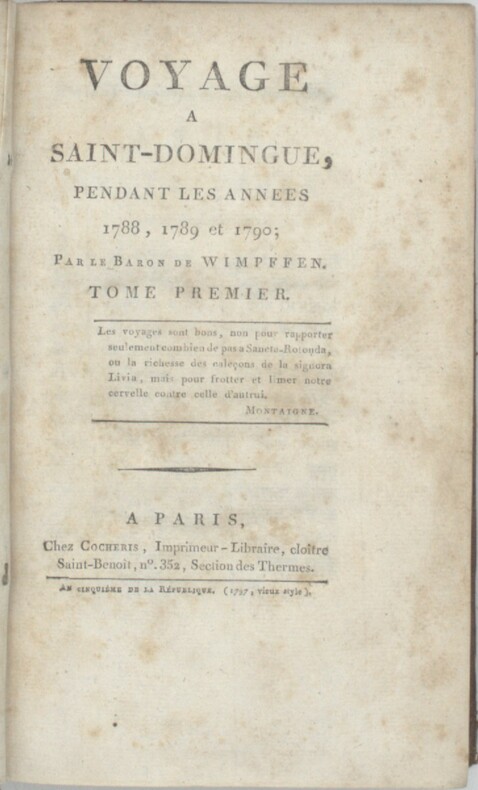
1797PHO-1518Paris, Cocheris, An cinquième de la République (1797). 2 volumes in-8 en 1, pleine basane, dos lisse avec pièces de titre et de tomaison rouge (Reliure de l’époque), rousseurs et papier bruni, coiffe usée.
1712MARI0879Wien, Georg Schlegel 1712. kl.-8°, 212 S., 11 nn. S. Reg., die Ss. 211/212 u. letztes Reg. Bl. dplt. eingebund., Ss. 222/223 fehlen in Pag. (Text richtig), 2 Kpf.karten fehlen. Lederband d. Zt. beschabt, Deckel springt auf, flieg. Vors. oben ca 2 cm ausgeschnitten (fehlt), Textspiegel tlw. stärker gebräunt. [2 Warenabbildungen]
1760GIT00076A La Rochelle chez Jérôme Légier et Pierre Mesnier 1760. 2vol in-4 XLII 1f n ch 766pp 2ff blancs et XII 796pp 1f blanc. Pleine basane havane, dos à nerfs orné de compartiments dorés, pièces de titre et de tomaison rouges, tranches brique, rel époque. Coiffes et coins usés, petits manques de cuir sur les dos.
1751603556London, printed for John & James Rivington and John Crofts, 1751. 2 Bl., VI, XXXIX, 430 S.; 1 Bl., 446 S., 1 Bl. Moderne Halbleder mit Buntpapierbezug. [2 Warenabbildungen]
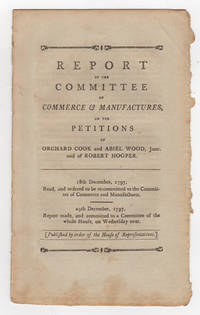
179743741Philadelphia: Printed by William Ross 1797. First edition. Removed. Very good mostly unopened uncut untrimmed copy minor browning at lower edge. 3 226-232 2 pp. 8vo. Evans dated it both 1797 and 1798. two petitions both concerning a waving of taxes on spirits the Orchard Cook and Abiel Wood case claiming the ship was wrecked on an island and the cost of recovering the cargo exceeded the cost of the mechandise and that their insurance had lapsed. In the second case Hooper claimed he was lax in filing papers for re-shipping a cargo overseas. Wisely both were declined as the committee felt the government is not in the business of insuring that a business is successful and well run. Ah to return to those days. Orchard Cook 1763-1819 and Abiel Wood 1772-1834 had a better idea. They both became U.S. Representatives from Massachusetts. OCLC locates eight copies. Evans 33015. Evans 34753. ESTCW15017. [Printed by William Ross] unknown books
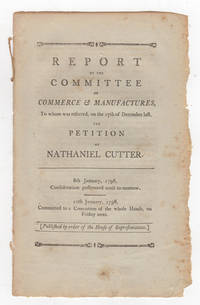
179843744Philadelphia 1798. First edition. Removed. A very good copy lightly soiled and edge worn. 4 pp. 8vo. Nathaniel Cutter wanted relief from being re-taxed on goods that left Massachusetts where he had paid tax and then returned to the same port with the same goods because he was harrassed by the British and French and turned away in the Dominican Republic. The committee wisely wrote: "Your Committee however cannot find any good reason for relieving him against consequences of a risque which every exporter ought to calculate for himself." Cutter would continue to take risks suppling the French in Saint-Domingue and a claim was allowed him in 1803 by the American Commission in Paris for unpaid costs by the French See Greg H. Williams: The French Assault on American Shipping 1793-1813: A History p. 154. Evans 34754. ESTCW25464. unknown books
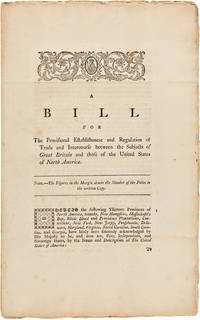
1788WRCAM47396London 1788. Paginations given below. Folio. Four of the titles string-tied as issued. First title lightly foxed and toned. Very good. In a half morocco and marbled boards box spine gilt. An interesting assemblage of British legislation from the period immediately following the Revolutionary War documenting British efforts to allow only very limited trade with the newly independent United States. British trade policy during this period is an excellent example of a foreign power taking advantage of the weak structure of the American Articles of Confederation which made it difficult for the thirteen states to act in concert and out of a any position of strength through unity. <br> <br> By 1783 the United States had formal trade relations with only two nations: France secured through the 1778 Treaty of Amity and Commerce; and the Netherlands via a Commercial Treaty negotiated by John Adams in 1782. Before the Revolution British merchants had relied heavily on exports sent to the British colonies in North America which greatly outweighed goods imported to Britain from the colonies. After the war the British government was reluctant to sign a formal commercial treaty with the United States. The states at the time were operating under the relatively weak structure of the Articles of Confederation and the British felt that they could secure the benefits of trade with the American states without making any treaty concessions. <br> <br> Britain opted instead for a series of acts that established limited trade with the United States and between the United States and Canada and the British colonies in the West Indies. The first of these laws was passed in 1783 and the evolution of that law is reflected in the first three items below. In all these British laws severely circumscribed American trade with England and with English colonies though they did allow some markets for American exports and did facilitate the flow of much needed imports into the United States. In 1784 British exports to the United States were valued at more than £3.5 million while American exports to England were less than one-fifth of that sum. The United States and Great Britain would not sign a formal trade treaty until the Jay Treaty which was approved in 1795 and which gave the United States limited trading rights in the British West Indies. <br> <br> The first second third and fifth titles below were printed in very small numbers for the use of members of Parliament during debate and action on the bills. Known as "slip bills" they are a snapshot of the legislation as it proceeded through the legislative process. The first and fifth titles contain blank spaces in the text where dates and tariff rates would be filled in later and all four of the slip bills have printed docketing on the final page. The first and fifth items also contain a printed note before the text of the bill reading "the figures in the margin denote the Number of the Folios in the written copy" which indicates just how early in the legislative process these bills were printed. <br> <br> The four bills and one act included in this group are: <br> <br> 1 A BILL FOR THE PROVISIONAL ESTABLISHMENT AND REGULATION OF TRADE AND INTERCOURSE BETWEEN THE SUBJECTS OF GREAT BRITAIN AND THOSE OF THE UNITED STATES OF NORTH AMERICA caption title. London. 1783. 31pp. This bill gives the United States the same trading status as other independent sovereign states but restricts American exports to Great Britain only to those goods that are "the growth produce or manufacture of the said United States." It thus forbad the "triangular" trade in which American merchants liked to engage while not imposing the same restriction on British exporters. ESTC locates only five copies. ESTC N32490. BELL G578 ref. <br> <br> 2 A BILL AS AMENDED IN THE COMMITTEE FOR THE PROVISIONAL ESTABLISHMENT AND REGULATION OF TRADE AND INTERCOURSE BETWEEN THE SUBJECTS OF GREAT BRITAIN AND THOSE OF THE UNITED STATES OF NORTH AMERICA caption title. London. 1783. 51pp. This bill expands on and further defines the previous bill clearly spelling out the limitations on American trade with England while imposing no such restrictions on English merchants and in fact making every provision to facilitate British exports to America. ESTC locates six copies. ESTC N32061. <br> <br> 3 A BILL AS AMENDED IN THE COMMITTEE TO WHOM THE SAME WAS RE-COMMITTED FOR THE PROVISIONAL ESTABLISHMENT AND REGULATION OF TRADE AND INTERCOURSE BETWEEN THE SUBJECTS OF GREAT BRITAIN AND THOSE OF THE UNITED STATES OF NORTH AMERICA caption title. London. 1783. 51pp. As with the previous two versions of this bill the language here explains that it would be "highly expedient" to have a trade treaty with the United States but until that point England would make due with legislation regulating Anglo- American commerce. The same restrictive language regarding exports from America is carried over. ESTC locates only five copies. ESTC N32016. <br> <br> 4 AN ACT TO EXTEND THE POWERS OF AN ACT.FOR GIVING HIS MAJESTY CERTAIN POWERS FOR THE BETTER CARRYING ON TRADE AND COMMERCE BETWEEN THE SUBJECTS OF HIS MAJESTY'S DOMINIONS AND THE INHABITANTS OF THE UNITED STATES OF AMERICA TO THE TRADE AND COMMERCE OF THIS KINGDOM WITH THE BRITISH COLONIES AND PLANTATIONS IN AMERICA.caption title. London: Printed by Charles Eyre and William Strahan 1784. 2715-716pp. This law specifically relates to British exports of iron hemp and sail cloth from the Baltic states to the United States. ESTC locates only three copies. ESTC N58431. BELL G585. <br> <br> 5 A BILL FOR REGULATING THE TRADE BETWEEN THE SUBJECTS OF HIS MAJESTY'S COLONIES AND PLANTATIONS IN NORTH AMERICA AND IN THE WEST INDIA ISLANDS AND THE COUNTRIES BELONGING TO THE UNITED STATES OF AMERICA; AND BETWEEN HIS MAJESTY'S SAID SUBJECTS AND THE FOREIGN ISLANDS IN THE WEST INDIES caption title. London. 1788. 91pp. This bill essentially prohibits American trade with Britain's colonies in the West Indies and prohibits American exports to Canada as well. The sole exemption is with regard to salt from the Turks Islands a product the English wanted to encourage. The bill allows American ships to receive salt on the islands. It also limits exports from the West Indies to America on such goods as sugar molasses coffee etc. to British ships only. ESTC locates only four copies. ESTC T201245. RAGATZ p.95. BELL G618 ref. <br> <br> An important group of rare working drafts of British legislation. hardcover books
17531764Imprimé à Amsterdam et se trouve à Paris, chez les Frères Estienne, 1753. 2 parties en 1 vol. in-12 de (6)-139 pp. ; 235 pp., veau havane, dos orné à nerfs, pièce de titre en maroquin rouge, tranches rouges (reliure de l'époque).
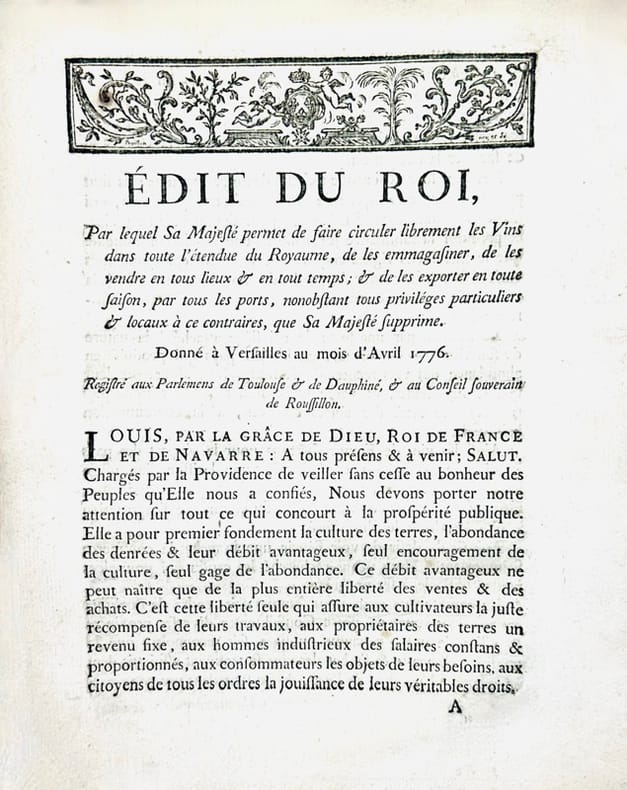
177644820Paris, De l'Imprimerie Royale, 1776. 1 vol. In-4 broché de 28 pp.
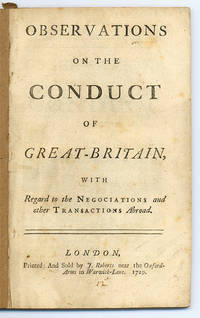
1729658131729. London: printed and sold by J. Roberts 1729. London: printed and sold by J. Roberts 1729. English Trade in the West Indies Trade. Great Britain. Amhurst Nicholas 1697-1742 Attributed. Observations on the Conduct of Great-Britain With Regard to the Negociations and Other Transactions Abroad. London: Printed: And Sold by J. Roberts 1729. 61 1 pp. Octavo 7-3/4" x 4-1/2". Stab-stitched pamphlet in later plain wrappers. Light rubbing minor wear to spine ends and corners light soiling to title page and verso of final leaf. Light toning to text light foxing to a few leaves. A nice copy. $100. First edition. Attributed in some sources to Nicholas Amhurst this pamphlet defends Sir Robert Walpole then chancellor of the exchequer against accusations of neglecting England's West Indian commerce to the advantage of Spain. It describes English expeditions to counter Spanish influence and in the interest of fairness lists English ships taken by Spain since the Treaty of Hanover 1725. English Short-Title Catalogue T41776. unknown books
1729658131729. London: printed and sold by J. Roberts 1729. London: printed and sold by J. Roberts 1729. English Trade in the West Indies Trade. Great Britain. Amhurst Nicholas 1697-1742 Attributed. Observations on the Conduct of Great-Britain With Regard to the Negociations and Other Transactions Abroad. London: Printed: And Sold by J. Roberts 1729. 61 1 pp. Octavo 7-3/4" x 4-1/2". Stab-stitched pamphlet in later plain wrappers. Light rubbing minor wear to spine ends and corners light soiling to title page and verso of final leaf. Light toning to text light foxing to a few leaves. A nice copy. $100. First edition. Attributed in some sources to Nicholas Amhurst this pamphlet defends Sir Robert Walpole then chancellor of the exchequer against accusations of neglecting England's West Indian commerce to the advantage of Spain. It describes English expeditions to counter Spanish influence and in the interest of fairness lists English ships taken by Spain since the Treaty of Hanover 1725. English Short-Title Catalogue T41776. unknown
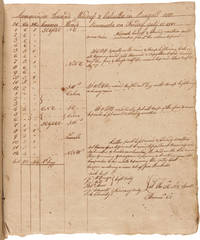
1796WRCAM54712Mostly at sea from New York with stops in Calcutta Saint Helena Ascension Island and Cornwall England 1796. 246pp. Square folio. Original crude burlap covers stab-sewn with thick string. A bit toned and foxed occasional ink or tobacco burns. Very good. A remarkable artifact of early American naval commerce containing the sailing directions and shipboard activities of the "Ship Washington of Philadelphia" which sailed from New York to Calcutta rounding the southern tip of Africa and visiting Saint Helena and Ascension Island before crashing on the rocks at Cornwall England on the way to Hamburg Germany. The log contains a navigational ledger with locations headings wind and weather remarks along with occasional sick lists names of men "unfit for duty" those put on light duty temperatures and other information. The remarks are quite detailed and specific regarding shipboard work and activity. <br> <br> The captain of this final voyage of the ship WASHINGTON was Samuel Hubbart but the identity of the sailor who kept this log is unknown. The ship departed New York on July 4 1795 and reached Calcutta on August 31. Without the need for recording navigational data while in port the log's author switches from the ledger-style format and writes longer more-detailed daily entries describing the crew's activities. The crewmen mentioned include pilots boatswains carpenters coopers caulkers sailmakers and others. Most of the entries pertain to the maintenance of the ship while anchored in the bay. Numerous mentions are made of crew on board fixing various equipment including types and amounts of supplies. A few entries note the employment of Indian "Cooleys" on board the ship making various repairs. An interesting incident of September 17 bears relating: <br> <br> "Hearing a noise upon the main Deck Mr. Naylor went to see what was the matter - upon engaging found Abraham Moor had struck Thomas Williams the Cook as Moor said for wanting to trouble a girl which Moor had on board - Mr. Naylor told him he should not ill use that man for he had every reason to believe it to be false what he alledged against the Cook. Moor said he did not come here to be jawd by a black Man.S." <br> <br> After swearing he would "never go home" on the WASHINGTON Moor literally jumped ship just after this confrontation and hid on another ship before being found and brought back to the WASHINGTON "in irons." <br> <br> In early November a few entries mention the ship receiving a supply of sugar taking on "Three Burr Load of Sugar" on November 7 and two more "Burr Load" two days later. Subsequent entries detail the loading of several "Burr Load of Bales" and "one hundred bags of ginger." <br> <br> Over the course of the ship's time at Calcutta the author mentions encounters with at least four other American ships: the GANGES the HAMILTON the MAJOR PINKNEY of Charleston and the "American Ship Camilla of New York arriv'd here from London." <br> <br> By early February the WASHINGTON left Calcutta for the voyage to Hamburg spelled variously here as "Hamborough" and "Hamburgh" though the ship would never make it to Germany. On March 15 and again on April 6 the recordist notes an inventory of the ship's water supply. By March 23 the ship reaches a point "prependicular on Cape Lagulas Bank" the southernmost point of Africa. About a week later the punishment of a drunken sailor is reported: <br> <br> "Joseph Gonrabbysp who has for some time past been addicted to Drunkeness and no person on board having given him any liquor he was discovered this morning to have taken from the Ships stores about half a Gallon of rum and from his being frequently very drunk there is no doubt of his having been Guilty of the same offence before for which Capt. Hubbart is necessitated to order his Boatswain to flog him. Accordingly mustered all hands aft and give him one and a half dozen lashes." <br> <br> On April 16 the WASHINGTON arrived at the remote island of Saint Helena in the South Atlantic Ocean sending "the Boat on shore with an Officer to the Governor for permission to Anchor." Here the WASHINGTON restocked supplies including water potatoes & other vegetables rice and bread before embarking for Ascension Island which they reached on April 25. The author remarks on the "number of remarkable rocks like pyramids" and "a low point of black Rocks with a fine white sandy beach back of it" witnessed at Ascension Island. The WASHINGTON spent one night at Ascension where a group of men went ashore in order to "spend the Night in Catching Turtle in the different Bays." The crewmen caught twelve turtles and brought them aboard ship before continuing their journey. <br> <br> While heading north to Europe the WASHINGTON was boarded on May 17 by the "Quebec British Frigate Cap J Cook in Company with the Carnatic 74 Rear Admr Powel with a convoy of 21 sail of Transports & Gun boats with 10000 Troops on board bound for Martinico Martinique." On June 7 they again encounter another ship "a Spaniard from some port in South America bound for Cadiz out 3 months & 10 days - we cannot understand rightly what port she was from." <br> <br> Then on June 18 disaster struck the WASHINGTON as it ran aground at the Lizard Rocks off Cornwall England. The log book records the ship's demise: <br> <br> "The weather still very thick and hazy. At 9PM hearing the Surf break on shore took in all the studding sails Braced the Yards sharp and hauled to the Southward finding ourselves in amongst the Rocks off the Lizard have all aback and endeavored to get her out from among them but the Flood tide making very strong drove the Ship so hard upon the Rocks that with every endeavour we found it impracticable to get her off she having settled on them & the strength of the tide Thumping her very hard upon the Rocks sounded the Pump and found she made water very fast. Fired several Guns as a signal of Distress which brought several boats off from the Shore to our assistance." <br> <br> For the next couple of weeks the crew of the WASHINGTON participated in "discharging the cargo" from the ship so that it is not "plundered by the natives" sending everything to Falmouth "where the Goods are deposited under the protection of a Custom house Yaught." The log book mentions one crewman of the WASHINGTON "threatening revenge on Captain Hubbart." Another crewman is put "under a Guard of Soldiers" after selling off some of the muslin stored in the bales rescued from the wreck. Here the ship's log ends along with the career of the Ship WASHINGTON. <br> <br> A unique record of the last voyage of an early American trading vessel with insight into late 18th-century navigational methods and the commercial interests of Federal-era America. unknown books
17745521Marseille 1774. No Binding. Very Good. Folio - over 12 - 15" tall. Two folio bifolia 43.1 x 27.7 cm each with letterpress text woodcuts and manuscript text on the first leaf. Retaining deckle edge on all sides folded and annotated as typical of such documents one of the documents a bit weak at the folds otherwise very well preserved. Two rare folio-size maritime insurance policies from 1770s Marseille relating to mercantile voyages to France's American colonies in the Caribbean and valuable witnesses to the more practical bureaucratic aspects of maritime trade in late 18th-century France. Each document is illustrated with the three large woodcut seals of the city and carries in letterpress the standard legal formulas particular to Marseille as well as extensive manuscript notes and signatures completing the policy. The earlier of the two policies signed in May of 1774 relates to the vessel La Gentille likely the frigate later recorded as having taken part in the 1780 Battle of Martinique a stalemate between the French and British navies during the American War of Independence. The second policy signed on 3 November 1777 concerns the Bon Pasteur a ship under the command of captain Pierre Antoine Massier. Historical records show that this policy was nearly redeemed: Returning from Martinique in late December the Bon Pasteur was fired upon by the British frigate Westmoreland off the coast of Cabo de Gata in Spain boarded by six men each armed with a brace of pistols and a saber and Captain Massier roughly handled. The English suspected that the Bon Pasteur was not carrying goods from Martinique but from New England tobacco rice which would have been in violation of the protectionist economic policies common in both the French and British colonies in the Americas. After several sailors aboard the Bon Pasteur were thoroughly questioned the ship was sent on its way and its insurers in Marseille breathed a sigh of relief. OCLC does not locate any institutional copies of Marseille policies of this sort. B.-M. Emerigon and P. S. Boulay-Paty Traité des assurances et de contrats à la grosse vol. 1 pp. 54-5; Bulletin de la Socété archéologique historique et artistique vol. 3 pp. 277-8; Observations sur le Mémoire justificatif de la cour de Londres 1780 pp. 12-3. books
1788126576Rouen: 1788. Dupont de Nemours refuted First edition written in response to the Eden Treaty of 1786. Bound at the rear is Tableau du maximum des denrées et aliments dans le district de Rouen Rouen: de l'Imprimerie du District et du Journal de Rouen an 2e de la République 1793/4. Octavo 208 x 128 mm. Contemporary quarter roan spine lettered in gilt marbled paper boards and endpapers. Extremities rubbed boards scuffed contents generally bright with occasional soiling some chipping and unevenness to title leaf else a very good copy. Goldsmiths' 13590; McCulloch p. 145. hardcover
1713PHO-1341A Paris, Chez Pierre Ribou et Rouen chez Jean Baptiste Machuel (tome 5), 1713. 6 volumes in-12, relié plein veau époque, dos à nerfs orné avec pièce de titre et tomaison, tranches marbrées, Tome 5, reliure légèrement différent avec tranches rouges, coins et coiffes usés .T1,27p-501p-1f(table); T2, 1f-465-1f (table);T3 ,1f-402-3f(table);T4,1f-367-2f(table);T5 ,3f(titre, épître)-467-2f(table),T6 3f(titre, épitre)244 -2f (table) .Illustré de 63 planches la plupart repliées, dont un portrait et 3 grandes cartes (manque la carte du Japon) ; quelques vignettes dans le texte , quelques planches au tome 5 volantes, 1 planche doublée.
179028800La Rochelle 1790 une lettre (de 4 pages, une feuille pliée en deux) manuscrite à l'encre brune e sur papier velin ligné filigrané : "J. GAILLARD", format : 19,5 centimètres de large x 25,5 centimètres de haut, adresse de la lettre au centre de la 4ème page à l'encre brune : à Mr L. Admyrault Négociant de la Rochelle chez Mr Vincent, rue st Joseph à Paris , LETTRE DE MR NICOLAS SUIDRE [NÉGOCIANT ARMATEUR NÉGRIER A LA ROCHELLE] A ADMYRAULT LOUIS NÉGOCIANT ARMATEUR NÉGRIER A PARIS : " NOUVELLES DE LA ROCHELLE : MR BELLEAU REMPLACE MR DE LA COSTE A LA MUNICIPALITE, ME DE LA COSTE A ETE NOMME PRESIDENT DU DIRECTOIRE ....JE SOUHAITE QUE LE COMITE DES RAPPORTEURS FASSE DROIT SUR NOTRE DEMANDE POUR L'ALTERNAT, MR DE MISSY A BIEN FAIT DE REMERCIER, C'EST MR POUPET, CI-DEVANT COURTIER EN EAU-DE-VIE QUI L'A REMPLACE......... AINSI IL N'Y AURA PLUS DE NEGOCIANTS DANS LE DISTRICT DE LA ROCHELLE, NI AU DEPARTEMENT.... NOUVELLES SUR LES ARRIVAGES DE CAFFE....PRIX DES SUCRES BRUTS....LE NAVIRE "LE BON PERE" SERA ICI D'ICI LE MOIS DE SEPTEMBRE ...LA RARETE DU NUMERAIRE EST GENANTE POUR LE COMMERCE..;", LA ROCHELLE, le 31 JUILLET 1790
179222254La Rochelle 1792 une lettre (de 2 pages, une feuille) manuscrite à l'encre brune sur la première page sur papier velin ligné filigrané, format : 19 centimètres de large x 23 centimètres de haut, adresse de la lettre au centre de la 2ème page à l'encre brune : à Mr L. Admyrault Paris, LA ROCHELLE, LE 24 AVRIL 1792,
179022350La Rochelle 1790 une lettre (de 4 pages, une grande feuille pliée en deux) manuscrite à l'encre brune sur les 3 premières page sur papier velin bleuté ligné filigrané, format : 20 centimètres de large x 25,5 centimètres de haut, adresse de la lettre au centre de la 4ème page à l'encre brune : à Mr Louis Admyraud négociant de la Rochelle, Chez Mr Vincent, Rue St Joseph à PARIS, lettre signée SUIDRE , La Rochelle, le 10 Juillet 1790,
179022351La Rochelle 1790 une lettre (de 4 pages, une grande feuille pliée en deux) manuscrite à l'encre brune sur les 3 premières page sur papier velin bleuté ligné filigrané, format : 20 centimètres de large x 25,5 centimètres de haut, adresse de la lettre au centre de la 4ème page à l'encre brune : à Mr Louis Admyraud négociant de la Rochelle, Chez Mr Vincent, Rue St Joseph à PARIS, Marque Postale : "LA ROCHELLE" en noir, lettre signée SUIDRE , La Rochelle, le 27 Juillet 1790,
179022352La Rochelle 1790 une lettre (de 4 pages, une grande feuille pliée en deux) manuscrite à l'encre brune sur les 3 premières page sur papier velin bleuté ligné filigrané, format : 20 centimètres de large x 25,5 centimètres de haut, adresse de la lettre au centre de la 4ème page à l'encre brune : à Mr Louis Admyraud négociant de la Rochelle, Chez Mr Vincent, Rue St Joseph à PARIS, Marque Postale : "LA ROCHELLE" en noir, lettre signée SUIDRE , La Rochelle, le 17 Juillet 1790,
1731WRCAM46721London 1731. 31pp. Folio. Vertical fold reinforced with tissue. Minor soiling. Very good. A protest against a Bill to restrain the northern colonies from trading with the French and Dutch sugar islands. One of five editions published all rather scarce. Only four copies of this edition noted by ESTC - at the National Archives New-York Historical Society University of Michigan and the University of Minnesota. European Americana also notes Yale and JCB. ESTC N15514. EUROPEAN AMERICANA 731/37. unknown books
1731WRCAM46722London 1731. 31pp. Folio. Vertical fold reinforced with tissue. Very light foxing and wear. Very good. A protest against a bill to restrain the northern colonies from trading with the French and Dutch sugar islands. One of two editions published. Only four copies located by ESTC: British Library Bibliothèque National John Carter Brown Library and University of Minnesota. ESTC T20672. HANSON 4222. EUROPEAN AMERICANA 731/39. unknown books
1702605135Wittenberg, J. Hake, 1702. 4to. 8 Bl. Geheftet.
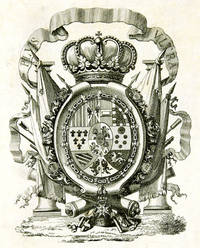
1778WRCAM37240Madrid: Pedro Marin 1778. 219262pp. plus engraved leaf with royal coat of arms. Quarto. Contemporary mottled calf gilt spine gilt extra. Edges of covers slightly worn corners heavily worn. Modern bookplate on front pastedown old book dealers' descriptions on front pastedown. Contemporary ownership inscription "Castillo" on titlepage. Occasional minor soiling and dampstaining in upper margins of a few leaves remainder of text fresh and clean with wide margins printed on heavy paper. Very good plus. Detailed rules and regulations governing Spain's late 18th-century commercial policy in Latin America with a preliminary section of nineteen pages providing a summary of the articles and tariffs documented in the main portion of the text. With this REGLAMENTO. the Crown terminated Cadiz and Seville's monopoly of trade with Spanish America allowing other cities of the realm to participate. In addition to much information on commerce and numerous tariffs on a large variety of Spanish and American goods several sections discuss shipping ports and other maritime activities directly related to commercial activity. The work also includes the text of concessions granted to Louisiana. PALAU 255843. SABIN 68890. MEDINA BHA 4845. Pedro Marin unknown books
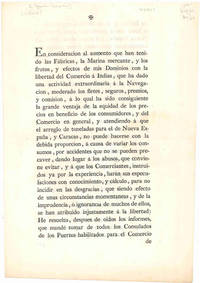
1789WRCAM47977Madrid 1789. 3pp. Folded folio sheet. Two worm holes very minor soiling else fine. This royal decree liberalized the tightly controlled trade between Spain New Spain and the Captaincy of Caracas. The Crown hoped to spur navigation and commerce and lessen the incentive for smuggling. Export duties on goods traveling to the Indies were to be slashed by ten percent but penalties against contraband would still be enforced. unknown books