156 résultats
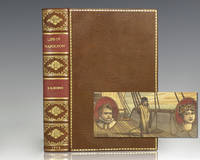
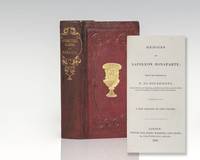
183698390London: Scott Webster & Geary 1836. Rare finely bound example of the Memoirs of Napoleon with a fine fore-edge painting of Napoleon on horseback leading his troops to battle. 12mo. bound in full red morocco gilt titles and tooling to the spine gilt vignettes to the front and rear panels gilt turn ins all edges gilt. In near fine condition with light rubbing. The earliest fore-edge paintings date possibly as far back as the 10th century; these earliest paintings were symbolic designs. Early English fore-edge paintings believed to date to the 14th century presented heraldic designs in gold and other colors. The first known example of a disappearing fore-edge painting where the painting is not visible when the book is closed dates from 1649. The earliest signed and dated fore-edge painting dates to 1653: a family coat of arms painted on a 1651 Bible. Around 1750 the subject matter of fore-edge paintings changed from simply decorative or heraldic designs to landscapes portraits and religious scenes usually painted in full color. Modern fore-edge painted scenes have a lot more variation as they can depict numerous subjects not found on earlier specimens. These include scenes that are erotic or they might involve scenes from novels like Jules Verne Sherlock Holmes or Dickens etc. In many cases the chosen scene will depict a subject related to the book but in other cases it did not. In one instance the same New Brunswick landscape was applied to both a Bible and to a collection of poetry and plays. The choice of scenes is made by either the artist bookseller or owner thus the variety is wide. The technique was popularized in the 18th century by John Brindley 1732-1756 publisher and bookbinder to the prince of Wales and Edwards of Halifax a distinguished family of bookbinders and booksellers. The majority of extant examples of fore-edge painting date to the late 19th and early 20th century on reproductions of books originally published in the early 19th century. Scott, Webster & Geary unknown books
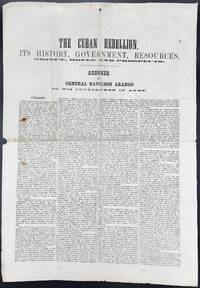
1870449481870. Broadsheet circular with title printed in various sizes and styles of type 17 x 12 inches printed in four columns on both sides of the sheet. The address is signed in type by Napoleon Arango and dated March 28th 1870. Arango eloquently states his objections to the insurrection declared by Carlos Manuel de Cespedes an effort aimed at achieving independence from Spain fought as the "Ten Year War" or "Great War" 1868-1878. OCLC locates four copies American Antiquarian Society Princeton Harvard Michigan. Creased from folding thumbnail sized chip to left margin not affecting text; one small hole at fold slightly affecting a letter or two and another small hole in top margin possibly from posting. A small spot or two of browning but a nice copy. <br/><br/> unknown books
18071008118vo contemporary calf spine and tips and marbled boards red leather spine label folding colored fronstispiece illustration for the last pamphlet 89 132 2 ad 48 pp. Covers almost completely detached hinges rubbed and extremities rubbed and worn in places light foxing and aging; otherwise near very good. Interesting collection of three scarce pamphlets relating to the conflict between England and France at the beginning of the 19th century. OCLC Worldcat locates only two copies of the third Title The Trial. The folding hand colored frontispiece at the beginning of the third pamphlet depicts a confrontation between Napoleon and John Bull. books
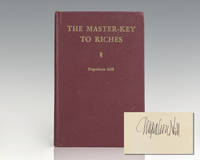
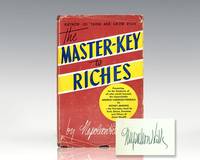
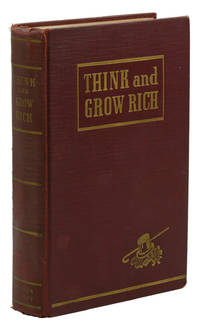
1945116778Los Angeles: The Willing Publishing Company 1945. First edition of Napoleon Hill's classic work. Octavo original cloth. Boldly signed by Napoleon Hill on the front free endpaper. In near fine condition with light rubbing. Based on the Andrew Carnegie formula for money-making The Master Key To Riches describes in step-by-step detail today's greatest practical philosophy of success. This philosophy culled from the success experiences of hundreds of the world's most powerful and wealthy men will show you how to succeed in any walk of life. The Willing Publishing Company hardcover books
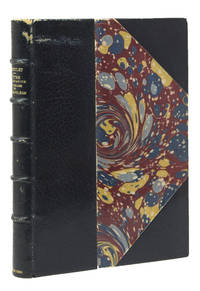
1879122443London: George Routledge and Sons 1879. Finely bound example of Horne's biography of Napoleon Bonaparte with a fore-edge painting of him. Octavo bound in full morocco with red morocco spine labels lettered in gilt gilt tooling to the spine in six compartments within raised gilt bands gilt ruling to the front and read panel marbled endpapers all edges gilt with a fore-edge painting. With additions by S.R. Townshend Mayer. Illustrated with several hundred designs by Raffet and Horace Vernet tissue-guarded frontispiece portraits of Napoleon. With the original cloth cover adhered to the front pastedown. In near fine condition. The first known example of a disappearing fore-edge painting where the painting is not visible when the book is closed dates back to 1649. Around 1750 the subject matter of fore-edge paintings changed from simply decorative or heraldic designs to landscapes portraits and religious scenes usually painted in full color. The technique was popularized in the 18th century by John Brindley 1732-1756 publisher and bookbinder to the Prince of Wales and Edwards of Halifax a distinguished family of bookbinders and booksellers. The majority of extant examples of fore-edge paintings date to the late 19th and early 20th century on reproductions of books originally published in the early 19th century including the present volume. George Routledge and Sons hardcover books
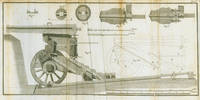
1805249883Milan: De l'Imprimerie de J. J. Destefanis 1805. First edition. 6 folding plates of cannon and fortifications by C. Piraud at the end. viii 9-216 p. 8vo. Contemporary marbled boards rebacked to style in half calf with red morocco spine label light foxing to prelims and plates. First edition. 6 folding plates of cannon and fortifications by C. Piraud at the end. viii 9-216 p. 8vo. Napoleon's Seige Specialist. Francois Marquis de Chasseloup-Laubat 1754-1833 was a French general who fought in the French Revolution and was chief of engineers in the army of Italy under Napoleon. He led the seiges of Maastricht Milan and Mantua. He reconstructed the defences of northern Italy during the peace of 1800-1805 during which time he constructed the great fortress of Alessandria on the Tanaro. He then served in the Polish and German campaigns where he directed the siege of Danzig and reconstructed many fortresses. Napoleon praised Chasseloup as one of his best generals.<br/>The detailed plates at the end of the work give plans for cannon and fortifications as well as designs for a portable bridge a well a sawmill and other instruments of war. <br/>Scarce; OCLC locates only 5 copies. No copies at auction on ABPC and only a handful of copies of the second edition appeared at French auction. De l'Imprimerie de J. J. Destefanis unknown books
1869304468New Haven 1869. Engraved title printed in blue 94 albumen print photographs comprising 22 views 2 interiors and 4 class or group shots all approx. 6-1/2 x 8-1/2 inches and 66 individual portraits of faculty and students 5-1/2 x 4 inches each photograph captioned in pen on the mount several of the faculty and student portraits inscribed by the sitter. Large 4to 12-3/4 x 10 inches. Contemporary full brown morocco covers with blind-stamped geometric border central title and school arms stamped in gilt a.e.g. Rebacked preserving parts of original spine new endsheets covers scuffed damage discoloration and stains to some pages a few photos badly damaged or foxed. Engraved title printed in blue 94 albumen print photographs comprising 22 views 2 interiors and 4 class or group shots all approx. 6-1/2 x 8-1/2 inches and 66 individual portraits of faculty and students 5-1/2 x 4 inches each photograph captioned in pen on the mount several of the faculty and student portraits inscribed by the sitter. Large 4to 12-3/4 x 10 inches. Photographic yearbook for the Yale class of 1869 with many fine images of the New Haven campus and several interior shots. The photographs were taken by Napoleon Sarony of New York his first such yearbook work the field being dominated by George Kendall Warren of Boston. Sarony parlayed his work for Yale into contracts for a half dozen more schools in 1870. Welling Photograph in America p. 254 unknown books
194589292Los Angeles: The Willing Publishing Company 1945. First edition of Napoleon Hill's classic work. Octavo original cloth. Boldly signed by Napoleon Hill on the front free endpaper. Contemporary inscription to the front free endpaper near fine in the rare original dust jacket with some chips to the extremities. Based on the Andrew Carnegie formula for money-making The Master Key To Riches describes in step-by-step detail today's greatest practical philosophy of success. This philosophy culled from the success experiences of hundreds of the world's most powerful and wealthy men will show you how to succeed in any walk of life. The Willing Publishing Company hardcover books
1810309945Paris: Chez L. Ch. Soyer Libraire-Editeur rue du Doyenné no 2 1810. With 54 plates 1 folding. 48 pp. 1 vols. 8vo. Three quarter blue levant marbled sides t.e.g. by L. Lemardeley. Bookplate of the prince d'Essling Victor et Fidelis. Fine. With 54 plates 1 folding. 48 pp. 1 vols. 8vo. Handsome copy of this compendium of beautiful line engravings of the architectural and decorative elements of the celebration of the wedding of Napoleon with Marie Louise of Austria on 1 April 1810.<br/><br/>From the library of the descendants of Napoleon's marshal Massena Duc de Rivoli and Prince d'Essling. Chez L. Ch. Soyer, Libraire-Editeur, rue du Doyenné, no 2 unknown books
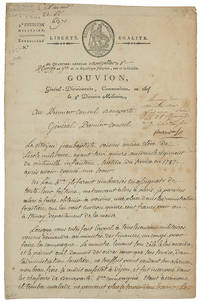
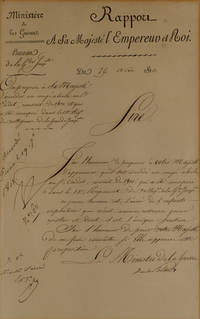
14458French Emperor who conquered most of Europe. Letter signed "Bonaparte" dated January 1 1801 in French page size is 13 1/4" x 8 1/2" on letterhead titled "To 1st Counsul Bonaparte General 1st Counsul." Written by General Laurent de Gouvion Saint-Cyr 9th division Commander to Napoleon Bonaparte. One page on "Liberte-Egalite" "Republique Francaise" letterhead with an illustration of the Greek goddess representing the Army. <br/><br/>General Gouvion writes to Napoleon ".When you called on all the former servicemen Voisins asked for a leave to the Finance Minister to do the campaign. The Minister praising his zeal granted it to him.and was drafted into the chasseurs of Bonaparte 6th company." Now wounded he request to get his position back. On top of the letter Napoleon replies that the veteran should come and see the 1st Consul on the 18th in Paris and signs in his hand "Bonaparte." Light scattered toning overall in very good condition with a strong signature. <br/><br/>At the time this letter the 32 years old Bonaparte had just become ruler of France and First Consul. He had crossed the Alps into Italy defeated the Austrians at the Battle of Morengo and 2 weeks after this letter on January 15 1801 he signs an armistice bringing temporary peace in Europe. unknown books
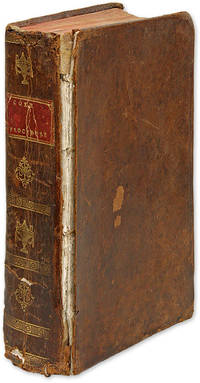
1806710721806. Paris 1806. iv 246; iv 108 4 pp. Paris 1806. iv 246; iv 108 4 pp. First Edition of the Code de Procedure Civile with Early Annotations by a Breton Lawyer Code Napoleon. Lucas de Peslouan Eugene Marie 1791-1873. Code de Procedure Civile Edition Originale et Seule Officielle. Paris: De l'Imprimerie Imperiale 1806. iv 246 pp. Interleaved. Bound with Code Napoleon. Table Alphabetique et Raisonnee des Matieres Contenues dans le Code de Procedure Civile. Paris: De l'Imprimerie Imperiale 1806. iv 108 4 pp. Octavo 8" x 5". Contemporary sprinkled sheep blind rules to boards lettering piece and gilt ornaments to spine edges of text block rouged blind tooling to board edges. A few scuffs to boards considerable rubbing to extremities with wear to spine ends and corners front board beginning to separate but secure front free endpaper edgeworn and partially detached minor worming to final text leaf and rear free endpaper at center of hinge. Light toning annotations to rectos and versos of most interleaves most likely by Eugene Marie Bonaventure Lucas de Peslouan a few manuscript notes in same hand laid in "Lucas-Peslouan" to title page of Code. $3000. First edition. The Code de Procedure Civile was issued two years after the publication of the Code Civil Code Napoleon. It is one of the main components of the legal system established during the Empire. The Table Alphabetique et Raisonnee is a companion index volume. The annotations in our copy date from 1810 to 1820. This period coincides with the career of Eugene Marie Bonaventure Lucas de Peslouan an attorney from a notable Breton family that produced several generations of lawyers and notaries. His annotations which range in length from phrases to several sentences are notably meticulous. They comment on the articles give clarifications pose procedural questions and refer often to laws from the Revolutionary period and early years of the Empire. Several notes are cross-references and there are a number of comments in question-and-answer form. For example in the section "Proceedings Before the Courts" "The claims directed against undivided successions in the national domain do they fall under judicial or administrative jurisdiction "Answer: "They must be prosecuted administratively=Court of Appeal of Paris. unknown books
1813247548Pirna 1813. On a one-page Document Signed "duc de Feltre" by Henri Jacques Guillaume Clarke Minister of War requesting the discharge. 1 vols. Folo. Some very slight soiling otherwise very good. Handsomely mounted and framed. On a one-page Document Signed "duc de Feltre" by Henri Jacques Guillaume Clarke Minister of War requesting the discharge. 1 vols. Folo. At a critical moment even as Napoleon is battling Allied forces in Germany he grants a full discharge to a conscript whom the Minister of War the Duc de Feltre describes as a "young man the eldest of 9 orphaned children for whom he is the sole means of support". unknown books
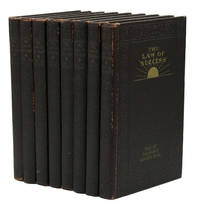
1939140941399Meriden CT: The Ralston Society 1939. Near Fine. Early reprint. Sixteen lessons complete in eight volumes bound in publisher's dark brown/maroon cloth decorated in blind and stamped in gilt. Near Fine with light rubbing and shelf wear to covers with several small patches of heavier rubbing and scuffing. Pages toned. A nice set. The Ralston Society unknown books
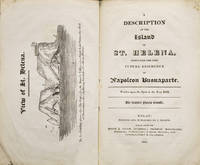
1815302741Wigan: J. Brown 1815. First edition. Woodcut frontispiece. 24 pp. 8vo. Later marbled boards with red morocco label to upper board original wrappers bound in. First edition. Woodcut frontispiece. 24 pp. 8vo. EXCEEDINGLY RARE DESCRIPTION OF NAPOLEON'S HOME IN THE ATLANTIC. With the defeat of the French at Waterloo England once again prepared to confine Napoleon. Looking for somewhere more than remote than Elba this time he was bound for St. Helena a tiny windswept island in the South Atlantic that was first discovered by the Portuguese and previously in control of the East India Company. <br/><br/>In the wake of this decision there was much interest in the island and printers scrambled to meet demand. This little pamphlet commences with a history of the island followed by an account of its inhabitants food live stock climate and the all-important garrison. The woodcut includes a key to landmarks on the island. Of additional interest are the "Remarks on Ascension Island" being another British possession in the Atlantic.<br/><br/>Not in OCLC not in COPAC. This copy only on ABPC. J. Brown unknown books
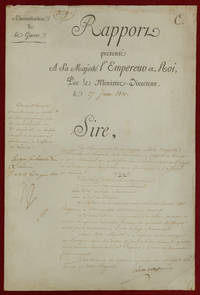
1810247547St. Cloud 1810. On a one-page document "Rapport présenté à sa Majesté l'Empereur et Roi" signed by the "Ministre-Directeur" Paris 27 juin 1810. 1 vols. Folo. Some very slight soiling otherwise very good. Handsomely mounted and framed. On a one-page document "Rapport présenté à sa Majesté l'Empereur et Roi" signed by the "Ministre-Directeur" Paris 27 juin 1810. 1 vols. Folo. Napoleon Cuts Surgical Instruments. On this document requesting among other surgical supplies for the army in Spain "3 caisses d'instruments à - amputation" Napoleon has penned this brief order:<br/><br/> "Envoyez seulement deux 2 caisses.<br/><br/> "St. Cloud le 30 juin 1810". unknown books
1937140941529Meriden CT: The Ralston Society 1937. First Edition. Very Good. First edition first printing. Bound in publisher's maroon cloth stamped in gilt lacking the dust jacket. Very Good. Cloth a bit frayed at extremities and lightly stained. Light stain to top textblock edge. Pages toned a paperclip impression to several leaves and several are edge-worn. A scarce first printing of a book Hill claimed was inspired by a suggestion from Andrew Carnegie. The Ralston Society unknown books
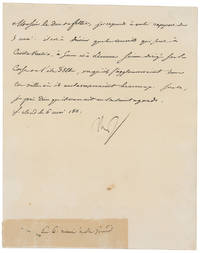
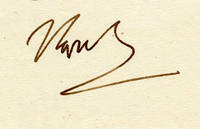
14904Emperor of France and great military leader. 1 page Letter Signed in French and dated May 6 1811. Writing to his Minister of War the Duke of Feltre Napoleon writes translated: "I am answering your report of the fifth of May. It is desired that the conscripts who are at Civita Vendina Genoa and Livorno are directed on to Corsica or the Isle of Elba see that they are gathered in the cities where they are much needed." An additional slip with a notation in another hand is pinned to the lower left. He signs in his hand "N.p."<br/><br/>This is a very unique letter as it mentions two small islands on the globe that were crucial to Napoleon's destiny. He was born in 1769 on the small island of Corsica in the year that Corsica was transferred to France from Italy. After his defeat by the Alliance and his adieu at Fontainebleau in 1814 he was exiled to the tiny island of Elba off the coast of Italy. At the time of writing this letter Napoleon was at the height of his power and his empire was at its zenith; he could not have imagined that he would end on the small island of Elba mentioned here. Given the remoteness of both these locations and their sizes in the huge empire that Napoleon built it seems unlikely that we would find another document mentioning both the island of his birth and the island of his exile together on one piece making this a very special letter. An especially clean attractive example from Napoleon at the height of his power. Central vertical and horizontal folds and trivial soiling. In fine condition. unknown books
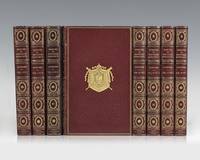
1836109608London: Richard Bentley 1836. Finely bound extra-illustrated edition set of de Bourrienne's Memoirs of Napoleon Bonaparte. Octavos eight volumes bound in full 19th century crimson morocco by Riviere and Son with gilt titles and tooling to the spines in six compartments within raised gilt bands central gilt Napoleonic coats of arms and double gilt ruling to the front panels gilt turn-ins and inner dentelles all edges gilt illustrated with engravings including frontispieces to each volume. In near fine condition. Based on years of intimate friendship and professional association with Napoleon Bonaparte Louis Antoine Fauvelet de Bourrienne's Memoirs of Napoleon gained the author fame upon publication for its vivid and detailed account of his interactions with Napoleon and his extended family. Invigorated by many dialogues not only in which the author participated but even of conversations that he was only told about by others the narration offers an intimate portrait of its subject: his brilliance skill at governance and military prowess. Richard Bentley unknown books
180725997<p><b>NAPOLEON BONAPARTE.</b>Letter Signed in French signed as "<i>Napol</i>" at the top of the third page. Written at Osterode Germany March 11 1807. 7.25 x 8.875 inches. </p><br /><p><b>Translation from the French</b></p><p>"<i>Monsieur General Clarke my intention is that the 2nd Italian regiment reports at Kolobrzeg until the entire Italian division is present; that will permit us to return the 19th of the Line here. Marshall Kellermann writes me that the 5th 6th 7th and 8th provisional regiments have left. The 5th has been at Kassel a long time. Write to Kassel requesting that they send you the 5th it will be replaced by the 9th. The 6th must be at Magdeburg the 7th must have returned by the 5th. The 8th will arrive there the 17th. My intention is that we leave no one at Magdeburg and that you direct everyone to Szczecin or to Kostrzyn.</i>"</p><p>"<i>Maral Kellermann assures me that they are well armed and dressed. My managerial staff needs reinforcements for these eight provisional regts; I have thus ordered Mal Kellermann to have the last four regiments that is the 9th 10th 11th and 12th depart as soon as they are organized. My intention is that once they arrive in Berlin you review them let them rest several days and give them coats and shoes. You will do the same thing at Kostrzyn. The 31st Light Infantry must arrive at Berlin. Direct them towards Szczecin after giving them a little rest and reviewing them. I prefer that regiments pass by Szczecin rather than by Kostrzyn because circumstances can render them exposed and that they clear a passage from Marienberg to Torun.</i>"</p><p>"<i>The 45th of the Line arrives the 14th at Mainz and will proceed directly to Magdeburg. The 3rd Battalion of the 17th of the Line will begin marching March 2nd for Magdeburg. You will review them. If there are 800 mn dash them off to this regiment without leaving them any time at Magdeburg. The 3rd Battalion of the 21st of the Line will have arrived at Mainz. Ask Marshall Kellermann when he arrives. On this I pray that God keeps you in his holy care. At Osterode March 11 1807.</i>"</p><p>"<i>Napol.</i>"</p><p><b>Historic Background</b></p><p>Napoleon Bonaparte—emperor military commander and master geopolitical strategist—addressed this lengthy missive to his Minister of War Henri Jacques Guillaume Clarke 1765-1818 in early March 1807 from the last months of the War of the 4th Coalition October 1806-July 1807 when Napoleon's forces were marching east conquering modern day Poland. Napoleon won the war after forcing the surrender of Polish strongholds Szczecin in October 1806 Gdansk in May 1807 and Kolobrzeg in July 1807.</p><p>Napoleon personally commanded his Grande Armee of up to 1000000 soldiers. In this Polish campaign Napoleon's French forces joined German Italian and Polish troops against the coalition of Prussia Russia Great Britain and Sweden.</p><p>As this letter shows Napoleon was intimately involved in the minutest details; Napoleon berated subordinates if they did not report everything to him. This letter mentions the movements of 15 regiments to and from nine German and Polish cities.</p><p>Napoleon relied on General Clarke for inspection and provisioning conscription and internal discipline. General Clarke was recognized with the title of Duc of Feltre in August 1809.</p><p>Marshall Francois-Christophe de Kellermann 1735-1820 was a career soldier whose resistance against the Prussians at the Battle of Valmy 1792 earned him Napoleon's great respect.</p><p><b>Napoleon Bonaparte</b> 1769-1821. Born at Ajaccio Corsica. He quickly rose through the ranks of the French Army to become Commander of the Army of Italy. After he defeated the Austrian army and conquered Italy in 1796 he was given command of the Army of England. Rather than attacking directly he planned to wipe out her trade in the Indian subcontinent. Sailing from Toulon he captured Malta and in early July 1798 he captured Alexandria and advanced into Cairo. However at the Battle of the Nile on August 1 1798 the French fleet was practically annihilated by Admiral Nelson's Royal Navy. Napoleon secretly returned to Paris in 1799 in time to join in the coup d'état that overthrew the Revolutionary government. He arranged a new constitution and was to a ten-year term as First Consul. But having secured peace with Austria and the Pope he arranged an election that voted him Consul for life. On December 2 1804 Napoleon crowned himself Emperor of France.</p><p>In 1805 he found himself at war with Prussia Saxony and soon Austria in addition to England causing the fall of The Holy Roman Empire. He later set off the Peninsular War by sending armies into Portugal and Spain. Napoleon's "Continental System" was undermined by Russia which opened her ports to neutral shipping. In June of 1812 Napoleon invaded and attempted to conquer the Russian Empire. He defeated the Russian army at Borodino in September. However Napoleon miscalculated the Russian winter the strength and nationalism of the Russian people and the determination of Czar Alexander I to protect his empire at all costs; to deprive Napoleon's troops of shelter and supplies the Czar had Moscow burned. The disastrous defeat and retreat cost Napoleon more than 500000 men of the army of 600000 he had set out with.</p><p>In 1813 Wellington routed the French and forced them out of Spain. Prussia Saxony and Austria had allied with Russia and invaded France and stripped away much of her conquests. Napoleon was forced to abdicate in April 1814; he was given sovereignty over the island of Elba and allowed to retain the title of Emperor. Within a year Napoleon returned to Paris supported by his army and his people. Europe declared war. Wellington's army in Belgium and Blucher's on the Rhine joined forces to overwhelm Napoleon at Waterloo. Napoleon fled to Paris and surrendered in July 1815. Exiled a second time the man who ruled Europe spent his last six years on the small island of St. Helena in the South Atlantic. He died there six years later. His body wasn't allowed to be repatriated until 1840.</p><p>Napoleon instituted political and social reforms that reined in the excesses of the French Revolution pulled the nation out of bankruptcy created a fair tax scheme reorganized the French educational system and instituted the Napoleonic Code which provides the precedent for modern French law combined the basic tenants of old Roman law with ideas from the Enlightenment. He thus planted the seeds of the modern middle class and created institutions that continue to shape our world.</p><p><b>Condition</b></p><p>On watermarked cream bifold paper in near fine condition with light paper folds.</p><p><b>Provenance</b></p><p>Ex-Marc-Arthur Kohn "The Empire in Paris" December 2 2013 Paris France part of lot 38.</p> books
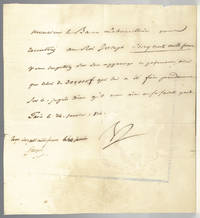
18141195371814. Rare original manuscript letter in French signed by brothers and co-monarchs Napoleon Bonaparte and Joseph Bonaparte. Napoleon in his role as French Emperor has signed as "Np" near the center of the letter while Joseph in his role as King of Spain and the Indies has signed as "Joseph" at lower left. Napoleon's original command was directed from Paris on January 24 1814 while the docket indicates that Joseph received the sum in question the same day. Ex-Good Speeds per pencil notation from October 14 1964 at top verso. Napoleon instructed Francois Roullet Baron de la Bouillerie 1764-1833 to give 500000 francs to his older brother Joseph. De la Bouillerie had served in various financial capacities dating from Napoleon's earliest days as First Consul including General Treasurer of the French crown after 1811. Translated in full with unchanged spelling and punctuation: "Monsieur Baron Labouillerie you will give to King Joseph five hundred thousand francs. You will attribute this payment to his appanage as well as the one of 300000 francs that was made to him previously. On this I pray God keeps you in his holy care. Paris the 24 January 1814. In very good condition. The piece measures 7.25 inches by 7.875 inches. Napoleon Bonaparte was a French military and political leader who rose to prominence during the French Revolution and led several successful campaigns during the Revolutionary Wars. As Napoleon I he was Emperor of the French from 1804 until 1814 and again in 1815. Napoleon dominated European and global affairs for more than a decade while leading France against a series of coalitions in the Napoleonic Wars. He won most of these wars and the vast majority of his battles building a large empire that ruled over continental Europe before its final collapse in 1815. One of the greatest commanders in history his wars and campaigns are studied at military schools worldwide. He also remains one of the most celebrated and controversial political figures in human history. unknown books
1928140940868Meriden CT: The Ralston University Press 1928. First Edition. Very Good. First edition. Complete eight volume set bound in light blue variant cloth stamped in dark blue. First edition. Very Good with sunning to spines light mottling to cloth heads and tails a little worn and frayed. Scratch to spine of Vol. 1 binding error with front free endpaper pasted onto paste down penciled gift inscription on page facing copyright page another to Vol. VIII front hinge a little over-opened. A classic of the self-improvement genre. The Ralston University Press unknown books
18121156521812. Rare military commission boldly signed by French Emperor Napoleon Bonaparte. One page dated April 19 1812 the document contains a request for 17861 francs to replace uniforms and shoes that were destroyed in a fire in the city of Aurich on July 18 1811. Additionally signed by Napoleon's Minister of War "Duc de Feltre." Accompanied by several additional military documents in French and German including an autograph letter signed by Michel Ney four days prior to the battle of Guttstadt-Deppen two reports of the inspector of engineering pertaining to fortifications and many others. With a first edition auction catalog from Sotheby's Napoleon & Berthier Auction on Tuesday March 1 1938. In near fine to fine condition. An exceptional collection. Napoleon Bonaparte was a French military and political leader who rose to prominence during the French Revolution and led several successful campaigns during the Revolutionary Wars. As Napoleon I he was Emperor of the French from 1804 until 1814 and again in 1815. Napoleon dominated European and global affairs for more than a decade while leading France against a series of coalitions in the Napoleonic Wars. He won most of these wars and the vast majority of his battles building a large empire that ruled over continental Europe before its final collapse in 1815. One of the greatest commanders in history his wars and campaigns are studied at military schools worldwide. He also remains one of the most celebrated and controversial political figures in human history. unknown books
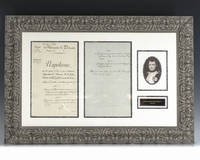
120531Rare Imperial Decree boldly signed by French Emperor Napoleon Bonaparte. Two pages partially printed in Italian the decree outlines a proposal for the construction of a bridge over the Sesia River in Vercelli to be financed by the Kingdom of Italy as part of Napoleon's civic improvement plan initiated during his administration of Ital. Dated April 12 1809 the decree reads in part "<span class="match">Napoleon</span> by the grace of God & by the Constitution French Emperor King of Italy Protector of the Rhine Confederation have decreed and decree what follows: Art. 1. Our Kingdom of Italy will contribute the certain sum of 150000 lire to the expense of building the Vercelli bridge on the Sesia. Art. 2. The payment will be made in installments at the rate of 50000 lire per year starting from the current year. Art. 3. This expense will be carried into the budget of the Minister of the Interior and to the head of the extraordinary works of water and roads. Art. 4. The Minister of the Interior is in charge of the execution of this decree. Given at our Imperial Palace of the Tuileries this day April 12 1809". Signed by Napoleon Bonaparte at the conclusion the decree "Napole". Double matted and framed with a portrait of Napoleon. The entire piece measures 31.5 inches by 21.25 inches. Napoleon Bonaparte was a French military and political leader who rose to prominence during the French Revolution and led several successful campaigns during the Revolutionary Wars. As Napoleon I he was Emperor of the French from 1804 until 1814 and again in 1815. Napoleon dominated European and global affairs for more than a decade while leading France against a series of coalitions in the Napoleonic Wars. He won most of these wars and the vast majority of his battles building a large empire that ruled over continental Europe before its final collapse in 1815. One of the greatest commanders in history his wars and campaigns are studied at military schools worldwide. He also remains one of the most celebrated and controversial political figures in human history. unknown books
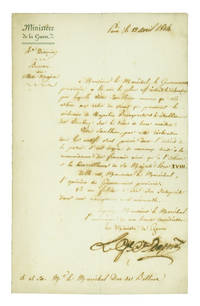
1814247420N.p. Paris 1814. 1 p. on letterhead of "Ministère de la Guerre". Folio. Some very slight waterstaining affecting a few letters otherwise very good handsomely mounted and framed. 1 p. on letterhead of "Ministère de la Guerre". Folio. ". dans une circomstance . mémorable". An extraordinary letter of historic significance written a mere two days after the Treaty of Fontainebleau of April 11 1814 which set the terms of Napoleon's abdication and ended an era. Dupont had been one of Napoleon's most distinguished generals but his surrender in the disastrous Spanish campaign led to disgrace and imprisonment. After the fall of Napoléon Dupont became Minister of War for Louis XVIII and in just such letters as this to Marshal Victor - one of Napoleon's most trusted generals - negotiated the acquiescence of Napoléon's military leaders: in translation "Monsieur le Maréchal; - The provisional government has read with intense interest the declaration in which your Excellency has announced his adherence to the act of the Senate pronouncing the abdication of Napoleon Buonaparte and the restoration of the Bourbons on the throne on their ancestors. By this declaration taken in the interest of the country your Excellency has established anew a claim to the gratitude of the French people as well as the respect and good will of His Majesty Louis XVIII. Such is the opinion sir of the provisional government - and I am more than happy to be its messenger on this memorable occasion". unknown books
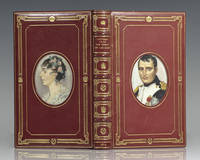
1891122635London: Printed for James Ridgway 1891. First edition of Napoleon's biographer Emmanuel Comte de las Cases' collected letters. Octavo bound in full morocco by Bayntun-Riviere in an elaborate Cosway-style binding with hand painted miniature ivorene portraits of Napoleon Bonaparte and Marie Louise Duchess of Parma set under glass within a gilt borders to the front panel and rear panels gilt titles and tooling to the spine in six compartments within raised gilt bands elaborate gilt ruling to the panels gilt turn-ins and inner dentelles marbled doublures and endpapers all edges gilt. In fine condition. Exceptionally rare. Cosway bindings named for renowned 19th-century English miniaturist Richard Cosway were popularized if not invented in the early 1900s by the renowned London bookselling firm of Henry Sotheran. The earliest Cosway bindings were created by Miss C.B. Currie who faithfully imitated Cosway's detailed watercolor style of portraiture from designs by J.H. Stonehouse Sotheran's manager. These delicate miniature paintings often on ivory were set into the covers or doublures of richly-tooled bindings and protected by a thin pane of glass. Printed for James Ridgway unknown books