Sohr, Samuel AugustAntiquariat.de

71 résultats
178195025HBDessau und Görlitz:, In der Buchhandlung der Gelehrten, 1781. 1 Bl. (Titelblatt), 1 Bl. vakat, 42 Seiten, schlichte Fadenheftung, 16 x 10 cm.
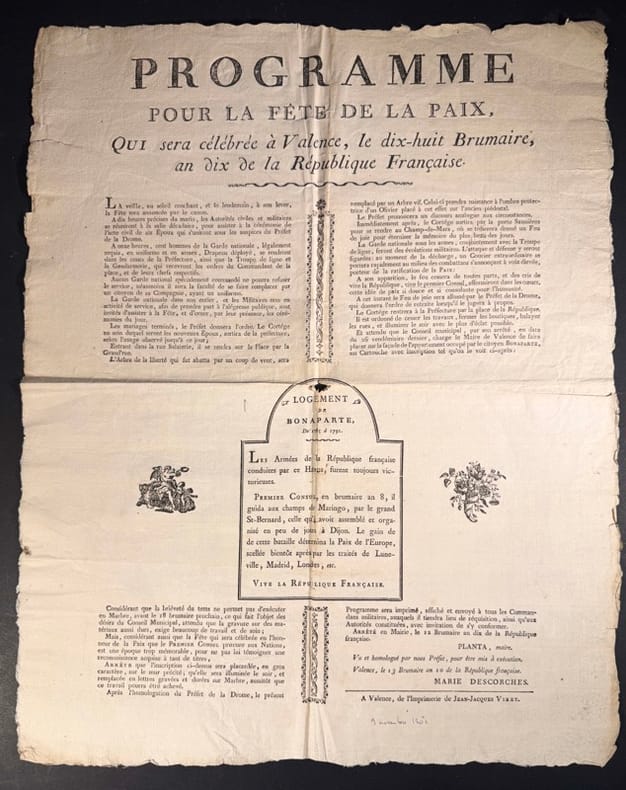
17993264A Valence de l’imprimerie de Jean Jacque Biret sur un texte signé du 13 brumaire an dix de la République Française. 1799 Grande affiche non ébarbée 53x42 cm, trace de pliure (en 4), signature au verso « Bons » (probable « bon à tirer »). L’affiche présente le détail du déroulé de la célébration durant laquelle « six époux s’unirons nous les auspices du préfet de la Drome. » A la suite des épousailles et d’un défilé militaire la foule se rendra sur la place par la grand rue « L’arbre de la liberté qui fut abattu par un coup de vent sera remplacé par un arbre vif. Celui-ci prendra naissance à l’ombre protectrice d’un olivier placé à cet effet sur l’ancien piédestal. (…) S’en suivra un feu de joie et une reconstitution de bataille militaire, de toute part des cris de Vive la République ! Vive le premier consule ! affirmeront dans les cœurs cette idée de paix si douce et si consolante par l’humanité »L’appartement occupé par le citoyen Bonaparte de 1785 à 1791 se verra orné d’une plaque en attendant qu’elle fut remplacée par une stèle de marbre.
1797152774Paris: Chez H. J. Jansen 1797. Presented to Napoleon First edition presentation copy to Napoleon inscribed on each half-title verso "au Général Bonaparte; l'auteur". The work gives Saint-Fond's 1741-1819 account of his travels to Britain in the year 1784 with important observations on the geology of northern England and Scotland most notably his recognition that Fingal's Cave was a volcanic formation which had gone unnoticed by Joseph Banks. The work also includes anecdotes of Banks Adam Smith John Whitehurst and the Royal Society. The work was issued in octavo and the present large paper printing on quarto sheets; an English translation followed in 1799. At the time of publication Saint-Fond was professor of geology at the Jardin des Plantes; he was later involved in the extraction to French institutions of scientific materials across Napoleonic Europe. As one of the travelling commissaires of the clumsily but explicitly named Commission du gouvernement pour la recherche des objets scientifiques et artistiques dans les pays conquis par les armées de la République française established under the Directory for the purposes of pillage directed by connoisseurship and scientific expertise Saint-Fond certainly interacted with Napoleon who himself had refined the process by inserting clauses into peace treaties ensuring that governments would hand over the items selected. One of Saint-Fond's greatest triumphs was securing the fossil skull of the Monster of Maastricht a massive aquatic reptile from its home in Belgium. His 1799 account whereby the piece was retrieved by twelve grenadiers in exchange for an offer of 600 bottles of wine helped elevate the fossil to wide cultural fame but current informed opinion considers the narrative to be somewhat exaggerated. At publication Napoleon was leading French forces to repeated victories against the Austrians in northern Italy building his reputation as a national hero. It is well known that Napoleon was much taken with the myth of Ossian - he presumably read with particular attention the passages in the book relating to Fingal's legendary cave vol. II p. 454. So too he may have paid particular attention to Saint-Fond's account of his meetings with Adam Smith where Smith praised Rousseau and Voltaire and took Saint-Fond to a bagpipe competition much to his displeasure II pp. 277-283. Napoleon read the Wealth of Nations as a young man responding enthusiastically to the text though later affecting disdain for the economist. 2 vols quarto 255 x 196 mm. With 7 folding engraved plates. Contemporary calf rebacked with original spines laid down and later twin red and green labels spine compartments and covers ruled in gilt new endpapers. Housed in a brown solander cloth box by the Chelsea Bindery. Book label of 20th-century French collector Hubert Heilbronn to front pastedowns transposed from earlier endpapers when they were replaced. Extremities restored and gilt retouched. Contents with general soiling spotting and occasional rippling short closed tear in gutter of vol. II sigs. L-N 5.5 cm closed tear at foot of vol. II 2E3 not affecting text. A good copy. For Saint-Fond's role as a commissaire see Pierre-Yves Lacour La République naturaliste 2014. hardcover
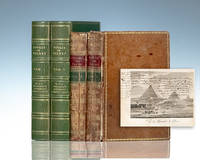
1799146536A Paris: Chez Dugour et Durand Libraires Rue et Hotel Serpente 1799. Volney's important work on Egypt and Syria from the library in exile of Napoleon Bonaparte with his annotations and corrections throughout several made as he was dictating details from the Egyptian Campaign for his own Memoirs. This copy may also have accompanied him during his Egyptian Campaigns; it is known that Napoleon brought along a copy of Volney's book to Egypt and it served as the standard reference source for the members of the campaign. Octavo two volumes bound in full contemporary French sprinkled calf with gilt tooling to the spine morocco spine labels lettered in gilt gilt scrolling to the front and rear panels with 3 engraved folding maps and 5 folding plates. First published in 1787 this important travel account by the renowned French historian orientalist philosopher and politician Constantin Francois de Chasseboeuf comte de Volney 1757-1820 is considered the best exposition of Egypt from Ottoman Syria in the late eighteenth century. It served as a basis for later Egyptian expeditions and many scientists as well as Bonaparte himself took this work with them on their expeditions. His candid descriptions did not romanticize Egypt's history or its contemporary social and political conditions but discussed the ills that plagued the country and explored the military weakness of the Ottoman Empire. Based on his observations Volney discouraged a conquest of Egypt and while he supported his friend Bonaparte politically he declined the invitation to accompany Napoleon's expedition in person. It is known that Napoleon brought along a copy of Volney's book to Egypt and it served as the standard reference source for the members of the campaign. The French campaign in Egypt and Syria 1798--1801 was a Napoleonic campaign in the Ottoman territories of Egypt and Syria executed by Bonaparte. Napoleon proclaimed to "defend French trade interests" and to establish "scientific enterprise" in the region. Despite early victories and an initially successful expedition into Syria Napoleon and his Armee d'Orient were eventually defeated and forced to withdraw especially after suffering the defeat of the supporting French fleet by the British Royal Navy at the Battle of the Nile. However on a scientific front the expedition was a success that led to the discovery of the Rosetta Stone creating the field of Egyptology. This important copy contains numerous annotations in ink and pencil in Bonaparte's hand mostly concerning measurements and other calculations including a heavily annotated folding plate of the pyramids "Vue de Pyramides de Djize" in Vol. I. The first volume contains ink annotations on pages 188 232 272 273 277-79 281 plate at page 229 cited above and map "Carte de la Syrie" at p. 288 outlines drawn in red pencil. The second volume contains mostly pencil annotations on pages 223 225 227 229 272 ink and pencil and 333. These corrections were made by Napoleon as he was dictating details from the Egyptian Campaign for his own Memoirs see provenance below. After Napoleon's death on St. Helena a large portion of his last library was divided by the executors among heirs and friends. The remainder was removed from St. Helena by order of the British Government and sold to the important French bookseller in London Martin Bossange. The lots that failed to sell almost half were quickly consigned by Bossange to Sotheby's and sold on 23 July 1823. The lengthy catalogue entry for the present lot in the Sotheby's catalogue reads: "This Work is one of the most interesting books that has occurred for sale for many years. Most persons are aware that Napoleon wrote very little but dictated to his favorite Generals Bertrand Montholon and Count Las Casas. The Egyptian Campaign which forms a part of two volumes just published of his Memoirs have been dictated from these volumes: he has taken notice of the most trifling error in the book; hence the many CORRECTIONS BY HIM. The Plate at page 229 vol. i is entirely covered with his hand writing. This unique Book forms an historical document which will be looked at with a mixture of pleasure and pain by the admirers of so great a man." Provenance: Napoleon I each title-page with circular hand-stamp in brown ink from Napoleon's library at Longwood House on St. Helena; and with his numerous ink annotations to plates and text in both volumes; Sir James Lewis Knight-Bruce bookplates; and with a note from his grandson regarding this copy: "These two volumes of 'Volnay's Voyages' which belonged to Napoleon the first were understood to have accompanied him during his Egyptian Campaigns and contain many notes in his the Emperor's handwriting. My grandfather the late Lord Justice Sir James Lewis Knight-Bruce of Roehampton Priory purchased these books presumably about 1821-2 when they were sent to England from St. Helena for sale. They being in Napoleon's possession there until his death in 1821." In very good condition with splitting to the spine and joints small section of leather torn from the upper cover of Vol. II; some wear to extremities. Occasional pale spotting internally final blank leaves 30/8 of both volumes removed presumably at the time of binding. First map in Vol. I with small marginal tear repaired near gutter margin second and third maps each with 2-inch tear repaired at gutter a few other plates with small marginal tears or reinforcements. Housed in a custom full crushed levant morocco clamshell box by Riviere & Son. Third edition revised and corrected. An exceptional piece of history with fascinating provenance. Chez Dugour et Durand, Libraires, Rue et Hotel Serpente hardcover
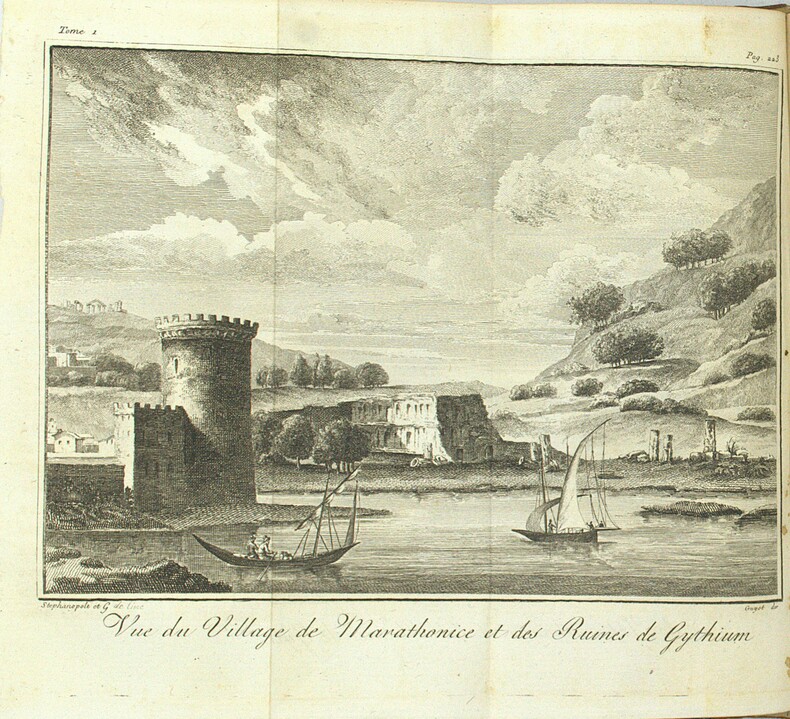
1800PHO-1932Paris, de l’imprimerie de Guilleminet, 1800, 2 tomes en 1, in-8, xvi-303pp,1f-319pp., demi basane, dos lisse avec pièce de titre rouge et date verte, tranches mouchetées, illustré de 8 planches dont 2 dépliantes, étiquette en page de garde « Marquis de Civille » et ex-libris manuscrit au titre, quelques écritures en marge, frottements aux plats et coupes. A été relié avec, écrit à la plume, la table des volumes ainsi qu’un texte fustigeant le coté révolutionnaire de l’auteur considéré comme un espion de Bonaparte désirant conquérir la Grèce.
17947348Kiel u. Greiphswalde 1794. (2), 94 Seiten. Kart.-Einband d. Zeit.
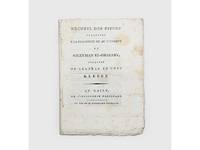
1800177962Paris: Imprimerie de la république 1800. The end of Napoleon's invasion of Egypt Sole edition of this rare document published shortly before Napoleon's forces withdrew from Egypt in which Cairo's council the diwan attempts to create an impression of continuing allegiance to France at a time of great political instability foreshadowing the eventual rejection of colonial rule. We locate only three copies of this document in institutions Leiden BnF and Bayerische Staatsbibliothek. In Paris where it was published the declaration would have been interpreted as a sign of Egyptian loyalty to Napoleon and his general in chief Jacques-François de Menou also known as Abdallah J. Menou d. 1810 but the reality was somewhat different. Napoleon's invasion of Egypt had begun in 1798 inspired by a desire to counteract Britain's influence in the Middle East and to 'liberate' the country from Ottoman rule. He took Cairo late in July 1798. However Nelson's victory at the Battle of the Nile in August 1798 left the French without a fleet and Napoleon was forced to halt his expansion into Syria in 1799. Napoleon managed to hold advancing Ottoman forces at the Battle of Abukir in June 1799 but news soon reached him that his gains in Europe had been reversed and he resolved to abandon his own forces and return to France which he did in complete secrecy on 23rd August 1799. He left behind him General Kléber who would soon be murdered and de Menou who succeeded Kléber as general in chief in June 1800. The Convention of El Arish signed in January 1800 by the French and the Ottomans at the instigation of the British intended to bring the French presence in Egypt to an end but only after de Menou's defeat at the Battle of Alexandria in March 1801 were the French forces ultimately repatriated. Written in November 1800 after the Convention had been signed but before the withdrawal was finalized this declaration was signed by the leading members of the council including the Grand Imam of al-Azhar Shaykh Abdallah al-Sharqawi d. 1812 and witnessed by de Menou. The translators were the renowned orientalists Silvestre de Sacy and Pierre Jaubert. The latter acted as Napoleon's interpreter in Egypt. Bifolium leaf size 463 x 585 mm black letterpress across four pages. Text in French and Arabic. Creased where folded small chips to lower edge light foxing and dust soiling: a very good example of a fragile document. unknown
180020813Augsburg. Rollwagen, 1800. Gest. Frontispiz, gest. Titel, 8, 6 Bll. Kalendarium, 196 SS., 10 Kupfertafeln von Nussbiegel nach Weber. 12° (ca. 11 x 7 cm). Illustr. Orig.-Pappband mit kolorierten Deckelvignetten, Goldschnitt, im Pappschuber der Zeit.
179599603HBLeipzig:, Lee, 1795. 14 Bll., 2 gestochene grenzkolorierte Karten, Broschur der Zeit, 24 x 40,5 cm (quer). [4 Warenabbildungen]
179722229Nürnberg, 1797. 34 SS. Fol., ohne Einband, fadengeheftet, Bindung gelockert. Einige Seiten im Bug mit Einriß, tls. hinterlegt.
18000140-25o. O. [ca. 1800]. Stahlstich v. F. Mehl nach Carl Geiger. 19, 5 x 26, 5 cm.Carl Geiger del., F. Mehl sculp. In gutem Zustand.
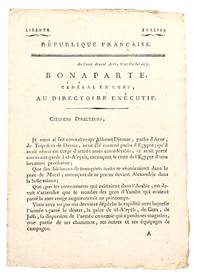
17992197<p><em><strong>Printed in Alexandria: Napoleon admits his first defeat</strong></em></p><p>Napoléon Bonaparte 1769-1821; Louis Antoine Fauvelet de Bourrienne 1769-1834.</p><p><strong>République française. Au camp devant Acre le 21 Floréal an 7. Bonaparte Générale en chef au Directoire exécutif. </strong>incipit: <strong>Je vous ai fait connaître qu' Ahhmet Djezzar Pacha d'Acre de Tripoli et de Damas avait été nommé Pacha d'Egypte.</strong></p><p>including:</p><p><strong>République française. Au quartier-général devant Acre le 8 Floréal </strong>sic<strong> an 7. Bonaparte Générale en chef au Directoire exécutif. </strong>incipit: <strong>Je vous ai fait connaître par le courrier que je vous ai expédié le 27 floréal les événements glorieux pour la République qui se sont passés depuis trois mois en Syrie.</strong></p><p>Alexandria <em>Imprimerie orientale et française</em> after May 16 1799.</p><p>4°. 8 pp. Collates: A-A4.</p><p>Two reports by General Napoleon from the battlefields in current Israel printed in Alexandria. Although the imprint is missing material characteristics strongly indicate that this was printed in Alexandria after October 1798 when the better printing equipment moved to Cairo. For instance the publication uses the same thick paper as <em>Expedition de Syrie jusqu'a la prise de Jaffa</em> kept by us. Additionally the absence of a capital "É" in the title led to the use of an apostrophe ' a solution also employed in <em>Expedition de Syrie jusqu'a la prise de Jaffa</em> where various methods were used to address this issue. Another edition of these reports was printed at the Imprimerie Nationale in Cairo now only found at the Bibliotheque nationale de France.</p><p>General Napoleon embarked on his Syria Campaign after securing control of Cairo engaging in several battles across what is now Egypt Gaza and Israel. The campaign culminated in his defeat at the fort of Acre modern-day Akko Israel. To keep his people informed and maintain control of the narrative Napoleon regularly sent military reports back to Egypt where they were printed to disseminate propagandist information.</p><p>The present publication contains two such reports. The first dated May 10th 1799 was written from Acre by Napoleon's secretary Fauvelet de Bourrienne. In this report Napoleon admits to his first defeat as a military leader. He was defeated by Ahmed Pasha al-Jazzar who successfully defended the fort of Acre for the Ottomans. This victory brought Jazzar significant fame in the Muslim world earning him the sobriquet "the slave who defeated Napoleon." The report also notes that as a result of this victory "Ahhmet Djezzar Pasha of Acre Tripoli and Damascus had been appointed Pasha of Egypt by the Ottomans" thereby challenging Napoleon's hold on the territory.</p><p><br />After this news Napoleon describes in the present report the campaign's progress since his last dispatch two months earlier detailing various military engagements in the Gaza/Israel/Palestine region including the Battles of Nazareth Cana and Mount Tabor.</p><p>In the second report dated May 16th Napoleon explains the reasons for his defeat at Acre and outlines his strategy for retreating to Egypt including his intention to destroy Jaffa near present-day Tel Aviv Israel on his way back.</p><p><strong>Condition: </strong>first and last pages very slightly rubbed otherwise in excellent condition.</p><p><strong>Copies:</strong> none only one copy of the Cairo editon in BnF: FRBNF33764485.</p> Imprimerie orientale et française
1799PHO-1973Paris, Carteret et chez Dentu, An VII (1799), in-8, VIII-457pp., relié papier bleu, dos lisse avec pièce de titre, , petits frottements, quelques rousseurs, pages d’index courtes en marges.
1800178043Cairo: Imprimerie nationale 1800. The commission unanimously declared that the said Suleiman al-Halabi is guilty First edition one of 500 copies printed of the court proceedings from the murder trial of Suleiman al-Halabi. The Kurdish student was tried for the assassination of Jean-Baptiste Kléber the French army's commanding officer whom Napoleon described as "the god Mars in uniform". This detailed record includes the interrogations of al-Halabi and his accused accomplices during which the former admitted his guilt and premeditation alongside the closing arguments by Antoine Léger Sartelon commissaire-ordonnateur as well as the court's judgement. It also comprises supporting documents from the trial such as a list of court members and witness statements in which the sub-officers Perrin and Robert describe finding al-Halabi covered in blood. Also included is a post-mortem examination of Kléber and a report of the injuries sustained by the architect Jean Baptiste Protai who survived the attack. The medical reports are both by the chief doctor René-Nicholas Dufriche Baron Desgenettes. After the assault on Alexandria Kléber 1753-1800 was given command of the province later leading his division into action on the expedition to Syria. When Napoleon left for France in secrecy at the end of 1799 he made the unsuspecting Kléber commander of the army. In this capacity he negotiated the Convention of El Arish which was signed by representatives from the Ottoman Empire and France. It intended to end the French campaign with the repatriation of troops and return of territory to the Ottomans. The armistice was abrograted by the British leaving the outraged Ottomans to send an assault force commanded by Grand Vizier Yusuf Ziya Pasha d.1819 whom the French defeated at the Battle of Heliopolis. Shortly after retaking Cairo which had risen in revolt Kléber was viciously stabbed in the heart chest arm and thigh by al-Halabi c.1777-1800 who was supportive of the Ottoman cause. Al-Halabi was convicted of the murder; on 17 June 1800 he had his right hand burned before being impaled while four scholars accused of complicity were beheaded. The skull of al-Halabi is held at the Musée de l'Homme in Paris and was for a time studied by French phrenologists while Kléber's remains are buried in his hometown of Strasbourg. The French army capitulated to the British in 1801 and Egypt was returned to Ottoman control in 1802 following the Treaty of Paris. Napoleon reflected on the character of Kléber during his exile on St Helena: "Kléber! It was the god Mars in uniform. Courage conception he had everything; All he needed was to have his battlefield at his disposal longer" quoted in Correspondance. When Napoléon invaded Egypt in 1798 he saw printing as a strategic necessity and established a press immediately after reaching Alexandria. Known as the Imprimerie nationale in Cairo and the Imprimerie orientale et française in Alexandria it was the third press to be established in Ottoman territory following Muteferrika's in Istanbul and Abdallah Zakher's press in Lebanon. Although discontinued after Napoleon's occupation ended the Imprimerie inspired the Bulaq Press as "many Egyptian intellectuals had seen the presses and realized the benefit to be derived from them" Kent p. 61. Sartelon ordered 500 copies printed with translations made in Turkic and Arabic for provincial distribution. We have traced 14 copies in institutions of which 12 contain all three translations two are unclear. Octavo 220 x 157 mm pp. 47 1 blank as rear wrapper. Stitched as issued in self-wrappers. Pale staining to wrappers and four leaves at end a few marginal paper flaws not affecting text. A very good copy. Boustany 10; Geiss 15; Schnurrer 422; all citing three language versions together. Allen Kent Harold Lancour Jay E. Daily eds. Encyclopedia of Library and Information Science vol. 24 1978; Napoléon "Éloge de Kléber Tome II page 65 30 mars 1821 " in Correspondance de Napoléon Ier: Tome XXXI oevres de Napoléon Ier à Sainte-Hélène 1869. unknown
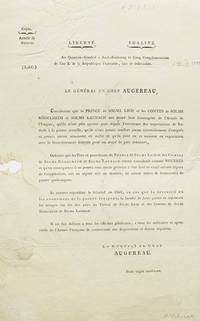
1799217365Quartier-Général à Aschaffenbourg 1799. One page. 1 vols. Folio 31.4 cm; 12-1/4 inches. Small chip and tear at left margin no loss. Addressed on blank verso. One page. 1 vols. Folio 31.4 cm; 12-1/4 inches. Napoleon Expands in the North. Recognizing the neutrality of the three German princes above and exempting them from the obligatons to pay any tribute quarter any troops raise forces etc. except that the Général en Chef "se reserve au case la necessité ou les evenemens de la guerre l'exigent la faculté de faire passer et séejourner les troupes sur les dits pays unknown books
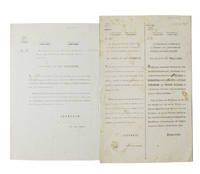
1800217366Quartier-Général à Offenbach 1800. One page text in French. with: Biligual French and German version of the same broadside. 1 vols. Folio 31.4 cm; 12-1/4 inches. Very slight soiling. One page text in French. with: Biligual French and German version of the same broadside. 1 vols. Folio 31.4 cm; 12-1/4 inches. The French Invade Germany. Annoucing that in light of the treaty signed with the three German princes their territories "seront traités en païs en paix avec la République" etc. unknown books
1799217365Quartier-Général à Aschaffenbourg 1799. One page. 1 vols. Folio 31.4 cm; 12-1/4 inches. Small chip and tear at left margin no loss. Addressed on blank verso. One page. 1 vols. Folio 31.4 cm; 12-1/4 inches. Recognizing the neutrality of the three German princes above and exempting them from the obligatons to pay any tribute quarter any troops raise forces etc. except that the Général en Chef "se reserve au case la necessité ou les evenemens de la guerre l'exigent la faculté de faire passer et séejourner les troupes sur les dits pays unknown
1800217366Quartier-Général à Offenbach 1800. One page text in French. with: Biligual French and German version of the same broadside. 1 vols. Folio 31.4 cm; 12-1/4 inches. Very slight soiling. One page text in French. with: Biligual French and German version of the same broadside. 1 vols. Folio 31.4 cm; 12-1/4 inches. Annoucing that in light of the treaty signed with the three German princes their territories "seront traités en païs en paix avec la République" etc. unknown
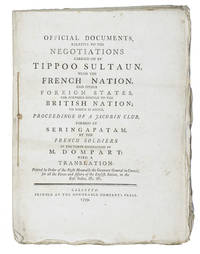
1799ABC_45147Calcutta: Honorable Companys Press 1799. Never bound but side stitched through 3 holes. Super Royal 4to 33.5 x 25 cm. A British propaganda publication printed in Calcutta transcribing secret documents that the British supposedly found in the palace of Seringapatam: primarily Tipu Sultans correspondence with the French considered a betrayal of the British. Tipu Sultan 1750-1799 ruler of the Kingdom of Mysore in southern India took part in a long-standing military feud with the British but made peace with them in 1792. When the French under Napoleon made a push for India in 1798 the British attacked Tipus forces once again starting the Fourth Anglo-Mysore War and eventually killing Tipu Sultan in the attack on Seringapatam. He had a fearsome reputation as the Tiger of Mysore and the present publication attempts to discredit him as a traitor. His supposed affiliation with the French Jacobin Club would have especially concerned British readers. Most of the correspondence between Tipu Sultan the French and their allies including Zaman Shah Durrani ruler of what was to become Afghanistan is printed in parallel columns in English and French. Also included is the text of a letter from Tipu Sultan printed letterpress in Persian in the nastaliq script: 9 lines of type apparently set in the nastaliq type cut under the direction of Charles Wilkins 1749-1836 who served the East India Company in India and became their leading orientalist. It was first used at Calcutta in 1781. The only earlier type for the script that has been clearly documented is thought to have been cut in the 1590s for the Propaganda Fide in Rome who used it around 1633. Neil Benjamin Edmonstone translated the Persian and G.G. Keble the French. Although the book is a true very large quarto point holes along the fold at the head and deckles at the foot and fore-edge the chainlines are vertical though one would not expect sheets this large to be made in double moulds the usual reason for chainlines parallel to the long axis of the sheet.In good condition. Wholly untrimmed and with most bolts unopened and the point holes present.l Shaw Printing in Calcutta 359; Shaw SABREB sab00086; not in Cat. East-India Comp. Honorable Companys Press, unknown
180011401Maestricht - Paris NYPELS, MERLIN, BARBOU, NYON 1800 1 Maestricht, Th. Nypels, Paris, Merlin, Barbou, Nyon, Desenne, an IX (1800), in-12, dos lisse orné à huit faux-nerfs dorés, pièce de titre en maroquin rouge, plats cartonnés, tranches marbrées, 222 pages.
1800137699). Seitliches Brustporträt im Oval mit Aquatinta-Einfassung. Anonymer Kupferstich, um 1800. Bildgröße ca. 10,4 : 7,5 cm. Blattgr. ca. 18 : 14,5 cm.
1797482959Altona (d.i. Frankfurt, Behrens, 1797). 80; 115 S. Mit gestochenem Porträt, 1 Kupfertafel mit Ansicht von Mantua u. 1 gefalteten grenzkolorierten Karte. Pappband d. Zeit mit Schutzumschlag (Ecken u. Kanten bestoßen). [4 Warenabbildungen]
17932182723/10/1793. <blockquote><p>Written just days after his first ever promotion</p><p> </p><p>One of only 4 documents of Bonaparte stretching back a century we can find during the siege signed with the early Italian form his signature Buonaparte</p></blockquote><p>The French Revolution had not only overthrown a monarch it had pitted Europe against France. Austria and more distantly England saw a revolutionary France as a transcendental threat. So as Paris was engaged in a massive upheaval it faced an ongoing state of hostilities with its neighbors. This led to a series of executive governments the most famous of which was the Committee of Public Safety established in April 1793 after the King had already been beheaded. In July of that year Maximilien Robespierre was elected to the Committee; and so under his leadership began the Reign of Terror so named because terror was in fact a policy instrument recognized by the state as an extension of the Revolution which must be maintained at all costs. This control extended everywhere; they controlled the police and the army and their agents went nationwide to do Robespierre’s bidding.</p><p><a href=""https://cdn.raabcollection.com/wp-content/uploads/20231204170943/buonapartebody.jpg""><img class=""alignnone size-post-window wp-image-21845"" src=""https://cdn.raabcollection.com/wp-content/uploads/20231204170943/buonapartebody-1600x567.jpg"" alt="""" width=""1600"" height=""567"" /></a></p><p>Among the gravest threats to the new government under Robespierre was the royalist sentiment in the South along the coast which just so happened to be within reach of the British Royal Navy. Here in open defiance of the Republicans royalists hoisted the “flour de lys†flag in the fall of 1793 in the city of Toulon. By that time French troops were already on their way to that city where they would confront 13000 men from the combined forces of England Spain Naples and Piedmont. The French generals were in control of their troops but Robespierre also sent to this key battleground his brother Augustin and Antoine Saliceti a Corsican like Napoleon and like him close to the French cause. These two were to report on the loyalties of generals the extent of success and to advise Paris in all matters. They had final say in the South and in reality controlled life and death.</p><p>At the time when the siege of Toulon began the Chief of Artillery was wounded and since Toulon would require a strong bombardment this deficit had to be filled. Napoleon Buonaparte as he spelled his name then had until then mainly been involved in provincial battles in his native Corsica. He was a relative unknown in France and had no high title although he had studied in the military academy there and was in service to the national army. His family had in fact fled Corsica because of its allegiance to France. In what may go down as one of the great coincidences in history he happened to be in the area as the French gathered for the assault on Toulon and was given the command of artillery by Augustin Robespierre and Saliceti whom he knew from Corsica. This seemingly insignificant event at the time would make his career and changed the history of Western Europe.</p><p>The siege itself began in mid September. He was dissatisfied by the sole battery—called the ""Mountain"" positioned on the height of Saint-Laurent since September 19. He established another on the shore of Brégallion called the ""sans-culottes"". On the first of October after a failure of General La Poype against the ""Eastern Fort"" of Faron Bonaparte was asked to bombard the large fort of Malbousquet whose fall would be required to enable the capture of the city. He therefore requisitioned artillery from all of the surrounding countryside. Promoted to Chief of Battalion on October 18 he set about strengthening his battery for the great push.</p><p><a href=""https://cdn.raabcollection.com/wp-content/uploads/20231204170934/Buonapartebody2.jpg""><img class=""alignnone size-post-window wp-image-21847"" src=""https://cdn.raabcollection.com/wp-content/uploads/20231204170934/Buonapartebody2-1600x506.jpg"" alt="""" width=""1600"" height=""506"" /></a></p><p><strong>Document signed</strong> October 23 1793 Ollioules near Toulon signed Buonaparte an early Italian form of his signature just days after being promoted to Chief of Battalion. ""<em>Statement of the pieces of artillery and other necessary effects to complete the army for the Siege of Toulon.""</em> The document continues us columns to note the type of weapon what would be necessary what they have now and what is missing along with any observations.</p><p>Napoleon performed with great skill and Toulon was taken a significant defeat to the royalists and to England. Buonaparte was credited with French success. Where soldiers who failed Paris were guillotined those who won were feted and promoted. Augustin reported back to his brother Maximilien Robespierre that Napoleon was an exceptional commander. The elder brother decided that he would be named brigadier general in December 1793.</p> unknown
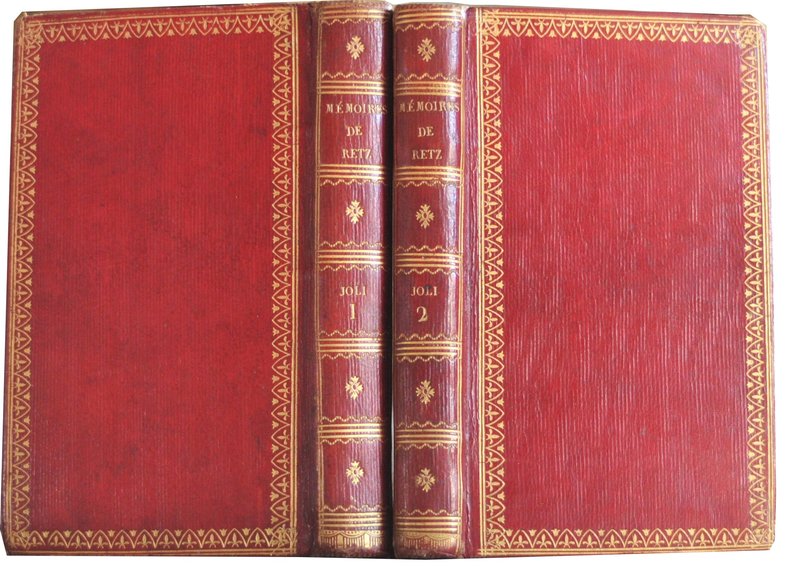
171846405266Amsterdam, chez Jean Frédéric Bernard, 1718 ; 2 vol. in-12, plein maroquin à longs grains, encadrement dentelles dorées, dos lisses XXIV pp., 191 pp. - Titre, 234 pp.ÉDITION ORIGINALE publiée par l’éditeur de la seconde édition des Mémoires du Cardinal de Retz auxquels ces deux volumes font suite. Tchémerzine IX, p. 395.Exemplaire provenant d’une des bibliothèques de Napoléon, avec sur les deux titres le petit cachet ovale avec l’aigle couronné et la mention Cabinet de l’Empereur.Il a ensuite appartenu au bibliophile A. Barbet (ex-libris manuscrit), les pages de garde portent une note manuscrite de ce dernier : “Les mémoires du Cardinal de Retz dont le ms original appartenait aux moines de Saint Mihiel en Lorraine venaient d’être publiés à Nancy, mais avec beaucoup de lacunes (...) suit un extrait de la notice en-tête de l’édition des Mémoires de Retz de 1820 et un extrait d’une lettre de J. B. Rousseau au sujet des Mémoires de G. Joli “plus mauvais que ceux de son maître, je conclus qu’ils ne valent rien du tout et sur ce pied là, je ne les lirai point.”
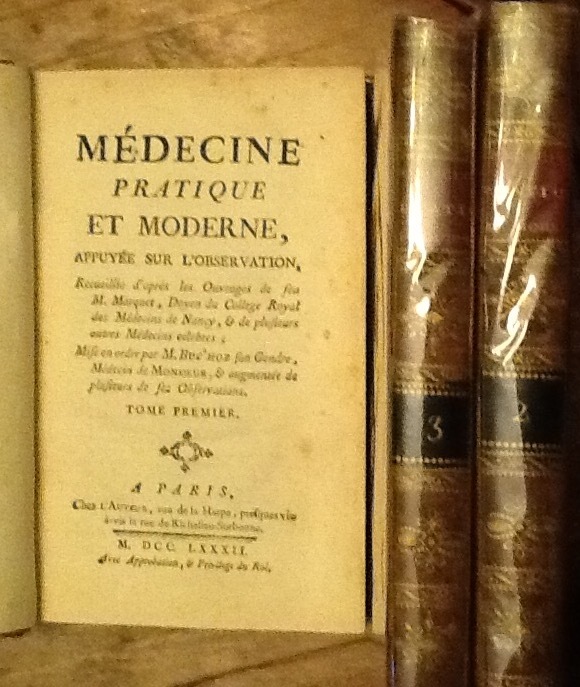
1782CCC00011Apla. L'auteur Paris, 1782. Couverture rigide. État : Très bon. Complet en 3 vol. Pleins cuirs Recueillie d'après les ouvrages de feu M.Marquet, doyen du collège royal des médecins de Nancy, et de plusieurs médecins célèbres; Mis en ordre par M.Buc'hoz son Gendre, médecin de Monsieur, et augmentée de plusieurs de ses observations.