[Louis XV]Biblio.com
57 résultats
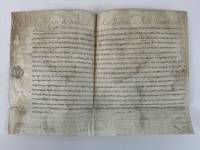
17711402464Tours 1771. Other. Parchment Manuscript One Leaf w. 17 in. x h. 11.25 in. In Good condition. Folded twice with notarial markings to verso. Light age toning overall with minor warping to parchment. Some text especially along the central vertical fold and right margin is significantly worn impacting legibility. Opening in prominent script with the royal titulature: “Louis par la grâce de Dieu Roy de France et de Navarre.†Papier timbré stamp along left edge indicates execution within the Généralité de Tours and the text begins with the formal notarial preamble and Salut formula. Appears to pertain to a land transaction involving a Henry de la Grilliere. Marked in notarial hand at bottom "collationne" indicating that this is an expédition official engrossed copy of a royal act not signed by Louis himself but valid as a legal instrument because it bears the countersignature of his empowered secretary. The secretaire du roi in this case appears to be a "Rocheteau" as noted on fold-in: "Par le Roy / Rocheteau". Additional contemporary notes on the fold-in appear signed “Lahante.†<br> <br> RW Consignment. Shelved at Rockville Room A General Ephemera Part 2. In the Ancien Régime the expédition was the engrossed notarized copy of a royal act prepared for official or private use. Such documents were valid legal instruments even when lacking the King’s autograph as they bore the countersignature of a secrétaire du roi one of a small corps of royal secretaries empowered to issue acts in the monarch’s name. The Généralité de Tours an administrative and fiscal district centered on the city of Tours oversaw taxation legal recording and the enforcement of royal ordinances in the surrounding provinces. Documents on papier timbré stamped paper or parchment were required for most legal acts after the 1674 édit du timbre ensuring that the crown collected stamp duties on contracts wills property transfers and other instruments. 1402464. Special Collections. unknown
17700JT103France 1770. Signed in print "Louis" with other dignitaries this is a very fine pre-revolution edict of the King and rare as such. Stunning vignette. Autograph. Manuscript. Very Fine. 4to - over 9¾" - 12" tall. Paperback
175028367N. P. 1750. Within ornamental border. 1 vols. ca 9 x 14 inches. Broadside. Folded some light discoloration and soiling penned emendments else very good. Within ornamental border. 1 vols. ca 9 x 14 inches. Listing members of the Consellors of State including Messieurs Daligre De Morangis De Lezeau D'Estempes Des Hameaux De Marilac Poncet Bouvherat De Seve La Fosse Voisin Pussort and several others including the Bishop of Chartres and of Sées. unknown
40904saying that "My Cousin having conferred on Dostergnies the rank of Second Lieutenant of the Brebeuf Company in the infantry Regiment of Beauce of which you are in command vacant by the promotion of Lieutenant Vernimont. I am writing this letter to tell you that you are to receive him and recognise him as second in command and all those whom it may concern; And the present letter being to no other purpose I pray God My Cousin that he may keep you in good health and protect you. Written at Versailles." I side folio together with an engraving of the Emperor 10½" x 8" Versailles 5th September Transcription Mon cousin ayant donné à Dostergnies la charge de lieutenant en second en la Compagnie de Brebeuf dans le Régiment d'Infanterie de Beauce qui est sous votre charge vacante par la promotion de Varnimont en Lieutenant. Je vous écris cette lettre pour vous dire que vous ayiez à le recevoir et faire reconnaître en la d. charge de tous ceux et ainsy qu'il appartiendra ; Et la présente n'étant pour autre fin je prie Dieu qu'il vous ayt Mon Cousin en sa Sainte et digne garde. Écrit à Versailles le cinquième septembre 1735. Louis M. Le Duc de Caumont Translation My Cousin having conferred on Dostergnies the rank of Second Lieutenant of the Brebeuf Company in the infantry Regiment of Beauce of which you are in command vacant by the promotion of Lieutenant Vernimont. I am writing this letter to tell you that you are to receive him and recognize him as second in command and all those whom it may concern; And the present letter being to no other purpose I pray God My Cousin that he may keep you in good health and protect you. Written at Versailles the fifth of September 1735. Louis The Duke de Caumont unknown
5437Manuscript letter single folio sheet dated 16 February 1716 signed Louis in the hand of Louis XV's secretary countersigned by Louis Phélypeaux Marquis de La Vrillière Secretary of State addressed to Cardin Le Bret member of the parliament of Provence and nephew of the regent the Duc d'Orléans stating that a royal edict has been sent to the parliament of Provence 'which explains the circumstances in which merchants of my Kingdom must obtain passports from me to which edict I append a declaration forbidding any of my subjects to conduct commerce in the South Seas'; the verso with address of Le Bret; the document is complete legible and remarkably fresh with original folds. In France the period 1715-1723 is known as the Régence during which time Philippe Duc d'Orléans was in charge of the country's affairs owing to the fact that Louis XV was still a minor. In 1716 when this letter was written the War of the Spanish Succession had only recently ended and a member of the French House of Bourbon Philip V was now on the Spanish throne. The royal edict alluded to in the present letter ostensibly forbidding French subjects to conduct trade in the Pacific was typical of French diplomacy towards Spain in the early part of the eighteenth century. It was designed to allay Spanish fears that its monopoly of the rich resources along the western seabord of the Americas - namely the silver mines of Mexico and Peru - was under threat from the French but in reality the situation was quite different. While flattering the Spanish and officially appearing to discourage this type of trade France turned a blind eye toward its own merchants rounding Cape Horn and from the end of the seventeenth to well into the eighteenth century French private companies including the Compagnie de la Mer Pacifique or Mer du Sud and other private adventurers out of ports such as St Malo and La Rochelle conducted many voyages to the west coast of the Americas. These merchants carried royal passports which described the purpose of their voyages as being non-commercial in nature - they were simply exploring or acquiring scientific knowledge. Paradoxically these voyages proved so lucrative resulting in massive volumes of silver bullion for the French coffers that a genuine voyage of exploration in the Pacific was not carried out by the French until Bougainville 1766-69. Throughout this period England the new rival of France as a maritime superpower adopted an official policy towards the Spanish similar to that of the French - one of non-interference with the Spanish trading empire on the Pacific seaboard of the Americas - and it was not until the voyages of Wallis Carteret and Cook that it undertook serious exploration of the Pacific. unknown
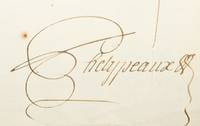
50248France c.1773. Manuscript in ink 5 pp. folio; extremely well preserved; bound in modern papered boards with gilt-lettered red leather title label to the front; ex libris label of H. P. Kraus to front pastedown. One of the most important institutions in the history of evangelisation in Asia the Missions Étrangères de Paris MEP or Foreign Missions Society was founded in 1663 under the authority of Louis XIV as an organisation of secular priests and lay persons dedicated to missionary work in foreign lands. Although early on it had been active in North America by the late eighteenth-century the MEP's activities were almost entirely concentrated in Asia. The present document is a fully contemporary manuscript copy written in a clerical hand - whether that of a legal or religious scribe is not clear - of the 1773 Lettres Patentes issued under Louis XV concerning the newly codified regulations privileges and formal recognition of the MEP. It comprises a preamble two-and-a-half pages followed by 17 articles numbered I-XVII. At the foot of the last page of the document it is indicated that the original was signed by Louis and by Jean-Frédéric Phélypeaux Minister of State. hardcover
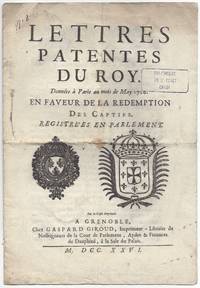
17261177Sur la Copie imprimée a Grenoble: Chez Gaspard Giroud Imprimeur - Libraire de Nosseigneurs de la Cour de Parlement Aydes & Finances de Dauphiné à la Sale du Paris 1726. First edition. Signed by Augustin D’Arcisas on the last page. With embosses seal at the end. With woodcut coat of arms of Louis XV and D’Arcisas on title page. Bound with string. Folded. Collection stamp on title page. A brown stain at the center of each leaf. Upper corners dusted. First edition. Signed by Augustin D’Arcisas on the last page. With embosses seal at the end. With woodcut coat of arms of Louis XV and D’Arcisas on title page. Bound with string. 8 p. <p><br /> Letters Patent in relation to the endeavors of the redemption of Christian captives and slaves.<br /> <p><p><br /> Letters Patent issued by the French King Louis XV and signed by Augustin D’Arcisas a friar of the Order of the Holy Trinity and Captives of Montpellier and “Procureur General des Esclaves†of Daupiné.<br /> <p><p><br /> D’Arcisas who already led successful missions at the Barbary Coast and redeemed seventeen captives from Meknes and Tétouan in Morocco and forty-six from Algiers commissions a merchant from Crest Pierre André Farjon to quest for Christian slaves in Crest and in the diocese of Die and grants him the King’s privileges and exemptions according to the Letters Patent. Signed and dated by D’Arcisas in Crest on November 4 1734.<br /> <p>. Chez Gaspard Giroud, Imprimeur - Libraire de Nosseigneurs de la Cour de Parlement, Aydes & Finances de Dauphiné, à la Sale du unknown