Louis XVBiblio.com

57 résultats
232927114X.Gpaperback. Good. Access codes and supplements are not guaranteed with used items. May be an ex-library book. paperback
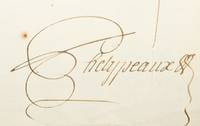
5437Manuscript letter single folio sheet dated 16 February 1716 signed Louis in the hand of Louis XV's secretary countersigned by Louis Phélypeaux Marquis de La Vrillière Secretary of State addressed to Cardin Le Bret member of the parliament of Provence and nephew of the regent the Duc d'Orléans stating that a royal edict has been sent to the parliament of Provence 'which explains the circumstances in which merchants of my Kingdom must obtain passports from me to which edict I append a declaration forbidding any of my subjects to conduct commerce in the South Seas'; the verso with address of Le Bret; the document is complete legible and remarkably fresh with original folds. In France the period 1715-1723 is known as the Régence during which time Philippe Duc d'Orléans was in charge of the country's affairs owing to the fact that Louis XV was still a minor. In 1716 when this letter was written the War of the Spanish Succession had only recently ended and a member of the French House of Bourbon Philip V was now on the Spanish throne. The royal edict alluded to in the present letter ostensibly forbidding French subjects to conduct trade in the Pacific was typical of French diplomacy towards Spain in the early part of the eighteenth century. It was designed to allay Spanish fears that its monopoly of the rich resources along the western seabord of the Americas - namely the silver mines of Mexico and Peru - was under threat from the French but in reality the situation was quite different. While flattering the Spanish and officially appearing to discourage this type of trade France turned a blind eye toward its own merchants rounding Cape Horn and from the end of the seventeenth to well into the eighteenth century French private companies including the Compagnie de la Mer Pacifique or Mer du Sud and other private adventurers out of ports such as St Malo and La Rochelle conducted many voyages to the west coast of the Americas. These merchants carried royal passports which described the purpose of their voyages as being non-commercial in nature - they were simply exploring or acquiring scientific knowledge. Paradoxically these voyages proved so lucrative resulting in massive volumes of silver bullion for the French coffers that a genuine voyage of exploration in the Pacific was not carried out by the French until Bougainville 1766-69. Throughout this period England the new rival of France as a maritime superpower adopted an official policy towards the Spanish similar to that of the French - one of non-interference with the Spanish trading empire on the Pacific seaboard of the Americas - and it was not until the voyages of Wallis Carteret and Cook that it undertook serious exploration of the Pacific. unknown
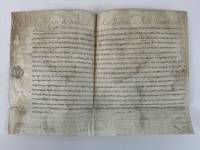
17711402464Tours 1771. Other. Parchment Manuscript One Leaf w. 17 in. x h. 11.25 in. In Good condition. Folded twice with notarial markings to verso. Light age toning overall with minor warping to parchment. Some text especially along the central vertical fold and right margin is significantly worn impacting legibility. Opening in prominent script with the royal titulature: “Louis par la grâce de Dieu Roy de France et de Navarre.†Papier timbré stamp along left edge indicates execution within the Généralité de Tours and the text begins with the formal notarial preamble and Salut formula. Appears to pertain to a land transaction involving a Henry de la Grilliere. Marked in notarial hand at bottom "collationne" indicating that this is an expédition official engrossed copy of a royal act not signed by Louis himself but valid as a legal instrument because it bears the countersignature of his empowered secretary. The secretaire du roi in this case appears to be a "Rocheteau" as noted on fold-in: "Par le Roy / Rocheteau". Additional contemporary notes on the fold-in appear signed “Lahante.†<br> <br> RW Consignment. Shelved at Rockville Room A General Ephemera Part 2. In the Ancien Régime the expédition was the engrossed notarized copy of a royal act prepared for official or private use. Such documents were valid legal instruments even when lacking the King’s autograph as they bore the countersignature of a secrétaire du roi one of a small corps of royal secretaries empowered to issue acts in the monarch’s name. The Généralité de Tours an administrative and fiscal district centered on the city of Tours oversaw taxation legal recording and the enforcement of royal ordinances in the surrounding provinces. Documents on papier timbré stamped paper or parchment were required for most legal acts after the 1674 édit du timbre ensuring that the crown collected stamp duties on contracts wills property transfers and other instruments. 1402464. Special Collections. unknown
1895AQ21723London: H. S. Nichols & Co. 1895. Limited edition of 500 copies. xii 282pp. With a portrait frontispiece. Original publisher's gilt-stamped blue cloth. Lightly rubbed and marked spines a trifle sunned. Contemporary armorial bookplate of Alexander Meyrick Broadley and recent book labels of Marion C. Walker to FEP occasional spotting/browning. The private memoirs of Louis XV 1710-1774 as related by the lady's maid of Madame de Pompadour his mistress. The French King's ineffectual rule contributed to the decline of royal authority that led to the outbreak of the French Revolution in 1789. . 8vo. H. S. Nichols & Co. hardcover
40904saying that "My Cousin having conferred on Dostergnies the rank of Second Lieutenant of the Brebeuf Company in the infantry Regiment of Beauce of which you are in command vacant by the promotion of Lieutenant Vernimont. I am writing this letter to tell you that you are to receive him and recognise him as second in command and all those whom it may concern; And the present letter being to no other purpose I pray God My Cousin that he may keep you in good health and protect you. Written at Versailles." I side folio together with an engraving of the Emperor 10½" x 8" Versailles 5th September Transcription Mon cousin ayant donné à Dostergnies la charge de lieutenant en second en la Compagnie de Brebeuf dans le Régiment d'Infanterie de Beauce qui est sous votre charge vacante par la promotion de Varnimont en Lieutenant. Je vous écris cette lettre pour vous dire que vous ayiez à le recevoir et faire reconnaître en la d. charge de tous ceux et ainsy qu'il appartiendra ; Et la présente n'étant pour autre fin je prie Dieu qu'il vous ayt Mon Cousin en sa Sainte et digne garde. Écrit à Versailles le cinquième septembre 1735. Louis M. Le Duc de Caumont Translation My Cousin having conferred on Dostergnies the rank of Second Lieutenant of the Brebeuf Company in the infantry Regiment of Beauce of which you are in command vacant by the promotion of Lieutenant Vernimont. I am writing this letter to tell you that you are to receive him and recognize him as second in command and all those whom it may concern; And the present letter being to no other purpose I pray God My Cousin that he may keep you in good health and protect you. Written at Versailles the fifth of September 1735. Louis The Duke de Caumont unknown
175739532N. P. Paris 1757. Pp. 1-4. 1 vols. 4to. Disbound stitchmarks some minor discoloration else very good. Pp. 1-4. 1 vols. 4to. Part of the investigation following the execution of Robert-François Damien nicknamed "Robert le Diable" for the attempted assassination of Louis XV le Bien-Aimé. The second piece issued by Ysabeau.¶ The 5th of January 1757 Robert-François Damiens stabbed King Louis XV. The wound bled profusely and the King who feared he was dying made his confessions for his life of vice. Fearing that Damiens was working for the British or the Jesuits he was horribly tortured with red-hot pincers boiling oil molten lead and wax poured into his wounds. He still maintained that he was working on his own and had intended only to scare the King. He was presented to the nation as a monster Voltaire described him as "Le monstre est un chien qui aura entendu aboyer quelques chiens Enquêtes et qui aura pris la rage." He was condemned the 28 March and in the Place de Grève he was publicly tortured his body torn into pieces by horses and his still-living trunk burned on a large pyre with the ashes spread to the wind. The execution was a major spectacle for the city drawing large crowds. His house was destroyed and his family forced to change their name and leave the country. Robert le Diable. <br/><br/> unknown
175028367N. P. 1750. Within ornamental border. 1 vols. ca 9 x 14 inches. Broadside. Folded some light discoloration and soiling penned emendments else very good. Within ornamental border. 1 vols. ca 9 x 14 inches. Listing members of the Consellors of State including Messieurs Daligre De Morangis De Lezeau D'Estempes Des Hameaux De Marilac Poncet Bouvherat De Seve La Fosse Voisin Pussort and several others including the Bishop of Chartres and of Sées. unknown