Mistress Beecher Stowe HarrietLivre Rare Book

362 résultats
1853RO30333082Au bureau du magasin pittoresque. 1853. In-8. Broché. A relier, Couv. défraîchie, Dos abîmé, Papier jauni. 563 pages. Nombreuses gravures in et hors texte. Nombreuses rousseurs. Couveture et ouvrage partiellement désolidarisés. Déchirures. Coins pliés, déchirés.. . . . Classification Dewey : 326-Esclavage
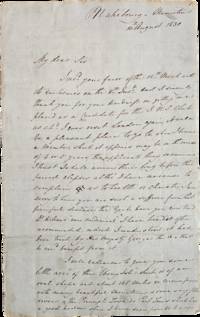
1830List2931Mahébourg Mauritius 1830. Single unsigned fourteen-page letter measuring 8 x 12 ¾ inches. Folded with some stains and pencil marks. Overall near fine. In 1830 Mauritius was a British colony captured from the French in 1810 during the Napoleonic Wars. It was originally a Dutch colony and the Dutch had introduced enslaved labor to the islands. Enslaved people were imported from Madagascar India and Southeast Asia to harvest the valuable ebony trees and later to farm sugarcane. It became a French colony in 1715 and among other provisions the French government awarded upper-class colonists large land grants each with twenty enslaved people to work them. Slavery was abolished in 1835 under British rule after which the planters still farming sugarcane turned to indentured servant labor from India and China alongside illegal slavery.1<br /> <br /> Offered here is a lengthy single letter written by an unknown author to an unknown recipient from Mahébourg in 1830 shortly before this radical change. The letter describes the lives and economic circumstances of the planters and merchants and of the non-white population particularly Malabar people and free and enslaved Black people.<br /> <br /> Noting that “every inch of ground that will produce sugar cane is planted with it†including “the former fine gardens to some of the Habitations†the author reports on the situation for sugar planters:<br /> <br /> “The price of sugar here is not more than 20/per Cwt. for the best quality which does not now remunerate the Planter as his expenses are becoming every day more heavy in consequence of their slaves diminishing . The want of Slaves induced many of the Planters to send for Chinese Labourers and several hundreds were imported at a great expense but unfortunately they did not answer and were obliged to be reshipped for their native Country again at the charge of those who sent for them.â€<br /> <br /> The author later notes that “nearly everyone of the Planters have heavy mortgages on their Estates and are obliged to pay this immense Interest which keeps them poor and will I fear ultimately ruin themâ€. In fact the planters in British Mauritius had extra duties on their sugar exports compared with their Caribbean counterparts. The shopkeepers on the other hand “calculate on retiring with a fortune in five years– therefore you will fancy what must be their prices also their profits.â€<br /> <br /> Though writing from Mahébourg the author describes the capital city of Port Louis at length especially its Malabar Indian and free Black residents—the lives of the latter particularly the free Black women seem especially grim. They write:<br /> <br /> “The Centre of Port Louis is inhabited by all the respectable people and many most excellent houses buildings– the Catholic Chapel the English Church amongst the number. The Suburbs to the West is the part occupied by about 3000 Malabars called ‘Malabar Town.’ – They are dressed mostly in white with Turbans ear rings c c and the females with ornaments in their noses and on their Toes as they generally go bare foot. – Once a year they have what is called a ‘Yamsee’ or a festival in honor of Mehomet which lasts for about a fortnight during which time they seem to get no sleep a continual beating of tom toms – jingling of bells – carrying pagodas which are made of various coloured paper and most richly ornamented followed by all the population of their Caste with their faces daubed with red white c and which has a most ludicrous appearance. The Suburbs to the South is called ‘black Camp’ – the Houses being very small and poor and inhabited by all the free blacks as well as many Mulattoes. – Also a certain class of females of the population of colour – who are visited immediately on the Arrival of a Ship the Crews soon enquiring the way to the ‘Camp.’â€<br /> <br /> As regards relations between the races the author recounts an incident that followed the 1828 abolition of the color bar which would ostensibly give the free non-white population the same rights as the whites:<br /> <br /> “The Theatre is a very good one but has been closed for several months past the Actors Actresses gone to Bourbon in consequence of the promulgation of the act ‘causing all free people of the population of Colour’ to have the same laws – the same privileges as the Whites’ fearing they ought come to the Theatre which they had hitherto been forbidden thereby cause disturbances as the French Whites detest them wd. not sit in the same box it was considered best to shut the Theatre which is a great loss to the Place it being the chief public amusement and indeed the only one we have here.â€<br /> <br /> Overall a detailed letter giving insight into life in a slave colony at a time when significant changes were on the horizon. Of interest to scholars of the colonial history of Mauritius and the second wave of British colonialism.<br /> <br /> 1 Truth and Justice Commission Report of the Truth and Justice Commission Vol. 1 Mauritius: Government Printing 2011. unknown
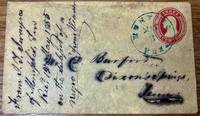
185536035Memphis: n.p. 1855. Paper. Fair. Paper envelope. Approximately 6" x 3". No letter with the envelope. A stamped three cent envelope with postal mark dated May 8 location not clear. Paper is toned with small thin tear located under the address from use of the pen. <br /> <br /> Written on the front side is "From J. T. Swayne of Memphis Ten Rec'd 12 May 1855 on the subject of a Negro from Weaver." This was addressed to Mr. C. Burford of Dixon's Springs Tennessee. J. T. Swayne was a former Mayor of Memphis during the reconstruction. There are references to the Burford family in Dixon Springs Smith County Tennessee online. n.p. unknown
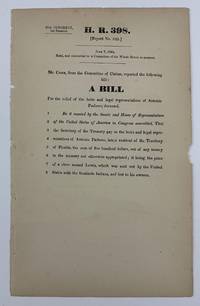
18445887Washington DC: June 7 1844. Very good. Broadside 12.25 x 7.75 inches. Light tanning shallow marginal chips and some fraying to left and right edges. An unrecorded slip-bill printing of a House Resolution with a phenomenal back story involving an erudite elusive and resourceful Florida slave. The slip bill authored by Howell Cobb U.S. Representative from Georgia stipulates that the Secretary of the Treasury pay the sum of five hundred dollars to the heirs and representatives of Antonio Pacheco a former resident of Florida the sum "being the price of a slave named Lewis which was sent out by the United States with the Seminole Indians and lost to his owners." That's where the plot thickens. The slave is now known to history as Luis Fatio Pacheco born in 1800 to enslaved parents on the "New Switzerland" plantation in Florida which was surrounded by a mix of Europeans Africans and Native Americans. As such Luis became fluent in several languages including Seminole which later made him a valuable asset.<br /> <br /> After a conflict with his owner Luis attempted to escape slavery in 1824 by fleeing to Spanish fisheries on Florida's Gulf Coast but he was captured by U.S. military authorities the following year. Skilled as he was in languages and literacy by the military Luis was sold in 1832 to Antonio Pacheco a Cuban merchant. After Antonio's death Luis became the property of Pacheco's widow. When tensions began to ratchet up again between American military forces and the Seminole tribe a U.S. Army officer made a deal to rent Luis from the Pacheco estate at the rate of $25 a month to take advantage of his services as an interpreter. In December 1835 Luis was accompanying a troop detachment led by Major Frances L. Dade in a march to reinforce Fort King near the present-day city of Ocala Florida. Evidently that day Luis was assigned as a scout; he has said to have attempted to warn Dade of a possible ambush by the Seminoles which went unheeded by the commander. The result is today known as the Dade Massacre in which Dade and most of his men were killed.<br /> <br /> According to the narrative provided by Luis who spoke Seminole he explained to the warriors that he was a slave and successfully pleaded for his life. Luis lived with the Seminoles as a captive for nearly two years before again managing to escape. In September 1837 Luis surrendered to the U.S. Army at Fort Peyton near St. Augustine. Soon after he was accused of collaborating with the Seminoles in the Dade Massacre. In 1841 negotiations between the US government and Seminole leader Coacoochee the Native American leader claimed Luis as his property captured in war. Coacoochee was permitted to take Luis together with other Black Seminoles to Oklahoma for resettlement. This event led to the claim by Anthony Pacheco‘s heirs for restitution of a lost slave. The Joint Committee on Claims approved the claim. Luis's story eventually became a focal point in the abolitionist argument against slavery and in 1858 Ohio representative Joshua R. Giddings published a book portraying Luis as a hero against the system. In any case the question of whether or not Luis betrayed Dade has never been completely resolved. June 7 unknown
1858PHO-1208Paris , chez Pagnerre , 1858 , un volume in-12 , 389pp-2ff , demi cuir époque , dos à nerfs avec auteur et titre , coiffe usée , petites rousseurs
18762754Paris, Imprimerie Nationale, 1876. In-8 broché de 226 pp., couverture bleue imprimée.
18752755Paris, Imprimerie Nationale, 1875. In-8 broché de 207 pp., couverture bleue imprimée.
18772756Paris, Imprimerie Nationale, 1877. In-8 broché de 268 pp., couverture bleue imprimée.
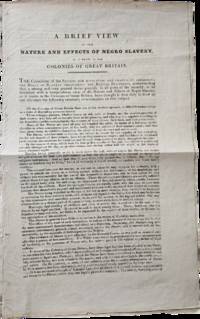
1823List3302London England: Ellerton and Henderson 1823. Three page document measuring 8 ½ x 13 ¼ inches. Folded with some small wrinkles at edges else Near Fine. A document produced by the Society for Mitigating and Gradually Abolishing the State of Slavery throughout the British Dominions better known as the Anti-Slavery Society. The group was founded in London in 1823 by a group of politicians philanthropists and businessmen including William Wilberforce Joseph Sturge and Zachary Macaulay. The document discusses the horrors of enslavement—even unfavorably comparing the British colonies’ conditions with those in the US—and decries the fact that after the 1807 Slave Trade Act essentially nothing more had been done to put “an end to a condition of society which so grievously outrages every feeling of humanityâ€. We find a single copy of the Ellerton and Henderson edition in physical format listed in OCLC as accession number 83930673. Ellerton and Henderson unknown
1823423251London: Printed by Ellerton and Henderson Gough Square 1823. Near Fine. Folio 21.5 x 33 cm / 8½" x 13â€. pp. 1 2-3 4 blank. Light vertical and horizontal center folds three short tears at the horizontal fold near fine with a contemporary drawing of a few survey lines and diagrams very lightly sketched in ink and pencil on the final blank page. The Society states its case against slavery in the Colonies of Great Britain where "there are at this moment upwards of 800000 human beings in a state of degrading personal slavery." It provides a brief but detailed description of "the immoral inhuman and unjust" nature of the slave trade and of the absolute power of slave owners. Printed by Ellerton and Henderson, Gough Square unknown
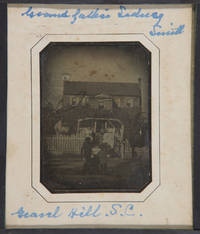
184542820850<p><strong>A unique survival.</strong> This important collection of largely identified photographs documents the home and family of Dr. Sidney Smith and those he enslaved at Gravel Hill his South Carolina plantation. The collection includes an extraordinary daguerreotype depicting Dr. Smith his two daughters and his brother posed together with two enslaved African American men. This is <strong>one of the earliest known images—if not the very earliest photograph—of an identified plantation owner posing with enslaved African Americans. </strong></p><p><strong> The photographs :</strong></p><p>1. Quarter plate daguerreotype 4 x 3 1/8 in. of Gravel Hill Plantation near Robertville St. Peter's Parish Beaufort District South Carolina. Ca. mid-to-late 1840s. Manuscript notation on passe-partout mat "Grandfather Sidney Smith Gravel Hill S.C." The image shows the plantation house with various figures engaged in an unidentified activity with a horse tied to a picket fence. The two girls in white may be Sidney Smith's daughters Arabella b. 1832 and Julia b. 1837 and the others may be enslaved African American children. An enslaved African American subject stands on the steps in the background. In the foreground are two figures with an unknown object perhaps a dog cart or a bone-shaker bicycle. In front of the house is a heavily-vined grape arbor presumably connected with Smith's efforts in viniculture.</p><p>2. A quarter plate tintype copy of the above daguerreotype.</p><p>3. Sixth plate daguerreotype of Sidney Smith his daughters Arabella and Julia his brother James Laurens Smith and two unidentified African American men almost certainly enslaved men. Ca. mid-1840s-1850. One of the girls is blurred because she is hold a struggling dog. Accompanied by the envelope in which the daguerreotype was discovered with penciled notation about the subjects as well as a tentative date of "1850 or thereabout."</p><p>4. Sixth plate daguerreotype of Smith's daughters Arabella and Julia pointing to a book and an unidentified object. Ca. mid-1840s-1850.</p><p>5. Sixth plate daguerreotype of Sidney Smith. Ca. 1845. Smith appears to be wearing a mourning band on his coat suggesting that the image was made following the death of his first wife Eliza in March 1845.</p><p>6. Sixth plate tintype copy of the above portrait.</p><p>7. Sixth plate tintype portrait of Maria King Smith second wife of Sidney Smith with an infant possibly William King Smith. A period copy image.</p><p>8. Sixth plate ambrotype of William King Smith son of Sidney and Maria Smith possibly as a cadet. Ca 1850s.</p><p>9. Quarter plate ambrotype of Sarah Smith sister of Sidney and James Laurens Smith aunt to Arabella and Julia. Ca 1850s-1860s.</p><p>10. Sixth plate ambrotype of Rosa Nicholes sister of Maria Smith with "Eddie" Postell possibly the Edward Postell who was killed in action in 1863 at Fort Wagner. Ca 1850s.</p><p><strong> Dr. Sidney Smith</strong></p><p>Sidney Smith was born in 1805 in or near Beaufort SC the son of William Smith a man of moderate wealth and Elizabeth Wilson Smith of Philadelphia reportedly a Quaker. Sidney was sent to Yale College and subsequently studied medicine in Ohio. His younger brother James Laurens Smith b. 1809 studied law but he apparently never practiced devoting himself instead to agriculture. Sidney Smith married Eliza Lawton in 1829. The two had several children including daughters Arabella and Julia. Smith was apparently practicing medicine in the vicinity of Robertville South Carolina as well as trying his hand at being a planter. In 1831 he appears in the Lawton Family Papers as having been paid two dollars for "expirating a Fungus Tumor from the head of Little Negro Shiloh" Inabinett 1963. His name appears in several land transactions in the upper St. Peter's Parish in Beaufort District where he experimented with various crops.</p><p>Smith's experiments with wine received wide-ranging coverage in the press. A notice in the Boston Daily Atlas of 28 December 1844 printed a report from a Savannah newspaper: "This editor of the Savannah Republican has samples of eight kinds of wine made by Dr. Sidney Smith of Robertville Beaufort District S.C. They are pure juice of the grape without the addition of any spirits whatever. One of the specimens is from the vintage of 1833 another from that of '38 and the other six from that of the present year. They differ in flavor according to the species of grape from which they were expressed … Dr. S. has on hand some 800 gallons of those wines which he finds useful for all medicinal and culinary purposes."</p><p>Smith's first wife Eliza died in 1845 at the age of 37 possibly explaining her absence from the group portrait. In 1846 Smith married Maria Ann King with whom he would have two children who survived into adulthood William King Smith b. 1846 and Walter Watson Smith b. 1849.</p><p>By 1850 Smith and most of his family had left Gravel Hill and relocated to Marietta Georgia where he acquired another plantation Rockford near Marietta. By this time Smith had acquired 74 slaves according to the 1850 Slave Schedules of the United States Census. He continued to run Gravel Hill as an absentee owner from Georgia.<br />In 1853 Smith sold Gravel Hill then comprising 700 acres and his other plantation properties in the Robertville area to John Goldwire Lawton in 1853 according to genealogical records at the Heritage Library Foundation. Smith's Gravel Hill home appears to have been on the site of present-day Gravel Hill Plantation the ca. 1910 hunting preserve near Robertville on the National Register of Historic Places. The elaborately decorated center-hall plan home as well as the town of Robertville was burned by W.T. Sherman's troops in 1865.</p><p>After the war the land was sold to Northern buyers. Newer structures were apparently built on the foundations of the original Gravel Hill around 1910 when it was refashioned as a gentleman's hunting plantation. Dr. Smith and his wife Maria died in 1856. Their sons Walter and William became wards of Smith's brother James who himself apparently died in 1865. Walter Smith was a student at the Georgia Military Institute when it closed at the time of W. T. Sherman's approach in 1864. At the age of 14 he and the other cadets were sent to guard the river crossings in the approaches to Atlanta. With his brother William Walter served in Confederate units until the end of the Civil War. Sidney Smith's sister Sarah known as "Aunt Sarah" to Walter and William Smith wrote vivid letters describing the evacuation of Marietta and her flight to Atlanta.</p><p>While no documentary evidence of the Smith family's views on slavery has been found Susan E. Geoffrey claims in her academic paper "A Southern Family in Transition 1830-1865" that Sidney and his siblings were "reasonably humane to their slaves according to the standards of their society." Geoffrey adds that Sidney's sisters Sarah and Hannah developed an interest in educating their brothers' enslaved children. Dexter's biographical sketch of Smith notes that Smith "opposed strenuously the act of nullification in South Carolina and by his personal efforts retarded the action of that State." Smith's brother James provided in his 1853 will that every tenth! child born into slavery in the estate should at age eighteen be granted freedom to be facilitated by the Colonization Society.</p><p><strong>The photographers</strong></p><p>The photographers of these images are unidentified but it appears that Smith himself may have made two of the daguerreotypes. <em>Biographical Sketches of the Graduates of Yale College with Annals of the College History</em> vol. 7 1913 notes of Smith: "He was a man of unusual mental gifts an earnest student and devoted to the community and mankind. When the art of the daguerreotype was first introduced he was a pioneer in cultivating it in the South."</p><p>Based on his interest in the "art of the daguerreotype" it is possible that Smith created the daguerreotypes himself perhaps with the aid of an assistant so he could be included in certain images most notably the group portrait. The informal group portrait shows a relaxed family posing together. Smith appears to have moved into the frame at the last moment after setting up the shot. Likewise the subjects in the Gravel Hill daguerreotype are in casual poses as if they are in a Daguerreian snapshot of the family rather than formally arranged portraits.</p><p><strong>Dating</strong></p><p>The approximate dating of the featured images has been determined based on the estimated ages of Smith's daughters Arabella and Julia who are pictured in two or perhaps three of the daguerreotypes. Arabella b. 1832 and Julia b. 1837 appear to be around the ages of twelve/thirteen and eight/nine respectively. The girls appear together in a sixth plate daguerreotype portrait and in the sixth plate group portrait of Dr. Sidney Smith his brother and two unidentified African American men almost certainly enslaved subjects. The sisters may also be the two girls in white dresses on the steps of the house in the quarter plate daguerreotype.</p><p>This dates those daguerreotypes to the mid-1840s and no later than 1850 thus making them among the very earliest photographs of a slave-holding antebellum plantation.</p><p><strong> A rare opportunity</strong></p><p>It is evident that Dr. Sidney Smith wanted to use the new art of photography to create a visual record of his plantation home at Gravel Hill and of his family and the enslaved individuals who worked for him. The daguerreotypes offered here most notably the group portrait of Smith with his brother daughters and two Black men are unique in depicting enslaved subjects posed together with their owner especially in a relatively informal setting. We are not aware of comparable images dating from the mid-to-late 1840s.<br />This exceptional collection of photographs from an identified family in the antebellum South is worthy of further research.</p><p><strong>References </strong></p><p>Dexter Franklin Bowditch. <em>Biographical Notices of Graduates of Yale College</em> 1913</p><p>Geoffrey Susan E. "A Southern Family in Transition 1830-1865" 1982 Accessed online through the Heritage Library History and Research Center in Hilton Head SC September-October 2024. Background on the Smith family is derived from this academic paper although the research center's copy is incomplete lacking numerous footnotes and bibliography. Some but not all of Geoffrey's sources have been located in the William King Smith Papers Wilson Special Collections Library UNC Chapel Hill.</p><p>1845-1850 four daguerreotypes and ca. 1855-1860 three ambrotypes plus three early tintype copy images. 10 items.</p>
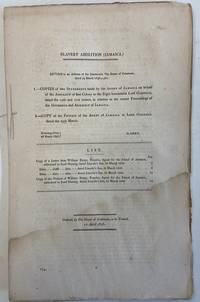
1836175381836. This pamphlet is a return to an Address of the House of Commons from March 25 1836 whereby the Agent of Jamaica William Burge protests against the unilateral abolition of slavery in the British Empire. Ordered to be printed by the House of Commons in London April 1836. 13 pages. 13" x 8.25" inches. Included within is a copy of three letters from the Agent to Lord Glenelg the British colonial secretary as well Burge's protest to Glenelg. Burge states: He is desirous that His Majesty's Government should understand that this Protest is made not as the performance of a formal act of official duty but from his conviction that the proposed legislation for Jamaica is a direct violation of the constitutional rights of that Colony rights coeval with its establishment and which have hitherto been respected." The Agent was a colonial official who was the official representative of a British colony who was based in London and acted as lobbyists and trade negotiators for the affairs of the colony. While Burge had at other times claimed to "hate" slavery he employs the British analogue of the "states rights'" argument that many moderate politicians in the United States used to signal personal distaste for slavery but to nonetheless protect the institution's existence on the basis of constitutionality. When the institution of slavery died out in the British Empire after 1836 the abolitionist movement in the US gained tremendous momentum despite the protests of our own William Burge's. This piece is overall in very good condition. unknown
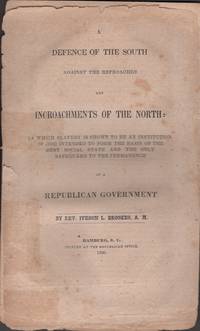
185036089Hamburg South Carolina: Printed at the Republican Office 1850. Wraps. Fair. Wraps. 48 pages. Covers are detached and stitching mostly removed leaving several loose pages. Small edge tears to a few pages. Toning to the contents. Pages 47 and 48 has an old tape repair with slight loss of print. This is pro Slavery and religious defense of the institution from a Southern Minister. Fair only. From the North Carolina Encyclopedia ncpedia dot org:<br /> <br /> "Iveson Lewis Brookes Baptist clergyman planter and Southern sectionalist was the eldest of five sons of Jonathan and Annie Lewis Brookes and was born in Rockingham County. His father was a veteran of the Revolution. His parents had only recently moved to North Carolina from Spotsylvania County Va. where many of his relatives continued to live; soon after his birth his parents moved permanently to Caswell County. Educated in a local academy during his early years in 1812 Brookes enlisted in the American army. After seeing only limited action during the War of 1812 he entered The University of North Carolina. He was graduated in 1819 after developing what proved to be a lifelong acquaintance with both James K. Polk and Thomas Hart Benton. In his commencement address entitled "Is the State of the World Better in the Present Age Than at Any Former Period" Brookes expressed an optimism and an enmity to slavery that were totally antithetical to his later positions. Undecided about his future he spent a year as a teacher in Greensboro"."Although he had opposed slavery as a student at The University of North Carolina Brookes became a staunch defender of slavery and a rabid southern sectionalist. During the Nullification controversy he was made a minuteman by Governor James Hamilton of South Carolina. In 1861 at the age of sixty-eight he offered himself for service in the Confederate Army. From the first appearance of abolitionism he feared for the future of southern society. From 1835 he wrote dozens of defenses of slavery most of them in the form of letters to northern antislavery periodicals. His most famous defenses were two pamphlets written during the crisis of 1850: A Defence of the South against the Reproaches and Incroachments of the North 1850 and A Defence of Southern Slavery against the Attacks of Henry Clay and Alexander Campbell 1851 the latter written at the behest of Governor James Henry Hammond of South Carolina. The productions of an enraged slaveholder revealing little of the optimistic and balanced thinking of his youthful years those two documents stood as the most characteristic statements of a die-hard southern sectionalist who had learned to love the life of a slaveholding planter. Printed at the Republican Office unknown
188452888Boston: Printed by the Order of the City Council 1884. First Edition. Small quarto 26.5cm; marbled paper over navy blue calf spine in seven compartments with six raised bands leather labels titling and decorative elements stamped in gilt on spine; marbled endpapers; engraved portrait frontispiece1011-70 with an additional 31 leaves bound in. Armorial bookplate of Walter Merriam Pratt on front pastedown. Re-backed with the original spine laid down; light wear to upper and lower board edges with some touch-up to leather at crown and heel; Very Good. A grangerized copy containing 22 ANS and ALS ca.1-4pp one autograph sentiment a 4.25" x 6.5" cabinet card signed by Phillips and several clipped portraits of various sizes depicting Phillips his wife and his son in uniform. Most prominent among the letters are those written to G.W. Putnam 6 H.G. Denny 2 R.L. Winthrop 2 John Boyle O'Reilly 1 and an October 8 1853 ALS to abolitionist and social reformer Gerrit Smith in which he claims to have mislaid his letter but is available to come to Brooklyn either on 15 December or 5 January 1854 and that his fee would be fifty dollars. Handsome volume memorializing American abolitionist and orator Wendell Phillips 1811-1884 commissioned by the City of Boston in an edition of 5000 copies. Nearly half the text is comprised of the eulogy by George William Curtis and includes extensive remarks by city council members and aldermen a prayer by Rev. Minot J. Savage an address by the Mayor and a poem by Mrs. Mary E. Blake. A proud son of Boston Phillips abandoned a career in law after being converted to the cause of abolitionism by William Lloyd Garrison in 1836. He was a frequent speaker at meetings of the American Anti-Slavery Society active in the free-produce movement a member of the Boston Vigilance Committee and an early advocate of women's rights. Later in life he turned considerable effort towards gaining equal rights for Native Americans and together with Helen Hunt Jackson and Massachusetts Governor William Claflin helped found the Massachusetts Indian Commission. cf.BAL 4347. Printed by the Order of the City Council unknown
181619598Winchester Va.: J. Foster Printer 1816. First edition. Fragile sheep rubbed but sound; some light foxing and spotting; front joint just a trifle tender; a good sound copy of a moderately crude American book. Small 8vo original sheep red leather label gilt lettering 219 1 pages. An eccentric book-length poem from Elder Joseph Thomas 1791-1835 the wide-ranging charismatic North Carolina itinerant preacher known as the White Pilgrim for his habit of attiring himself in white apparel in all seasons and climes. Thomas includes a fairly lengthy and graphic section here leveled against slavery and its e suggesting those who endorse slavery might "Let them be bound and torn away / From wives and friends to Africa. / Let them be starv'd and beat one year / Then say 'tis right I'll say 'tis queer; / Or whip their wives before their eye-- / Is that all right O no they cry." Thomas also suggests abstaining from the product of slave labor "In sugar works where Negroes toil / A leg and arm they often boil; / They grind them up and mix the sweet / Of all that luxury we eat. / O temp'rate man use not that food / That's stain'd or mix'd with negro blood! / That taste luxur'ous now forego / Which causes human gore to flow." Stoddard & Whitesell 1148; Sabin 63639. Early ink autograph ownership signatures to the front free endpaper and to a rear blank and endpapers. Small tear from the lower margin of one leaf with loss of a few letters but no loss of sense. J. Foster, Printer, unknown books
183419536Boston: Russell Odiorne & Metcalf et al. 1834. First edition. Stitching evidently renewed at an early date; some wear and soiling light chipping and foxing; a good sound copy. Stitched pamphlet lacking wrappers 8.88 x 5.38 inches 80 pages. The notorious privateer and slave trader Pedro Gibert operating out of Colombia attacked the Salem brig Mexican off the coast of Florida in 1832 and set the American ship on fire. Captured off the coast of Africa by the Royal Navy in 1833 Gibert and his crew were brought to America for trial making him and two of his crew that last men to be hanged for piracy in the United States. It is interesting to note that one of the defense attorneys was David Lee Child 1794-18874 the abolitionist journalist and husband of Lydia Maria Child. Child had fought on the liberal side in Spain in 1823 as was fluent in Spanish which may have been the reason he was given the job of working with the Spanish-speaking prisoners--though the question of whether his liberal principles guided him to provide adequate counsel to defendants whose numb er included black sailors despite the fact that the Panda was a slave ship seems an open or at least under-explored question not addressed in any of the standard biographical sketches. This first edition of the Russell Odiorne and Metcalf edition of the trial did not include portraits; so-called second and third editions were published the same year had added plates. Sabin 69915. Traces of the original wrappers present. Russell, Odiorne & Metcalf [et al.], unknown books
187912907Paris, Hachette, 1879 ; 2 tomes in-8 ; demi-chagrin rouge-cerise, fleurons décoratifs et titre dorés (reliure de l'époque) ; (12), IV, 496 ; (4), 544 pp., 2 frontispices, 9 cartes en couleurs dont 2 très grandes dépliantes en fin de chaque volume et 2 dépliantes, dont celle du fleuve Lingstone (Congo) et de ses chutes.
1807177680London: Richard Phillips 1807. First edition of this account of the British colonies within modern-day Guyana. Bolingbroke was a staunch supporter of the Transatlantic slave trade which he discusses in Chapter Five and dedicated this work to the colonial secretary William Windham. Henry Bolingbroke 1785-1855 was a Norfolk merchant who first visited Demerara in 1798. This region had been under the control of the French and Dutch until it was captured by the British in 1796. Bolingbroke remained in the colony until 1805; he then travelled to Surinam in Dutch Guiana to become Deputy Vendue Master in 1807 responsible for public sales and auctions including those of enslaved people. He was one of the 16 MPs who voted against the abolition of slavery in March 1807. In Chapter Five Bolingbroke writes about slavery and what he viewed as its economic importance. In his dedication to Windham 1750-1810 he praised him for relaxing monopoly restrictions and "resisting the abolition of a liberty essential at new settlements of importing additional labourers" p. iii. Quarto pp. xii 400. Folding engraved map. Original green paper-covered boards rebacked modern spine label edges untrimmed. Signature of one George Atkinson on front pastedown a few pencil notes internally. Spine head stabilized boards marked foxing and toning to map and contents two small closed tears to map repaired offsetting to title page: a very good copy. Sabin 6182. hardcover
1847448051847. Paris, Pagnerre, 1847. Format 13x21 cm, broche, 32 pages. La couverture imprimee sert de page de titre. Une signature a l'encre sur la premiere page. Tres bon etat.
187556706Hachette, 1875, in-12, 256 pp, un portrait gravé en frontispice, reliure demi-basane verte, dos à 4 nerfs soulignés à froid, auteur, titre et fleurons dorés (rel. de l'époque), dos lég. frotté, bon état. Bon exemplaire sans rousseurs. Edition originale (Lincoln Bibliography, 3833)
1880771641880 Paris, Hachette, 1875, in 12 broché, 256 pages ; portrait en frontispicecouverture fanée.
18831255001883. First Edition. Signed. PILLSBURY Parker. Acts of the Anti-Slavery Apostles. Concord N.H.: Clague Wegman Schlicht 1883. Octavo original gilt-lettered brown cloth floral endpapers; pp. 503. $1500.First edition of the fearless abolitionist's memoir a distinctive presentation copy inscribed by Pillsbury to ""To Mr. & Mrs. F. M. C With sincere regards and best wishes of their friend Parker Pillsbury. Concord New Hampshire 1894."" Hailed as a ""fighting book"" it documents the bold tactics of this notorious radical who early warned America was ""hastening to a baptism of blood"" and was praised by Emerson as a ""tough oak stock of a man not to be silenced or insulted or intimidated"" a splendid copy in original cloth.Born in Massachusetts in 1809 the son of a blacksmith Pillsbury became a Congregational minister but was soon famed as one of the era's most radical abolitionists. Having once witnessed a slave auction he recorded its advertisement of: ""'two mules a horse and 27 Negroes' Does any mortal man or woman"" he asked ""comprehend all the tremendous meaning of those words"" Infamous for his apocalyptic style and confrontational tactics Pillsbury early declared the nation was ""hastening to its baptism. It is a baptism of blood."" He was resolute in denying any possible ""union with slave-holders""and also insisted ""women must be given their due rights."" Emerson admired him as a ""tough oak stock of a man not to be silenced or insulted or intimidated by a mob because he is more mob than they. He mobs the mob."" He was ""in Susan B. Anthony's eyes the Jeremiah of the anti-slavery movement"" Filler Parker Pillsbury 315 328-37.Fiercely anticlerical in his writings and in action Pillsbury would dramatically interrupt ""religious services calling on audiences to 'come out' from their proslavery churches."" He linked most clergy to timid politicians and cautious abolitionists proclaiming them a ""brotherhood of thieves"" Robertson Hard Cold Stern Life 189. Pillsbury's 1883 memoir Acts of the Anti-Slavery Apostles was above all ""a fighting book."" In it he writes of his esteem for his fellow white radical Stephen S. Foster and leading Black abolitionists such as David Ruggles as well as his disdain for Lincoln; Pillsbury ""never forgot that the idolized Lincoln meant to save the Union and not necessarily to free the slaves"" Filler 336. First edition first printing: issued in brown cloth this copy and in green cloth no priority determined. Blockson 9099. See Work 304 1884 edition. This copy is inscribed to ""To Mr. & Mrs. F. M. Crosby."" It is notable that while there was a Crosby family of abolitionists in New Hampshire the identity of this copy's recipients could not be confirmed.Text pristine; tiniest bit of soiling to cloth. An especially handsome copy in fine condition. hardcover
1837101441Pamphlet small 8vo removed dbd 11 pp. Removed some minor foxing normal aging and browning; otherwise very good. This pamphlet was prepared for the New York chapter of the Religious Society of Friends Quakers for their annual meeting to oppose slavery. Not surprisingly this tract encourages people to help end "this stain upon our national character." While there are religious sentiments in this work much of the discussion relates to social injustice and morality. Mahlon Day (and New York Quakers),
1837101441Pamphlet small 8vo removed dbd 11 pp. Removed some minor foxing normal aging and browning; otherwise very good. This pamphlet was prepared for the New York chapter of the Religious Society of Friends Quakers for their annual meeting to oppose slavery. Not surprisingly this tract encourages people to help end "this stain upon our national character." While there are religious sentiments in this work much of the discussion relates to social injustice and morality. Mahlon Day (and New York Quakers), books
186261272New York: D. Appleton & Co 1862. Second Edition. Octavo 20.5cm. Green cloth titled in gilt on spine; yellow coated endpapers; 39018pp; 8 tinted lithographs. A firm copy rubbed at spine ends and bumped at corners mildly foxed: Very Good.<br /> <br /> Commander Andrew Hull Foote 1806-1963 served on the USS Perry from 1849 to 1851 suppressing the slave trade off the coast of Africa. In 1854 he published an abolitionist history of Africa describing African cultures American colonies and the slave trade. He was a noted commander for the Union Navy until his unexpected death of kidney disease in 1863. D. Appleton & Co unknown