Negro Agricultural and Technical CollegeBiblio.com
439 résultats
0260545929.Ghardcover. Good. Access codes and supplements are not guaranteed with used items. May be an ex-library book. hardcover
0265026555.Gpaperback. Good. Access codes and supplements are not guaranteed with used items. May be an ex-library book. paperback
0260612669.Ghardcover. Good. Access codes and supplements are not guaranteed with used items. May be an ex-library book. hardcover
0265072425.Gpaperback. Good. Access codes and supplements are not guaranteed with used items. May be an ex-library book. paperback
0260465496.Ghardcover. Good. Access codes and supplements are not guaranteed with used items. May be an ex-library book. hardcover
0365045721.Ghardcover. Good. Access codes and supplements are not guaranteed with used items. May be an ex-library book. hardcover
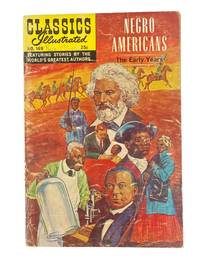
1962220401962. African American Comics Negro Americans: The Early Years Classics Illustrated No. 169. New York: Gilberton Company Inc. 1962. Staplebound with color-illustrated wrappers. A standalone issue of Classics Illustrated devoted entirely to the contributions of Black Americans from the colonial period through the 20th century. Published in 1962 during the height of the Civil Rights Movement this comic-format educational work-unusual in the Classics Illustrated series for focusing on real historical figures rather than literary fiction-was part of a broader mid-century effort to integrate African American history into mainstream curricula. As the cover proclaims the issue was intended to spotlight "the early years" of Black American achievement and in doing so it offers one of the earliest accessible visual histories of Black leaders for a youth audience. Historical figures covered in this issue include Crispus Attucks the first American killed in the Revolutionary War Benjamin Banneker mathematician and surveyor of Washington D.C. James Beckwourth a pioneering scout of the American West Harriet Tubman Frederick Douglass Daniel Hale Williams the first successful heart surgeon Booker T. Washington educator and founder of Tuskegee Institute George Washington Carver agricultural scientist and Matthew Henson co-discoverer of the North Pole.<br /> <br /> The comic also addresses Black contributions to the American Revolutionary War and Civil War with attention to the roles of enslaved people Black regiments and wartime espionage. Notably the "Inventors" section highlights Elijah McCoy lubrication systems Garrett Morgan gas mask and traffic light and Granville T. Woods rail signaling foregrounding underacknowledged Black innovation in American industrial history. Illustrated in full color throughout with strong sequential art emphasizing dignity resilience and ingenuity. Though the terminology "Negro Americans" reflects mid-century nomenclature the tone is respectful and didactic aimed at broad public education. These visual histories played an important role in the representation of African American figures in postwar American youth culture.Light wear and creasing consistent with age and small pen marks to cover but internally clean and complete. A remarkable and visually compelling early effort to narrate African American history to a popular audience. unknown
1966ZB393162Negro Bibliographic and Research Center 1966-1969. volumes 1-5 1966-1969 an uninterrupted run of complete volumes mostly softcover price is for the lot . - If you are reading this this item is actually physically in our stock and ready for shipment once ordered. We are not bookjackers. Buyer is responsible for any additional duties taxes or fees required by recipient's country. Photos available upon request. Negro Bibliographic and Research Center paperback
19592773494Madrid.: Escelicer. 1959. Paperback. Cubierta deslucida. Good. 22 cm. 366 p. 12 lám. Encuadernación en tapa blanda de editorial ilustrada. Colección 'La Historia Anecdótica'. Guerra mundial 1939-1945. Prisioneros. Rusia . Cubierta deslucida. Depósito legal: M 3243-1959 Reclutamiento. Enseñanza. Unión de repúblicas socialistas soviéticas. URSS. 355.257.7247 355.2 Historia de Europa.940.42 940 Escelicer. paperback
19592849054Madrid.: Escelicer. 1959. Hardcover. Cubierta deslucida. Good. 22 cm. 366 p. 12 lám. Encuadernación en tapa dura de editorial. Colección 'La Historia Anecdótica'. Guerra mundial 1939-1945. Prisioneros. Rusia . Cubierta deslucida. Depósito legal: M 3243-1959 Reclutamiento. Enseñanza. Unión de repúblicas socialistas soviéticas. URSS. 355.257.7247 355.2 Historia de Europa.940.42 940 Escelicer. hardcover
*W012487.- Madrid. 1959. Escelicer. 8º mayor. 366 p. Con fotos fuera de texto. . . . unknown
19593278442Madrid.: Escelicer. 1959. Paperback. Good. 22 cm. 366 p. 12 lám. Encuadernación en tapa blanda de editorial ilustrada. Colección 'La Historia Anecdótica'. Guerra mundial 1939-1945. Prisioneros. Rusia . Historia de Europa 940.42:355.257.7247 Escelicer. paperback
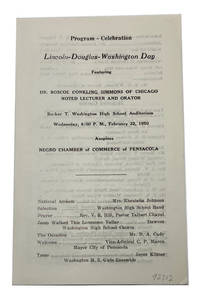
195092712Pensacola Florida 1950. Very Good. Folded four-page program. 23 cm. The third and fourth pages list about 175 individuals couples businesses and organizations as Patrons. We have no further information about the Negro Chamber of Commerce of Pensacola which appears to have organized this event. unknown
0260612103.Ghardcover. Good. Access codes and supplements are not guaranteed with used items. May be an ex-library book. hardcover
1019838140.Ghardcover. Good. Access codes and supplements are not guaranteed with used items. May be an ex-library book. hardcover
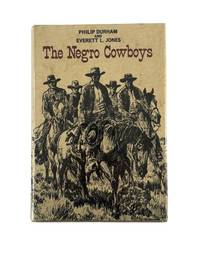
1965183241965. Western Americana The Negro Cowboys. Philip Durham and Everett L. Jones. Dodd Mead and Company: New York 1965. First edition. 278 pages Hardcover Measures 6 x 8 inches. Original dust jacket shows a group of men on horseback their faces obscured in shadow. The text begins "Now they are forgotten but once they rode all the trails driving millions of cattle before them.They numbered thousands among them many of the best riders ropers and wranglers." The true history of the cowboy stands in stark contrast to the mythology of John Wayne that surrounds it. African Americans escaping slavery and limited opportunity sought out the vast expanse of the American west to build new lives. Published in 1965 amid race riots and the assassination of Malcolm X this text made visible the invaluable contributions made by African American cowboys whose lives and contributions had been long buried. Cover clean and intact very slightly creased. Textblock clean tight and bright. Overall very good condition. unknown
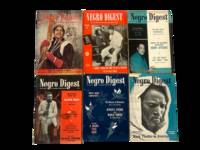
1947223891947. Johnson John H. founder. Negro Digest 1947-1969 documents African American political thought literary production and cultural criticism across the postwar period the Civil Rights Movement and the emergence of the Black Arts Movement. Published as a digest format periodical the magazine brought together essays fiction journalism and commentary by leading Black writers and public intellectuals establishing a widely circulated forum for debate on race identity labor international politics and the arts. The issues in this archive include contributions by figures such as LeRoi Jones Alice Childress C. Eric Lincoln Arna Bontemps and Barbara Ann Teer supporting research into African American intellectual history Black theater and mid twentieth century print culture.<br /> <br /> Negro Digest. Chicago: Johnson Publishing Company 1947-1969. Archive of six issues in printed wrappers each approximately 7.5 x 5.5 inches. Issues included are: 1 January 1947 with articles including Richard Wright's "How Jim Crow Feels" Eleanor Roosevelt's contributions and "How Jackie Robinson Took It"; 2 February 1951 featuring "I Didn't Raise My Boy to Be a Fighter" by Lillie Brooks and articles by Walter White and Roi Ottley; 3 November 1961 including "The New Black Renaissance" by Arna Bontemps and commentary by Duke Ellington and C. Eric Lincoln; 4 December 1962 featuring "The Menace of Mediocrity" by C. Eric Lincoln and essays on African American urban life and global politics; 5 April 1967 Second Annual Theater Issue including LeRoi Jones's play Slave Ship and essays by Alice Childress Ronald Milner and others on Black theater and performance; 6 April 1969 Annual Report on Black Theater in America with contributions by Barbara Ann Teer Woodie King Jr. and a roundtable including Sam Greenlee and Hoyt W. Fuller. The issues include essays reportage literary excerpts and visual material documenting cultural and political developments.<br /> <br /> Published during a period of expanding Black media and activism Negro Digest functioned as a central platform connecting literary production with political discourse tracing shifts from integrationist arguments in the postwar years to the cultural nationalism and artistic experimentation of the late 1960s. The inclusion of theater-focused issues reflects the increasing importance of performance as a site of political expression within the Black Arts Movement while earlier issues address labor segregation and international Black identity. Light edge wear and rubbing particularly to earlier issues; covers remain vibrant with pages clean and intact; overall very good condition. This archive provides sustained documentation of African American intellectual and cultural life across a critical period of twentieth century history. unknown
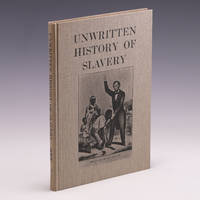
1968SKU-0665AG02004195Microcard Editions 1968. 1. Hardcover. Very Good. Very Good; Hardcover; Very light wear to the covers; Unblemished textblock edges; The endpapers and all text pages are bright and unmarked; The binding is excellent with a straight spine; This book will be shipped in a sturdy cardboard box with foam padding; Medium-Large Format Quatro 9.75" - 10.75" tall; 1.2 lbs; Gray cloth covers with title in black lettering; 1968 Microcard Editions; 160 pages; "Unwritten History of Slavery Autobiographical Accounts of Negro Ex-Slaves" by Negro Ex Slaves. Microcard Editions hardcover
1920171801920. Club teaches African-American girls about Home Economics Gardening Social and Civic Responsibility. C. 1920s. Negro Girls' Club Record Book. Published by Georgia State College of Agriculture in Athens Georgia. 20 pages. 9 x 5.75 in. Original printed wrappers. "Use this book to keep a record of al the club work done during the entire year." Printed as workbook with pages to take notes on numerous domestic projects including planning a garden canning produce cooking sewing and balancing a budget. Includes a rubric where a member's annual work will be evaluated. "Each club member is expected to make an exhibit at some fair or public meeting." Most of the pages are not filled in. 5 pages have child-like scribbles and doodles in pencil. Originally belonged to Sarah G. Daniel a girl in 6th Grade. Thumb-soiling to wrappers. In good condition. unknown
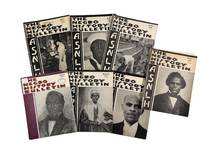
1941211681941. Woodson Carter G. The Negro History Bulletin. These mid-twentieth century periodicals document the institutionalization of African American historical scholarship and pedagogy under the leadership of Carter G. Woodson whose work established Black history as a formal field of study in the United States. Issued between 1941 and 1949 these issues provide primary evidence of how African American history was researched interpreted and disseminated during a period shaped by World War II migration and ongoing struggles for civil rights. Founded in 1937 at the urging of Mary McLeod Bethune the Negro History Bulletin functioned as an educational tool for teachers and students presenting accessible scholarship on African American life the African diaspora and global Black history. Editorial direction under Woodson emphasized correcting omissions in dominant historical narratives and foregrounding Black agency with content ranging from slavery and Reconstruction to contemporary wartime contributions and cultural production.<br /> <br /> Woodson Carter G. ed. The Negro History Bulletin. Washington D.C.: Association for the Study of Negro Life and History 1941-1949. Seven issues. Quarto. Stapled wrappers.<br /> Archive of seven issues spanning April 1941 through June 1949 each approximately 20-22 pages and measuring 8.5 x 11 inches illustrated with black and white photographs and line drawings. Contents include: 1 April 1941 issue with articles on the Underground Railroad Black communities in Canada and book reviews; 2 May 1944 issue addressing World War II and African American participation across military and civilian life; 3 March 1945 issue featuring Sojourner Truth labor equality free Black populations in antebellum Alabama and racial violence; 4 May 1945 issue examining the Department of Negro Affairs and early American attitudes toward slavery; 5 May 1947 issue including studies of formerly enslaved families such as the Loguens and Tanners suffrage in the South and profiles of Black educators; 6 January 1949 issue with articles on education in Haiti the Negro Little Theatre Movement Negro spirituals and a biography of Frederick Douglass; 7 June 1949 issue addressing intersections of Jewish and Black history modernization in the Virgin Islands regional Black history in Maryland and Virginia and educational policy.<br /> <br /> These issues were produced during a formative period in the expansion of African American historical consciousness when Woodson's efforts challenged the exclusion of Black experiences from mainstream curricula and scholarly discourse. The Negro History Bulletin operated as a bridge between academic research and classroom instruction shaping generations of teachers and students and contributing to the eventual institutionalization of Black Studies programs in the later twentieth century. The publication continues today as the Black History Bulletin recognized as the longest continuously published journal for practitioners in the field. Clean pages with light handling wear; fragile binding to the earliest issue and a punch hole to the upper corner of the June 1949 issue; overall very good condition. The archive provides a concentrated record of early African American historiography and educational practice during a critical period of intellectual and social transformation. unknown
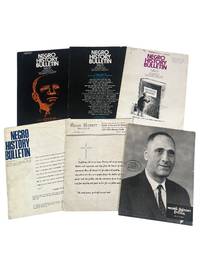
1964212461964. Woodson Carter G. ed. The Negro History Bulletin. These mid-twentieth century periodicals document the expansion of African American historical scholarship and pedagogy during the Civil Rights era when educational institutions activists and scholars increasingly challenged the exclusion of Black history from mainstream curricula. Issued between 1964 and 1971 these issues reflect the evolving intellectual priorities of the period including the emergence of Black Studies programs renewed attention to Reconstruction and slavery and the growing influence of Black Power thought. Founded in 1937 at the urging of Mary McLeod Bethune the Negro History Bulletin functioned as a teaching-oriented publication under the direction of Carter G. Woodson and the Association for the Study of Negro Life and History providing accessible but research-informed content for educators students and general readers. The issues in this group demonstrate how African American history was interpreted and taught during a period of legislative change cultural transformation and increased institutional recognition.<br /> <br /> Woodson Carter G. ed. The Negro History Bulletin. Washington D.C.: Association for the Study of Negro Life and History 1964-1971. Archive of six issues. Quarto. Stapled wrappers.<br /> Archive includes: 1 May 1964 issue with a dedication to Albert N. D. Brooks; 2 December 1964 issue featuring articles on John Willis Menard African American education and Black military service; 3 January 1969 issue including content on Wiley College Library poetry book reviews and contemporary educational policy developments; 4 January 1971 issue addressing music W. E. B. Du Bois's The Souls of Black Folk and the expansion of Black Studies programs; 5 October 1971 issue including discussions of Freedmen's schools antebellum Black separatist rhetoric Southern Black political organizations and housing and social policy; 6 November 1971 issue featuring articles on Black Power five years after its emergence the Gabriel Insurrection of 1800 Southern integration and prominent Black professionals. Each issue approximately 20-22 pages measuring 8.5 x 11 inches illustrated with black and white photographs and line drawings.<br /> <br /> These issues were produced during a period in which African American history moved from the margins toward institutional recognition particularly through the establishment of Black Studies programs and curriculum reforms in schools and universities. The Negro History Bulletin played a central role in translating scholarly research into classroom practice shaping how history was taught during a decade of social and political transformation. Its continued publication now under the title Black History Bulletin reflects its long-standing influence within the field. Light wear to covers; bindings generally sound with clean interiors; overall very good condition. The archive provides a focused record of African American historiography and educational practice during the Civil Rights era. unknown
1948072130International Publishers 1948. Hardcover. Very Good. Original 1948 hardcover in VG condition: excellent unmarked pages slight wear slight darkening at the lower spine and adjacent area. The dust jacket is fair-minus with two long tears and pieces missing on the front and spine yet is mostly intact and protected by a new clear removeable cover. 245 pages slightly age-yellowed. 15oz International Publishers hardcover
19613987Pittsburgh: Shields Watson & Washington Attorneys at Law 1961. Very good. Together 4 leaves 7 pp. the first two legal-size 14" x 8 1/2" the others slightly shorter; brad bound inside a 14.74 x 9" printed chemise folded to 9" x 3.75". Creases at folds; chemise moderately worn; leaves lightly dust-soiled with one small stain. APPLICATION TO CHARTER AN AFRICAN AMERICAN NON-PROFIT BUSINESS ASSOCIATION. IT WAS CREATED IN RESPONSE TO JIM CROW LAWS THAT REMAINED IN FORCE IN WESTERN PENNSYLVANIA AND ELSEWHERE. THIS SCARCE PRIMARY SOURCE MATERIAL DOCUMENTS THE NEEDS OF AFRICAN AMERICAN BUSINESS OWNERS TO UNITE IN ORDER TO SURVIVE. <br /> <br /> Our charter shows that the "Negro Licensed Beverage Association of Western Pennsylvania" NLBAWP was a group of African American hotel owners restaurant owners and tavern owners. Lingering Jim Crow laws and other societal forces made it exceptionally difficult for such businesses to succeed in the Pittsburgh area and of course elsewhere. The late 1950s and early 1960s saw the development of similar organizations in Philadelphia National Negro Licensed Beverage Association and New Orleans Negro Tavern Owners Association. <br /> <br /> Importantly this document lists the goals of the NLBAWP organization:<br /> <br /> "To foster strengthen and improve business within the Negro community." <br /> "To advance the cause of the Negro tavern and hotel owner as a whole." <br /> "To give service to members to do things for them which they cannot do for themselves or which can be done better or less expensively if done collectively." <br /> "To create and project the proper image of a tavern or hotel owner in the community." <br /> "To sponsor aid and assist any charitable or civic project approved by the members."<br /> <br /> One noteworthy incorporator listed here was Vivian Mason Lane. Lane owned four Pittsburgh taverns in the 1960s and was a community leader through at least the 1980s. She led a neighborhood Chamber of Commerce and ran unsuccessfully for County Commissioner and the State House.<br /> <br /> The 1966-67 Negro Traveler's Green Book "For Vacation Without Aggravation!" lists a grand total of eight suitable motels tourist homes and restaurants in Pittsburgh. In any event we have been unable to determine what -- if anything -- became of the Negro Licensed Beverage Association of Western Pennsylvania. Shields, Watson & Washington, Attorneys at Law unknown
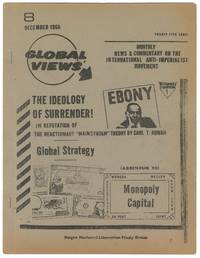
196613499San Francisco: Global Views 1966. The final issue of this short-lived theoretical journal of the Negro National Liberation Study Group NNLSG which published “news and commentary on the international anti-imperialist movement.†It appears as though eight issues were published monthly between May-December 1966. Almost nothing is available on the journal or the NNLSG at least under that name although the Labadie record states that in 1967 Global Views merged with Black Marketer and Burning Spear the newsletter of Omali Yeshitela’s JOMO Junta of Militant Organizations to form Black Power which was the journal of House of Umoja and the Black Panther Party Northern California two groups formed by RAM members and Soulbook editors Ken Freeman and Ernie Allen. <br /> <br /> Content for this issue includes an article titled “The Ideology of Surrender: In Refutation of the Reactionary ‘Mainstream’ Theory by Carl T. Rowan†in which Rowan is described as an “ideologist of the black bourgeois clique†for attacking Black Power as a separatist movement. This article is followed by an expanded version of an article on “Monopoly Capital†printed in issue 2 of Global Views includes six new appendices. The issue concludes with an editorial and excerpts from Dr. Ira S. Cohen’s address before the Commonwealth Club on U.S. imperialism’s drive to rule the world. <br /> <br /> Side-stapled mimeographed sheets 11†x 8 ½†26 p. Some toning to covers else a fine copy. Only two libraries hold any issues in WorldCat. The Labadie has a complete run and Northwestern holds two issues 5 8. In DANKY. Global Views unknown
8474909619.Gpaperback. Good. Access codes and supplements are not guaranteed with used items. May be an ex-library book. paperback