4 résultats
1670021799sans lieu Stampatus in Stampatura Stampatorum 1670 un volume in-16° (8,7 x 14,8cm), 191 pp. Reliure de l'époque en pleine Basane brune, dos à nerfs à caissons ornés et dorés, étique de titre, roulette dorée sur les coupes, tranches rouges. (reliure frottée, petits manques de cuir aux coiffes, à une charnière et sur les coupes, coins émoussés, fente à une charnière sur 2cm, quelques rousseurs pâles, des feuillets uniformément brunis). Edition la plus complète que l'on ait de ce recueil (BRUNET I-393). Juriste natif de Solliès près de Toulon, Antonius de Arena ou Antoine Arène (v. 1500- 1544) est l'auteur de divers poèmes comiques dans un provençal mâtiné de termes latins, et notamment d'un traité sur la danse. A la suite des poésies d'Arena se trouve une autre pièce macaronique du poète de la Pléiade Rémy Belleau (pp. 96-106) "De Bello Huguenotico". Magnifique vignette de titre gravée représentant un paon. Annotations au crayon en page de garde. Surlignages et corrections ancien.ne.s manuscrites à l'encre sur 3 feuillets. La seconde partie de l'ouvrage est consacré à l'oeuvre du poète Bartholomeus Bolla, ce sont des pièces en italien pour certaines et en patois de Bergame pour d'autres. Surlignages et corrections manuscrites à l'encre sur 3 feuillets. RARE.
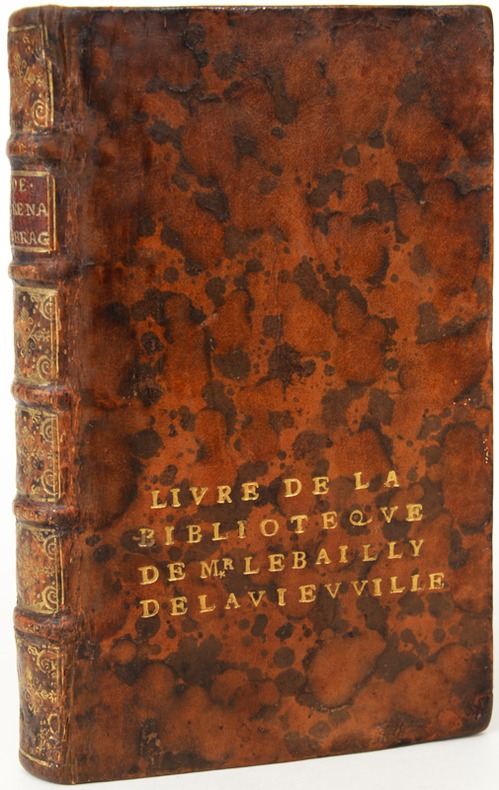
167040233S.l. (Paris), Stampatus in stampatura stampatorum, 1670. 2 parties en 1 vol. in-12 de 191-(1) pp., veau marbré, dos orné à nerfs, pièce de titre en maroquin rouge, super-libris en capitales dorées sur le plat supérieur, tranches mouchetées (reliure de l'époque).
16702332Stampatus in Stampatura Stampatorum" i.e. Paris 1670. 12mo 142 x 80 mm. 191 pp. Two parts separately titled but continuously paginated. Woodcut peacock device on title. A pretty copy; occasional light foxing to upper margins. Eighteenth-century French red morocco sides with triple gilt fillet smooth spine gold-tooled with green morocco lettering-piece edges gilt over marbling marbled endpapers edges slightly scuffed. Provenance: Marquis de Rognes engraved armorial bookplate signed Nicolas de Mire 1777.<br/><br/>Most complete edition of one of the earliest collections of French macaronic poetry an often burlesque admixture of the vernacular and Latin celebrated for its valuable descriptions of and notations of early Provençal dance. The preface from the supposed publisher "Librarius" is addressed to the "bragardissimis" dancers of France: bragare in Arena's personal brand of Latin means to "have fun" but Arena's work addressed to students was intended to meet a semi- serious need: To attract students to the University of Aix less popular than the faculties of Avignon and Montpellier the rector had decided to authorize a ball at the time of graduation for the graduates and their families but "for certain students dancing in public was a much more forbidding test than all of those that they had undergone during their studies" Louisson-Lassablière p. 268 our translation. Thus Arena's goal was to familiarize students with the many different "basses danses" currently in fashion. <br/><br/>Following a prose introduction to the subject the poem in 1896 lines is in two parts the first being an autobiography in which the author successively a law student soldier and lawyer of whom little else is known recalls his horrific experiences in the Italian campaigns including an eye-witness account of the Sack of Rome in 1527. Following his final return from Italy in 1528 he had given his first dance lessons and thus the work segues into a largely tongue-in-cheek introduction to dance and to proper comportment. Of greatest interest for dance historians are the technical descriptions of dances found in a four-page section pp. 86-90 in French in which the author uses a stenographic notation system in which each step is designated by the initial of its name repeated to indicate a repetition of the step. Thus in the description "R c ss d ss d d d ss r c ss a ss r c" "c" signifies "congé" "ss" signifies "deux simples" "d d d" signifies "trois doubles" and so on. Such detailed choreographic records are rare for this period. Each dance description occupying no more than one line is prefaced by the title or titles of popular songs or melodies to which it should be danced. The earliest known edition of the work was printed anonymously probably in Lyons in 1528; at least 40 more editions followed the last from 1758 a full census including untraced and "ghost" editions is provided by R. Mullally. The present edition includes other previously published macaronic verse including Rémy Belleau's "Poema macaronicum de bello huguenotico" and separately titled a collection of Italian macaronic poetry by Bartolomeo Bolla first printed in 1604 with satirical poems such as one addressed to the "culinary Muse" p. 147 humourous lists of attributes including types of women associated with various Italian towns pp. 121-129 and poems in the patois of Bergamo. On textual grounds Mullally revised the attribution of this edition to Paris; it was traditionally assigned to Lyon. Brunet I 393 "Edition la plus complète que l'on ait de ce recueil" ; Fletcher Bibliographical Descriptions of Forty Dance Books 3a ; Clarke Four Hundred Years of Dance Notation 1987 no. 6; Robert Mullally "The editions of Antonius Arena's Ad suos compagnones studiante" Gutenberg-Jahrbuch 1979:146-57 edition P12. Cf. Marie-Joëlle Louisson-Lassablière "Antonius Arena ou le Latin macaronique" in E. Bury Tous vos gens à Latin 2005. Stampatus in Stampatura Stampatorum," [i.e., Paris] unknown books
16702332Stampatus in Stampatura Stampatorum" i.e. Paris 1670. 12mo 142 x 80 mm. 191 pp. Two parts separately titled but continuously paginated. Woodcut peacock device on title. A pretty copy; occasional light foxing to upper margins. Eighteenth-century French red morocco sides with triple gilt fillet smooth spine gold-tooled with green morocco lettering-piece edges gilt over marbling marbled endpapers edges slightly scuffed. Provenance: Marquis de Rognes engraved armorial bookplate signed and dated Nicolas de Mire 1777; coded purchase note "ca" in pencil on recto of final free endleaf probably from Jean-Jacques Debure ca. 1800 thanks to Erick Aguirre for this information.<br/> <br/> Most complete edition of one of the earliest collections of French macaronic poetry an often burlesque admixture of the vernacular and Latin celebrated for its valuable descriptions of and notations of early Provençal dance. The preface from the supposed publisher "Librarius" is addressed to the "bragardissimis" dancers of France: bragare in Arena's personal brand of Latin means to "have fun" but Arena's work addressed to students was intended to meet a semi- serious need: To attract students to the University of Aix less popular than the faculties of Avignon and Montpellier the rector had decided to authorize a ball at the time of graduation for the graduates and their families but "for certain students dancing in public was a much more forbidding test than all of those that they had undergone during their studies" Louisson-Lassablière p. 268 our translation. Thus Arena's goal was to familiarize students with the many different "basses danses" currently in fashion. <br/> <br/> Following a prose introduction to the subject the poem in 1896 lines is in two parts the first being an autobiography in which the author successively a law student soldier and lawyer of whom little else is known recalls his horrific experiences in the Italian campaigns including an eye-witness account of the Sack of Rome in 1527. Following his final return from Italy in 1528 he had given his first dance lessons and thus the work segues into a largely tongue-in-cheek introduction to dance and to proper comportment. Of greatest interest for dance historians are the technical descriptions of dances found in a four-page section pp. 86-90 in French in which the author uses a stenographic notation system in which each step is designated by the initial of its name repeated to indicate a repetition of the step. Thus in the description "R c ss d ss d d d ss r c ss a ss r c" "c" signifies "congé" "ss" signifies "deux simples" "d d d" signifies "trois doubles" and so on. Such detailed choreographic records are rare for this period. Each dance description occupying no more than one line is prefaced by the title or titles of popular songs or melodies to which it should be danced. The earliest known edition of the work was printed anonymously probably in Lyons in 1528; at least 40 more editions followed the last from 1758 a full census including untraced and "ghost" editions is provided by R. Mullally. The present edition includes other previously published macaronic verse including Rémy Belleau's "Poema macaronicum de bello huguenotico" and separately titled a collection of Italian macaronic poetry by Bartolomeo Bolla first printed in 1604 with satirical poems such as one addressed to the "culinary Muse" p. 147 humourous lists of attributes including types of women associated with various Italian towns pp. 121-129 and poems in the patois of Bergamo. On textual grounds Mullally revised the attribution of this edition to Paris; it was traditionally assigned to Lyon. <br /> <br /> Brunet I 393 "Edition la plus complète que l'on ait de ce recueil" ; Fletcher Bibliographical Descriptions of Forty Dance Books 3a ; Clarke Four Hundred Years of Dance Notation 1987 no. 6; Robert Mullally "The editions of Antonius Arena's Ad suos compagnones studiante" Gutenberg-Jahrbuch 1979:146-57 edition P12. Cf. Marie-Joëlle Louisson-Lassablière "Antonius Arena ou le Latin macaronique" in E. Bury Tous vos gens à Latin 2005. Stampatus in Stampatura Stampatorum," [i.e., Paris] unknown