2 324 résultats
158479301584. Fine woodcut printer’s device on title woodcut port. on verso of the dedicatee Henri III & several woodcut illus. in the text. 22 p.l. 558 5 pp. Folio fine 18th-cent. marbled calf joints & ends of spine very carefully repaired arms in gilt on both covers of the great bibliophile. the duc d’Aumont triple gilt fillet round sides spine richly gilt red morocco lettering piece on spine a.e.g. Paris: A. l’Angelier 1584.<br/> <br/> First edition a fine copy from the library of the great bibliophile the duc d’Aumont 1709-82 one of the outstanding book and art collectors of his age with his arms in gilt on both covers. This is the first French national bibliography a monumental work of fundamental importance for the history of French literature and scholarship. It has remained an indispensable reference and source book to this day as attested by Brunet Petzholdt and Besterman.<br/> <br/> The roughly 3000 authors are arranged alphabetically by their given names and La Croix du Maine gives succinct bio-bibliographical information for each. Our edition contains a remarkable proposal not reprinted in the 18th-century edition for the formation of a French national royal library housed in about 100 “noble†bookcases of which a most attractive illustration is printed on p. 511. This woodcut appears to be the first illustration of library furniture in a printed book. La Croix du Maine also urges the arrangement of the books by a system that is quite close to a decimal classification.<br/> <br/> La Croix du Maine 1552-92 began this bibliography at the age of 17 and in the process accumulated a large library. A Protestant sympathizer he was assassinated at 40 and was therefore unable to issue further volumes as he had planned.<br/> <br/> A fine copy. This copy appeared in the auction lot 2977 of the library of the duc d’Aumont which was sold in January 1783 in Paris by De Bure.<br/> <br/> ⧠Besterman The Beginnings of Systematic Bibliography pp. 24-25. Grolier Club Bibliography 29. unknown
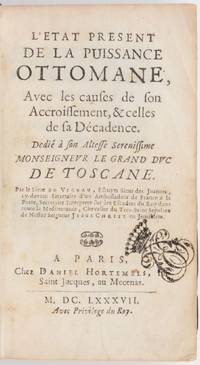
16871559A Paris: Chez Daniel Hortemels Saint Jacques au Mecenas 1687. First edition. In contemporary leather. Spine with five raised bands compartments gilt titled. Tinted edges. Bookplate and shelfmark on inner front panel. A different possessor’s inscription on flyleaf. Ownership stamp on title page. Spine with worm traces. Corners slightly bumped. Inside clean with occasional stains throughout. Overall in very good condition. First edition. In contemporary leather. Spine with five raised bands compartments gilt titled. Tinted edges. 30 370 4 p. Complete. <p><br /> First edition of Du Vignau’s important work dealing with the decline of the Ottoman Empire.<br /> <p><br /> <p><br /> L'état présent de la puissance Ottomane was written after the unsuccessful siege of Vienna by the Ottomans in 1683 and the following withdrawal. It deals with the possible reasons led to the decline of the Ottoman Empire and provides an overview of the period Ottoman power. The book gained interest throughout Europe and in the subsequent year a second edition was printed in the Hague and an English translation was also published.<br /> <p><br /> <p><br /> A year after the present work Du Vignau published another book Le Sécretaire turc. “In both works he described himself as a former secretary at the French embassy in Istanbul the ‘secrétaire-interprète’ to the King’s fleet in the Mediterranean and even a godson to Louis XVI. None of these claims appear to be true.†Ghobrial 2013 Sieur des Joanots Du Vignau was a pseudonym invented by Édouard de La Croix who was indeed a secretary in the French embassy in Istanbul between 1670 and 1680 and again between 1685–1686. La Croix published his Mémoires in 1684 and four other books between 1686 and his death in 1704 among them Le Sécretaire turc and the present book. “The reason for his having used a pseudonym remains unclear. Interestingly the two titles published under the name Du Vignau … are the only books written by La Croix that were not dedicated to Louis XVI but instead to the Grand Duke of Tuscany an indication perhaps of his attempts to cultivate a new patron in the person of Cosimo III de’ Medici.†Ghobrial 2013<br /> <p><br /> <p><br /> Scarce we could trace only 3 copies in institutional holdings BL; BnF; Bibliothèque municipale de Lyon.<br /> <p><br /> <p><br /> Provenance: Bookplate: "De la bibliothèque du Comte Nicolas d’Eszterhazyâ€; ownership inscription in ink: “Clementsâ€.<br /> <p><br /> <p><br /> Bibl.: Ghobrial J-P.: The Whispers of Cities: Information Flows in Istanbul London and Paris in the Age of William Trumball. Oxford: Oxford University Press 2013. pp. 1–7.<br /> <p>. Chez Daniel Hortemels, Saint Jacques, au Mecenas unknown
LCS-18423Exemplaire très pur et à belles marges conservé dans sa première reliure en veau de l’époque. Paris, chez Robert Pepie, 1688. In-8 de (1) f., titre, 267 pp., (1) p. Au bas de la dernière page on lit: “A Paris, de l’Imprimerie de la veuve Denis Langlois, 1688”. Cachet D.L.P. en bas du titre. Relié en veau brun granité de l’époque, dos à nerfs orné, coupes dorées, tranches dorées sur marbrures. Reliure de l’époque. 186 x 118 mm.
1703B7089Paris: Chez Simon Langlois c 1703. near fine with text clean and crisp. . Edition: First Edition. Binding: Contemporary full paper boards expertly rebacked; raised spine with five 5 bands black ink title on vellum label on two; central black fleur de lis design on four. Notes: Provenance: Upper pasted endpaper with owner’s armorial bookplate: “Watkin Williams Esq of Penbedw // in the County of Denbighâ€. Concerning this name Archaeologia Cambrensis states: “1789. Watkin Williams Esq. of Penbedw in the county of Denbigh but owner of property in the parishes of Mallwyd and Llan-y-mowddwy in the county of Merioneth M.P. first for Montgomeryshire and afterwards during nearly thirty years for the Flint contributary boroughs was appointed lieutenant and custos rotulorum for Merionethshire.†Final free endpaper watermarked. <br>This edition of this Canadiana publication is unique in that we are not able to locate another copy of the same anywhere. The second last paragraph of the introduction to the priests clergy and missionaries in this edition states that this publication encloses at the end of the first part or 'Rituel' a second part entitled 'les Statuts Ordonnances & Mandemens.' instructions prepared at various times by the Church for the conduct of all including those entrusted to the clergy that these instructions may not be ignored. The recipient are advised that they are restatements of instructions previously given to be read often just as such given in the Ritual itself; they are to be followed with precisions including all the rules contained not to be lost sight of observed faithfully in all works and ones conduct. The inclusion of this paragraph is unlike the introduction of another edition published at the same time and same location but not including this paragraph or the 'Statuts.'. <br>The present work describing festivals sacraments statutes and ordinances for the use by priests in Quebec is extremely rare and was immediately followed by a second edition published the same year: Gagnon reports that in a copy of the second edition of 1703 now at the Laval University library and previously owned by Abbé Plante a note says that the first edition “would have been almost completely destroyed by the sinking of the ship …carrying it to Canada and for this reason a second edition was immediately made.†<br>On the “privilege†included as the final leaf in our first edition example it is stated that the work was registered on March 30 1703 and completed for print for the first time on March 31 1703; <br><br>Saint-Valier was a supporter of the Counter Reformation. His initial intent in the New World was to engage in the conversion of the indigenous residents. He introduced Jesuits and Recollects in an attempt to evangelize New France. Many of these missions Illinois Louisiana and Mississippi resulted in conflicts between Bishop Saint-Vallier the Jesuits and the seminary of Quebec.<br><br>His various construction projects reflect a desire to restore and renew the authority in the Catholic Church as the main institution of administrative organization. In 1697 Saint-Valier built a palace in Quebec for his clergy and as a place of hospitality. During the same year he also established a nuns monastery in Trois-Rivières Saint-Vallier’s zeal for religious activities and establishments stretched from Quebec Montreal Acadia and Louisiana. His way of life embodied that of the ideals of the Council of Trent.<br><br>The Diocese of Quebec was vast and its population diverse and widespread. It included the whole of French North America or what was called New France divided in seven colonies: Newfoundland Acadia ÃŽle Royale Louisiana Illinois Upper Country and Canada inhabited by Indigenous people and the European settlers. During the tenure of Saint-Vallier immigration from France was mostly over; the European colonists were farmers fishermen sailors merchants and ‘coureurs des bois’ overseen by a small elite of aristocratic leaders but a great demographic explosion occurred between 1685 and 1730 the white population in New France jumping from c. 12000 inhabitants to c. 41500.<br><br>During the same time the number of Amerindian fell from c. 163500 to c. 61500. That loss mainly in the tribes of Louisiana was attributed to warfare and diseases brought to the valley of the Mississippi. The number of Aboriginals compared to white settlers is one reason for the presence of so many religious orders in New France. The missions and conversions to Christianity were deemed very important.<br><br>Priests of the Missions Étrangères of Paris the Jesuits the Recollets and the Sulpicians often worked in collaboration with the nuns from different orders like the Congrégation de Notre-Dame or the Canonesses of St. Augustine of the Mercy of Jesus at l’Hôtel-Dieu de Québec. The arrival of Saint-Vallier and his strong views on what should be the duties of the priests created a shock wave in the orders especially for the Seminary of Quebec newly founded by his predecessor Bishop Laval. … Saint-Vallier's tenure as bishop was defined by interminable quarrels with governmental and religious institutions in French North America. … his active leadership style brought him into conflict with various groups who perceived him as at times domineering and micromanaging.<br>While subject to much criticism Saint-Vallier was also admired in his diocese for his dedication and self-sacrifice. Rather than staying in Quebec or Montreal he tirelessly traveled the back-country. The founding of the Hôpital Général and installation of Jesuits and Recollets at Montreal were also to his credit.<br><br>There was a very strong suspicion in the colonies and in France that the Bishop of Quebec was in fact a follower of Jansenism. . In the beginning of the 18th century the Bishop wrote 3 books; the Ritual the Catechism and the ‘Statuts et ordonnances’ – two of which are bound in the present volume. <br>…the Superior of the jesuite order decided to attack Saint-Vallier’s authority by writing a long critic of those three books seeing them as a "lapse into Arianism Pelagianism Jansenism Lutheranism and Calvinism". Father Bouvart based his accusations on different passages of the works of the Bishop … who eventually appealed to the Sorbonne to have his works rehabilitated. The doctors of the Faculty of Theology declared the Ritual and the Catechism perfectly orthodox and censured the critic of Bouvart. Nevertheless Saint-Vallier decided to re-edit in 1713 the Ritual so as to cast away all doubts about his pretended Jansenist ideas. This book remained in use in the parishes until the middle of the 19th century. The present work is the unedited original and first edition of his ritual and statuts. <br><br>The disputes with the religious orders of New France the government and the merchants gave way to a more peaceful period that lasted until his death. Austere throughout his life he became more and more humble in his way of living and turned toward contemplation and simple duties. .He also took very seriously his duties of Bishop and developed parishes in the farthest corners of the diocese.<br><br> Size: Octavo 213 x133mm. Illustration: Text in French; with some text in Latin<br>Achevé d'imprimer pour la premiere fois ce 31 mars 1703. Relié avec le Rituel du même. <br><br>Illustrated with two printer's devices representing the arms of the archdiocese of Quebec; various head and tail pieces incl. vignettes; in-text music notes on Qiiii-Si; Ggii-iiii. References: Philéas Gagnon: Essai de bibliographie canadienne: Inventaire d'une bibliothèque . Volume 1: 3138 & 3139 p.437; Archaeologia Cambrensis Volume 1 p.142. Pages: Ff. 2 bl. ill. title bl. author to priests on the use of the book 4 Fetes Observe’es 4 604 table 2 errata 3 bl.; ill. title bl. letter 3 8-146 table 2 privilege 2 bl.2; In leaf collation: bl. v A-Z8 Aa-Nn8 Oo-Rr4 iiiff. table; a1 a3-a8 e8 i8 o8 u8 aa8 ee8 ii2 oo8 uu8 aaa1 ii bl. Category: Book Canada; Book Religious Christianity; Chez Simon Langlois, hardcover
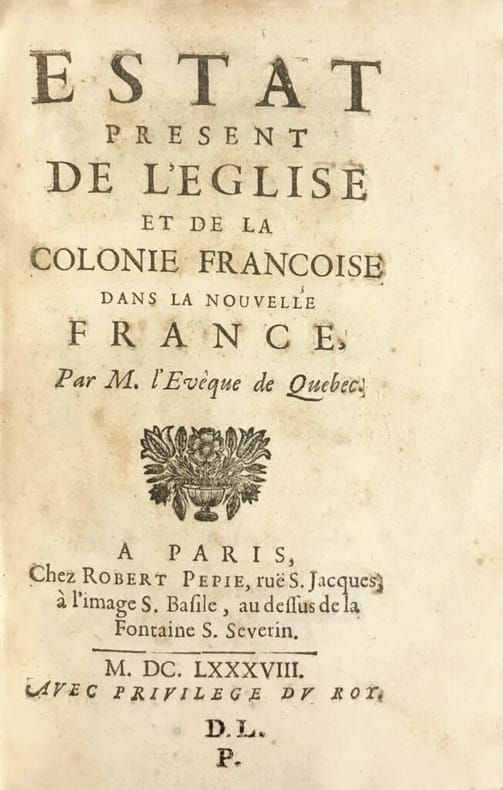
1688CAIla[SA43Paris: Robert Pepie 1688. 1688. 8vo. pp. 1 p.l. 267 1privilege. woodcut title vignette headpiece & initial. contemporary mottled calf gilt back rubbed several holes in front joint lower outer corner damaged ink stains to pp. 62-63 few other stains to last leaf & margins of some others upper outer corner of last leaf & rear endpaper singed. First Edition Second Issue with cancel title. Only two copies of this issue are located in the Amicus database of Canadian libraries. The more common first issue has the title Estat Présent De L'Église Et De La Colonie Françoise Dans La Nouvelle France. with identical imprint. Saint-Vallier was Laval's successor as Bishop of Quebec 1688-1727. The present work written in the form of a letter to an anonymous friend describes his trip to New France between May 1685 and January 1687 to survey the bishopric prior to his consecration. On the voyage out he sailed on board the same vessel as the Marquis de Denonville the newly appointed Governor of New France. Saint-Vallier first visited Quebec then all of the parishes along the St. Lawrence finally arriving at Montreal. Travelling along the inland waterways he made his way with a small escort to Acadia returning to Quebec in the fall of 1686. His informal account provides descriptive details respecting the native tribes and their relations with the white settlers specific reports on missionary activities and sketchy information regarding troubles with the Iroquois. "This is one of the rarest accounts of the missions published irregularly after the discontinuance of the annual Jesuit Relations with the one for 1671-72.It appeared in one edition only but with different title-pages.". Bell Bell S58. Church 707. European Americana 688/208. Howes S41. JCB p. 198. Sabin 66979. cfDionne II 218 cfGagnon I 1284 cfHarrisse NF 159 cfLande 773 cfStreeter VI 3632 cfTPL 98 and cfVlach 665 other issue. DCB II pp. 328-334. Story p. 743. Winsor IV pp. 315-16. 1st Edition. Hardcover. Good. Paris: Robert Pepie, 1688. Hardcover
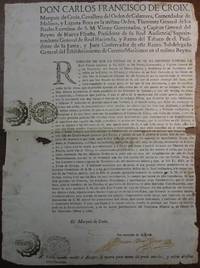
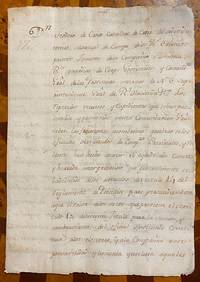
1768230014Mexico 1768. unbound. 2 pages in Spanish roughly translated 16.5 x 12 inches A Royal Proclamation: El Marquis de Croix March 9 1768 ordering the mine owners to make concessions and increase wages in small part: ".A decline in mining.the mines have the common enemy of water which has flooded them.the excessive construction cost of which the Kingdom has no wealth. Is the relief moderation the price you ask as the best mines are completely uninhabited and desolate Send my fatherly love to my vassals subjects.I'll strive by all means.that they are fruitful. I've visited the Council of the Indies. Faith issued.and the moderate price of quicksilver.which is distributed to the miners a part of the quarto has so far been given for relief to support the work.I command you with consequences that you publish and carefully observe that the above ceiling of a fourth part of the price at which would have been taken in quicksilver.be given to the miners.ending the embargo. Also by Royal Proclamation inserted within it is free of tax." Also signed by Manuel Rodriguez 1697 - 1772 -- military leader on the Coahuila-Texas frontier esteemed explorer and one of the greatest Indian fighters from Texas. After the departure of Jacinto de Barrios y Jaurequi in February of 1768 he became brief interim governor and military commandant of the Province. Rare signature as Commandant and Governor of the Province. According to the Texas State Historical Association "It was not until recently that archivists were aware that Rodriguez was a Governor.a fact scarcely noted by historians. Horizontal fold; two holes; smudges in the left margin. Very good- condition.<br/><br/> De Croix 1699 - 1786 was the Viceroy of New Spain Mexico who served during the period of Great Turbulence. The sole purpose of his five-year administration 1766 - 1771 was absolute obedience to the king whom he always referred to as "Mi amo." In 1767 he expelled the Jesuits from the colony removing them from their Monasteries and Colleges allowing them to leave with scarcely the clothes on their backs. These measures provoked a rebellion in which the Viceroy dealt severely with the rebels proclaiming censorship of literary and scientific publications 1768 and hanging the leaders of the uprising. No sooner had opposition been eliminated de Croix turned his attention toward the war-seeking Apache and Comanche Indian tribes financing and authorizing an expedition led by Captain de Galvez into Nueva Vizcaya whereby the Indians were soundly defeated. In March 1768 following the slow-downs boycotts and disturbances in the mines of Guanajuato and Pachuca over the low wages paid to the miners de Croix stunned the Colony by siding with the miners and forcing the mine owners to agree to an increase in wages. His actions were deemed "one of the most significant social reforms in the New World" at that time.<br/><br/> unknown books
1768230014Mexico 1768. unbound. 2 pages in Spanish roughly translated 16.5 x 12 inches A Royal Proclamation: El Marquis de Croix March 9 1768 ordering the mine owners to make concessions and increase wages in small part: ".A decline in mining.the mines have the common enemy of water which has flooded them.the excessive construction cost of which the Kingdom has no wealth. Is the relief moderation the price you ask as the best mines are completely uninhabited and desolate Send my fatherly love to my vassals subjects.I'll strive by all means.that they are fruitful. I've visited the Council of the Indies. Faith issued.and the moderate price of quicksilver.which is distributed to the miners a part of the quarto has so far been given for relief to support the work.I command you with consequences that you publish and carefully observe that the above ceiling of a fourth part of the price at which would have been taken in quicksilver.be given to the miners.ending the embargo. Also by Royal Proclamation inserted within it is free of tax." Also signed by Manuel Rodriguez 1697 - 1772 -- military leader on the Coahuila-Texas frontier esteemed explorer and one of the greatest Indian fighters from Texas. After the departure of Jacinto de Barrios y Jaurequi in February of 1768 he became brief interim governor and military commandant of the Province. Rare signature as Commandant and Governor of the Province. According to the Texas State Historical Association "It was not until recently that archivists were aware that Rodriguez was a Governor.a fact scarcely noted by historians. Horizontal fold; two holes; smudges in the left margin. Very good- condition.<br/> <br/> De Croix 1699 - 1786 was the Viceroy of New Spain Mexico who served during the period of Great Turbulence. The sole purpose of his five-year administration 1766 - 1771 was absolute obedience to the king whom he always referred to as "Mi amo." In 1767 he expelled the Jesuits from the colony removing them from their Monasteries and Colleges allowing them to leave with scarcely the clothes on their backs. These measures provoked a rebellion in which the Viceroy dealt severely with the rebels proclaiming censorship of literary and scientific publications 1768 and hanging the leaders of the uprising. No sooner had opposition been eliminated de Croix turned his attention toward the war-seeking Apache and Comanche Indian tribes financing and authorizing an expedition led by Captain de Galvez into Nueva Vizcaya whereby the Indians were soundly defeated. In March 1768 following the slow-downs boycotts and disturbances in the mines of Guanajuato and Pachuca over the low wages paid to the miners de Croix stunned the Colony by siding with the miners and forcing the mine owners to agree to an increase in wages. His actions were deemed "one of the most significant social reforms in the New World" at that time.<br/> <br/> unknown
14320Paris, Kilian, Picquet, 1826.
7223Amsterdam & Paris, Desaint, 1768. Cinq ouvrages en un volume in-8 (195 x 124 mm), IV pp., 162 pp., 3 tables dépl.; 48 pp.(interversion du texte avec le quatrième ouvrage à partir du cahier C); 8 pp.; 8 pp.; un tableau dépl., 147 pp. et 1 p. n. ch.; 2 ff. n. ch., 314 pp., 1 f. n. ch. Veau porphyre, triple filet doré en encadrement sur les plats, dos à nerfs orné de caissons avec pièce d'armes au cerf doré répété, pièces de titre vert foncé et rouge, coupes filetées, tranches marbrées, habiles restaurations (reliure de l’époque).
169764860Leipzig, Johann Ludwig Gleditsch, 1697. 4°. Haupttitel in Rot u. Schwarz. Mit 4 Kupfertiteln, 17 gefalt. Kupferkarten, 55 (2 gefalt.) Kupfertafeln u. einigen Textholzschnitten. Zus. ca. 1.700 S., Ldr.-Bde. d. Zt. a. 5 Bünden m. reicher Rückenverg., goldgepr. Rückenschild u. gespränkeltem Farbschnitt.
168815851Thomas Amaulry Lyon 1688 4 vol. 4 volumes in-12 de 10 ff.n.ch. (titre, épitre et préface) 536 pp. 8 ff.n.ch. (table), 1 f.n.ch. (titre) 576 pp. 10 ff.n.ch. (table et privilège), 1 f.n.ch. (titre) 576 pp. 10 ff.n.ch. (table) et 1 f.n.ch. (titre) 706 pp. 8 ff.n.ch. (table et privilège),, veau brun de l'époque, dos à nerfs orné, pièces de titre, tranches jaspées (épidermures sur certains plats, accrocs à certaines coiffes, quelques coins usés).
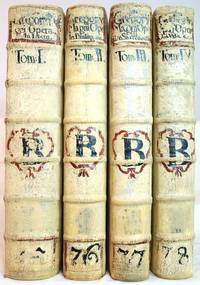
17051410030042Parisiis: Sumptibus Claudii Rigaud via Citharaea 1705-01-01. Hardcover. Very Good. Folio. 4 Volumes. Bound in contemporary full blind-stamped pigskin vellum. Black title on spine. Brass clasps to each volume. Original vellum tags on each title page for quick reference. Good bindings and covers with only minor Wear to extremities. Soiling to boards. Library markings on spine in contemporary gray black and red paint. Library bookplate of the Neander Library on inside boards. Owners inscriptions on inside boards detailing the set as a gift from Countess Marie-Margarite Waldstein upon her death in 1725. Presentation inscription on FEP to Dr. August Neander dated 1830 by Carl Hubner Carl Ferdinand Gustav Muller and Ludwig Wienfreiht Bath. Owners name of the Capuchin Monastery in Hradsite and date of 1725 on title page of each volume of Capuchin monastery in Hradiste. Lacking frontis of Pope Gregory I. Contemporary notation in ink and pencil on last blanks. Clean unmarked pages with minor tanning to extremities. Brunet II 1723/24. <br><br> Contents of each Volume are: Tomus primus. Libri moralium in Job XXXV. Libri duo in Ezechielem. Libri duo in Evangelia --Tomus secundus. Liber regulae pastoralis. Dialogorum libri IV. Registrum epistolarum. Epistolarum ordo restitutus. Index geographicus & varii alii indices --Tomus tertius. Liber sacramentorum S. Gregorii Papae ex editione D. Hugonis Menardi. Notae & observationes ejusdem D. Hugonis Menardi in Librum sacramentorum. Benedictiones quae in Libro sacramentorum desiderantur ex Lambecio. Benedictionum episcopalium aliud supplementum ex ms. Theodericensi. Liber antophonarius S. Gregorii Papae. Liber responsalis seu Antophonarius ex ms. Compendiensi. Variae expositiones in Librum I. Regum lib. VI. Expositio super Cantica canticorum. Expositio in septem psalmos poenitentiales. Concordia quorumdam testimoniorum sacrae scripturae --Tomos quartus. Vita S. Gregorii Papae auctore Paulo Diacono. Eadem auctore Johanne Diacono. Eadem ex ejusdem S. Gregorii Papae scriptis potissimum recens adornata. Sancti Paterii Liber de expositione Veteris & Novi Testamenti. Alulfi De expositione Novi Testamenti libe <br><br> Countess Mary Margaret Waldstein 1689-1725 was the wife of Prince Franz Josef of Waldstein 1680-1722 was an early supporter of the Capuchin Order and their monastery in Hradiste present-day Czechoslovakia. She is called the "mother of the Capuchins." <br> The House of Waldstein is a Czech noble family that received prominent state and civil positions beginning in the 17th century. It was one of the first among the Bohemian nobility to be promoted to Graf count in 1628 and two years later to the imperial court. Its most famous members include General Albrecht von Wallenstein and statesman Ferdinand Gabriel von Waldstein the patron of Ludwig van Beethoven. <br><br> The Order of the Capuchin Friars Minor is an Order of friars in the Catholic Church one of the chief offshoots of the Franciscan Order. The Order began in 1520 when Matteo da Bascio an Observant Franciscan friar said he had been inspired by God with the idea of that the manner of life led by the Franciscans at the time was not in keeping with their found St. Francis of Assisi had envisioned. He created the Capuchin Order to return to the primitive way of life solitude and penance as practiced by St. Francis. The name of their order comes from the Cappuccio a hood worn by the Camaldolese monks in gratitude for refuge given by the monks in the initial years of the order. <br><br> Dr. Johann August Wilhelm Neander 1789-1850 was a German theologian and church historian. Originally born into a Jewish family he changed his name to Neander when he became a Christian in 1806. A German Lutheran he studied with F D. Schleiermacher 1768-1834 in Berlin but soon switched his interest from speculative theology to church history. <br> His General History of the Christian Religion and Church Allgemeine Geschichte der christlichen Religion und Kirche remains the greatest monument of his genius. In this Neander's chief aim was everywhere to understand what was individual in history. In the principal figures of ecclesiastical history he tried to depict the representative tendencies of each age and also the types of the essential tendencies of human nature generally. His guiding principle in dealing both with the history and with the present condition of the church was "that Christianity has room for the various tendencies of human nature and aims at permeating and glorifying them all; that according to the divine plan these various tendencies are to occur successively and simultaneously and to counterbalance each other so that the freedom and variety of the development of the spiritual life ought not to be forced into a single dogmatic form" Otto Pfleiderer. <br> Neander had considerable influence not only in his own church and country but also further afield through the combination of scholarly excellence and personal interest that he achieved in his teaching and writing. Neander believed that church history is not just an academic pursuit but part of the mission and ministry of the church. <br><br>The Congregation of St. Maur often known as the Maurists were a congregation of French Benedictines established in 1621 and known for their high level of scholarship. The congregation and its members were called after Saint Maurus died 565 a disciple of Saint Benedict credited with introducing the Benedictine rule and life into Gaul. <br>The primary idea of the movement was not the undertaking of literary and historical work but the return to a strict monastic regime and the faithful carrying out of Benedictine life. <br>Their historical and critical school produced a number of works of scholarship which still are of permanent value. The foundations of this school were laid by Dom Tarisse the first superior-general who in 1632 issued instructions to the superiors of the monasteries to train the young monks in the habits of research and of organized work. The output was prodigious coming from a single society. The qualities that have made Maurist work proverbial for learning are its critical tact and its thoroughness. <br><br> Pope Gregory I Latin: Gregorius I; c. 540 - 12 March 604 commonly known as Saint Gregory the Great was Pope from 3 September 590 to his death in 604. Gregory is well known for his writings which were more prolific than those of any of his predecessors as pope. He is also known as St. Gregory the Dialogist in Eastern Orthodoxy because of his Dialogues. For this reason English translations of Orthodox texts will sometimes list him as Gregory Dialogus. <br> Throughout the Middle Ages he was known as the Father of Christian Worship because of his exceptional efforts in revising the Roman worship of his day. His contributions to the development of the Divine Liturgy of the Presanctified Gifts still in use in the Eastern Orthodox Church were so significant that he is generally recognized as its de facto author. <br> The Protestant reformer John Calvin admired Gregory and declared in his Institutes that Gregory was the last good pope. He is the patron saint of musicians singers students and teachers. The mainstream form of Western plainchant standardized in the late 9th century was attributed to Pope Gregory I and so took the name of Gregorian chant. <br> Gregory is commonly credited with founding the medieval papacy and so many attribute the beginning of medieval spirituality to him. Gregory is the only Pope between the fifth and the eleventh centuries whose correspondence and writings have survived enough to form a comprehensive corpus. GREGORIUS I MAGNUS 540-604. This is an oversized or heavy book that requires additional postage for international delivery outside of Canada and the US. Parisiis: Sumptibus Claudii Rigaud, via Citharaea hardcover
17723031Paris, Saillant et Nyon, Michel Lambert, 1772-1773 ; six volumes in-4 ; demi-veau glacé fauve, dos à nerfs, caissons joliment décorés, pièces de titre et de tomaison havane, têtes dorées, tranches juste ébarbées (Sarazin, relieur parisien, première moitié du XIXe) ; I : 608 pp., (1) f. d'approbation ; II : 444 pp., CIV pp. (Epitre, Préface, Avertissement, Discours, Sonnets), 108 pp. (tables et errata) ; III : (2) ff., VIII pp. (Introduction), XLIII pp. (Préface et Sonnet), 698 pp., (1) f. d'approbation ; IV : (2) ff., 650 pp., (1) f. d'approbation ; V : (2) ff., 572 pp. ; VI : VIII pp., 359 pp., 118 pp. de tables, (1) f. d'errata.
17071673A Amsterdam: Aux depens d’Estienne Roger Marchand Libraire chez qui l’on trouve un assortiment general de toute sorte de Musique 1707. First Amsterdam edition. With Valentine de Laborde’s bookplate on inner front panel. Woodcut device on title page. Woodcut initials and tailpieces throughout. 19th century leather. Spine richly gilt with title vignettes. Marbled endpapers. Binding restored at hinges. Engraved frontispiece missing. Old entry of ownership on title page in faded ink. Some spots and stains occasionally throughout. L6 torn at lower corner with no effect to the text. Overall in very good condition. First Amsterdam edition. With Valentine de Laborde’s bookplate on inner front panel. Woodcut device on title page. Woodcut initials and tailpieces throughout. 19th century leather. Spine richly gilt with title vignettes. Marbled endpapers. 261 1 p. Frontispiece missing. <p><br /> First Amsterdam edition of this collection of oriental tales. <br /> <p><br /> <p><br /> Scarce edition of Histoire de la Sultane de Perse et des Visirs a collection of oriental tales partly corresponding with the stories of the book The Story of the Forty Viziers. Published first in the same year in Paris chez la veuve de C. Barbin translated by François Petit de la Croix however some sources attribute the translation to Antoine Galland the French translator of the Arabian Nights which was published three years earlier.<br /> <p><br /> <p><br /> Provenance: Valentine de Laborde 1806–1894 wife of Gabriel Delessert Prefect of Paris Police muse of Prosper Mérimée. <br /> <p>. Aux depens d’Estienne Roger Marchand Libraire chez qui l’on trouve un assortiment general de toute sorte de Musique unknown
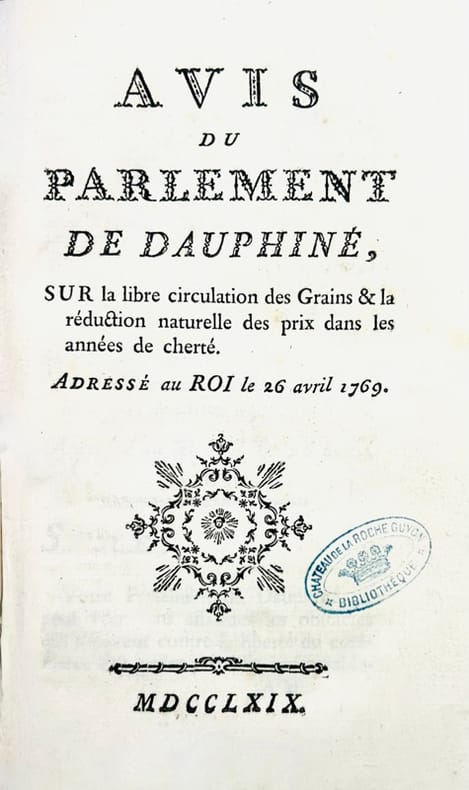
17247No place, 1769. With 1 folding table. 147, (1, Avis au relieur) pp. 8vo. Modern red half morocco, marbled boards, gilt lettering. Einaudi 2247; Higgs 4642; Leblanc, De Thomas More à Chaptal, contribution bibliographique à l'histoire économique, 290; not in Kress; not in Goldsmiths; not in INED. First edition.There are some copies of the first edition (and this is one of those copies), where the pages 122-124 contain a long note, not present in all copies of the first edition, which note refers to the session of the Parlement de Paris. In this note the author defends the Abbé Baudeau and his work Avis aux honnêtes gens qui veulent bien faire, a work which had become the subject of a request for its prohibition. Most copies of the first edition are without this printed note and in these copies the pagination jumps from page 123 to 126. Why this note was apparently withdrawn and no longer printed in later produced copies is unknown. During the discussion on free trade of grains several 'Parlements' gave their opinions. 'Celui de Dauphiné donnait solennellement, le 26 avril 1769, un Avis qui était une exposition magistrale de la doctrine physiocratique, d'une orthodoxie impeccable. 'Ouvrage excellent à tous égards, s'écrie Dupont en l'annonçant aux 'lecteurs patriotes' aux 'bons citoyens'; ouvrage que nos derniers neveux baigneront encore des larmes de leur reconnaissance, comme nous l'avons fait nous-même en le lisant.' ..... l'Avis fut rendu public. L'impression produite pouvait être si forte que le Parlement de Paris s'arrangea pour faire disparaître la brochure: 'Cet ouvrage est devenu bientôt excessivement rare, écrit Bachaumont, parce que le système qu'on propose à Sa Majesté est totalement opposé à ce que les Parlements de Paris et de Rouen ont écrit sur cette matière, et que cette première Compagnie n'a pas trouvé bon qu'on répandit sous ses yeux un écrit si contraire à sa façon de penser.' Le manifeste du Parlement de Dauphiné n'en émut pas moins l'opinion , et son succès rejaillit sur le parti tout entier' (Weulersse, i, p. 200). 'Le Parlement du Dauphiné se fait défenseur de l'Edit de 1764, donc de la liberté du commerce des grains et de la concurrence. Il s'élève contre les entraves et les limitations qui lui sont apportées' (Leblanc, op.cit.) - Extremely rare.
195855654Paris Les Sept 1958 In-folio, en feuilles, couverture imprime (embotage de l'diteur).12 lithographies originales en couleurs hors texte par Alfred Manessier. Tirage limit 157 exemplaires numrots sur vlin de Rives et signs par lartiste. Un des 81 exemplaires.
17803452Monclova 1780. Very good. Folio 305 x 213 mm two untrimmed sheets folded once to produce 8 pp. manuscript on 7 pages final page blank. Watermark: Picador type of Heawood 3471: caballero / bull countermark. Top right corners damp stained overall in excellent state. A RARE CONTEMPORARY MANUSCRIPT COPY OF AN ORDER OF TEODORO DE CROIX regulating the presidios regarding the rights of presidial representatives. The present MS clarifies Article 10 of Title 14. Here it is decreed that the presidial representatives are not permitted to purchase for the troops receive money for goods nor contract debts and in case of their bankruptcy of the funds under their control their property will be confiscated. Our manuscript is a copy certified in Monclova September 25 1780 with the written name of Juan de Uvalde not signed. For a COMPLETE TRANSLATION of the manuscript see below.<br/><br/>Teodoro de Croix 1730 Lille France - 1792 Madrid was Viceroy of New Spain. He was the first comandante general of the Internal Provinces serving as the virtual ruler of the northern frontier from his appointment in 1777 to his selection as viceroy of Peru in 1783 a position he held until 1790. <br/><br/>Early documents relating to Teodoro de Croix are now scarce on the market. THIS MANUSCRIPT was the last one of its kind to appear at auction in 2001: Dorothy Sloan Auction 11 lot 99 purchased by her from the consignor after the sale; purchased by us from Dorothy Sloan Rare Books in 2020. In 1968 a much later 3-page document appeared at Parke Bernet undated but after 12 Jan. 1790. These are the only two Teodoro de Croix related manuscripts to have been offered at auction in FIFTY-THREE YEARS.<br/><br/>Our manuscript is written on a type of Spanish paper that Headwood dates to "1766-1776." The text offers valuable primary documentation on presidial-military matters relating to the Arizona-Sonora border in the colonial era. <br/><br/>The significance of the text is such that two other manuscript copies survive both at the Bexar Archive Briscoe Center UT Austin: MS e_bx_003394 D.S. 1-3v pp. in E. 6/23/1780-11/23/1780; and a 1797 copy made in Chihuahua: MS e_bx_003393 D.S. 1-3v p. in E. 6/23/1780-3/10/1797.<br/><br/>TRANSLATION:<br/><br/>DON TEODORO DE CROIX Cavallero de Croix of the Teutonic Field Marshal Order Field Marshal of the Royal Armies First Lieutenant of the Flemish Company of the Royal Guard Corps Governor and Commandant General of the Interior Provinces of New Spain Superintendent of the Royal Treasury &c. <br/><br/>The repeated appeals and "expedientes" presented and initiated at this commandery general concerning the astonishingly frequent bankruptcies of paymasters of presidial and "volante" companies have exposed the mistaken belief and erroneous interpretation generally accorded the articles of Title 14 of the regulations for presidios. The validity of the votes called for in Article 10 of the same title for the election and appointment of the paymaster imposes on the electors and the company the unlimited and absolute responsibility for whatever results debts and charges he contracts during his term. Consequently all the individuals of the company must satisfy such obligations in proportion to their respective salaries and allotments. Accepting this mistaken interpretation of the regulations they have continued practicing this belief since it was commanded that the regulations be observed. Whatever was contrary to this misinterpretation was considered a punishable infraction opposed to the rights of the people the good faith of contracts and commerce and the honor and reputation of the officers and troops who on this wrong principle have unjustly suffered the burden of paying debts for which they are not under any circumstances obligated and that of often losing the value of their income and preferential credit. And finally this has been seen many times as the cause whereby some companies have been unable for a time to perform their functions so that this notorious harm has been passed on to the provinces in general which thus have been lacking in the tranquility safety and defense which they could have been and should have been afforded for the ends for which the King maintains and pays the troops of the frontier in particular. In order to avoid future risks of such a grave nature which if not remedied would alone cause the desolation of the province I have resolved in conformity with the well-founded and wide-ranging opinion of the auditor of the commandery don Pedro Galindo Navarro on the matter in question that the following shall be observed and understood as having the sovereign approval of the King with the force and rigor of ordinances: <br/><br/>DECLARATIONS: <br/><br/>¶ 1st: Paymasters named by companies with the formalities prescribed in the afore-cited article 10 title 14 of the regulations of presidios do not have the power or authority of the companies to purchase on credit to receive borrowed money or to contract any debt or obligation in the companies' name. In addition to this companies are not obligated to satisfy any such debts or obligations if their paymasters do contract them. Rather creditors must claim them against the paymasters themselves or against such properties as they may possess. <br/><br/>¶ 2nd: In the event of the bankruptcy of paymasters who have not delivered or apportioned to their companies the entirety or any part of the funds or supplies to have been received in the companies' name at the royal pay offices the said companies are legitimately entitled to collect what is lacking from whatever properties belong to the bankrupt paymasters. The companies are to have priority and preference over every other personal creditor which the paymasters may have whether prior or posterior in time. This is to be the status of such debts because of the nature of the credit--being directed towards the service of the King and the common defense and benefit of the provinces--and also because paymasters must not use this capital which has been entrusted to them to pay their particular debts since the interests placed in their care and the goods which would have been acquired therewith are not properly those of either the paymasters or the companies. <br/><br/>¶ 3rd: Therefore immediately upon discovery of the bank- ruptcy of any paymaster by the adjutant inspector or those commissioned temporarily to exercise the functions of this office or by the captain or commander of the company the arrest of the paymaster and the confiscation of all his belongings shall be effected. They shall be appraised by qualified persons and sold at public auction. With the proceeds therefrom the balance resulting in favor of the company shall be covered before all else. The remainder if any shall be deposited in the chest having three locks where the "gratificazion" fund is kept so that when other creditors appear and are heard it may be delivered and paid to them according to the graduated order of priority. <br/><br/>¶ 4th: Upon completion of these first proceedings which shall be judicial and to which all formality sh:all be extended by the officer whom it behooves to practise them procedures shall be taken without the slightest delay to determine the cause from which the bankruptcy emanates. Witnesses who may be able to give an account of it shall be examined and a declaration and confession from the suspect shall immediately be taken. Afterwards his objections and defense shall be heard so that the autos may be justified in the terms and processes prescribed and approved by the royal order of May 15 1779 and circulated among the presidios and companies. Then the penalty appropriate to the which is found to have been committed may be imposed. <br/><br/>¶ And whereas such resolutions as I have made as a consequence of the last inspection reviews and those I have made later to clarify them with the opinion of the assessor and auditor of war directing them now to the adjutant inspectors. may contribute to the prompt and scrupulous observance of the preceding four declarations I order that the latter be published by bando in all the cities villas towns and presidios of the provinces under my command that they may come to the attention of all and that none may plead ignorance. Given at Arispe on the twenty third of June seventeen hundred eighty. <br/><br/>¶ El Cavallero Teodoro de Croix. Antonio Bonilla Santiago 25 September 1780. Juan de Uvalde. unknown books
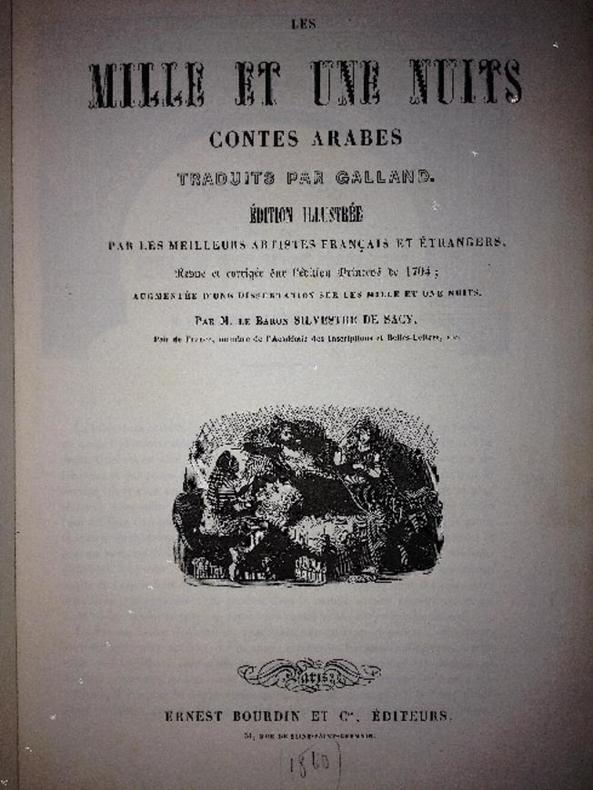
184012241840 Contes arabes traduits par Galland. Edition illustrée par les meilleurs artistes français. revue et corrigée sur l'édition princeps de 1704 , augmentée d'une dissertation sur les mille et une nuits , par le baron S. de Sacy. Paris Ernest Bourdin et Cie. 51, rue de Seine Saint Germain ( 1840 ) et ( 1843 ) pour les Mille et un jours , Contes Persans, Turcs et Chinois, par Petit de la Croix, Cardonne, Caylus, etc, augmentés de Nouveaux Contes traduits de l' arabe par M. Sainte-Croix Ajpot. Edition illustrée. à Paris chez Pourrat (Ed. 1843 ) . 4 volumes grand in 8. 1/2 veau glacé noir à petits coins . reliure homogène ; reliure époque. dos lisses très ornés de longs filets et fleurons dorés . titres dorés. date en queues des dos. couvertures et dos conservés. non rognés. ex libris G. Beugesco. typographie Lacrampe et Plon. reliures signées S. Magnin. abondamment illustrés in et hors textes.reliures et intérieur très frais. imprimés sur papier de choix. complet des 3 volumes et augmenté du volume des Contes des Mille et un Jours.Les Mille et un Jours . Contes Persans , turcs et chinois . ed. illustrée . Paris . Pourrat frères ed. couv. et dos . imp. Giroux. des feuillets habilement restaurés à l'époque .ref. carteret page 256. ref. Vicaire pages 862-863.TRES JOLIS EXEMPLAIRES exempt de rousseurs. Edition en premier tirage avec toutes les couvertures conservées, grands de marges, ébarbés et imprimés sur papier de choix.Tôme 1: couv. cons.+fx titre+frontispice rehaussé or+fx titre+ titre avec vignette de titre +viii et 482pp+ 4ème couv.et dos cons. 6 ht. et de très nombreuses ill. in texte.Tôme 2: couv.coul.cons.+fx titre+front. rehaussé or+fx titre avec vignette de titre+ titre avec vignette de titre + 572pp+4ème couv.coul. cons et dos. 7 h.t. et de très nombreuses il. in texte.Tôme 3: couv.coul. cons+fx titre+front. en noir+fx titre avec vignette de titre+ titre avec vignette de titre + 482pp+4ème couv.coul. cons et dos. 4 h.t. et de très nombreuses ill. in texte.Tôme 4: couv.coul cons+fx titre+ titre avec vignette de titre+436pp+4ème couv.coul. cons et dos. illustré de très nombreuses vignettes in texte.Nota: les trois premiers volumes, " les Mille et une nuits " Ernest Bourdin ; 51, rue de Seine Saint Germain , sans date ( date en queue des dos 1840 ), le quatrième volume " les mille et un jours " chez Pourrat , sans date; ( date en queue du dos 1843 )dates notées ultérieurement au crayon en bas des pages de titre, soit 1840, pour les 3 premiers volumes.
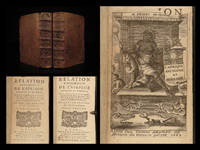
168820169<p><b>1688 AFRICA 1ed History EGYPT Mummies Pyramids Illustrated Tunisia MAPS LaCroix</b></p><p>Pherotee La Croix's "<i>Universal Relation of Africa</i>" is a famous 17th-century history of Africa. La Croix was a professor of geography in Lyon whose work on Africa became a lasting authority of African geography and history. However much of La Croix's "Afrique" was heavily inspired by Dutch author Olfert Dapper's "<i>Description of Africa</i>".</p><p>Even still La Croix's work is notable for the exquisite full-page and folding engravings as well as descriptions of some of the greatest mysteries of Africa including a section on <b><u>Egyptian pyramids the Sphinx and mummies</u></b>! Other topics include voyages to the Barbary coast Tunisia Algiers and Morocco.</p><p>Item number: #20169</p><p>Price: $1950</p><p>LA CROIX Pherotee de</p><p><b><i>Relation universelle de l'Afrique ancienne et modern</i></b></p><p>A Lyon chez Thomas Amaulry 1688. First edition.</p><p><br /></p><p><u>Details</u>:</p><p>· Collation: Complete with all pages; </p><p>o Vol. I – 18 12 536 16</p><p>o Vol. II – 2 576 20</p><p>o <b>43 illustrations in two tomes</b></p><p>· Language: French</p><p>· Binding: Leather; tight and secure</p><p>· Size: ~6.5in X 3.75in 16.5cm x 10cm</p><p>· Exceedingly rare and desirable </p><p>Our Guarantee:</p><p>Very Fast. Very Safe. Free Shipping Worldwide.</p><p>Customer satisfaction is our priority! Notify us with 7 days of receiving and we will offer a full refund without reservation!</p><p>20169</p><p>Photos available upon request. </p> Thomas Amaulry hardcover
18196No place, 1769. With 1 folding table. 145 (misnumbered 147, pagination jumps from 123 to 126, text complete; 2, (Avis au relieur, blank) pp. 8vo. Contemporary blind paper covers with paper label on spine, very nice copy, entirely unpressed, with very wide margins and uncut. Einaudi 2247; Higgs 4642; Mattioli 334; Leblanc, De Thomas More à Chaptal, contribution bibliographique à l'histoire économique, 290; not in Kress; not in Goldsmiths; not in INED. First edition.There are a few copies which contain a long note on the pages 122-124, which note refers to the session of the Parlement de Paris. In this note, not printed in this copy, which is why the pagination jumps, the author defends the Abbé Baudeau and his work Avis aux honnêtes gens qui veulent bien faire, a work which had become the subject of a request for its prohibition. Copies with this note have consecutive pagination: why this note was apparently withdrawn and no longer printed in later produced copies is unknown, but it does explain the jump in pagination. During the discussion on free trade of grains several 'Parlements' gave their opinions. 'Celui de Dauphiné donnait solennellement, le 26 avril 1769, un Avis qui était une exposition magistrale de la doctrine physiocratique, d'une orthodoxie impeccable. "Ouvrage excellent à tous égards, s'écrie Dupont en l'annonçant aux 'lecteurs patriotes' aux 'bons citoyens'; ouvrage que nos derniers neveux baigneront encore des larmes de leur reconnaissance, comme nous l'avons fait nous-même en le lisant."....... l'Avis fut rendu public. L'impression produite pouvait être si forte que le Parlement de Paris s'arrangea pour faire disparaître la brochure: "Cet ouvrage est devenu bientôt excessivement rare, écrit Bachaumont, parce que le système qu'on propose à Sa Majesté est totalement opposé à ce que les Parlements de Paris et de Rouen ont écrit sur cette matière, et que cette première Compagnie n'a pas trouvé bon qu'on répandit sous ses yeux un écrit si contraire à sa façon de penser.'' Le manifeste du Parlement de Dauphiné n'en émut pas moins l'opinion , et son succès rejaillit sur le parti tout entier' (Weulersse, i, p. 200). In short, the opinion expressed in this text (in favour of free trade, competition, etc.) was quite the opposite of the opinion held by the magistrates, and hence they decided it was not a good idea to have a text circulate that was so opposed to their way of thinking. 'Le Parlement du Dauphiné se fait défenseur de l'Edit de 1764, donc de la liberté du commerce des grains et de la concurrence. Il s'élève contre les entraves et les limitations qui lui sont apportées' (Leblanc, op.cit.) - Extremely rare.
17692899[], , 1769. In-8 de 147-(1) pp., demi-veau havane marbré, dos lisse orné, pièce de titre en maroquin rouge, tranches jaspées (reliure de l'époque).
1769002098Paris Cellot 1769
1652YRG-383In-4, plein cuir raciné, dos à cinq nerfs, caissons ornés de fleurons, pièce de titre, Frontispice gravé SN, ainsi qu'une autre gravure 324 pages. Dos restauré, joliment, manque de dorure au pieds du dos, petit manque de papier en bas de page du frontispice, intérieur frais . Chez Pierre Chevalier.
1791262494Paris: Chez Buisson 1791. hardcover. good. 3 volumes. 8vo 1/2 contemporary calf with gilt decorated spines edges of contemporary board corners worn and bumped on all volumes spines lightly rubbed scattered light foxing mostly to margins in all volumes upper right corner lacking on last blank page of volume III pages in volume I slightly wavy throughout some pages lightly creased in upper right corner margins of volume II. Paris: Chez Buisson 1791. Second Edition<br/> <br/> Study of constitutions and their development. Pages 321-406 in volume II are a study of the United States Constitution. Pages 341-426 in volume III are a study of the French constitution. This work also includes the study of the constitutions of Germany Poland Sweden Venice the Netherlands Great Britain Naples Spain and Switzerland.<br/> <br/> Chez Buisson unknown
1791262494Paris: Chez Buisson 1791. hardcover. good. 3 volumes. 8vo 1/2 contemporary calf with gilt decorated spines edges of contemporary board corners worn and bumped on all volumes spines lightly rubbed scattered light foxing mostly to margins in all volumes upper right corner lacking on last blank page of volume III pages in volume I slightly wavy throughout some pages lightly creased in upper right corner margins of volume II. Paris: Chez Buisson 1791. Second Edition<br/><br/> Study of constitutions and their development. Pages 321-406 in volume II are a study of the United States Constitution. Pages 341-426 in volume III are a study of the French constitution. This work also includes the study of the constitutions of Germany Poland Sweden Venice the Netherlands Great Britain Naples Spain and Switzerland.<br/><br/> Chez Buisson unknown books