483 résultats
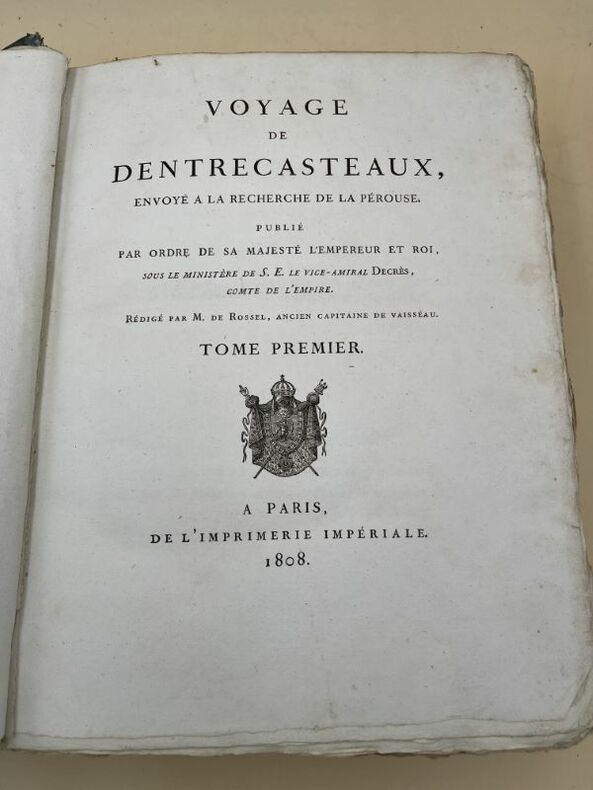
1808164452Imprimerie Impériale A Paris, de l'Imprimerie Impériale, 1808. Tome I seul, Un volume très fort In-folio, relié cartonnage d'attente de l'époque, LVI + 704 pages et 32 planches dépliantes. Le corps de l'ouvrage est en très bon état, les pages, à grandes marges ne sont ni tachées ni affectéees de rousseurs, imprimées sur beau papier. Les planches dépliantes sont également en bon état, présentant juste quelques petites pointes de rousseurs dans les marges sans gravité. La reliure (cartonnage d'attente) est en mauvais état. Rappelons que d'Entrecateaux avait été envoyé, en 1781) par Louis XVI à la recherche de La Pérouse
1775(LCPCRELI-0006)("Les Princes agissent comme Ministres de Dieu, & ses Lieutenans sur la Terre; c'est par eux qu'il exerce son Empire... Il paraît de tout cela, que la Personne des Rois est sacrée, & qu'attenter sur eux, c'est un sacrilège...") PETITY Jean-Raymond DE (abbé). (Saint-Paul-Trois-Châteaux, 1724 - Paris, 1780) "SAGESSE DE LOUIS XVI, MANIFESTEE DE JOUR EN JOUR, ENSEIGNEE A SES PEUPLES, FONDEE SUR LES PREMIERS PRINCIPES DE TOUTE VERITE". 1775, Paris, Gueffier. 2 volumes in-8° (198x130 mm) (dimensions pages 193x121 mm) I: LXXX (faux-titre, titre, explication de l'allégorie, préface, explication), 502 pp.; II: (2) ff. (faux-titre et titre), XCVI, 461, (1) pp. 1 frontispice gravé d'après un dessin de l'auteur et 4 figures allégoriques (Sagesse, Sagesse Humaine, Sagesse Mondaine et Fausse Sagesse) par Gravelot. (a-e8, A-Y8, Z4, Aa-Ii8; a-f8, A-Z8, Aa-Ee8, Ff6) Séduisantes reliures en maroquin rouge mosaïqué et décoré de l'époque. Encadrements avec triple roulette dorée sur les plats et fleurons dorés; petites pièces de maroquin vert aux angles internes des encadrements. Dos lisses divisés en compartiments avec fleurons dorés et faux nerfs en maroquin vert avec décorations dorées; pièces de titre et de tomaison en maroquin vert et citron. Filet doré sur les coupes. Tranches dorées. Gardes de papier décoré. Edition Originale, rare, de ce texte philosophique et moral sur la Sagesse et qui célèbre aussi l'avènement du jeune Louis XVI (1754-1793). Superbe exemplaire en maroquin mosaîqué du temps. Monté au trône en 1774, à dix-neuf ans, et sacré dans la Cathédrale de Reims le 11 juin 1775, presque cinquante-trois ans après le Sacre de son grand-père Louis XV, le nouveau Roi représente toute l'attente et l'espoir de renouvellement et de changement, après un règne marqué par de nombreux scandales. L'auteur, prédicateur de la pieuse Reine Marie Leczinska, a inventé le frontispice, dessiné par Moitte fils et gravé par Moitte père, dans lequel le Roi est représenté de profil sous l'Oeil de Dieu, accompagné par la Sagesse. Provenance: Etiquette de papier avec ex libris manuscrit du temps gratté (Mlle ...?) au verso des premiers plats. (Cohen, 793; Cioranescu, 49699) (LCPCRELI-0006) (2.300,00 €)
A Paris, de l'Imprimerie Impériale, 1808. Tome I seul, Un volume très fort In-folio, relié cartonnage d'attente de l'époque, LVI + 704 pages et 32 planches dépliantes. Le corps de l'ouvrage est en très bon état, les pages, à grandes marges ne sont ni tachées ni affectéees de rousseurs, imprimées sur beau papier. Les planches dépliantes sont également en bon état, présentant juste quelques petites pointes de rousseurs dans les marges sans gravité. La reliure (cartonnage d'attente) est en mauvais état. Rappelons que d'Entrecateaux avait été envoyé, en 1781) par Louis XVI à la recherche de La Pérouse
Recueil de 14 pièces reliées en un volume in-8 (193 x 123 mm), cartonnage de papier marbré de réemploi à la Bradel (reliure signée Goy et Vilaine). La source principale pour l'histoire de la "fuite de Varennes", les 20 et 21 juin 1791. Cet exemplaire contient le recueil complet des procès-verbaux et annexes publiés par l'Assemblée nationale durant l'épisode même. Ils rendent compte en détail des événements et des réactions des autorités politiques, militaires et administratives, jour par jour, sinon heure par heure. Louis XVI, Marie Antoine et la famille royale quittèrent clandestinement les Tuileries dans la nuit du 20 juin 1791 pour tenter de rejoindre la place forte royaliste de Montmédy, à partir de laquelle le roi espérait lancer une contre-révolution. Mais l'opération tourna court et la berline royale fut interceptée en chemin, dès le lendemain, à Varennes-en-Argonne, L'épisode marque un tournant décisif dans le cours de la Révolution française, en précipitant l’abolition de la monarchie et l'établissement d'un régime républicain en France. Éminemment romanesque, il a inspiré nombre de romans et de films. Quelques auréoles, quelques rousseurs et petites taches éparses, 4 feuillets brunis. Très bon exemplaire, très bien relié.
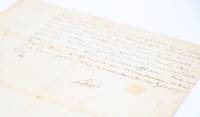
177690973Versailles 1776. Fine. From the Private Correspondence of Louis XVI Versailles 31 janvier 1776 18.3 x 24.4 cm Bifeuillet Letter written by a secretary and signed by Louis XVI addressed to Cardinal Ludovico Calini in ink over eleven lines. The signature of Charles Gravier Comte de Vergennes appearing at the foot of the bifolium accompanies that of the King for these New Year wishes. The recipient's name is inscribed on the verso: ""Mon Cousin le Cardinal Calino"". A few waterstains a small hole at ""qu'il vous ait"". ""My Cousin I have seen with pleasure from your letter of October 1st the token of the sincerity of the wishes you express for me at the beginning of this year. Your good intentions are as well known to me as you must be certain of my desire to give you proof of my esteem and affection. Whereupon I pray God that He may have you My Cousin in His holy and worthy keeping. Written at Versailles the 31st of January 1776."" our own translation. Louis XVI was twenty-two years old when he wrote this letter having reigned for barely two years. The recipient Cardinal Ludovico Calini had been appointed Camerlengo of the Sacred College in 1774 at the King's accession and was by then holding one of his last ecclesiastical offices. An intimate exchange between Louis XVI and Cardinal Ludovico Calini in which the King returns ""the sincerity of the wishes"" extended to him for the New Year of 1776. unknown
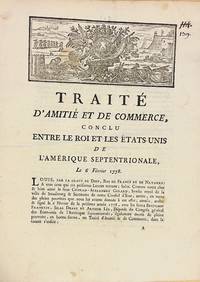
17783485A Lyon: De l'Imprimerie du Roi 1778. Scarce Lyon edition. With a woodcut vignette of the royal French arms on the title-page set against an allegorical background. Sewn. Contemporary inked numbers on the title-page. Trace of folding. Light creasing and tanning throughout; closed tears along the spine. Occasional spotting with light brown stains on the final leaf. Overall in very good condition. Scarce Lyon edition. With a woodcut vignette of the royal French arms on the title-page set against an allegorical background. Sewn. 12 p. <p><br /> The first treaty ever signed by the United States - France's formal recognition of American independence.<br /> <p><p><br /> Rare Lyon edition of the Treaty of Amity and Commerce concluded on 6 February 1778 between the Kingdom of France and the United States of America - the first official treaty entered into by the U.S. as a sovereign nation. Signed by American commissioners Benjamin Franklin Arthur Lee and Silas Deane the treaty recognized the United States as an independent entity in the eyes of a major European power a pivotal development in securing legitimacy abroad during the Revolutionary War.<br /> <p><p><br /> The treaty established mutual most-favored-nation trade relations protection for commercial shipping and reciprocal restrictions on fishing - notably the United States' agreement not to fish on the Newfoundland banks. It was signed concurrently with a secret treaty of military alliance though only the commercial treaty was published immediately in France. This Lyon imprint issued by the royal press and featuring the French arms on the title-page reflects the official dissemination of the agreement beyond Paris.<br /> <p><p><br /> The treaty was ratified by the Continental Congress in May 1778. France's entry into the war shortly thereafter shifted the balance of power and marked a turning point in the revolution. This was the first formal diplomatic agreement signed by the United States laying the groundwork for future international recognition and foreign policy.<br /> <p><p><br /> While Howes notes two Paris editions of 1778 - one of 23 and another of 8 pages both listed in the NUC - regional printings are known from Aix and possibly Grenoble recorded in only three copies. This Lyon printing is listed by Echeverria & Wilkie 778/35A who located only a single example in a private collection at the time of their bibliography. Rare in institutional holdings and seldom seen on the market.<br /> <p><p><br /> A very rare edition of a foundational treaty that marked the beginning of U.S. international diplomacy and a relationship vital to the success of the American Revolution.<br /> <p><p><br /> References:<br /> <p><p><br /> Sabin 96565; Howes T328; Echeverria & Wilkie 778/36; Malloy 468; Revolutionary Hundred 51; Streeter Sale 2:791.<br /> <p>. De l'Imprimerie du Roi unknown
17782478631778. Manuscript book. Pages ruled in green and brown borders. 5 101 3 ff. 1 vols. 8vo. Contemporary dark brown morocco gilt arms of Louis XVI on upper and lower covers within gilt ruled borders with fleurs-de-lys at corners spine gilt with fleurs-de-lys morocco label a.e.g. Short start in foot of upper joint else fine. Bookplates of Mortimer L. Schiff Henry du Rosnel and three others. Manuscript book. Pages ruled in green and brown borders. 5 101 3 ff. 1 vols. 8vo. In a law dated 18 March 1776 Louis XVI attempted to rationalize the organization of provincial governments and the present manuscript is the resulting report on the actual ranks and classes of the various provincial government officials. The principal governors are listed by name with emoluments and the ranks and numbers of subordinate officials are also noted. The principality of Monaco a French protectorate gives genealogical information in addition to the names and fiscal details. The government of Corsica is described as the last of the second class provinces ff. 99-101. The manuscript includes a table of contents for the provinces and concludes with six pages of financial summaries.<br /> This volume is of particular interest as it documents the French military and civil hierarchy on the eve of French involvement in the American Revolution. Notable figures with connections to the French participation include the Maréchal le Duc de Broglie governor of Metz who refused Lafayette's request to join. The Duc de Broglie was also patron of the Baron de Kalb. The Duc de Noailles governor of the royal house at Saint-Germain-en-Laye was the grandfather of Lafayette's wife. The comte de Rochambeau not named here was appointed in 1776 as governor of Villefranche; his rank is given as Major-Commandant 2600 livres.<br /> Rare and beautiful and dense with information on French administrative practice under the ancien régime. unknown
17782478631778. Manuscript book. Pages ruled in green and brown borders. 5 101 3 ff. 1 vols. 8vo. Contemporary dark brown morocco gilt arms of Louis XVI on upper and lower covers within gilt ruled borders with fleurs-de-lys at corners spine gilt with fleurs-de-lys morocco label a.e.g. Short start in foot of upper joint else fine. Bookplates of Mortimer L. Schiff Henry du Rosnel and three others. Manuscript book. Pages ruled in green and brown borders. 5 101 3 ff. 1 vols. 8vo. State of the French Government: Louis XVI attempts Reform 1776-8. In a law dated 18 March 1776 Louis XVI attempted to rationalize the organization of provincial governments and the present manuscript is the resulting report on the actual ranks and classes of the various provincial government officials. The principal governors are listed by name with emoluments and the ranks and numbers of subordinate officials are also noted. The principality of Monaco a French protectorate gives genealogical information in addition to the names and fiscal details. The government of Corsica is described as the last of the second class provinces ff. 99-101. The manuscript includes a table of contents for the provinces and concludes with six pages of financial summaries.<br/>This volume is of particular interest as it documents the French military and civil hierarchy on the eve of French involvement in the American Revolution. Notable figures with connections to the French participation include the Maréchal le Duc de Broglie governor of Metz who refused Lafayette's request to join. The Duc de Broglie was also patron of the Baron de Kalb. The Duc de Noailles governor of the royal house at Saint-Germain-en-Laye was the grandfather of Lafayette's wife. The comte de Rochambeau not named here was appointed in 1776 as governor of Villefranche; his rank is given as Major-Commandant 2600 livres.<br/>Rare and beautiful and dense with information on French administrative practice under the ancien régime. unknown books
_2.jpg)