533 résultats
187525499Philadelphia: Claxton Remsen & Haffelfinger for the Library Committee of the Grand Lodge of Pennsylvania 1875. First Edition. Cloth. Near Fine. First Edition. xv 17-236 pages. Plus thirteen plates with albumen photographs by Frederick Gutekunst. 8vo. Publisher's vibrant blue cloth with highly decorated gilt spine. #991/1000 copies. A bright clean copy noting old tape repair to rear of title page. Includes errata slip soiled. Cloth. Gutekunst was a significant photographer in the Philadelphia area garnering medals at national and international exhibitions and photographic major figures who passed through the area. Claxton, Remsen & Haffelfinger for the Library Committee of the Grand Lodge of Pennsylvania unknown
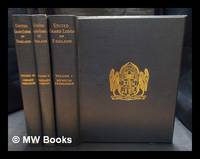
1938403624London : United Grand Lodge of England 1938. 1st edition. Hardcover. Near fine copies in the original gilt-blocked cloth. Spine bands and panel edges very slightly dust-toned as with age. Remains particularly well-preserved overall; tight bright clean and strong. Physical description; ix 341p : ill some col. plates ; 30cm. Notes; Spine title: United Grand Lodge of England. Volume 1. Museum Catalogue. Titlepage in red and black. Colour plates are tipped in. Subjects; Freemasons. United Grand Lodge of England. United Grand Lodge of England. Art collections. Catalogues. Freemasons. Museums. Philanthropy. London : United Grand Lodge of England hardcover
185827473Richmond: Chas. H. Wynne Printer to the Grand Lodge 1858. 43 1 blank pp. bound with PROCEEDINGS OF A GRAND ANNUAL COMMUNICATION OF THE GRAND LODGE OF VIRGINIA.13TH DAY OF DECEMBER A.L. 5858 A.D. 1858. Richmond: Wynne. 1859. 166pp. bound with PROCEEDINGS OF AN OCCASIONAL GRAND LODGE OF ANCIENT FREE AND ACCEPTED MASONS OF THE STATE OF VIRGINIA AT WILLIAMSBURG ON TUESDAY THE 11TH DAY OF OCTOBER A.L. 5859 A.D. 1859. Richmond: Wynne. 1860. 42 2 blanks pp. bound with PROCEEDINGS OF A GRAND ANNUAL COMMUNICATION OF THE GRAND LODGE OF VIRGINIA.12TH DAY OF DECEMBER A.L. 5859 A.D. 1859. Richmond: Wynne. 1859. 164pp. bound with PROCEEDINGS OF A GRAND ANNUAL COMMUNICATION OF THE GRAND LODGE OF VIRGINIA.10TH DAY OF DECEMBER A.L. 5860 A.D. 1860. Richmond: Wynne. 1860. 152pp. All five imprints bound together in later half morocco and black cloth hinges starting with gilt-lettered spine title numerical label on spine. Old rubberstamp on front pastedown. Occasional light dust or minor wear. All Very Good but for the absence of wrappers.<br /> <br /> The first of these five pamphlets records the proceedings commemorating George Washington's birthday and the construction of the Virginia Washington Monument. Governor Wise speaks on the occasion. The imprints supply a complete picture of contemporary Freemasonry in Virginia with reports remarks regulations membership lists and philosophy. <br /> Haynes 6497. Chas. H. Wynne, Printer to the Grand Lodge unknown
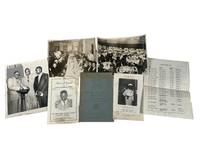
1969214941969. Prince Hall Freemasonry materials 1940s to 1990s document the institutional life leadership structures and community functions of one of the most significant African American fraternal organizations in the United States and provide direct evidence of how lodges operated as centers of social civic and religious life across multiple decades. Founded in 1784 in response to racial exclusion from mainstream Masonic bodies Prince Hall lodges sustained networks of mutual aid education and leadership within Black communities. This archive records both formal lodge activity and personal commemorative practices supporting research into African American history fraternal organizations and the continuity of Black institutional life from the mid twentieth century through the post civil rights era.<br /> <br /> Seven items including three silver gelatin press photographs one yearbook two funeral programs and one membership roster originating from Pennsylvania Louisiana and Illinois. The photographs measuring approximately 8.5 x 11 inches and dating from the 1940s to 1960s depict lodge events and gatherings including a 1946 banquet of Golden Shield Lodge No. 69 in Pittsburgh with members and guests seated beneath a lodge banner and a 1969 image from the annual workshop of the Most Worshipful Prince Hall Grand Lodge of Louisiana in New Orleans identifying members W. S. Finister Jr. Rufus Mayfield and Richard Turnley. The Golden Star Lodge No. 143 Yearbook. Pittsburgh 1969 includes membership rosters meeting schedules and lodge principles with cover imagery of the Masonic square and compass and printed meeting location at 143 Orr Street. Two funeral programs dated 1993 document services for Sister Mattie White at Central Baptist Church in Pittsburgh and John Columbus Coger at New Hope Temple Baptist Church in Philadelphia reflecting ceremonial practices and affiliations including possible connections to auxiliary organizations such as the Order of the Eastern Star. An additional birthday roster lists members' names and contact information indicating active social networks within the lodge.<br /> <br /> Produced across a period encompassing the Civil Rights Movement and its aftermath these materials demonstrate the sustained role of Prince Hall Freemasonry as a stabilizing institution within African American communities providing spaces for leadership development social organization and collective memory. The combination of formal lodge documentation photographic evidence of gatherings and funerary materials illustrates how fraternal structures extended into religious and familial life reinforcing continuity across generations. As a grouped archive these items preserve the operational ceremonial and personal dimensions of Black fraternal culture offering a layered record of community organization and identity. Minor edge wear and light handling marks with occasional annotations to photographs; overall condition very good. unknown
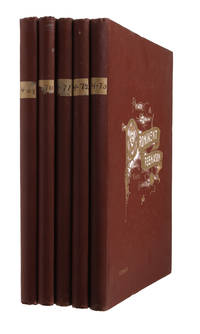
189263140New York Boston and Philadelphia John C. Yorston & Co. Masonic Publishers 1892. 4to 350 x 280 mm. Five volumes uniformly bound in publisher original full cloth with gilt lettering and ornamentation to front boards. Small paper-labels pasted on to spines. Light wear to extremities and a few scratches to edges of boards. A few plates with marginal brownspotting otherwise fine and clean. With numerous fine steel engraving. <br/><br/><em>Large Paper Edition of this grand and finely produced biographical compendium of American Freemasonry profusely illustrated with engraved portraits of prominent members across the United States. </em> hardcover
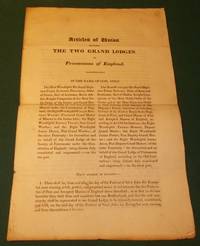
1813015433London: Bro. T. Harper Jun Printer 1813. Rare. 7pp. No printed date circa 1813/1824. Disbound. Pages clean. . Near Very Good. Quarto. Bro. T. Harper, Jun, Printer unknown
18886046Moscow Tx 1888. Good plus. 23331pp. Folio. Contemporary vellum boards. Front board coming detached from foot; loss from foot of spine; moderate wear to corners and edges. Final leaf detached otherwise minimal internal wear. A detailed and long-running record of minutes for the Henderson Yoakum chapter of Freemasons which covers well over thirty years of the group's history. This chapter was located in the small east Texas town of Moscow south of Lufkin whose population was 228 in 1880 according to the census. These entries document the formation of the chapter record votes on members with a count of white and black balls cast bylaws design of a chapter seal announcements of deaths of members foundation of a Masonic school in town and much other chapter business. The book also includes proceedings of trials against members including one on May 27 1860 at which "It was decided that accused was guilty of gross unmasonic conduct by 6 black ball to three white." The entries are interrupted after the meeting on October 20 1860 at which a committee was appointed "To report on the propriety of withdrawing or seceding from the Grand Chapter of the United States." On August 19 1865 after the close of the Civil War the entries resume. An alphabetical index of subjects occupies the initial leaves. The namesake of the masonic chapter Henderson King Yoakum was a soldier politician and author whose 1855 History of Texas was described by John Jenkins as "The first scholarly history of Texas written after annexation." He was a close friend of Sam Houston and a founding member of the chapter that adopted his named. Laid into this record book is a carbon copy of a letter to the son of Texas Governor William P. Hobby remarking that his grandfather Edwin Hobby was a member of the Henderson Yoakum chapter as well as three additional pieces of later Texas masonic ephemera. Also notable is the bookseller's label on the front pastedown denoting that the blank book used to record these minutes was obtained from Henry Hinck Bookseller & Stationer Galveston Tx. A fine document of masonic participation in rural Texas in the second half of the 19th century. unknown
179863098London Scatcherd & Whitaker; Parsons; Cawthorn 1793 - 1798. 8vo. Bound in 11 volumes. Volume 2 - 11 uniformly bound in contemporary half calfs. Volume 1 in half calf with later marbled paper covered boards. Bindings with wear and stains. Leather on spines cracked. Volume 1 with reinforced hinges a dampstain to first leaves. A few volumes with dampstain to first leaves but internally generally a nice and clean set. 616 4 pp. 2 frontispiece and 7 engraved plates; 4 480 pp. 7 plates Wolstieg only calling for 5; 4 450 4 pp. 7 engraved plates; 4 426 6 8 pp. 7 engraved plates Wolstieg only calling for 3; 2 436 pp. 6 engraved plates Wolstieg only calling for 2; 2 452 4 pp. 6 engraved plates Wolstieg only calling for 4; 6 438 4 pp. 8 engraved plates Wolstieg only calling for 6; 4 464 4 pp. 8 engraved plates Wolstieg only calling for 4; 6 506 pp. 9 engraved plates Wolstieg only calling for 4; 2 430 pp. 6 engraved plates Wolstieg only calling for 1; 2 IV 338 8 pp. 9 engraved plates Wolstieg only calling for 2. This set has a total of 79 engraved plates Wolfstieg only calls for 47 plates. <br/><br/><em>Rare complete run of the first English periodical dedicated to freemasonry “the archetype of later Masonic periodicals†Önnerfors The Freemasons’ Magazine 1793–1798 published at a crucial time in the history of European Freemasonry in the immediate aftermath of the French Revolution. It represents one of the first efforts by the fraternity to define consolidate and disseminate its intellectual and moral identity in public. Its contents - lodge proceedings philosophical essays antiquarian inquiries biographical notices poetry and finely executed symbolic engravings - reflect the full breadth of late Enlightenment Masonry. The importance of the work lies in its function as a precursor since it anticipates the Masonic journals in the 19th century and marks the transition of Freemasonry into a self-conscious print-based intellectual culture. â€The Freemasons’ Magazine represent a forceful statement of British Freemasonry concerning its vigour loyalty and societal engagement. During 1794 the journal for the first time served as a platform to refute anti-Masonic writings that circulated in the public. Important apologies such as Defence of masonry 1730 or Cousto’s spiced account of his treatment by the Portuguese inquisition were republished. Parts of Ramsay’s ‘Oration’ were republished not just once but twice. We can also witness how the Knights Templar called the ‘sublime degree of masonry’ entered the world of British Masonic imagination long after the continental development. Nevertheless at the very same time Freemasonry in Britain was also celebrating technological progress in industry agriculture and science which makes its relationship to modernity complex. The Freemasons’ Magazine managed to attract correspondents in different parts of the empire and even the USA. A particularly strong link throughout the first seven volumes was Edinburgh. In the last four volumes we find more material inserted from Ireland at exactly the time when political tensions there erupted into a full-scale rebellion. The political tense years of 1797 and 1798 offer an intriguing insight into the British psyche at the time. Under constant real and imagined threat of French invasion internally shaken by the Irish rebellion uprisings and repeated mutinies public opinion was fuelled with anti-Masonic ideas not at least by Robison’s book Proofs of a conspiracy. The Freemasons’ Magazine unfortunately did not survive 1798. Most importantly perhaps it can be regarded as the archetype of later Masonic periodicals developing into a archtype Masonic press by the middle of the nineteenth century with titles such as he Freemasons’ Quarterly Magazine and Review 1834–53 The Masonic observer 1856–9 he Freemason’s Magazine and Masonic mirror 1856–71 the Freemason 1869–1951 some of them surviving well into the twentieth century. Whereas Masonic periodicals during the first century of their existence tied into the ongoing debates and controversies surrounding Freemasonry in culture and society they developed more and more into purely internal membership magazines with little connection to the outside world.†Önnerfors The Freemasons’ Magazine 1793–1798. Wolfsteig 516 </em> hardcover