13 résultats
1781216887Jean-Marie Bruyset Pere & Fils Lyon 1781. Hardcover Leder Zustand: Exemplar einer Privatbibliothek mit Kennungen. Keine Eintragungen. Rücken Ecken Kanten stärker berieben. Jean-Marie Bruyset, Pere & Fils, Lyon, hardcover
1781216886Jean-Marie Bruyset Pere & Fils Lyon 1781. Hardcover Leder Zustand: Exemplar einer Privatbibliothek mit Kennungen. Keine Eintragungen. Rücken Ecken Kanten stärker berieben. Jean-Marie Bruyset, Pere & Fils, Lyon, hardcover
173213092Paris: Diocese De Paris. Good. 1732. Hardcover. Book #1. Clean full leather slightly age darkened. Spine with five raised bands and gilt decorated panels. Text tight clean & intact. Marbled endpapers. Page edges dyed red. Corners lightly rubbed. Front hinge starting at spine tail cover firmly attached. Prior owners inscription on front endpaper. Religion; 16mo 6" - 7" tall; 385 pages . Diocese De Paris hardcover
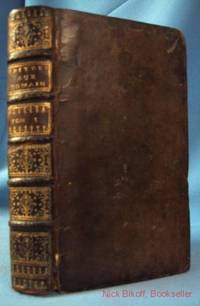
1755ANT105A. Angers Chez Pierre-Louis Dube Imprimeur de Monseigneur L'Eveque et De L'Universite a La Chaussee S. Pierre. A. Paris Chez H. L. Guerin et L. F. Delatour Rue S. Jacques A Saint Thomas D'Aquin 1755. Full leather. 12mo. Full leather with raised bands and gilt decorations along spine. Gilt is rubbed as are title plates. Boards are bowed and scuffed. Boards are edge worn. Corners are curling scuffed and chipped. Some leaves are curling at corners. Worn marbled end papers. Spine edges are gently worn and starting to chip. Spine/front board seam is starting to separate but hinges are strong and boards are firmly attached. Leather is cracking along spine and edges. Light foxing throughout. Some spotting on back board. Slight worming along gutter of BFEP leaves are unaffected 4 272; 2 viii 358 pages. A. Angers, Chez Pierre-Louis Dube, Imprimeur de Monseigneur L'Eveque et De L'Universite, a La Chaussee S. Pierre. A. Paris, Chez hardcover
1770LA - HAY082321770. Paris chez Humblot Libraire. relié demi-basane à coins. Un tampon et un numéro de bibliothèque en page de garde sinon très bon état d'ensemble reliure et intérieur. in-12. avec un bandeau et une lettrine ; dos lisse avec titre écrit à l'encre noire. unknown
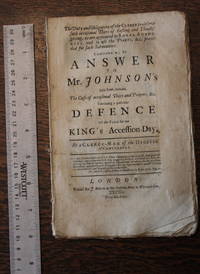
1722010524London: Printed for J. Roberts at the Oxford Arms in Warwick Lane 1722 Book. Good. Disbound. 42 pages. ESTC T75486. Disbound with no covers. Page edges are untrimmed and dusty. Staining to pages at start and finish. Printed for J. Roberts at the Oxford Arms in Warwick Lane unknown
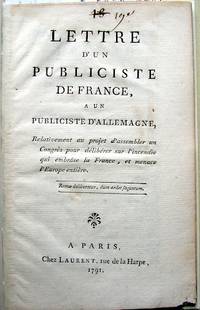
1791OB1042-10<p>A Paris Chez Madame Dufresne / Guerbart / Lacloye 1791. Soft Cover. 24 pages; 19.5 cm. Title continues: "de Messieurs du Directoire du Département des Vosges contre le clergé & le peuple fidèles à leur religion. Par un Curé Catholique Romain du Diocèse de Saint-Dié ." The only copies of this seem to be at BL and BN. One of a collection of 40 Royalist and counter-revolutionary tracts of the French Revolution. Stock#OB1042-10. Vg / in marbled paper wrapper.</p> Chez Madame Dufresne / Guerbart / Lacloye paperback
17711802280039London : Printed for J. Russell 1771. Hardcover. Acceptable. Octavo 19 cm. Contemporary calf. Marbled endpapers. viii 1 10-240 8 249-307 1 p. Front board detached rear joint split. Moderate rubbing loss to spine leather. Toning. <br> Lord Grosvenor was a British peer racehorse owner and art collector. In July of 1764 Lord Grosvenor married Henrietta Vernon daughter of Henry Vernon of Hilton Park Staffordshire. They had four sons. However the marriage was not happy and Henrietta had an affair with Henry Duke of Cumberland the younger brother of George III. The couple were discovered "in flagrante delicto" in 1769 which led to Grosvenor bringing legal action against the Duke for "criminal conversation" adultery. Grosvenor was awarded damages of £10000 which together with costs amounted to £13000. But Grosvenor was also known to be guilty of adultery himself so he could not sue for divorce. The couple separated and he settled an annual allowance of £1200 to his estranged wife. London : Printed for J. Russell hardcover
1778LD15793Metz: Joannes-Baptista Collignon 1778. Hardcover. Very Good. French 18th-century olive crushed morocco gilt tooled with scrolling acanthus leaves and fleurons spine gilt in six compartments enclosing fleurons two red morocco lettering labels BREVIARI METENSE PARS AUTUMNALIS marbled endpapers inner gilt dentelles all edges gilt; corners lightly bumped. Folio 255 x 195mm. Sold as a binding. <br/><br/> Joannes-Baptista Collignon hardcover
1715724874London: Printed for and Sold by H. Clements at the Half-Moon in St Paul's Churchyard 1715. Hardcover. Good/No D/J as Published. 8vo - over 7 - 9" tall. Full-leather. Bookplate to front paste down. Ffep and title page detached but present with damage to corner. Wear to binding with some staining to paste downs. An attractive and unusual title. Printed for and Sold by H. Clements at the Half-Moon in St Paul's Churchyard hardcover
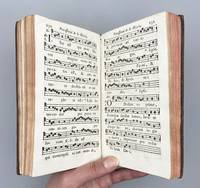
178211399Poitiers: J.-F. Faulcon & F. Barbier 1782. Contemporary mottled sheep slightly scuffed gilt spine and title red edges. <p>       The music chants and prayers for the annual processions celebrated by the canons of the 11th-century Church of St. Hilary in Poitiers. For extramural ceremonies the text specifies the routes and which other religious groups — Capuchins Augustinians Ursulines etc. — may participate. In good condition paper flaw slightly affecting text on one leaf bookplate of the Rouen Abp. É.-H. de Cambacérès 1756-1818.<br /> ¶See Collette’s “Le Processional de Saint-Hilaire le Grand de Poitiers aux XVIe et XVIIIe siècles édition et commentaire†in École pratique des hautes études. 4e section 1975 995-9.</p> J.-F. Faulcon & F. Barbier unknown
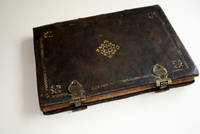
17902777Madrid 1790. Peter Marin. Small 4to. 224 pp. Bound in contemporary horsehide -- on covers a flower tool has been impressed in gold to form a cross in the outer edges a rope-work roll at the corners the same flower tool four raised bands on spine in the compartments impressions in gold of the same flower tool; two pair of original catches and clasps affixed by nails one indistinguishable replacement all edges gilt around edges of the textblock are 11 impressions of a 6-pointed star. Minor wear to binding text clean and crisp. Preserved in a cloth box. FEASTS AND FESTIVALS in Toledo. It was suggested to us that this book was bound in Columbia South America where it had been beautifully preserved located since Colonial times. Be that as it may the front and back pastedowns consist of printed Spanish Revenue Stamped paper: "Quarenta Maravedis / Sello Quarto Quarenta Maravedis Ano de Mil y Ochocientos Siete" 1806. Such documents would have been valid for one year only in Spain after which time the document was unusable in any official capacity and therefore of no value except as scrap paper. Our binding must date ca. 1807-1810. The provenance suggests that the book originated in Granada: on the verso is the contemporary inscription "Fratre Francisco Illorales" presumably of Illora Granda. ¶ Of particular veneration in Toledo was Saint Ildefonsus 607-667 Bishop of Toledo whose Feast is celebrated on 23 January. El Greco's portrait of him is in the Santuario de Nuestra Señora de la Caridad Illescas Toledo where it has been preserved along with four other El Greco paintings for more than 400 years. ¶ COMMENT: We are grateful to Farley Katz Esq. for his kind assistance in the cataloguing of this item. unknown
1703B7089Paris: Chez Simon Langlois c 1703. near fine with text clean and crisp. . Edition: First Edition. Binding: Contemporary full paper boards expertly rebacked; raised spine with five 5 bands black ink title on vellum label on two; central black fleur de lis design on four. Notes: Provenance: Upper pasted endpaper with owner’s armorial bookplate: “Watkin Williams Esq of Penbedw // in the County of Denbighâ€. Concerning this name Archaeologia Cambrensis states: “1789. Watkin Williams Esq. of Penbedw in the county of Denbigh but owner of property in the parishes of Mallwyd and Llan-y-mowddwy in the county of Merioneth M.P. first for Montgomeryshire and afterwards during nearly thirty years for the Flint contributary boroughs was appointed lieutenant and custos rotulorum for Merionethshire.†Final free endpaper watermarked. <br>This edition of this Canadiana publication is unique in that we are not able to locate another copy of the same anywhere. The second last paragraph of the introduction to the priests clergy and missionaries in this edition states that this publication encloses at the end of the first part or 'Rituel' a second part entitled 'les Statuts Ordonnances & Mandemens.' instructions prepared at various times by the Church for the conduct of all including those entrusted to the clergy that these instructions may not be ignored. The recipient are advised that they are restatements of instructions previously given to be read often just as such given in the Ritual itself; they are to be followed with precisions including all the rules contained not to be lost sight of observed faithfully in all works and ones conduct. The inclusion of this paragraph is unlike the introduction of another edition published at the same time and same location but not including this paragraph or the 'Statuts.'. <br>The present work describing festivals sacraments statutes and ordinances for the use by priests in Quebec is extremely rare and was immediately followed by a second edition published the same year: Gagnon reports that in a copy of the second edition of 1703 now at the Laval University library and previously owned by Abbé Plante a note says that the first edition “would have been almost completely destroyed by the sinking of the ship …carrying it to Canada and for this reason a second edition was immediately made.†<br>On the “privilege†included as the final leaf in our first edition example it is stated that the work was registered on March 30 1703 and completed for print for the first time on March 31 1703; <br><br>Saint-Valier was a supporter of the Counter Reformation. His initial intent in the New World was to engage in the conversion of the indigenous residents. He introduced Jesuits and Recollects in an attempt to evangelize New France. Many of these missions Illinois Louisiana and Mississippi resulted in conflicts between Bishop Saint-Vallier the Jesuits and the seminary of Quebec.<br><br>His various construction projects reflect a desire to restore and renew the authority in the Catholic Church as the main institution of administrative organization. In 1697 Saint-Valier built a palace in Quebec for his clergy and as a place of hospitality. During the same year he also established a nuns monastery in Trois-Rivières Saint-Vallier’s zeal for religious activities and establishments stretched from Quebec Montreal Acadia and Louisiana. His way of life embodied that of the ideals of the Council of Trent.<br><br>The Diocese of Quebec was vast and its population diverse and widespread. It included the whole of French North America or what was called New France divided in seven colonies: Newfoundland Acadia ÃŽle Royale Louisiana Illinois Upper Country and Canada inhabited by Indigenous people and the European settlers. During the tenure of Saint-Vallier immigration from France was mostly over; the European colonists were farmers fishermen sailors merchants and ‘coureurs des bois’ overseen by a small elite of aristocratic leaders but a great demographic explosion occurred between 1685 and 1730 the white population in New France jumping from c. 12000 inhabitants to c. 41500.<br><br>During the same time the number of Amerindian fell from c. 163500 to c. 61500. That loss mainly in the tribes of Louisiana was attributed to warfare and diseases brought to the valley of the Mississippi. The number of Aboriginals compared to white settlers is one reason for the presence of so many religious orders in New France. The missions and conversions to Christianity were deemed very important.<br><br>Priests of the Missions Étrangères of Paris the Jesuits the Recollets and the Sulpicians often worked in collaboration with the nuns from different orders like the Congrégation de Notre-Dame or the Canonesses of St. Augustine of the Mercy of Jesus at l’Hôtel-Dieu de Québec. The arrival of Saint-Vallier and his strong views on what should be the duties of the priests created a shock wave in the orders especially for the Seminary of Quebec newly founded by his predecessor Bishop Laval. … Saint-Vallier's tenure as bishop was defined by interminable quarrels with governmental and religious institutions in French North America. … his active leadership style brought him into conflict with various groups who perceived him as at times domineering and micromanaging.<br>While subject to much criticism Saint-Vallier was also admired in his diocese for his dedication and self-sacrifice. Rather than staying in Quebec or Montreal he tirelessly traveled the back-country. The founding of the Hôpital Général and installation of Jesuits and Recollets at Montreal were also to his credit.<br><br>There was a very strong suspicion in the colonies and in France that the Bishop of Quebec was in fact a follower of Jansenism. . In the beginning of the 18th century the Bishop wrote 3 books; the Ritual the Catechism and the ‘Statuts et ordonnances’ – two of which are bound in the present volume. <br>…the Superior of the jesuite order decided to attack Saint-Vallier’s authority by writing a long critic of those three books seeing them as a "lapse into Arianism Pelagianism Jansenism Lutheranism and Calvinism". Father Bouvart based his accusations on different passages of the works of the Bishop … who eventually appealed to the Sorbonne to have his works rehabilitated. The doctors of the Faculty of Theology declared the Ritual and the Catechism perfectly orthodox and censured the critic of Bouvart. Nevertheless Saint-Vallier decided to re-edit in 1713 the Ritual so as to cast away all doubts about his pretended Jansenist ideas. This book remained in use in the parishes until the middle of the 19th century. The present work is the unedited original and first edition of his ritual and statuts. <br><br>The disputes with the religious orders of New France the government and the merchants gave way to a more peaceful period that lasted until his death. Austere throughout his life he became more and more humble in his way of living and turned toward contemplation and simple duties. .He also took very seriously his duties of Bishop and developed parishes in the farthest corners of the diocese.<br><br> Size: Octavo 213 x133mm. Illustration: Text in French; with some text in Latin<br>Achevé d'imprimer pour la premiere fois ce 31 mars 1703. Relié avec le Rituel du même. <br><br>Illustrated with two printer's devices representing the arms of the archdiocese of Quebec; various head and tail pieces incl. vignettes; in-text music notes on Qiiii-Si; Ggii-iiii. References: Philéas Gagnon: Essai de bibliographie canadienne: Inventaire d'une bibliothèque . Volume 1: 3138 & 3139 p.437; Archaeologia Cambrensis Volume 1 p.142. Pages: Ff. 2 bl. ill. title bl. author to priests on the use of the book 4 Fetes Observe’es 4 604 table 2 errata 3 bl.; ill. title bl. letter 3 8-146 table 2 privilege 2 bl.2; In leaf collation: bl. v A-Z8 Aa-Nn8 Oo-Rr4 iiiff. table; a1 a3-a8 e8 i8 o8 u8 aa8 ee8 ii2 oo8 uu8 aaa1 ii bl. Category: Book Canada; Book Religious Christianity; Chez Simon Langlois, hardcover