60 résultats
1795024317Paris chez L. Reynier, sans date [An III], [1795] 1795 Cinq volumes in-8°, VIII 9-289 puis 277-458 pp. (1) pp. (table), 489 pp. (1) pp. (table), 471 pp. (1) pp. (table), 351 pp. (1) pp. (table) et 545 pp. (1) pp. (table) 7 pp. (arrêté des représentants du peuple près les écoles normales). Reliure en demi-basane racinée, dos lisses ornés de pièces de titre et de tomaison en maroquin rouge et vert, filets et pointillés dorés, tranches jaunes, signet (reliures du début du xixe siècle). (présence de quelques trous sur les dos des volumes et de petites galeries de ver en bordure des dos des tomes I-III et de celui des débats, quelques feuillets maladroitement rognés au tome I, présence de rousseurs pâles, mouillures à de nombreuses pages au tome V avec parfois atteinte au texte, sont manquantes les tomes II et VI ainsi que 11 planches, quelques erreurs de paginations notamment au tome III). Créées par décret de la Convention Nationale afin de former les instituteurs de langue française, les Écoles normales ont eu une durée de vie très courte : 4 mois, du 1er pluviôse au 30 floréal de l'an III ( 20 janvier - 19 mai 1795 ). Les leçons qui étaient professées, par les savants les plus illustres, devaient être toutes improvisées, recueillies par la sténographie et publiées dans le journal de l'école créé à cet effet, de même que les débats ayant lieu une fois par décade, à l'occasion desquels les élèves discutaient avec les professeurs. Notre série ne contient que 17 planches ( sur 28, gravées sur cuivre ), ces planches ont été placées à la fin du tome V; elles concernent les cours de géométrie descriptive. Ensemble en reliures uniformes, ce qui est rare, car ces cours étaient distribués feuille par feuille. SONT MANQUANTS 2 TOMES ( II - VI ) et 11 planches. RARE.
1771CLL-218Paris, chez Vente, 1771 2 tomes en un volume in-12 de (3) ff., XLIV, 202, 261, (3) pp., maroquin olive, filets dorés en encadrement avec fleurs de lys aux angles, armes au centre avec écu central de maroquin rouge, dos à nerfs orné et doré, pièce de titre de maroquin rouge, coupes et bordures décorées, tranches dorées (reliure de l'époque).
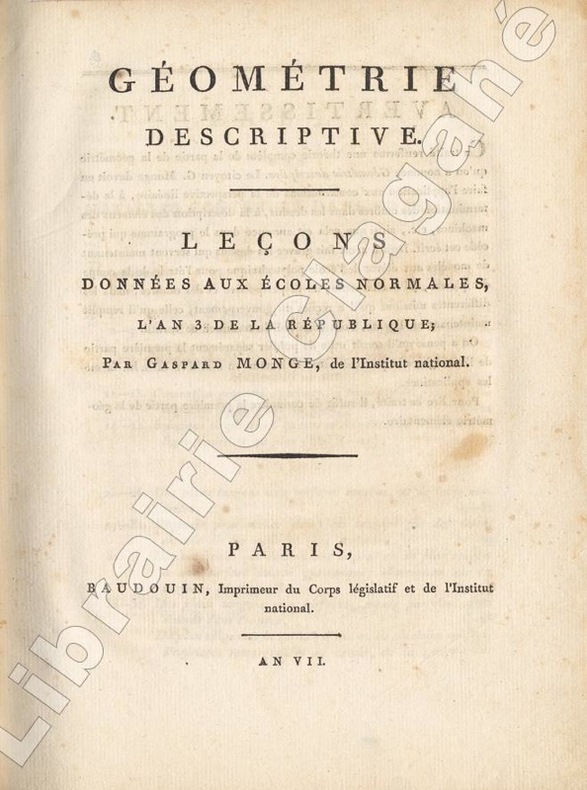
179817204Paris, Baudouin, an VII (1798-1799) ; in-4 , demi-basane marbrée, dos lisse titre en long (rel. moderne) ; VIII, la dernière blanche, 132pp., 25 planches gravées dépliantes.
178990025Paris: Rue et Hôtel Serpente 1789. Fine. Opening run of the journal ""Annales de chimie"" vehicle of ""The New Chemistry"" founded and directed by Antoine de Lavoisier Rue et Hôtel Serpente Paris 1789-1792 12.8 x 19.6 cm Relié First edition highly sought after in the 19th century comprising 14 of the first 15 volumes published between 1789 and 1792 of the first series of the celebrated French scientific periodical Annales de chimie. Volume 10 missing. Contemporary full brown calf spines smooth with gilt fillets brown morocco lettering-piece and green morocco numbering-piece blind-ruled border to covers red speckled edges bookplate of P. H. Chavoix to front pastedown of each volume. Volumes 1 and 11 numbered in Roman rather than Arabic numerals. Overall discreet restorations corners rubbed occasional light foxing and browning some worming to bindings not affecting text head and tail of headcaps worn on volumes 7 13 14 and 15. The complete first series of the Annales de chimie published between 1789 and 1815 runs to 96 volumes. From 1793 to 1797 publication was suspended following the arrest of Antoine Lavoisier the journal's treasurer and in Édouard Grimaux's words its ""true director."" The opening run here contains nearly all the issues produced under the direction of and with contributions from the chemists Antoine de Lavoisier and Baron Philippe Frédéric de Dietrich. Both were condemned to the guillotine during the Reign of Terror in 1794 and 1793 respectively. This set is further illustrated with 12 scientific plates including two by the engraver Sellier as well as a map of the county of Bigorre. The majority of the articles and essays are first editions written by distinguished French and foreign chemists and physicists who helped disseminate ""The New Chemistry"": in order of appearance Louis-Bernard Guyton de Morveau Antoine de Lavoisier Gaspard Monge Claude-Louis Berthollet Anne-François Fourcroy Philippe-Frédéric de Dietrich Jean Henri Hassenfratz Pierre-Auguste Adet Jean-Antoine Chaptal Martin Heinrich Klaproth Johann Georg Albrecht Höpfner Christoph Girtanner Johann Christian Wiegleb Jacques-Anselme Dorthes Johann Friedrich Westrumb Armand Seguin Henry Cavendish William Austin Martin van Marum l'abbé René Just Haüy Peter Jacob Hjelm Jan Ingenhousz Isaac Milner Johan Gadolin James Watt Lorenz Florenz Friedrich von Crell Charles Blagden Jean Senebier Jean d'Arcet William Higgins Nicolas-Louis Vauquelin Nicolas Joseph Thiéry de Ménonville Dom Michel Rubin de Celis Jacques Louis Schurer Augustin-François de Silvestre l'abbé Claude Chappe Antoine Augustin Parmentier Nicolas Deyeux Bertrand Pelletier Charles-Augustin Coulomb Joseph Priestley Richard Kirwan Jean André de Luc Jean-François Clouet chevalier Marsilio Landriani Jean-Noël Hallé François Pierre Nicolas Gillet de Laumont Georges-Charles Bartholdi Alexandre Brongniart Jean-Michel Haussmann Henri Reboul François René Curaudau Thomas Henry Jean-Anthyme Margueron Nicolas Leblanc Johann Rudolph Deiman Pieter Nieuwland Pierre de Ribaucourt Pissis fils Jean-Baptiste Van Mons ou encore Louis François Antoine Arbogast. In 1816 the Annales de chimie was retitled Annales de chimie et de physique. In 1913 the journal split into two separate publications Annales de chimie and Annales de physique. The titles have undergone further changes up to the present day. A collection of 14 volumes from the opening run of the prestigious French scientific periodical Annales de chimie containing numerous essays and articles most in first edition published under the editorship of distinguished figures: Antoine de Lavoisier Louis-Bernard Guyton de Morveau Gaspard Monge Claude-Louis Berthollet Anne-François Fourcroy Philippe-Frédéric de Dietrich Jean Henri Hassenfratz and Pierre-Auguste Adet. Rue et Hôtel Serpente unknown
1737219511737 Viennae Austriae, Typ. Leopolsi Joannis Kaliwoda - 1737 - Edition Originale du plus beau livre sur les Habsbourg - 2 tomes sur 3: T. I, T. III & dernier - 2 volumes In-folio - 1/2 Reliure frottée postérieure - Dos lisse à filets dorés - Pages de titre bi-colore rouge et noire avec vignette - Très grands Bandeaux, Lettrines & Culs-de-lampe - I) 2 tableaux dépliants: Fac-similé de documents & 1 Tableau Généalogique, illustrations en texte, 6 planches de sceaux in-fine PP HT - (18), LXXII-338 pages + Index 34 pages & Corrigenda (1) & 6 planches de sceaux.II) (17), Pagination 412 à 851 + Index (56) pages - Les 2 volumes très propres - En langues allemande et latine - Envoi rapide et soigné
178990025Rue et Hôtel Serpente | Paris 1789-1792 | 12.8 x 19.6 cm | Relié
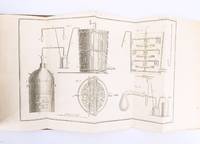
17941599Reliure pleine basane marron racinée. Dos lisse orné de filets dorés, pièce de titre rouge. Trois tranches sanguines. Intérieur très propre. Illustré de 4 tableaux imprimés sur papier bleu et de 60 planches repliées hors texte (fourneaux, moulages en terre et en sable, grues, marmites, fonderies, tours et tourillons). Les deux dernières planches, de grande dimension, présentent l'ensemble des canons réalisés grâce à la méthode de Monge. ÉDITION ORIGINALE.
17941311130103Impr. du Comite de salut public 1794-01-01. Hardcover. Very Good. 4to. Contemporary leather boards rebacked on modern leather spine. 27 cm. Good binding and cover. viii 231 p. lx folded leaves of plates. Lovely copper plates throughout. Generally clean unmarked pages. Collated. Goldsmiths'-Kress no. 16024.5-1. D.S.B. 9: 469-478. Impr. du Comite de salut public hardcover
179456237Paris, Comité de Salut Public, AN 2 (1794). 4to. Contemp. hcalf. Gilt spine. Titlelabel with gilt lettering. A small tear to leather at top of spine and joint. (4),VIII,231 pp., 4 folded tables and 60 large folded engraved plates. The first few leaves with scattered brownspots.
179456237Paris Comité de Salut Public AN 2 1794. 4to. Contemp. hcalf. Gilt spine. Titlelabel with gilt lettering. A small tear to leather at top of spine and joint. 4VIII231 pp. 4 folded tables and 60 large folded engraved plates. The first few leaves with scattered brownspots. <br/><br/><em>First edition. The plates are identical with those in Panckoucke's Encyclopedie. " Between 1786 and 1788 Monge investigated with Berthollet and Vandermonde the principles of metallurgy and the composition of irons cast metals and steels. This research enabled them to unite previous findings in these areas to obtain precise theoretical knowledge by means of painstaking analyses and to apply this knowledge to the improvement of various techniques." DSB - Poggendorff II184. </em> hardcover
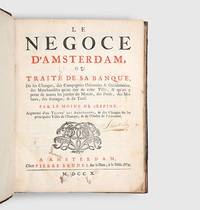
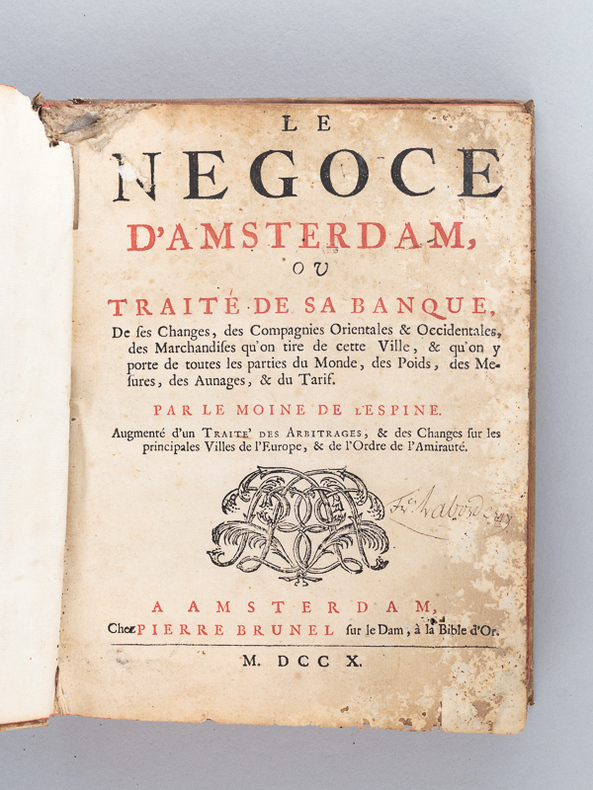
1710135031Amsterdam: Pierre Brunel 1710. Second edition bound as issued with Jacques Mondoteguy's Traité des Arbitrages also published by Pierre Brunel in 1710 but in Paris. Le negoce d'Amsterdam was first published in both Dutch and French in 1694. Jacques le Moine de l'Espine d. 1696 was a merchant dealer in art and maps mathematician and writer on economics who was based in Amsterdam from 1697 onwards. Quarto 221 x 165 mm. Title printed in red and black separate divisional title leaf for Traité des Arbitrages continuously paginated with that gathering Hh having five leaves. Woodcut title page vignettes to both head- and tailpieces initials numerous tables to text. Contemporary calf rebacked preserving the original spine title lettered in gilt to second compartment rest elaborately tooled in gilt raised bands marbled endpapers edges sprinkled red and blue. Early ownership signature "Jouxtel" hand written in ink to front pastedown "Jouxtely" to title page and final page "Jou:tel" to fore edge of book block likely the same hand which has carefully amended the catchword on the final page of Le Moine de L'Espine's work to match the first word of Mondoteguy's title page and neatly corrected a figure on p. 235; engraved bookplate of Jean R. Perrette to front pastedown. Corners restored a few marks to boards lower corner of book block up to p. 170 a little gnawed front free endpaper laid onto following blank occasional marginal dampstain but generally contents crisp a few pen trials to title page and last few blanks natural paper flaw along lower margin of leaf Ff1 resulting in small loss to lower corner not affecting text. Overall a very good copy. Goldsmiths' 4601. hardcover
178544970(Paris, Moutard, 1785). 4to. Extracted from ""Mémoires fe Mathematique et de Physique, Présentés à l'Academie des Sciences par divers Savans"", Tome X. Pp. 511-550 a. 2 folded engraved plates. Clean and fine.
178544970Paris Moutard 1785. 4to. Extracted from "Mémoires fe Mathematique et de Physique Présentés à l'Academie des Sciences par divers Savans" Tome X. Pp. 511-550 a. 2 folded engraved plates. Clean and fine. <br/><br/><em>First appearance of this importent paper by the "greatest geometer of the century" in which he solves some main problems in coordinate geometry especially he introduced the "distant formula" for three dimensions years before it was used by Lagrange. He laid the foundation of a completely new branch of mathematics known as descriptive geometry. The paper was delivered already in 1771 but not published until 1785. "His first important original work was "Memoire sur les développées les rayons de courbure et différents genres d inflexions des courbes á double courbure" He published an extract from it in June 1769 in the Journal encycyclop´matiques and in October 1770 he finished a more complete version that he read before the Academie des Sciences in August 1771; the latter however was not published until 1785 Mémoires de mathématiques et de physique présentés á ’Academic par divers scavanns. By then some of the most important ideas in the memoir no longer seemed so original because Monge had employed them in other works published in the intervening years. Nevertheless this memoir is of exceptional interest for it presents most of the new conceptions that Monge developed in his later works as well as his very personal method of exposition which combined pure geometry analytic geometry and infinitesimal calculus."DSB. </em> unknown
179825<p><b>LEWIS'S "TO THE READER" EXPLAINS HIS AFRICAN SLAVE CHARACTER HIS "MISANTHROPIC NEGRO"</b></p><p><b>LEWIS Matthew Gregory "Monk". </b><i>The Castle Spectre: A Drama. In Five Acts. First Performed at the Theatre Royal Drury-Lane on Thursday December 14 1797. By M. G. Lewis M. P. Author of The Monk &c. </i> 8vo disbound pp. 103 1 ad. London: Printed for J. Bell 1798. <br /></p><p>First Edition. An extraordinary commercial success although not a universal favorite of the critics. To the critics who objected to his use of black slaves in a Gothic story he defended himself by saying that if he could "have produced the same effect by making my heroine blue blue I should have made her." "As far as Lewis's search for novelty and striking effects is concerned it is interesting to highlight the character of Hassan an African servant.Hassan is in Ormond's service because the earl has cruelly snatched him from his family and hating the white race that he considers responsible for his sufferences the black slave refuses to escape only because he is aware of his master's evil propensity to torture people around him. Lewis exploited this unusual figure to introduce something new and surprising in his play but also to underline the demonic instincts of the villain."-Bertrand Evans <b>Gothic Drama from Walpole to Shelley</b>1947 online. Lewis's <i>To The Reader </i>pp. 100-103 admits borrowing from other authors saying: "To the originality of character I make no pretence.but I shall not so readily give up my claim to novelty when I mention my misanthropic <i>Negro: </i>He has been compared to <i>Zanga </i>but Young's hero differs widely from what I meant in <i>Hassan.Hassan</i> is a man of violent passions and warm feelings whose bosom is filled with the milk of human kindness but that milk is soured by despair.he has lost everything even hope; he has no single object against which he can direct his vengeance and he directs it at large against mankind. He hates all the world.that heart was once feeling and kind." This Lewis's most famous play went into eight printed editions by the following year and a total of eleven by 1803. "A brilliant example of the more thrilling type of melodrama accompanied by music by Michael Kelly.The story tells how Osmond the villain captures Angela.Father Paul is based on Juliet's nurse and on Sheridan's Father Paul."-Nicoll <b>A History of English Drama 1660-1900 </b> vol. III pp. 99-100. The play was particularly indebted to <i>The Castle of Otranto The Mysteries of Udolpho </i>and<i>Die Räuber. </i> Coleridge described it as a "peccant thing of Noise Froth and Impermanence." Despite its lack of originality "it was an excellent vehicle for presenting a series of striking scenes of suspense or spectacle--the sudden appearance of the ghost in an atmosphere prepared by forebodings.Kemble and Mrs. Jordan were by all accounts superb in the leading roles.But the principle reason for its success was the appearance of the ghost in Act IV.Louis F. Peck <b>A Life of Matthew G. Lewis </b>1961 pp. 73-74. Edith Birkhead <b>The Tale of Terror: A Study of the Gothic Romance </b>p. 66. Summers <b>A Gothic Bibliography </b>p. 254. <b>Nicoll </b>III p. 281. No copies have appeared at auction since at least 1975 nor as of this writing are there any online. Minor browning first and last leaves moderately so. 84146 ABAA-VBF<br /></p> J. Bell
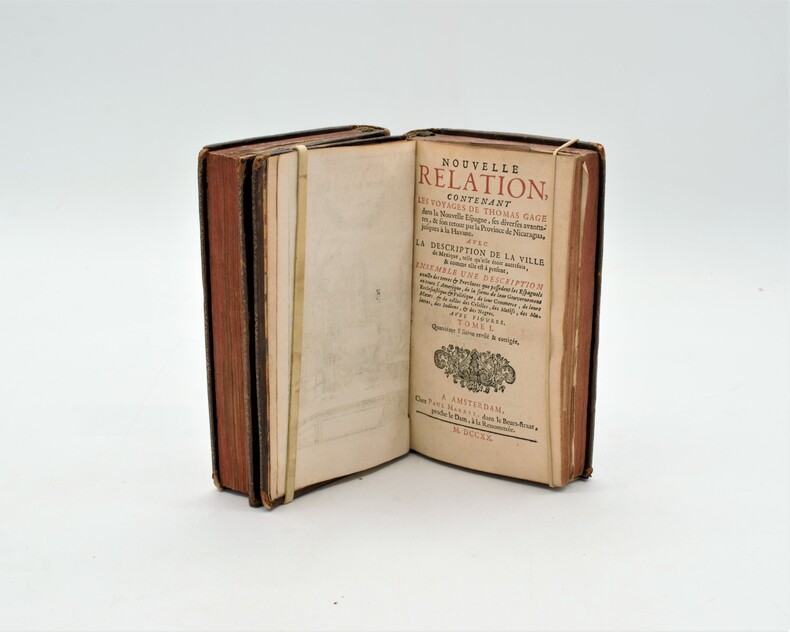
1720P2-7B-8Amsterdam, Paul Marret, 1720. 2 volumes in-12,, (13) ff , 431 pp , (5) ff , 360 pp. , relié plein veau époque , dos à nerfs ornés avec pièces de titre et tomaison rouge. Tranches rouges, charnière fendue tome1,léger manque à la coiffe du tome 2 , ex-libris de A. t’Sterstevens , écrivain belge avec ses notes. Quatrième édition, revue et corrigée, de la traduction de M. de Beaulieu.
179440625Paris: Comité De Salut Public. Very Good with no dust jacket. 1794. First. Vellum. B/ W ; 4to 8.25 x 10.5; 231 plates pages; 60 folding engraved plates; 4 folding tables. 4 viii 231 pages. 4to later vellum-backed boards gilt-lettered spine-label; generally clean and sound. Volume bulging from quantity of prints and fold outs. First edition of a work on " The principles of a gun-founding and manufacture of artillery iron and bronze" Piling 320. French language. Some foldouts protruding from book. . Comité De Salut Public hardcover
171650002165London: J. Tonson 1716. 1st Edition . Hardcover. Good. 12mo - over 6¾ - 7¾" tall. Original hardcover. Title pages shows date of MDCCXVI 1716. Printed by J. Tonson at Shakespear's Head over-against Catharine - Street in the Strand. Includes lengthly dedication by R. Molesworth 9dated march 16 1716 to the Princess Her Royal Highness Carolina Princess of Wales. Total pages: dedication 46 pp. Poems 156 pp. 4 pages of advertisements. Three-quarter-bound lin leather with marbled paper boards. Spine is missing about 1" at top and 1.75" at bottom. Small 1" tear on one of the advertisement pages and several pages have pencil tic marks which can be erased if desired. An extremely rare copy. <br/> <br/> J. Tonson hardcover
1710488841 vol. in-4 reliure de l'époque plein vélin blanc, Chez Pierre Brunel, Amsterdam, 1710, 2 ff. (titre puis avertissement et errata), 388 pp. et 1 f. n. ch. (tables) Titre complet : Le Négoce d'Amsterdam, ou Traité de sa Banque, de ses Changes, des Compagnies Orientales & Occidentales, des Marchandises qu'on tire de cette Ville, & qu'on y porte de toutes les parties du Monde, des Poids, des Mesures, des Aunages, & du Tarif. Par Le Moine de l'Espine. Augmenté d'un Traité des Arbitrages, & des Changes sur les principales Villes de l'Europe, & de l'Ordre de l'Amirauté [ Titre complet du Traité des Arbitrages : ] Traité des Arbitrages qui se font par Change sur les principales Villes de l'Europe, ou la Ville d'Amsterdam à Change ouvert. Avec un Traité des Changes Curieux, & tres-utile pour tous les Négocians, fait & expliqué en François par Jacques Mondoteguy, Bayonnais
1794CAT000515London: G. Woodfall 1794. First Edition. Hardcover Full Leather. Very Good Condition. 3 volumes in contemporary full speckled calf hinges a little rubbed a few corners slightly bumped light occasional age toning internally - a nice set. Old Lawes Agricultural Trust stamps to titles and endpapers list of subscribers in volume one. xix 1 384pp; 372pp; 374pp.<br/><br/>A carefully curated collection of farming wisdom from a variety of sources tips on cultivation cattle bee keeping cheese making etc. Size: 8vo. 3-volume set complete. Quantity Available: 1. Shipped Weight: Under 1 kilo. Category: Farming & Rural Life; Cooking Wine & Dining. Inventory No: CAT000515. G. Woodfall hardcover
174946401966Paris, Delaguette, 1749 ; in-12, veau fauve, encadrement fil. dor., dos orné. (Reliure de l’époque). 32 pp., 229 pp., (3 pp.)ÉDITION ORIGINALE. L’auteur était curé de Gouvieux, près Chantilly. Cioranesco 39134.De la bibliothèque du MARQUIS D’ALIGRE (ex-libris du XVIIIe s.) Né à Paris en 1726 dans une famille qui compta deux chanceliers, il fut nommé Président du Parlement en 1768. Il fit plusieurs fois des remontrances au roi contre les impôts et contre les opérations ministérielles subversives. En 1788, en présence de Necker, il lut un mémoire au roi dans lequel il pronostiquait les malheurs qui, selon lui, découleraient de la convocation des États-Généraux. N’ayant pas été écouté par le roi, d’Aligre démissionna du Parlement. Le jour de la prise de la Bastille il fut arrêté mais put s’échapper grâce à un de ses anciens domestiques. Il émigra à Londres où l’attendait une fortune placée dans une banque anglaise. Il mourut en 1798 à Brunswick, laissant une fortune colossale à ses deux enfants.Un coin frotté.
1718238501718 A Paris, chez Joseph Mongé ... M.DCC.XVIII., 1718. in-12 (9,5x16,5cm),[6], 72, 83, [12], 339, [12] p, [1] pl.-bl pp., 3 parties reliées en un volume.: "L'histoire abrégée de la Moscovie, des Czars ou Empereurs qui y ont regne, jusques a present", "La relation de ce que Pierre Alexeowitz, a present regnant, a fait de plus remarquable dans ses Etats" - Nouvelle édition française, rare. Illustrée d'un portrait au frontispice de Pierre 1er et d'une grande carte dépliante. Réimpression de l'originale française parue en 1717 chez Jean Boudot. Reliure en pleine basane brune d'époque. Dos à nerfs orné. Coiffes de tête et queue en partie élimées. Epidermures sur les plats. Frottements au coiffes et bordures,tranches rouges.Texte et ill.fraiches.
1765129721765 Metz, Chez Joseph Antoine, 1765, in 4 br., couverture muette d'origine de papier bleu (manques au dos), de (6)-VIII-390-(6) pp., 1 tableau dépliant et 12 planches d'anciennes abréviations manuscrites, gravées et placées in fine, tache d'encre sur la page de faux-titre, bon ex. tel que paru en grande partie non coupé, intérieur très frais.
17920010071France. Good with no dust jacket. 1792. Ephemera. On offer is a superb copy of the laws relating to the French national debt and the seizure of property of those French nobles who fled France to escape the guillotine. At the outset of the French Revolution Frances national finances were in total disarray. The country had virtually bankrupted itself in the Seven Years War with Britain and with its participation in the American Revolution. Moreover the French Royalty and nobility were a study in corruption and excess. Taxation only applied to the peasants. Making matters worse levying taxes at a local level was controlled not by the French government but by local boards who were very reluctant to impose more taxes on their already deeply-burdened local communities. It had to boil over at some point and that point came in 1789 with a full national revolution. The new republic still had the same financial mess on its hands. This document describes part of the efforts to deal with that mess. The first 8 pages deal with the financial levies that were imposed on local regions. This was an entirely new concept and it may have gone nowhere except for the looming shadow of the guillotine. However many regions appealed their levies and sought relief: Repartition des decharges accordees a titre de degrevementSequestre des biens des EmigresL'Assmblee Nationale ayant entendu le rapport du son comite de l'ordinaire des financees sur les petitions qui lui ont eye adressees par plusieurs departments afin d'obtenir un degrevement sur leur part dans les contributions des anees 1791 et 1792 ainsi que les trois lectures du projet de decret dans ses seances des 1re et 9 aout et 12 septembre et decrete qu'elle etoit en etat de deliberer definitivementTranslation: Breakdown of discharges granted as a rebateThe seizure of the property of the EmigrantsThe National Assembly having heard the report of its ordinary committee of finances on the petitions which were addressed to it by several departments in order to obtain a relief on their share in the contributions of the years 1791 and 1792 as well as the three readings of the draft of decree in its sessions of the 1st and 9th of August and 12th of September and decrees that it was in a position to deliberate definitively.The Law then goes on to address various issues raised and proposals to deal with them. Of interest is a chart inserted at what would normally be the end of the legal document that details the breakdown of discharges granted to each of the 17 Departments of France. Following the chart are pages 7 & 8 a far more sinister law relating to the properties and belongings of those French nobility and wealthy bourgeoisie who fled France at the outset of the Revolution known to history as Emigres. As the country spiraled downward into chaos and violence thousands fled France. Many went to neighbouring European countries and to Great Britain. They were definitely seen as a threat to the Revolutionary government. Fearful of these monarchists outside the country and with an all-but-destitute public treasury the leader of the Revolution hit upon the idea of seizing the property of all who had fled. They were offered the opportunity to return and failing that would lose all of their property and be executed if they ever returned. These 2 pages speak directly to that: Sequestre des biens des Emigres.La loi du 8 avril dernier relative aux sequestre des biens des emigres s'applique sauf les exceptions y portees a tous Francois sortis du royaume soit a l'epoque de la publication du decret du 9 fevrier precedent soit depuis ou qui viendroient par la fuite a emigrer. Translation: The seizure of the property of the Emigrants.The law of last April 8 relative to the sequestration of the property of emigrants applies except for the exceptions contained therein to all French citizens who left the kingdom either at the time of the publication of the decree of the preceding February 9 or since or who would emigrate by flight. The document is signed in print by Monge and Danton. Monge was Gaspard Monge a noted mathematician and founder of differential geometry. He was Minister of Marine. He later was heavily involved in new developments in French education and served in Napoleons administration. Danton was Georges Danton a leading figure of the Revolution. He died on the guillotine. For a historian this is a superb document. It is a direct connection to the chaos of the Revolution and the dark underside of popular revolutions. This is a 10-page document. It measures 9.0 inches by 8.5 inches and is 10 pages in length. The pages are bound together with thread. There is a large stain on the top left of the front page but it does not interfere with the legibility of the text. There is slight staining around the edges die to age. The document is printed and is very legible. Interestingly there is a chart inserted into the document between pages 6 and 7. It too is numbered Page 6. It is a single-sided chart. ; 9"x8.5"; 10 pages; Signed by All Authors .
17920010124Good with no dust jacket. 1792. Ephemera. On offer is a superb document drawn on September 22 1792 the very first official day of the French Republic République française founded following the French Revolution. In the aftermath of the Revolution of 1789 and the abolition of the monarchy the First Republic of France was established on September 22 of 1792. The National Convention was made up of groups representing differing political outlooks. At their first meeting the Convention decided to try King Louis XVI for treason based on his attempt to flee the country the previous year. They later found him guilty and executed him on January 21 1793. September 22 1792 was also established as the beginning date of the new Revolutionary Calendar. This document is a record of some of the minutes of that first convention and are dated September 22nd the first day of the new government. It is titled: Extract Du Proces-Verbal De La Convention National Relatif au renouvellement des Corps administrifs municipaux et judicairesTranslation: Extract From The Minutes Of The National Convention Relative to the renewal of the administrative municipal and judicial bodiesIt opens with a recording of these motions: Un membre fait la motion que toutes les administrations et tribunaux soient renouveles. Un autre demande que les operations faites a cet egard par les corps electoraux soient confirmes. Plusiers autres membres insistent pour que toutes les administations soient renouvelees et qu'il soit fait au repport prochain sur l'existance et laformation des tribunauxTranslation: A member makes the motion that all the administrations and courts be renewed. Another asks that the operations made in this respect by the electoral bodies be confirmed. Several other members insist that all the administrations be renewed and that the existence and formation of the courts be reported soon. The next few pages go on to detain other proposals and requests generally concerning legal matters. The document bears the printed signature of Monge and Garat. Gaspard Monge was a Minister of State serving as Minister of the Navy and Colonies. Interestingly Monge was a noted matheematician and founder of Differential Geometry. Garat was Dominique Joseph Garat Minister of the Interior. These minutes were ordered printed and distributed throughout France and this copy was sent to the City of Nancy in the north east of France. For a historian or a collector of material from the earliest days of the French Revolution this is a superb item documenting the earliest efforts of the French people to establish a republican government separate from the monarchy and the feudal system. The document measures 9.0 inches by 7.0 inches and is folded to make 4 pages. The printed text occupies all 4 pages and it bears not only a printed signature but also a fairly solid hand signature. When it was printed the paper was not placed squarely on the press and therefore the text is not aligned perfectly horizontal. The page bears the initial stamp of the new government displaying the Phrygian cap or liberty cap that was adopted as a symbol of the revolution. The paper is in good condition with some slight staining from dampness and age.; 8vo 8" - 9" tall; 4 pages; Signed by Author .
1714AQ15134London: Printed and Sold by J. Roberts 1714. 21pp 1. Without half-title. Recent red half-morocco red cloth boards lettered in gilt T.E.G. A trifle rubbed and marked. Marbled endpapers internally clean and crisp. The sole edition of an anonymous elegiac satirical epitaph upon army officer and politician John 1st Duke of Marlborough who contrary to the title survived until 1722 and indeed would certainly not have been interred at Antwerp given the allied offensive against the city during the recently concluded War of Spanish Succession. The prefatory remarks addressed to the publisher are signed by Thomas Johnson presumably the pseudonym of the unknown author. In those same remarks our author claims membership of the apparently fictional Marlborough Club who desired that he carry out this translation so that 'our own People may see the just Esteem which Foreigners have for the Memory of that Great MAN' a highly ironic proclamation that informs the intention of the epitaph as a whole. ESTC locates only copies at only three locations in the UK BL Cambridge Trinity and Oxford and ten in the United States Duke Folger Illinois Indiana Kansas Minnesota Missouri Newberry North Caroline and Texas. ESTC T120685. First edition. 8vo. Printed, and Sold by J. Roberts hardcover