Livre Rare Book
916 résultats
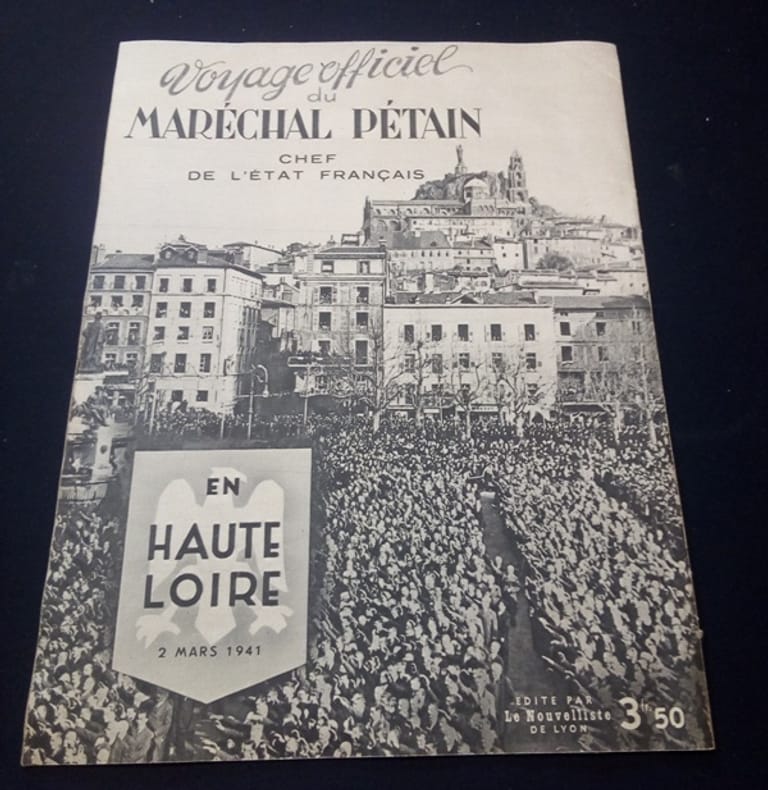
1941144EvLe Nouvelliste de Lyon 1941 Brochure in4 , agrafée , 22 pages de photographies , édité par Le Nouvelliste de Lyon .
1941144EvLe Nouvelliste de Lyon 1941 Brochure in4 , agrafée , 22 pages de photographies , édité par Le Nouvelliste de Lyon .
19946BROCHE 16 x24 - éditions SALSA - 216 PP - BULLETIN SALSA NOUVELLE SERIE N°27 - 1995 VESOUL
1941106601941 Plon (collection Occident) Paris 1941. E.O. (pas de grand papier). Bel envoi de Pierre JOBIT, contributeur de ce recueil, au Maréchal PETAIN. Textes sur l’Espagne de Eugenio d’ORS, MARANON, ZARAGUETA, GENOVES. Broché in-8, bel état général. Rare
1948R260108947EDITIONS DE LA COURONNE. 1948. In-12. Broché. Etat passable, Couv. défraîchie, Dos abîmé, Intérieur acceptable. 260 pages. Ecritures et traits de crayon en marge du texte. Manque au dos. Déchirures sur le second plat.. . . . Classification Dewey : 940.533-Pétain
16478Editions La clé d’or. 1948. Softcover Broché. 189 pages.
5516Paris, La Clé d'Or, Costard, 1948, broché, avec jaquette illustrée, 12x18,5 cm, 188 pages. Illustrations de BEN.
194438661944 Confluences (Lyon) (1944) / Imprimerie spéciale - In12 broché de 80 pages - Couverture blanche imprimée noiret rouge - Édition originale, tirée à 3000 exemplaires (n° 409) - Rare - Bon état avec quelques mouillures.
1987RO40042327EDITIONS COMPLEXE. 1987. In-12. Broché. Bon état, Couv. convenable, Dos satisfaisant, Intérieur frais. 267 pages.. . . . Classification Dewey : 940.533-Pétain
1987R320071481EDITIONS COMPLEXE. 1987. In-12. Broché. Bon état, Couv. convenable, Dos satisfaisant, Intérieur frais. 267 pages. . . . Classification Dewey : 940.533-Pétain
74498Paris, éd. Grasset,2006, très fort in-8, cartonnage souple, couv. photo en noir éditeur, 1024 pp., sommaire, annexes, chronologie, bibliographie, index, table des matières, Quelle est l'implication du gouvernement de Vichy et du maréchal Pétain dans l'extermination des juifs dans les camps de concentration ? Pas courant Très bon état
2001R150213654FLAMMARION. 2001. In-8. Broché. Bon état, Couv. convenable, Dos satisfaisant, Intérieur frais. 334 pages. . . . Classification Dewey : 940.533-Pétain
ISBN : 2702845703. FLAMMARION. 2001. In-8 Carré. Broché. Bon état. Couv. convenable. Dos satisfaisant. Intérieur frais. 334 pages
mon0003043139The Dial Press 1930-01-01. Hardcover. Good. 1.2000 8.6000 5.7000. The Dial Press hardcover
193085115London: Elkin Mathews & Marrot Ltd 1930. Presumed First U.K. Edition First printing. Hardcover. Good/No dust jacket present. 254 pages. Frontis illustration. Illustrations. Maps. Cocked. Henri Philippe Benoni Omer Pétain 24 April 1856 - 23 July 1951 commonly known as Philippe Pétain or Marshal Pétain was a French general who attained the position of Marshal of France at the end of World War I during which he became known as The Lion of Verdun. From 1940 to 1944 during World War II he served as head of the collaborationist regime of Vichy France. Pétain who was 84 years old in 1940 remains the oldest person to become the head of state of France. <br /> During World War I Pétain led the French Army to victory at the nine-month-long Battle of Verdun. After the failed Nivelle Offensive and subsequent mutinies he was appointed Commander-in-Chief and succeeded in repairing the army's confidence. Pétain remained in command for the rest of the war and emerged as a national hero. During the interwar period he was head of the peacetime French Army commanded joint Franco-Spanish operations during the Rif War and served twice as a government minister. During this time he was known as The Old Marshal. With the imminent Fall of France and the Cabinet wanting to ask for an armistice on 17 June 1940 Prime Minister Paul Reynaud resigned recommending to President Albert Lebrun that he appoint Pétain in his place which he did that day while the government was at Bordeaux. The Cabinet then resolved to sign armistice agreements with Germany and Italy. The government voted to transform the French Third Republic into the French State or Vichy France an authoritarian regime that collaborated with the Axis. After the war Pétain was tried and convicted for treason. He was originally sentenced to death but due to his age and World War I service his sentence was commuted to life in prison. His journey from military obscurity to hero of France during World War I to collaborationist ruler during World War II led his successor Charles de Gaulle to write that Pétain's life was "successively banal then glorious then deplorable but never mediocre". The Battle of Verdun was fought from 21 February to 18 December 1916 on the Western Front in France. The battle was the longest of the First World War and took place on the hills north of Verdun-sur-Meuse. The German 5th Army attacked the defences of the Fortified Region of Verdun and those of the French Second Army on the right east bank of the Meuse. Using the experience of the Second Battle of Champagne in 1915 the Germans planned to capture the Meuse Heights an excellent defensive position with good observation for artillery-fire on Verdun. The Germans hoped that the French would commit their strategic reserve to recapture the position and suffer catastrophic losses at little cost to the German infantry. Poor weather delayed the beginning of the attack until 21 February but the Germans captured Fort Douaumont in the first three days. The advance then slowed for several days despite inflicting many French casualties. By 6 March 201 2 French divisions were in the RFV and a more extensive defence in depth had been organized. Philippe Pétain ordered there to be no retreat and that German attacks were to be counter-attacked despite this exposing French infantry to the German artillery. By 29 March French guns on the west bank had begun a constant bombardment of Germans on the east bank causing many infantry casualties. The German offensive was extended to the west bank of the Meuse to gain observation and eliminate the French artillery firing over the river but the attacks failed to reach their objectives. In early May the Germans changed tactics again and made local attacks and counter-attacks; the French recaptured part of Fort Douaumont but then the Germans ejected them and took many prisoners. The Germans tried alternating their attacks on either side of the Meuse and in June captured Fort Vaux. The Germans advanced towards the last geographical objectives of the original plan at Fleury-devant-Douaumont and Fort Souville driving a salient into the French defences. Fleury was captured and the Germans came within 2 mi of the Verdun citadel but in July the offensive was cut back to provide troops artillery and ammunition for the Battle of the Somme leading to a similar transfer of the French Tenth Army to the Somme front. From 23 June to 17 August Fleury changed hands sixteen times and a German attack on Fort Souville failed. The offensive was reduced further but to keep French troops away from the Somme ruses were used to disguise the change. In September and December French counter-offensives recaptured much ground on the east bank and recovered Fort Douaumont and Fort Vaux. The battle lasted for 302 days the longest and one of the most costly in human history. In 2000 Hannes Heer and Klaus Naumann calculated that the French suffered 377231 casualties and the Germans 337000 a total of 714231 and an average of 70000 a month. In 2014 William Philpott wrote of 976000 casualties in 1916 and 1250000 in the vicinity of Verdun. In France the battle came to symbolize the determination of the French Army and the destructiveness of the war. Elkin Mathews & Marrot, Ltd hardcover
19504Romans, Domergue, 1936, 1 broché, couverture illustrée, sous chemise cartonnée aux couleurs de la France. in-4 de 64 pages, texte sur 2 colonnes, photos, illustrations, reproduction de gravures et peintures anciennes ( James de Missolz, Daniel Nemoz), bien complet des 2 calques (ornemental et publicitaire) ;
201210328Paris, Éditions du seuil, 1967 ; in-8, 334 pp., br. Broché état d'usage.
224389Paris, N.E.L, 1966 in-12, 156 pp., demi-percaline bleue, dos à nerfs, premier plat de couverture conservé (reliure moderne). Ex-libris Collection Ulrich.
1966RO80206151Nouvelles éditions latines. 1966. In-12. Broché. Etat d'usage, Couv. défraîchie, Dos satisfaisant, Intérieur frais. 156 pages. Rousseurs sur la couverture.. . . . Classification Dewey : 940.533-Pétain
1962LFA-126718455Un ouvrage de 286 pages, format 145 x 225 mm, illustré, broché, publié en 1962, Impr. Dumas, bon état
1941R200104745Sequana. 1941. In-12. Broché. Etat d'usage, Tâchée, Dos satisfaisant, Papier jauni. 94 pages. Pliures.. . . . Classification Dewey : 940.533-Pétain
1940008378PARIS S.P.I.D. 1940 Une plaquette in-8 brochée de 48 pages , infimes rousseurs sur la couverture , bon à très bon exemplaire . Bon Couverture souple
191855667Jean Cussac | Paris s. d. [circa 1918] | 14.50 x 24 cm | agrafé
191855667Paris: Jean Cussac 1918. Fine. Jean Cussac Paris s. d. circa 1918 14.50 x 24 cm agrafé First edition illustrated with photographs. Foreword by Paul Deschanel and preface by Philippe Pétain. Fold marks to first cover. Jean Cussac unknown
1966RO20007468Albin Michel. 1966. In-8. Cartonné. Bon état, Couv. convenable, Dos satisfaisant, Intérieur frais. 522p illustrées de photos noir et blanc. hors texte.. . . . Classification Dewey : 940.533-Pétain