[Fregatten Venus]Biblio.com

597 résultats
72591Stockholm Carl Gust. Cronland 1791. 4:o. 78 s. Liten fläck på första och sista sidan. Tagen ur band. Ur Ericsbergs bibliotek. Setterwall 3344. Bring Rättegångshandlingar 726:2. Ärendet var först uppe i regementskrigsrätten för att sedan avgöras i krigshovrätten. Fregatten Venus byggd av Chapman 1783 befann sig i juni 1789 utanför norska kusten under befäl av kapten Hanson. De råkade där ut för en rysk eskader som öppnade eld och efter en stunds strid måste Hanson och hans män kapitulera och Venus togs av ryssarna. Efter att tillbringat en tid i rysk fångenskap kom Hanson 1791 hem och ställdes inför domstol för förlusten av fartyget. Han bedömdes dock inte ha handlat brottsligt utan endast slarvigt och dömdes till böter motsvarande en halv årslön. unknown
15821Brive, Editions François Janaud, 2000. In-4, (32) pp., couverture portefeuille, étui carton vert.
1972MJ255851972-1987 17 volumes, in issues. Large 8vo. Numerous pages, plates, and text figures. Uniform original printed wrappers. A long, continuous run of the most important Japanese malacological periodical. Each year in four issues, except volume 34 (1975), in two issues, combining no's 1-2, and 3-4, for a total of 66 issues. Very well illustrated and containing many new species. Stamp on front covers, otherwise a very good, clean set.
9153403Short description: In Russian. Weizman, Rakhmil Yakovlevich. Factory Accounting in Connection with the Calculation and Commercial Organization of Factories and Plants. Moscow: All-Russian Central Union of Consumers, 1926. You are welcome to reach out to us for a detailed description of the copies currently available. Delivery of this book may take longer than usual including extended processing and pre-shipping time, no expedited shipping is available. Please advise us if you have a set date or a deadline to receive your order.SKU9153403
1887PHO-1969Rio de Janeiro, Lombaerts & Cie, 1887, grand in-4° (32x23cm), pleine percale époque, titre au dos, petits frottements aux mors, quelques rousseurs. Texte en portugais avec sa traduction française en regard, complet de ses illustrations sous serpentes.
1885PHO-1499Paris, Gauthier-Villars, 1885, 2 volumes grands in-4, couverture éditeur, Introduction et Zoologie 576pp., Botanique 23pp., Géologie 180pp., Planches 32pp.-2ff. et son Atlas de 2ff. et 68 planches en lithographie, d'études géologiques et zoologiques (55 planches de zoologie sur fond crème et 13 planches de géologie dont 10 d'observations microscopiques de roches, en couleurs), dos cassé à l’atlas.
19512110502150413577Bunkyo shuppan 1951. Soft Cover. Fine. Volume: 1 Bunkyo shuppan paperback
167514546Paris, Guillaume Desprez, 1675 ; in-16 ; plein veau havane granité, dos à nerfs décoré et doré, titre doré, roulette sur les coupes (reliure de l'époque) ; (36) (titre, Epistre, Préface et Table), 457 pp., (1) p. de Privilège, 59 figures et schémas dont 13 hors-texte.
pp. 14, 16, 14, cb, 12, 20, 1 tav. Le cinque “note” che compongono questo scritto sono di importanza capitale per la storia dell’astronomia: oltre a ipotizzare la lentezza di rotazione di Venere, Schiaparelli conclude che il pianeta sia avvolto costantemente da una coltre di nubi: è il primo scienziato a formulare quest’ipotesi nella storia dell’astronomia, ipotesi che – insieme ad altre – sarà destinata a resistere fino ai nostri giorni. La serie è estratta manualmente dai volumi dei “Rendiconti” del Reale Istituto lombardo di scienze e lettere. Compresa la tavola. In these five “note”, Schiaparelli reports his discoveries about the slow rotation of Venus, and for the first time makes the hypotesis on the blanket of clouds surrounding the planet, that is considered his discovery. The serie is materially taken from the volumes of the “Rendiconti del Reale istituto lombardo di scienze e lettere”, including the plate.
17244333Cologne, héritiers de Herman Demen, [Bruxelles, Foppens], 1724 ; in-8 ; plein veau glacé caramel, dos à nerfs orné, armes du marquis Jacques de La Cour de Balleroy en tête et en pied, roulette décorative dorée sur les coupes, tranches rouges (reliure de l'époque) ; (4) ff. (frontispice, titre imprimé en rouge et noir, Avis au lecteur, table), 352 pp.
1821003106Chez les principaux libraires (Imprimerie d’Herhan), se trouve chez Barba, 1821
183615806Wien, Mechitaristen Congregations-Buchhandlung, 1836. 441 S., 2 Bl. mit einigen kleinen Textholzschnitten. 1 Kupfertitel und 71 (2 doppelblattgr.) Kupfertafeln. Kl.-4°. HLdr. der Zeit mit Rückenschildern (etw. bestoßen und beschabt). [9 Warenabbildungen]
201298950Blue Kingfisher Limited. New. 2012. Paperback. 9881506433 . FREE UPGRADE to Courier/Priority Shipping Upon Request - IN STOCK AND IMMEDIATELY AVAILABLE FOR SHIPMENT - Flawless copy brand new pristine never opened -- Text in English and Chinese. 176 pp. ; 138 illus. 131 in color. -- with a bonus offer-- . Blue Kingfisher Limited paperback
Paris, L. Turgis, 1850 circa. Numero quattro litografie in colore d'epoca, cm 53 x 66 (il foglio). In basso al centro "Lithographiées par Lafosse d'après Lazerges", la firma di Lafosse nella parte figurata alla metà del margine laterale sinistro. Non facile a reperirsi la serie completa delle quattro. L'Asia e l'Europa presentano abrasioni del foglio nella parte superiore, lievissime fioriture d'insieme, tenue e bella la coloritura, molto decorative.
17795654Paris, Imprimerie Royale, 1779 - 1781 ; deux tomes in-4 ; plein veau havane marbré, dos à nerfs ornés et dorés, tranches rouges (reliure de l'époque) ; XVI, 707, (1), XIII (table), (3) pp. ; XVI, 844, XVI (table), (4) pp. et en tout 27 planches et cartes gravées hors-texte, dépliantes.
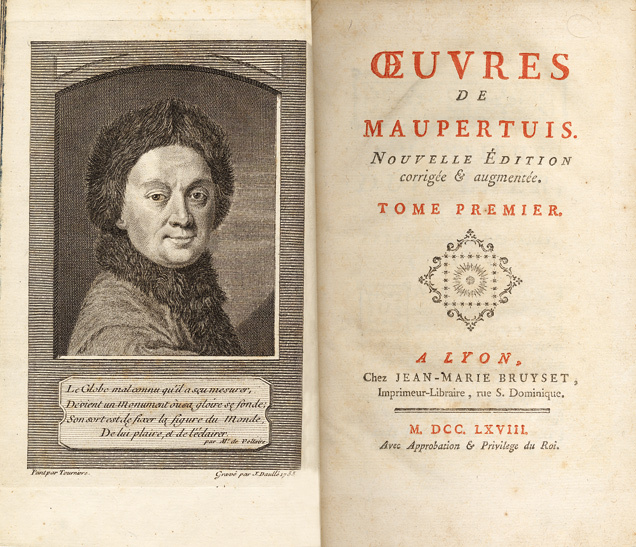
176815501Lyon, Jean-Marie Bruyset, 1768 ; 4 tomes in-8 ; veau fauve marbré, dos à faux-nerfs, décorés et dorés, pièces de titre et de tomaison grenat, filet doré sur les coupes, tranches marbrées (rel. de l'époque) ; (4) faux-titre et titre en rouge et noir à chaque tome ; XXXVI, 309, (3) pp. ; IV, 431 pp., (1 bl.), (1) f. blanc ; IV, 468, (4) pp. ; VIII, (12), 346, (4) pp., nombreuses figures ; portrait en frontispice gravé par J. Daullé d'après Tournière et carte hors-texte de l'arc méridien mesuré au cercle polaire au Tome 3.
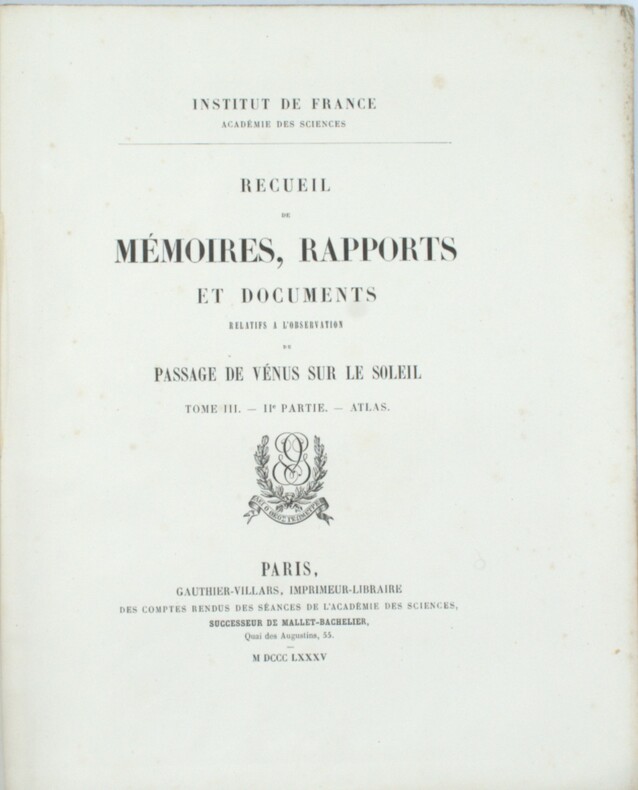
1878PHO-1677Firmin-Didot puis Gauthier-Villard, Paris, 1878-85, 5 volumes grands et forts in-4 (sur 8), tome 2, 1ere et 2eme partie relié cartonnage éditeur, tome 3, 1ere, 2eme partie et atlas, brochage éditeur, non coupé.
1772PHO-2432Paris, Charles-Antoine Jombert, 1772. In-4 (25,5x20cm), 2ff.-170 pp.-1f., Veau marbré époque, dos lisse orné avec pièce de titre en maroquin rouge, triples filets aux plats avec fleurs en écoinçons, tranches marbrées bleues. Dos frotté, début de fentes, petit trou de ver au dernier plat, petit travail de ver en marge, mouillure par intermittence. Complet avec 1 grand plan, 1 tableau dépliant et 3 planches hors texte.
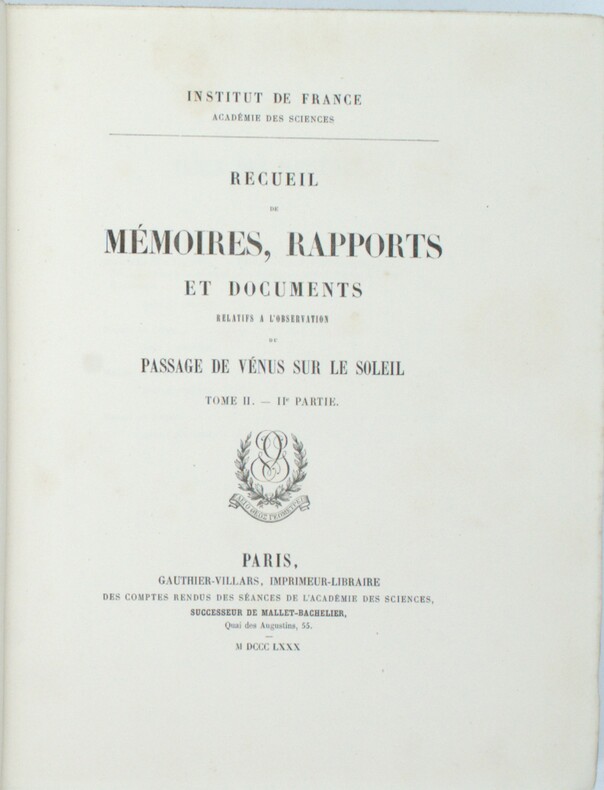
187665048Paris, Firmin-Didot et Cie puis Gauthier-Villars, 1876-1890, , 3 tomes en 8 volumes in-4 (atlas 68 planches et annexe compris), demi-chagrin brun de l'époque, dos à 5 nerfs, armes anciennement masquées en tête des dos, Édition originale de la totalité des publications de l'Académie des sciences autour de l'expédition astronomique française chargée d'étudier le passage de Vénus devant le soleil en 1874 : cette conjonction, qui a lieu deux fois tous les cent treize ans environ à huit ans d'intervalle, fut l'occasion de mettre sur pied un projet d'enregistrement photographique mené, entre autres, par le célèbre astronome Jules Janssen (1824-1907), qui embarqua officieusement, à bord de la mission japonaise dont il était chargé, un dispositif ingénieux de son invention : le très célèbre revolver photographique. L'expédition fit des observations à Nagasaki, Pékin, Saïgon, Nouméa en Nouvelle-Calédonie, l'île Saint-Paul dans l'océan indien et l'île Campbell à l'extrême sud des océans ; l'objectif astronomique put s'enrichir de multiples investigations dans les champs hydrographique, météorologique, géologique et zoologique. Ensemble d'une grande rareté, qui se compose comme suit: Le tome I (2 parties en 2 volumes) contient les procès-verbaux et les nombreux mémoires lus devant la Commission de 1872 à 1874 ; illustré de 3 grandes cartes dépliantes (passages de Vénus sur le soleil en 1874 et 1882) et de 4 planches gravées, dont l'une figure la lunette astronomique et un autre l'appareil photographique utilisé par Ad. Martin de Wolf. Le tome II (2 parties en 2 volumes) relate les missions de Pékin, de Saint-Paul, du Japon, de Saïgon et de Nouméa ; illustré de 26 + 35 planches, soit 10 planches de clichés photographiques originaux, dont l'une comprend des clichés du Soleil obtenus avec "l'appareil de le Commission du passage de Vénus", et plusieurs cartes et vues en lithographie, parmi lesquelles des représentations de l'Observatoire de Pékin. Les deux premières parties du tome III (2 tomes et 1 atlas) rapportent la mission de l'île Campbell illustrée de 6 planches + d'un atlas de 68 planches en lithographie d'études géologiques et zoologiques (55 planches de zoologie sur fond crème et 13 planches de géologie dont 10 d'observations microscopiques de roches, en couleurs et sous serpentes légendées). Enfin, la troisième partie du tome III (1 volume) contient tous les documents relatifs aux épreuves photographiques. L'Annexe paru en 1890 (relié à la fin de la 3e partie du 3e tome) fait le bilan des résultats obtenus (calcul des parallaxes, trajectoire de Vénus, etc.) Du point de vue de l'enregistrement photographique, l'expédition n'est pas une véritable réussite : en effet, comme le craignait Janssen, les appareils officiels embarqués pour les différentes missions ne sont pas similaires et ne permettent pas d'obtenir des photographies comparables. Face à cette appréhension, Janssen embarque son révolver photographique : "Although Janssen disagreed with the official prescriptions of the commission with respect to photography, "a spirit of discipline" compelled him to follow its prescribed methods during the expedition he was charged to lead to Japan. Nevertheless, in addition to the officially sanctioned instruments, Janssen brought along some unauthorized ones, including his controversial 'revolver'." L'appareil présente une innovation de taille : il ouvre la possibilité d'enregistrer un corps en mouvement. Janssen parvient à penser théoriquement la photographie comme un enregistreur de temps ; "J'ai eu la pensée de tourner cette difficulté au moyen d'un appareil qui permît de prendre, au moment où le contact va se produire, une série de photographies, à des intervalles de temps très courts et réguliers, de manière que l'image photographique de ce contact fût nécessairement comprise dans la série et donnât en même temps l'instant précis du Couverture rigide
In-4, [12] ll. (incl. frontispiece), 689 pp., [9] ll., engraved title-page, full-page coat of arms of the dedicatee on the verso of the title, 12 copper-engraved plates; contemporary vellum, ms. title stamp, one clasp remaining, blue edges (tiny stain touching some margins, very rare sporadic browning, small cover defects). Genuine beautiful copy.
1796ST20813Helmstedt: Printed and commissioned by C. G. Fleckeisen 1796. FIRST EDITION. 275 x 225 mm. 10 3/4 x 9". XVI 250 2 pp. <br/> Contemporary brown paste paper boards smooth spine with red roan label. WITH 10 ENGRAVED PLATES one folding by "G. T." after Schröter. Honeyman 2825; de la Lande p. 635; Poggendorff II 846; cf. DSB XII p. 226 NDB XXIII 590 Schröter and 510 Schrader. See also Sheehan and Baum "Observations and inference: Johann Hieronymous Schroeter 1745-1816" Journal of the British Astronomical Association vol.105 no.4 p.171-175. Joints and extremities somewhat rubbed boards with a hint of chafing occasional very minor foxing including to the final plate half a dozen leaves with faint dampstain to head edge but a really excellent copy the other plates clean and bright the text especially clean and fresh and the binding entirely sound.<br/> <br/> This is a very rarely seen early work on the topography of Venus written by the astronomer who first observed the planet's so-called phase anomaly and illustrated with 10 folding plates. One of a series of "fragments" Schröter published--the others concerning the sun the moon Saturn and Mercury--"Aphroditographische Fragmente" discusses the author's observations of Venus' surface at the same time coining the term "Aphroditographie" in reference to the Greek version of the goddess' name. The most important observation contained in our work concerns the phases of Venus: like the moon Venus appears to wax and wane when observed through a telescope. However due to the thickness of its atmosphere the planet will always appear less full than mathematical calculations indicate it should be. This phenomenon known as Venus' phase anomaly--or the Schröter Effect--first observed by the man who gave it its name in 1793 is discussed in detail in this text which is accompanied by highly detailed plates. Eight of these are focused on Venus primarily depicting its phases; another is a diagram of the telescope; and the other depicts the Orion Nebula to which there is a short addendum. Schröter 1745-1816 built a state-of-the-art observatory at Lilienthal in Lower Saxony equipped with the largest telescopes available at the time. One such instrument which he built in his own workshop was an impressive 27-foot telescope discussed in the present work which has sometimes been incorrectly credited to Schröter's colleague William Herschel 1738-1822. Schröter made systematic long-term observations of the surfaces of the moon and planets something DSB tells us he was the first to do. Not everything he discovered or asserted turned out to be true. Based on his findings he posited the existence of a mountain range on Venus' surface and suggested a rotation period for the planet. Both subsequently were disproven modern scientists have suggested that Schröter's "mountain" may have been an overly optimistic observation of a cloud formation but like the rest of his work they demonstrated the commitment to observational astronomy that leads astronomy historians William Sheehan and Richard Baum to call Schröter "the man who laid the foundations of planetology and modern selenography." His long and impressive astronomical career came to an unfortunate end in 1813 when during the Napoleonic invasion the French reportedly set fire to his observatory. His library instruments unpublished notes and copies of many of his works which were published in small runs at his expense were said to have been destroyed in the fire a fact that may partly explain the current rarity of our book. We have been able to trace at auction only an ex-library copy of the book with significant condition problems that sold in 1981 for a hammer price of £260; the fact that such an unattractive copy came from the distinguished Honeyman collection reinforces how difficult the work is to obtain. Printed and commissioned by C. G. Fleckeisen unknown
In-8°; cc. (12). Edizione originale del poema di Giovanni Francesco Pico della Mirandola, una delle prime fonti sulla collezione di statuaria antica conservata al Giardino del Belvedere in Vaticano. Scritto nell’ultimo anno del pontificato di Giulio II (1503-1513), l’opera sottolinea la passione per le antichità classiche che con questo papa divenne una vera e propria moda nella Roma del tempo. Molti si domandarono se fosse idoneo consevare nel tempio della cristianità una collezione che esaltava anche le divinità pagane. Pico, seguace della corrente savonaroliana che denigrava la cultura rinascimentale del recupero e dell’imitazione dei classici romani e greci, si serve di quest’opera per stigmatizzare questa contrasto, proponendo nei suoi versi la Vergine Maria come contraltare alla Venere classica, presentando la collezione del vaticano come la manifestazione fisica della corruzione culturale e morale della Roma di Giulio II. Nella lettera a Francesco Giraldi, umanista ed erudito nativo di Ferrara, datata 1512, Pico offre una sorta di panoramica sulle statue collocate nel Belvedere: sono tra le prime parole che vengono spese sul posizionamento in quel luogo di quello che fu il simbolo della rinascita del classico, il gruppo del Laocoonte ritrovato presso la Domus Aurea nel 1506 e acquistato da Giulio II. Vengono anche citate la statua di Apollo e Cleopatra, e la grande immagine del Tevere. Giovanni Francesco Pico della Mirandola (1470-1533), nipote di Giovanni Pico, autore di una biografia su Savonarola, si fece portavoce di una difesa degli insegnamenti cristiani contro la nuova cultura nascente. Salvatore Settis, Sonia Maffei, Ludovico Rebaudo, Laocoonte, fama e stile: “La matrice antica del luogo, giardino delle Esperidi, luogo ideale per l’ozio filosofico, centro della nuova politica di Giulio II colpisce Giovanni Pico della Mirandola; è li che egli ambienta il De Venere et cupidine cogliendo la natura pagana del luogo: Laocoonte e le anticaglie solo identificate per veloci evocazioni, sono quasi come idoli chiamati ad animare il regno di Venere e della vana venustas”. The original edition of the poem by Pico della Mirandola, one of the first sources on the collection of ancient statues preserved in the Belvedere Vatican Garden. Written during the last year of pontificate by Julius II (1513), the work underlines the passion for classic antiquities that became, with this Pope, a fever in contemporary Rome. Many was wondering if it was suitable to put a heaten sculpture collection in Vatican. Pico, follower of Savonarola in blaming Renaissance culture of recovery and imitation of Roman empire, through this work means to criticize the moral and cultural corruption of Iulius II Rome, putting this collection as its physical manifestation, and in his verses he puts the Holy Mary to counterbalance the classic Venus. In his letter to Giraldi, Pico offers a bird’s eye view on statues put in Belvedere. These are between the first words spent about the putting in this place of a symbol of Classic rebirth: the Laocoon found in the Domus Aurea area and bought by the pope.