130 résultats
1875011828Washington: Department of the Interior 1875. Book. Very good condition. No Binding. Signed by Authors. First Edition. A large partly printed document appointing A. J. Carrier to the position of Indian Agent for the Ponca Indians in Dakota Territory signed by President Ulysses S. Grant on January 13 1875. The document meaures 20.75 w x 16 h and is framed. Countersigned by Acting Secretary of the Interior B. R. Cowan. Included is an intersting archive of almost 30 items most of which relates to Carrier's service as Indian Agent at the Ponca Agency. Many are on Agency or United States letterhead. One document lists 16 Indians by name for rations stopped or doubled; another is a detail of picket guard one mile west of Point Village against Sioux attacks and lists an Indian Sergeant and 10 Indian Privates; many documents are receipts of payment to Indians for services at the Agency including Little Snake Peter Primeaux Frank Le Fleash Sick Bull Rough Face etc.; another is a large document torn at folds listing the names of 211 Indians signed with their marks receiving annuity payments witness and signed by A. J. Potter and A. J. Abbott and Charles P. Morgan interpreter. Additionally there are three printed govenrment publications including Army HQ General Orders No. 97 a Senate Petition by Carrier and a House of Representatives Report submitted by Carrier. There is also a statement of equipage and supplies for 1864-1865 signed by Carrier for the 198th Regiment Pennsylvania Volunteers Infantry Company A of which Carrier was an officer. There is also a five page "Descriptive List of Curiosities furnished by the Ponca Indians of Dakota." An interesting and unique collection of original documents. Department of the Interior unknown books
1885125381New York: Henry-Bonnard Bronze Co. c. 1885. Attractive bronze bust of of Ulysses S. Grant as General of the Army by famed American sculptor Henry Kirke Bush-Brown. The adopted nephew of sculptor Henry Kirke Brown Henry Kirke Bush-Brown was revered for his accurate realist sculptures illustrating American history. He produced three equestrian bronze sculptures erected at the Gettysburg battlefield depicting General George Mead the victor at Gettysburg General John F. Reynolds killed in action July 1 1863 and General John Sedgwick the senior most Union casualty of the American Civil War. In addition Bush-Brown made a bust of Abraham Lincoln dedicated in 1912 as part of the Lincoln Speech Memorial commemorating Lincoln's Gettysburg Address. Mounted on a bronze base the entire piece measures 7.75 inches in height. In fine condition. Following the close of the American Civil War Congress revisited the idea of a superior General rank initially intended for bestowal upon George Washington who held the rank of "General and Commander-in-Chief" which was a grade senior to all American major generals and brigadier generals from the American Revolutionary War but only entitled him to the three-star insignia of an Army lieutenant general. On July 25 1866 Congress enacted legislation authorizing the grade of General of the Army and on that same date the new grade was conferred on Lieutenant General Ulysses S. Grant as a reward for saving the Union in the American Civil War. The grade was recognized and continued in various acts until the Act of July 15 1870 which contained the requirement that "the offices of general and lieutenant general shall continue until a vacancy shall exist in the same and no longer and when such vacancy shall occur in either of said offices shall become inoperative and shall by virtue of this act from thence forward be held to be repealed. Henry-Bonnard Bronze Co. unknown books
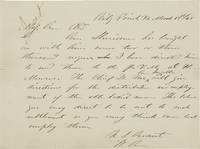
1865WRCAM53987City Point Va 1865. 1p. 6 x 7 3/4 inches. Verso docketed with an 1896 penciled presentation inscription to Chicago manufacturing magnate W.W. Wilcox with a faint ink stamp recording the date of presentation. Old horizontal folds light edge toning one tiny tear at bottom edge else fine condition. An important and revealing original communication from the pen of Lieutenant General Ulysses S. Grant near the close of the Civil War. Here Grant writes a telegram to Major General Edward Ord who was at that time in command of the Army of the James in Virginia. Ord's forces were participating in the Appomattox Campaign and achieved their greatest success at the Breakthrough at Petersburg just about two weeks after this telegram was sent. Ord would later be present for Lee's surrender at Appomattox Court House. <br> <br> In this letter Grant informs Ord that Sheridan has just brought in thousands of freed African Americans to work as laborers for the Union. Grant sends them to the provost marshal at Fort Monroe in Hampton Roads and informs Ord that he may employ some of the men however he might see fit. The text of the telegram reads: <br> <br> "Gen. Sheridan has brought in with him some two or three thousand negroes. I have directed him to send them to the F.V. at Ft. Monroe. The Chief Ar. Ms. Gen. Ingalls will give directions for the distribution and employment of the able bodied men. The balance you may direct to be sent to such settlement as you may think can best employ them. U.S. Grant Lt. Gen." <br> <br> Ord and his men were instrumental in bringing an end to the Civil War in the weeks that followed this telegram. On April 9 Ord led a forced march to Appomattox Court House that is credited with in part forcing Lee's final surrender. Of this march Gen. William Tecumseh Sherman wrote in an 1880 letter that he "had always understood that Ord's skillful hard march the night before was one of the chief causes of Lee's surrender." It is poetic justice of the highest order to consider that some of the African-American former slaves mentioned in this telegram were likely part of Ord's forces at Appomattox where they could have borne witness to the end of the Confederacy. THE WAR OF THE REBELLION: A COMPILATION OF THE OFFICIAL RECORDS OF THE UNION AND CONFEDERATE ARMIES Washington: Government Printing Office 1894 Series I Vol. XLVI Part III p.41. unknown books
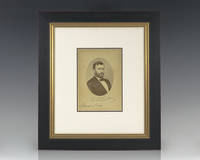
94709Rare original Mathew Brady photograph of Ulysses S. Grant. Boldly signed by Grant as the 18th President of the United States "U.S. Grant March 18th 1875." One of the earliest photographers in American history Mathew B. Brady brought home the reality of the Civil War to the American public with his innovative use of a mobile studio and darkroom to capture thousands of war scenes throughout the Civil War. Brady was also recognized as one of the premier photographic portraitists of the 19th century taking photographs of numerous celebrities including Andrew Jackson John Quincy Adams Abraham Lincoln and Robert E. Lee among others. Double matted and framed. The entire piece measures 19 inches by 16.5 inches. In near fine condition. Rare and desirable with such a strong signature signed by Grant during his presidency. Ulysses S. Grant served as president of the United States from March 4 1869 to March 4 1877. On January 29 1877 five days before he left office Grant gave an address to the Senate of the United States regarding a controversial dispute that had arisen over the results of the upcoming presidential election. In the address Grant argued that the people must put their trust in Congress stating: "In all periods of history controversies have arisen as to the succession or choice of the chiefs of states and no party or citizens loving their country and its free institutions can sacrifice too much of mere feeling in preserving through the upright course of law their country from the smallest danger to its peace on such an occasion; and it can not be impressed too firmly in the hearts of all the people that true liberty and real progress can exist only through a cheerful adherence to constitutional law. unknown books
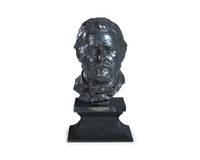
102885Original bronze bust of Ulysses S. Grant by Henry Shrady the famed sculptor of the Ulysses S. Grant Memorial on the west front of the United States Capitol in Washington D.C. Mounted on socle and base the entire piece measures 18.5 inches in height. In fine condition. An exceptional piece of Americana. Henry Merwin Shrady was an American sculptor known for the Ulysses S. Grant Memorial on the west front of the United States Capitol in Washington D.C. Shrady and architect Edward Pearce Casey won the competition to build the Ulysses S. Grant Memorial in 1902. In the twenty years Shrady spent executing its sculpture program he studied biology at the American Museum of Natural History and dissected horses to gain a better understanding of animal anatomy. The memorial was dedicated on April 27 1922 two weeks after Shrady's death. The Grant Memorial is described as "one of the most important sculptures in Washington" by James M. Goode in The Outdoor Sculpture of Washington D.C. It consists of a colossal equestrian statue of Grant atop a marble pedestal with bas relief plaques guarded by four lions. unknown books