2 653 résultats
177628646Frankfurt a. M. 1776. Vorrede von Ulysses von Salis Handschriftliche saubere Bemerkungen alter Hand auf Vorsatzblatt Eichenberg 8°. Pbd. d. Zt. Raetica unknown
1793333Zürich / Leipzig 1793. Erster Band alles erschieneneMit Anmerkungen zum ersten Bande Tafel VII fehlt oder wurde nicht eingebunden. Insgesamt guter Zustand. Einzelne Kupfer mit Einrissen. Neuerer Besitzername auf Vorsatzbl. Rara Ziegler 8°. Hldr. d. Zt. Raetica unknown
179220391792. Vierter Band Guter Zustand Barth 21871 Kl.-8°. Pbd. Raetica unknown
51290Vignon.1609.In-32 relié.895 p.Index.Edition gréco-latine.Reliure XVIIIème en veau raciné. Pages de gardes de la même époque.Page de titre avec manque de papier au coin droit.Mouillures légères en marges de l'Index.Court de marge haute.Bon exemplaire avec ex-libris Tixier.
1864101729Np New York: For sale by all News Agents. Price $1 per 100. 1864. 4to. Broadside text in two columns; creased from prior folding and split at creases some toning and paper clip rust staining. Republic campaign broadside reprinting an interview with Lincoln by former Wisconsin State Assemblyman Joseph T. Mills and former state Governor Alexander Williams Randall. Lincoln vigorously defends the use of Black soldiers in the Union Army against Democratic candidate McClellan's strategy of leniency towards Southern States rejoining the Union: "The slightest knowledge of Arithmetic will prove to any man that the rebel armies cannot be destroyed with Democratic strategy. It would sacrifice all the white men of the North to do it. There are now in the service of the United States near 200000 able-bodied colored men most of them under arms defending and acquiring Union territory. The Democratic strategy demands that these forces be disbanded and that the masters be conciliated by restoring them to slavery. Will you give our enemies such military advantages. to get them back into the Union Abandon all the posts now garrisoned by black men take 200000 men from our side and put them in the battle-field or corn-field against us and we would be compelled to abandon the war in three weeks. . There have been men base enough to propose to me to return to slavery the black warriors of Port Hudson and Olustee and thus win the respect of the masters they fought. Should I do so I should deserve to be damned in time and eternity. My enemies pretend I am now carrying on this war for the sole purpose of abolition. So long as I am president it shall be carried on for the sole purpose of restoring the Union. But no human power can subdue this Rebellion without the use of the emancipation policy and every other policy calculated to weaken the moral and physical forces of the Rebellion." This is the first separate printing of the interview which was first published as "The Loyal Road to Peace and the Disloyal Road to Ruin President Lincoln on Democratic Strategy" in the Wisconsin Grant County Herald August 1864. The broadside also prints Grant's letter to E.B. Washbourne "The Rebels have now in their ranks their last man. The little boys and old men are guarding prisoners guarding railroad bridges and forming a good part of their garrisons for entrenched positions " and a poem by Bayard Taylor on the Democrats' presidential nominating convention. REFERENCE: Sabin 41157; Weinstein Against the Tide 141 For sale by all News Agents. Price, $1 per 100. unknown
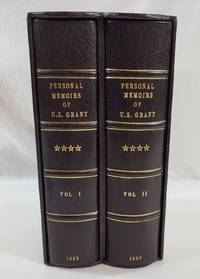
188528077New York:: Charles L. Webster & Company 1885. First Printing of the First US Edition. This is a Near Fine tight set with light wear to the extremities in the publisher's full brown calf leather binding with black leather tips. There is slight moisture bleed in Volume 1. The spine title is red leather and the volume label is black. The rear hinges of each volume have been reinforced. This set includes the facsimile letter of Grant's original terms for Lee's surrender laid in. Mark Twain was the publisher of this monumental memoir as well as its editor and proof reader. Twain was extremely fond of and a close friend of Grant and encouraged the President and war hero to write his memoirs. Grant was dying of throat cancer but completed his two volume opus dictating the second volume to a secretary. Twain noted in a letter to his daughter that the manuscript was not even set yet and 20000 sets had been ordered from only two states. "Wait till you hear from the other 37." Grant finished his memoirs on July 18 1885 and died five days later on July 23rd. Following his death advance orders of the memoirs reached 300000 sets realizing close to $450000 for his family which was otherwise penniless. In a 1992 New York Times book review General Schwarzkopf is quoted as using Grant's two-volume work as his model calling it the finest military history of the Civil War. Charles L. Webster & Company, hardcover
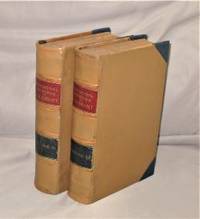
188547293New York: Charles L. Webster & Company 1885. Very Good. New York: Charles L. Webster & Company 1885 1886. First Edition. Two large octavo volumes; rebound in modern full brown morocco with leather labels and raised bands to spine; all edges marbled new marbled endpapers; 584pp. & 647pp. All maps illustrations and foldouts present including frontispieces with tissue guards. Mild shelfwear to boards; bindings sound; chipping to endpapers along margins with professional repair; light staining and toning; overall a Very Good and sound set in full leather.<br /> <br /> Nevins notes: "Written frantically while in a race with death these recollections rank with the best of the Civil War Period" Nevins II-59. Charles L. Webster & Company unknown
1885049078New York: Charles L. Webster & Co. 1885. First edition 1885 and 1886 recently rebound and housed in a slipcase. Three quarter dark brown morocco leather over marbled boards slightly raised spine bands spine lettered and decorated in gilt including four stars on each spine top edges gilt new marbled endpapers. The original gilt medallions from the original covers have been used on the sides of the slipcase which is complimentary to the dark brown leather and marbled book bindings. Includes the printed inscription dedicating the set to the American soldier and sailor near the beginning of the first volume a folding facsimile of Lee's surrender printed on yellow paper in the second volume several tissue-protected engravings maps including a folding map in the second volume. Very good to near fine condition with tissue protected frontises having some offsetting to the tissues some light foxing to the preliminaries of the second volume tight bindings very clean pages no names or other markings. The medallions on the slipcase show some rubbing otherwise about fine. All the marbled paper used in the bindings matches but there is a slightly different tonality to the front cover of volume II does not appear to be fading. Bindings are by Paul Sawyer of Daytona Beach Florida. First Edition. Hard Cover. Very Good. 8vo - over 7¾" - 9¾" tall. Charles L. Webster & Co. Hardcover
196763382Carbondale & Edwardsville IL: Southern Illinois University Press 1967- 1991. Eighteen vols. xxxix 1 458; xxxiii 1 399 1; xxv 1 479 1; xxv 1 520; xxv 1 458; xxiv 2 492; xxiv 588; xxiii 1 609 1; xxiv 700; xxv 1 618; xxvi 497 1; xxv 1 520; xxvi 599 1; xxvi 548; xxv 1 691 1; xxvi 635 1; xxiii 1 663 1; xxiii 1 661 1; xxiv 651 1 pp. With frontispiece’s photo illustrations facsimiles of letters maps. Uniformly bound in brick-red publisher’s cloth black & gilt spine labels minor bumping to upper right corner vol. 1 w/ d.j.’s from the Clark County Historical Society deaccessioning material. First editions of the first 18 volumes in this massive project encompassing Ulysses Grant’s letters and correspondence from his Prewar career through Reconstruction. Beginning with his 17-year-old cadet letters home at West Point and then service in Louisiana Texas the Mexican War and at Fort Vancouver entry into the Civil War the early campaigns of Fort Donelson Battles of Shiloh Corinth Vicksburg ascension to Lieutenant General the battles of Petersburg Cold Harbor & the Wilderness General Sherman’s March Appomattox assassination of President Lincoln the capture of Jefferson Davis and finally the disbanding of the immense Union Army. Simon d. 2008 drew upon a vast number of previously unpublished or unknown letters memorandum and writings of Grant and together with extensive notes and analysis offered an essential research tool for the study of American History the Civil War Reconstruction and the steps to the Grant Presidency. The set continues in production and Simon himself oversaw the first 31 annotated volumes. He also edited the memoirs of Julia Dent Grant. Southern Illinois University Press, hardcover
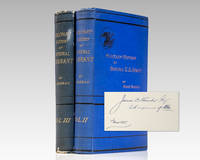
1885151234New York: D. Appleton and Company 1885. Finely bound editions of Badeau’s important “eyewitness estimation of Grant’s performance during the war†a continuation of Grant's Personal Memoirs. Octavo Vols. II and III of three volumes original publisher's cloth stamped in gilt and black. Presentation copy inscribed by the author on the front free endpaper of Vol. III in the year of publication "James C. Hunter Esq with compliments of A Badeau Xmas 1885." In very good. Rare signed by Badeau. Military History of Ulysses S. Grant by Union Brigadier General Adam Badeau—Grant’s aide-de-camp close associate and later literary collaborator—constitutes a substantial posthumous extension of Grant’s own narrative. Having served on Grant’s staff for much of the Civil War Badeau had sustained access to official correspondence operational planning and internal military deliberations. Although Grant’s Personal Memoirs 1885–1886 were completed shortly before his death Badeau assisted in their preparation and subsequently undertook a multi-volume study that expanded the documentary and analytical framework of Grant’s campaigns. Drawing upon wartime dispatches reports and private papers the work presents a detailed operational history while also engaging contemporary debates concerning command decisions and strategic coherence. As a result Military History of Ulysses S. Grant occupies an important position within late nineteenth-century Civil War historiography combining firsthand administrative proximity with retrospective analysis grounded in documentary sources. D. Appleton and Company hardcover
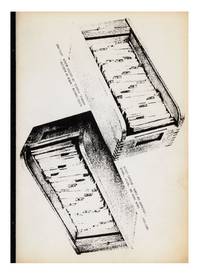
720940 photocopied pages incl. wrappers with many illus. stamp on upper wrapper. Small 4to 212 x 155 mm. orig. pictorial wrappers staple-bound. N.p.: 1978.<br /> The extremely rare fifth issue of Commonpress guest-edited by Ulises Carrion and devoted to boxing one of the artist's life-long passions. Based on floating editorship this mail art periodical comprised works contributed by fellow artists that were then photocopied. Carrión solicited projects from Klaus Groh Anna Banana Bill Gaglione Pawel Petasz Robin Crozier Silva Marcondes etc. On the inside of the lower wrapper Carrión writes: "The question now arises: has this anthology Primarily to do with art Or has it to do with box And this question is valid regardless of the plurality of meanings of the word 'box' which lead some participants to take it as meaning 'sport' and some others as 'receptacle'."<br /> A fine copy. Produced in an edition of 300 copies.<br /> ⧠Juan J. Agius ed. Ulises Carrión & The Big Monster 2014 p. 81. Guy Schraenen ed. Dear reader. Don't read. 2016 p. 218. U. Carrión Quant aux Livres 2008 p. 203. unknown books
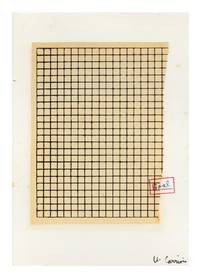
8888Amsterdam: ca. 1979.<br /> <br> <br> An original collage made by Ulises Carrión 1941-89 and gifted to Maurizio Nannucci b. 1939 in support of Zona’s non-profit mission following the Zona Parolo & Suono festival 11-19 June 1979. Near fine; faint foxing. <br /> <br> <br> ⧠See G. Schraenen ed. Dear reader. Don’t read. 2016 pp. 120-23 for similar works by Carrión employing graph paper. unknown
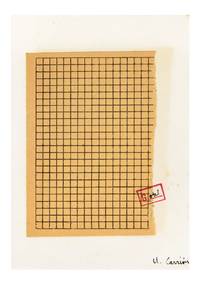
8889Amsterdam: ca. 1979.<br /> <br> <br> An original collage made by Ulises Carrión 1941-89 and gifted to Maurizio Nannucci b. 1939 in support of Zona’s non-profit mission following the Zona Parolo & Suono festival 11-19 June 1979. Near fine; very faint foxing and residue from the glue.<br /> <br> <br> ⧠See G. Schraenen ed. Dear reader. Don’t read. 2016 pp. 120-23 for similar collages by Carrión employing graph paper. unknown
10113159 pp. & one leaf with index & colophon. Small 8vo 180 x 115 mm. orig. printed pictorial softcover spine worn author portrait on lower cover. Guaymas Mexico: JoaquÃn Mortiz August 1970.<br /> <br> <br> First and only edition of Carrión’s second book a collection of six short stories printed in a numbered edition of 3000 copies. In the 1960s Carrión 1941-89 was one of Mexico’s emerging literary talents; a number of his short stories had been published in leading journals and his first play El Gran Espectáculo was performed at the Casa de la Cultura de Tlacotalpan Veracruz to rave reviews. Following his studies in philosophy and letters at the Universidad Nacional Autónoma de México he spent time in France and Germany 1964-65 with the aid of scholarships learning both languages. <br /> <br> <br> Dissatisfaction with the Mexican literary world and local hostility toward the gay community drove Carrión to emigrate to Amsterdam in 1970 where he found a progressive and free-spirited milieu. From then on he conscientiously abandoned literature and fully dedicated his life and work to the visual arts in the form of books films social experiments performances mail art etc. This book represents the artist’s final moment as a traditional/conventional author preceding his conversion to experimental and avant-garde methods of communication.<br /> <br> <br> “In 1970 he published a second six-story collection De Alemania considered a more mature work. Here he has perfected the interior monologue which is the primary manner in which his characters disclose themselves. In some stories the salient characteristic is alienation but in others Carrión employs humor as a catalyst. Since such characteristics are not always mutually exclusive he does achieve a delicate balance between the two.â€â€“Dictionary of Mexican Literature 1992 ed. Eladio Cortés p. 147.<br /> <br> <br> Very good copy internally fine; spine a little creased as with most copies. Housed in a cloth clamshell box. unknown
9232Many black & white illus. 15 leaves printed on rectos only except for one leaf. Small folio 295 x 210 mm. pictorial wrappers fastened with black plastic clasps. From verso of the first leaf: Amsterdam: Agora Studio Sept. 1980.<br /> <br> <br> A rare exhibition catalogue printed in an edition of 200. Carrión 1941-89 devised this as a retrospective of his works and communications with his collaborators for which he investigated the use of names and addresses. <br /> <br> <br> This catalogue with the introduction in parallel Dutch and English is fully illustrated with reproductions of Carrión’s earlier works and performances including pieces such as Arguments 1973 Homage to Van Gogh 1975 and The Muxlows 1978.<br /> <br> <br> A near fine copy of this scarce catalogue; some sunning at the edges. WorldCat records just five examples in North America.<br /> <br> <br> ⧠Quant aux Livres / On Books 2008 p. 210. unknown
1117720 leaves. Small 8vo 178 x 115 mm. orig. black printed dust-jacket perfect-bound. Geneva Switzerland: Ateliers Typographiques Héros-Limite 1995.<br/> <br/> The very rare second edition of Carrión’s beguiling bookwork composed of bound wallpaper samples one of the artist’s lesser-known books due to its rarity. The 1973 first edition published by the artists’ space In-Out Center was made in an edition of 50 numbered copies. The present work is one of 52 copies 26 of which are lettered A-Z the rest numbered 27 to 52; our copy is no. 42. This book is part of a series of re-publications that Juan J. Agius an executor of Carrión’s estate undertook to replicate the increasingly scarce and fragile bookworks Ulises Carrión 1941-89 created in the 70s. Under the imprint of Editions Héros-Limite in Geneva Agius produced second editions of Mirror Box 1st ed.: 1979 Looking for Poetry / Tras la PoesÃa 1st ed.: 1973 Arguments 1st ed.: 1973 and the present bookwork. <br/> <br/> â€In Ulises Carrión’s bookworks the ellipsis of the literary text is accompanied by an ellipsis of the narrative as can be seen in the listing of names or the identification of characters that are not linked by any narrative relationship within a story…In Tell me what sort of wall paper your room has and I will tell you who you are 1973 Carrión cuts out and binds together a set of wallpaper samples typing on them the name of the room in which each will appear. The names start in the first person my room then identify the members of his family and relations my parent’s room my sister’s room my uncle’s room my wife’s room my teacher’s room finally reaching a progressive lack of differentiation of the person to whom the room with the specific wallpaper belongs your room a room …’s room. The subtlety of this bookwork is apparent not only in the readymade of the wallpapers but also in the suggestion of a narrative that does not require a text for its construction: the simple association of the identities of the rooms’ owners in the first person informs us that the narrator has a teacher a wife etc. The progression of these identifications suggests a leaving of the family home to enter the world the framework of so many narratives found in short stories novellas and novels. The new art of making books permits the insinuation of a story without resorting to text or narrative…â€â€“João Fernandes “Art as Subversion: Make and Remake to Make Anew†in Guy Schraenen ed. Dear reader. Don’t read. 2016 p. 41 analyzing the 1st ed.<br/> <br/> In excellent and fresh condition. The first edition is unrecorded on WorldCat and we find only three copies of the second in North American institutions.<br/> <br/> â§ Juan J. Agius & Ricardo Ocampo eds. Ulises Carrión: Books & More Catalogue Raisonné 2013 25 pictured. unknown
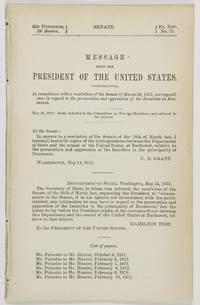
187255322Washington D.C.: United States Government Printing Office 1872. First edition. Softcover. vg. Octavo. 14pp. No wrappers with printed text starting on the first page.<br /> <br /> The printed text date May 14th 1872 relays an official Executive Communication from U.S President Ulysses S. Grant granting the United States Senate's Committee on Foreign Relations' previous request for information concerning the ongoing persecution of Jews in Romania and authorizing the transfer of said information from the U.S. State Department. The information here remitted to the Senate consists of a series of 14 pieces of correspondence dated October 6th 1871 - May 13th 1872 between the then U.S Consul to Romania Benjamin F. Piexotto 1834-1890 Second Assistant Secretary of State William Hunter Jr. 1805-1886 and U.S Secretary of State Hamilton Fish 1808-1893. The initial sections include the President's order the Secretary of State's introductory statement and a full list of correspondences included in chronological order.<br /> <br /> In the 1860s and 70s - following newly established autonomy from the Ottoman empire the unification of the Principalities of Moldavia and Wallachia and the ascendancy of the newly elected Prince Domnitor Alexandru Ioan Cuza - Romania saw a new extreme wave of anti-Semitic measures laws and attitudes. At the prompting of their respective Jewish citizens a number of countries in the international community voiced their opposition to these developments and sought to put pressure on the new Romanian government. In 1870 the United States entered the fray with the appointment of Jewish-American lawyer Benjamin F. Piexotto 1834-1890 as the new American consul in Bucharest. <br /> <br /> Piexotto served in Romania from 1871-1876 and was able to improve the conditions for Romania Jews during his tenure. He promoted the ideas of the Haskalah The Jewish Enlightenment and modernization to the community and among his numerous endeavors was responsible for improvements in modern Jewish education through the establishment of the Society for the culture of the Israelites in Roumania Societate Pentra Cultura Israelit Romania. Piexotto also funded the Roumänische Post in an effort to combat anti-Semitism in the Romanian Press. Ultimately his efforts are credited for strengthening Jewish community structures in the country and ultimately laying the groundwork for eventual Jewish emancipation as allowed for in the provisions of the 1878 Treaty of Berlin. <br /> <br /> Minor age toning and smudges to pages throughout. In overall very good condition. Protected in modern mylar. Full title: Message from the President of the United States Communicating In compliance with a resolution of the Senate of March 28th 1872 correspondence in regard to the persecution and oppression of Isrealites in Roumania.<br /> <br /> Resource: <br /> Gartner Lloyd P. Roumania America and World Jewry: Consul Peixotto in Bucharest 1870–1876. American Jewish Historical Quarterly Vol. 58 No. 1 September 1968 pp. 24-56 59-117. [United States Government Printing Office] unknown
1981509897Houghton Mifflin 1981. First Edition. Hardcover with Dust Jacket. FINE/NEAR FINE. SIGNED and INSCRIBED by Elytis on half-title 'For Stathis and Ralph' in GREEK. First English Edition First Printing. 74pp. Orange speckled paper over boards with blue-gilt lettering to front cover backed in blue finished cloth with silver-gilt spine lettering red endpapers. An exceedingly clean and crisp copy. Dust jacket has some trivial rubbing to head and tail of spine entirely crisp and bright otherwise. Ralph Sylvester and Stathis Orphanos were publishers of the fine-press publishing company 'Sylvester & Orphanos.' Stathis was a noted photographer and born of Greek parents maintaining a residence on the island of Samos throughout his life. First published in Greece in 1978 the year before Elytis was awarded the Nobel Prize Maria Nefeli was a stark departure from the earlier work that had won him renown as the greatest Greek poet of his generation. Its novelty gave many early readers pause but 'despite the initial reservations voiced by some critics Maria Nefeli came to be regarded as the summa of Elytis's later writings.' Poetry Foundation. Houghton Mifflin hardcover
1954List3210Greenville Illinois 1954. Two stapled packets of mimeographed typed pages eighty-seven and twenty-eight pages with one signed. Excellent to Near Fine. An autobiography and genealogy written by Ulysses S. DeMoulin 1871–1955 founder of DeMoulin Bros. a uniform manufacturing company which now mainly supplies marching band attire. The genealogy incorrectly traces the family’s history back to French Revolutionary figure Camille Desmoulins though it appears accurate otherwise. It includes a description of early Sebastopol Highland Illinois with a simple map. In the autobiography which is told in a large number of short anecdotes DeMoulin discusses his childhood and early life in Jamestown and Sebastopol and goes into detail about the early years of his company beginning with the formation of the Modern Woodmen of America fraternal organization for which the company supplied uniforms and items used in ‘rituals’. DeMoulin used the profits from this enterprise to invest in a number of others including a mine near Gold Hill Colorado and oil drilling land in Illinois. However the most interesting portions of the autobiography concern DeMoulin’s role in the development of agriculture in California’s Imperial Valley.<br /> <br /> DeMoulin first travels to southern California in 1903 happening to meet several engineers involved with the Imperial Irrigation System who take him to see the new town of Brawley:<br /> <br /> “Here by lantern light we sat around on the ground in the evening discussing many kinds of farm lands and if soft hard or sandy. We slept in ‘remadas’ made by setting posts to protrude about twelve feet above the ground which were then braced and divided into small box-like stalls. The remada was then covered with tree branches and a huge heavy taupalin sic curtain hung over the sides and front at night to keep out the dust of which you might find two or three inches at your door in the morning. A pitcher of water and a bowl were your only means of bathing. There were no streets in Brawley at this time only trails as the town had not yet been surveyed having only been founded in October 1902. People were living in tents while waiting for completion of hotel accommodations and other living quarters under construction.â€<br /> <br /> DeMoulin begins buying land in the Brawley area to rent to farmers and traveling to the area regularly. He describes the building of the Laguna Dam spending a week at the workers’ camp “at which time I slept in the workmen’s crudely-built bunks and ate with them at the long rough pine tablesâ€; and befriends author Harold Bell Wright. He also witnesses several conflicts with the IWW:<br /> <br /> “In 1908 there moved into Brawley about 200 International Workmen of the World or more familiarly known as ‘I.W.W.’s’ I won’t Work and in command was a Captain Stanley. However as most unwelcome guests they proceeded to join a strike in the cantaloupe sheds and inserting razor blades into apples the strikers threw them at workers. ‘Goons’ also tried to interfere with the trucking operations from the fields to the packing sheds. I recall of one driver telling a goon that if he even attempted to place a foot in his truck he would shoot him. And defying the driver the goon was instantly killed. Naturally this would cause a riot and they sent to El Centro for a tank such as it was in those days - a cannon and several machine guns. But soon after the Mayor had issued orders to shoot anyone getting out of hand an agreement was easily reached.â€<br /> <br /> University of Washington’s IWW History Project documents two IWW actions in Brawley between 1905 and 1920 neither of which match DeMoulin’s description; nor does the event appear in newspapers. However “Captain†William Stanley was in the area serving as the secretary of the I.W.W.’s chapter in the Imperial Valley. In 1911 Stanley was killed in an early battle of the Mexican Revolution assisting Mexican Liberal Party fighters in occupying Mexicali. DeMoulin claims to have traveled with several others to watch the fighting that would end the occupation:<br /> <br /> “It was suddenly discovered one morning that Captain Stanley and his I.W.W.’s had disappeared during the night and word had gotten around they had settled in Mexicalo sic a Mexican border town and were so strong in number they overpowered the police pillaged the shops and stores defying the Mexican Government by taking over complete possession of Mexicalo. However after putting up with this condition for several months the Mexican Government sent in about 500 Infantrymen with orders to get rid of them immediately under any condition. . Stanley’s men had made a large opening in the river bank to a depth of about five feet which led through to the bank facing south. From this vantage point his men could fire their muskets when the Mexicans advanced towards them and soon took to their heels when Stanley’s men began firing. . Several of us had driven down to sic Brawley to witness the fighting and bullets had been spattered everywhere. Many of the people never thinking of danger stood out in the open so as not to miss what was going on but I was glad to stay in the back of the adobes at least where one was protected from stray bullets. And having heard rumors of their retreating possibly the next day which was Sunday we drove down again but all was quiet and we met with no resistance. Many of the men were swimming and others were entertaining their wives and families in one way or another. We didn’t stay too long on that trip as one never knew what might happen. But it wasn’t long before they disappeared from Mexicalo entirely for which everyone was most grateful and happy.â€<br /> <br /> DeMoulin is none too fond of Mexican workers either describing how the 1928 construction of a primitive border wall “didn’t stop the wetbacks . from swimming across†and complaining that “regardless of having no sense nor education many were hired and the employers would hide them in groves because if they were arrested it would cost $160.00 including court and attorney fees to have each one returned to Mexico.†DeMoulin’s other targets for racial abuse include “a couple of crooked ‘Jewish Kikes’†who were “certainly professionals when it came to putting the money in their pockets†and several Black men who he claims steal from him.<br /> <br /> DeMoulin credits himself with bringing grapefruit production to the Imperial Valley and describes a scam by the area’s real estate agents to unload inferior farmland onto unsuspecting investors. He recounts his company making leather “‘Red Men’s’ costumes†for a “Chief Gray Eagle†in Oklahoma whose “squaws wouldn’t work for him any more.â€<br /> <br /> Of interest to historians of the Imperial Valley’s development and especially of labor relations in the agriculture industry. unknown
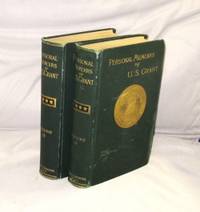
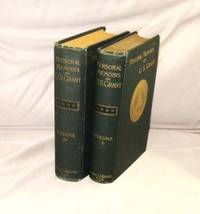
188528594New York:: Charles L. Webster & Company 1885 1886. First Printing of the First US Edition. Two Volumes Complete. A Very Good plus tight set in green cloth bindings stamped in gold on the spine and front covers with light wear to the spine edges and slight discoloration to the front board of Volume 1. This set is complete with the facsimile letter of Grant's original terms for Lee's surrender that is often missing. Mark Twain was the publisher of this monumental memoir as well as its editor and proof reader. Twain was extremely fond of and a close friend of Grant and encouraged the President and war hero to write his memoirs. Grant was dying of throat cancer but completed his two volume opus dictating the second volume to a secretary. Twain noted in a letter to his daughter that the manuscript was not even set yet and 20000 sets had been ordered from only two states. "Wait till you hear from the other 37." Grant finished his memoirs on July 18 1885 and died five days later on July 23rd. Following his death advance orders of the memoirs reached 300000 sets realizing close to $450000 for his family which was otherwise penniless. In a 1992 New York Times book review General Schwarzkopf is quoted as using Grant's two-volume work as his model calling it the finest military history of the Civil War. Charles L. Webster & Company, hardcover
188528635New York:: Charles L. Webster & Company 1885 1886. First Printing of the First US Edition. Two Volumes Complete. A Very Good plus tight set in green cloth bindings stamped in gold on the spine and front covers with light wear to the spine edges and slight discoloration to the front board of Volume 1. This set is complete with the facsimile letter of Grant's original terms for Lee's surrender that is often missing. Mark Twain was the publisher of this monumental memoir as well as its editor and proof reader. Twain was extremely fond of and a close friend of Grant and encouraged the President and war hero to write his memoirs. Grant was dying of throat cancer but completed his two volume opus dictating the second volume to a secretary. Twain noted in a letter to his daughter that the manuscript was not even set yet and 20000 sets had been ordered from only two states. "Wait till you hear from the other 37." Grant finished his memoirs on July 18 1885 and died five days later on July 23rd. Following his death advance orders of the memoirs reached 300000 sets realizing close to $450000 for his family which was otherwise penniless. In a 1992 New York Times book review General Schwarzkopf is quoted as using Grant's two-volume work as his model calling it the finest military history of the Civil War. Charles L. Webster & Company, hardcover
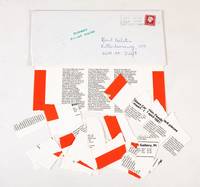
8076Single sheet exhibition invitation torn into ca. two dozen pieces. Amsterdam: Pieter Brattinga Gallery 1981.<br/> <br/> One of Ulises Carrión’s rarest mail art projects with the original mailed envelope sent to the collector Tjeerd Deelstra b. 1937. As the artist intended explained below a small torn portion is not present.<br/> <br/> “In 1981 when the Print Gallery Pieter Brattinga invited Carrión to exhibit his work there Carrión thought of a response project in which he instructed participants to reconstruct in any way they desired the bottom half of an invitation which had been shredded. They were then to sign it and mail it back to the gallery. The lower section of the invitation included a definition of mail art which the artist had torn up and from which he had then removed a small fragment. This way the definition of mail art could never be reconstructed and the instruction given by the artist was impossible to accomplish. The project resulted in 243 responses in all sorts of formats; not only intervened letters but also objects. By making participants reconstruct the invitation the project had a cyclical component that was emphasized by having the word ‘feedback’ in its title. In this way Feedback Pieces takes one step further Carrión’s intentions to reformulate not only the artwork but also the communication system through which it travels.â€â€“Aimé Iglesias Lukin “King Kong Archives: Ulises Carrión on Mail and Art†in Ulises Carrión: The Big Monster 2019 pp. 11-13 pictured.<br/> <br/> Both the envelope and torn-up invitation are in excellent condition.<br/> <br/> â§ Juan J. Agius ed. Ulises Carrión & The Big Monster 2014 pp. 120-35 pictured. unknown
796023 1 leaves mimeographed on rectos only. Small folio 288 x 187 mm. self-bound stapled. Warsaw: Galeria Remont 1977.<br/> <br/> One of Carrión’s rarest exhibition catalogues. The artist curated this show at the Galeria Remont in Warsaw a contemporary art space established by the Polish artist and filmmaker Henryk Gajewski b. 1948 in a dormitory student club at the Warsaw University of Technology. The gallery operated from April 1972 to November 1979 hosting performance art exhibitions of photography stamp art and bookworks and many other events. Carrión had staged an exhibition called Contents at the gallery the previous December. The present exhibition’s title translates as “Other Books.†Gajewski and Carrión contributed essays to the catalogue both in Polish.<br/> <br/> The majority of the catalogue consists of an extensive list of artists engaging with the book form and their bookworks. They include Robert Altman John Armleder Daniel Buren Mirtha Dermisache Peter Downsbrough General Idea Michael Gibbs Klaus Groh Ian Hamilton Finlay Dick Higgins Douglas Huebler Alison Knowles Richard Kostelanetz Joseph Kosuth Anna Kutera George Maciunas Raul Marroquin Maurizio Nannucci Clemente Padin Dieter Roth Ed Ruscha Takako Saito Carolee Schneemann Mieko Shiomi Telfer Stokes Endre Tot Jiri Valoch Wolf Vostell Herman de Vries Lawrence Weiner etc. etc. <br/> <br/> Leaves 16-23 present Carrión’s selections of seminal books along with essays theorizing on bookworks and mail art. Among the bookworks shown we note: Carrión’s Looking for Poetry 1973 General Idea’s Manipulating the Self 1971 Hamilton Finlay’s Honey by the Water 1973 Huebler’s Location Piece 2 1970 Kosuth’s Notebook on Water 1965-66 1970 Maciunas’s Flux Paper Events 1976 Ruscha’s Every Building on the Sunset Strip 1966 Schneemann’s Up to and Including Her Limits 1974 Shiomi’s Spatial Poem 1976 and Weiner’s Various Manners and with Various Things 1976.<br/> <br/> Near fine copy; staples rusted. The pictorial wrappers added to some examples of this catalogue were never bound with the present copy.<br/> <br/> ⧠For more information on the Galeria Remont see the Museum of Modern Art in Warsaw’s website page “Art Prints of the Exchange Gallery†then the section on Gajewski and Galeria Remont. <br/> <br/> U. Carrión Quant aux Livres 2008 p. 209.<br/> <br/> Juan J. Agius & Ricardo Ocampo eds. Ulises Carrión: Books & More Catalogue Raisonné 2013 p. 116. unknown
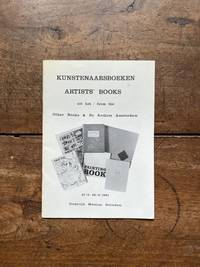
9374Seven black & white illus. 11 pp. Small 4to 210 x 150 mm. pictorial printed wrappers staple-bound. Schiedam Netherlands: Stedelijk Museum Schiedam 1981.<br /> <br> <br> An uncommon exhibition catalogue published by the Stedelijk Museum in Schiedam; the show was curated by Ulises Carrión 1941-89 and the books displayed came from his personal archive the Other Books and So Archive. By 1978 Carrión had closed his intrepid Amsterdam bookstore Other Books and So and converted it into an archive of artists’ books. This is one of a number of exhibitions on artists’ books that the artist organized; others took place in Iceland Poland Denmark and several locations across the Netherlands.<br /> <br> <br> This catalogue features an illuminating interview with Carrión in Dutch and English in which he spells out his criteria for what qualifies as a “bookwork†“an object book†and a “book object.†Describing the conception and production of his own bookworks he says: “When realizing my works I’m strongly influenced by my literary background I think. I’m constantly trying to get rid of it. Sometimes I succeed sometimes not. I try to reduce the book as much as possible to its essence – a sequence of signs. To me sequence implies time it means you cannot perceive a book in one time or moment. The second element is visual by nature – that which you see when you open the book. I try as much as possible to use signs other than literary even other than verbal. That’s why I use photography or rubber stamps. I’m very conscious of the paper. I strive towards an evident unfolding of the book. I don’t mean that the message should be evident but rather the book’s structure how the book fits together. You are free to interpret it as you wish but there must be some sort of recognizable structure. I’m not talking of just a pile of loose sheets.â€<br /> <br> <br> Carrión selected artists’ books by Juan Agius Anna Banana Guglielmo Cavellini Robin Crozier Claudio Goulart Kristjan Gudmundsson Davi Det Hompson Jiri Kolar David Mayor Bruno Munari Maurizio Nannucci Dieter Roth Ed Ruscha Takako Saito Jiri Valoch Lawrence Weiner etc. etc. A full listing of the works is found at the very end.<br /> <br> <br> In near fine condition. Printed in an edition of 350 copies.<br /> <br> <br> â§ Guy Schraenen ed. Dear reader. Don’t read. 2016 pp. 174 & 214 pictured. unknown
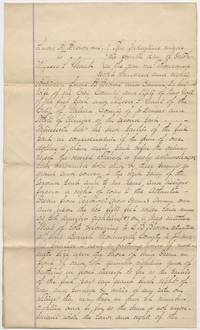
415194Unbound. Near Fine. One legal folio folded at the top to make four pages. Old folds as filed soiling and small tears at the extremities of the folds very good or better. A certified handwritten copy prepared in March 1885 shortly before Grant's death of an 1880 contract between Grant and Lewis B. Brown of New York City. Signed by various clerks with one seal but NOT SIGNED BY GRANT. The document gives Grant ".forever a right of way to the Atlantic Ocean from Seabrook now Ocean Avenue over and upon the lot. and the privilege to erect a bathing house of moderate size upon the Shore of said Ocean. ." Presumably the "bathing house" was what we'd call a cabana. The document has been docketed and stamped in 1887 two years after Grant's death. Grant's shore house served as the Summer White House during his two terms from 1869-1877 obviously this right-of-way was issued after his term was over. unknown