268 résultats
1879mon0003527901AMERICAN NEWS COMPANY 1879-01-01. Leather Bound. Acceptable. . 2-volume set brown cloth with gilt rebound spines splitting and edgewear rubbing and loss. Loose bindings torn hinges repaired with cloth tape. Pages are tanned and mostly clean. AMERICAN NEWS COMPANY hardcover
187740409Ny NY: Subscription Book Department With American News Co. Very Good with no dust jacket. 1877-9. FIRST EDITION. Leather. 4to 11.5"; Solidly bound with contents fine. Text is fine with 800 illustrations. Vol II spine has faded to brown from black. 3/4 leather bound at spne and corners. Golden print on covers. One of the most popular of the 19th century books. Very discrete inked ownership of Winokur. . Subscription Book Department With American News Co hardcover

18991379968St. Paul: The Pioneer Press Co. Printers 1899. Hardcover. Octavo xx 629 pages. In Fair minus condition. Spine is green with gold print. Boards in green cloth with gold print mitred edges. Wear to spine caps and corners blemishes on front and rear rubbing/shelfwear. Text block has bookplate on front pastedown cracked hinges preliminary pages including title page loose from binding paper is tanned and brittle. Illustrated: "Illustrated by thirty-one colored geological plates forty-eight plates of photographic views and 114 figures"- title page. At head of title: The Geological and Natural History Survey of Minnesota N.H. Winchell State Geologist 1896-1898. <br /> <br /> Oversized books. Additional postage necessary for expedited/international orders. Economy International shipping unavailable due to size/weight restrictions. For international/expedited customers please inquire for rates. <br /> <br /> <p>NOTE: Shelved in Locked Annex Area Netdesk Column QA ND-QA. 1379968. FP New Rockville Stock. The Pioneer Press Co., Printers hardcover
1864860A52Paris : Imprimerie et Librairie Administratives de Paul Dupont 1864-75. First edition. Cloth. Very Good. 10" by 8.5" . Not Stated . The first edition of two very scarce thesis from the 'Faculte des Sciences de Paris' by Van Tieghem and M Ulysse Gayon. Two very scarce volumes thesis from the 'Faculte des Sciences de Paris' to graduate in physical sciences. Rarely seen in commerce found institutionally only at the Royal Society Library. In the original French.Comprising:1864 theses by Van Tieghem concerned with 1. research on the fermentation of urean and hippuric acid; 2. physics statements given by the faculty. Argued on 8th June 1864. With one leaf of plates.1875 theses by M Ulysse Gayon concerned with 1. research on the spontaneous changes of eggs; statements given by the faculty. Argued on 19th March 1875. With one leaf of plates folding. Collated complete. In uniform full cloth bindings with titles in gilt to morocco spine labels. Externally very smart title labels slightly chipped. Internally firmly bound. Pages generally bright and clean. Very Good Imprimerie et Librairie Administratives de Paul Dupont hardcover
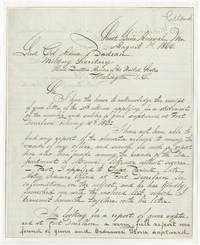
186622955St. Louis MO 1866. No binding. Fine. Manuscript Letter Signed as Lt. Col of Ordnance and Brevet Brigadier General to Adam Badeau Grant's Military Secretary St. Louis Arsenal Mo. August 1 1866. 2 pp. 7 3/4 x 9 1/2 in. Callender responds to Grant's aide-de-camp Adam Badeau's request ""for a statement of the number and calibre of guns captured at Fort Donelson February 16th 1862"" the Tennessee battle that was Grant's first success. Not having that report he offers one on Vicksburg instead.Callender advises: ""I have not been able to find any report of the character referred to among the records of my office and search for such a report has also been made among the records of the Department of the Missouri - likewise without success. But I applied to Capt. Brink late Acting Ordnance Officer at Fort Donelson for information on the subject and he has kindly furnished me with the enclosed list which I transmit herewith together with his letter neither is present. In looking for a report of the guns captured at Fort Donelson a very full report was found of guns and Ordnance Stores captured at Vicksburg - which if the General Grant desires could be forwarded to you.""Franklin D. Callender 1817-1882 Union officer; after distinguished service in the Seminole War and Mexican War took command of the St. Louis Arsenal in 1861 and served as Chief of Ordnance of the Dept. of the Missouri Nov. 19 1861-Mar. 11 1862; holding same post in Dept. of the Miss. March 11 - July 11 1862 he returned to Mo. where he was on the Governor's staff and then served in the advance upon and siege of Corinth; returned to Dept. of the Mo. and the St. Louis Arsenal July 11 1862 and commanded it throughout the war; breveted B.G. USA for Corinth St. Louis and war service. unknown books
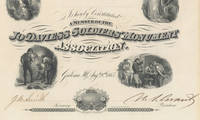
18653462628/08/1865. <p>Ulysses S. Grant was living in Galena Illinois when the Civil War broke out. The Civil War won on August 18 1865 Galena celebrated Grant’s heroic return. Following a jubilant procession with much flag waving and speeches a group of Galena citizens presented the General with a handsome furnished house on Bouthillier Street. Today the house is managed by the Illinois Historic Preservation Agency as the U.S. Grant Home State Historic Site.</p><p>The Soldiers Monument Association was a group of local organizations founded after the American Civil War to fund and erect monuments to fallen soldiers and veterans. In 1865 many such groups formed and one of these was the Jo Daviess Soldiers Monument Association in Galena Illinois established to honor that county's soldiers who served in the Civil War. The Association is known for its handsome membership certificates which pictured vignettes of Lincoln Liberty flags and soldiers and were signed by Grant who was the honorary president. In time a monument to the soldiers of Jo Daviess County was constructed in Grant Park Galena.</p><p>A <strong>membership certificate</strong> to the Soldiers Monument Association with compelling vignettes including Lincoln constituting individuals as members of the Jo Daviess Soldiers Monument Association Galena dated August 28 1865 and <strong>signed</strong> by Grant as President of the Association. Gen. J.C. Smith has also signed as Secretary.</p><p>This is the first Soldiers Monument Association certificate we have ever carried and it is particularly compelling with its association of Grant and Lincoln.</p><p><img class=""alignnone wp-image-25018 size-post-window"" src=""https://cdn.raabcollection.com/wp-content/uploads/20231204144051/Folder-site-11-1600x1327.jpg"" alt="""" width=""1600"" height=""1327"" /></p> unknown
18793244413/05/1879. <blockquote><p>We are aware of no other autographs of Grant from this trip having reached the market</p></blockquote><p>Richard Nixon was not the first President to visit China. On February 20 1979 the New York Times reported: ""When President Nixon arrives in China today on an unprecedented state visit he will not be the first American President to have set foot on that nation's shores. Nearly one hundred years ago while the Manchu dynasty still held sway over the crumbling Chinese Empire Gen. Ulysses S. Grant entered the gates of Peking and was borne in an imperial palanquin into the heart of the Forbidden City. Just one month after the expiration of his Presidential term General Grant embarked on a worldwide tour which took him to Europe Asia Minor India and Indochina on his way to the two great realms of the Far East. In all he spent six weeks In China visiting the cities of Canton Swatow Amoy Shanghai Tientsin and Chefoo with a full week in Peking from June 3 to 10 1879. During his stay he was entertained in the royal manner and granted interviews with Prince Kung the ruling regent of the Manchu Court —the real Emperor was only 5 years old at the time—and Li Hung_chang the Western_oriented strongman of North China.""</p><p>The Chinese had hopes largely unrealized that Grant would help them handle diplomatic and military crises with Japan and Vietnam where the French had influence. He went with a delegation of his own which included his wife and son officers of the US Navy and one of the earliest US ministers to China Chester Holcombe.</p><p><strong>Document signed</strong> Swatow Shantou China May 13 1879 a place card for the dinner held in Grant's honor that evening belonging to a Mrs. Scott. Signed by Ulysses S. Grant his son Frederick Dent Grant his wife Julia Grant Charge d'Affaires Chester Holcombe two representatives from his naval escort.</p><p><img class=""alignnone wp-image-25018 size-post-window"" src=""https://cdn.raabcollection.com/wp-content/uploads/20231204144051/Folder-site-11-1600x1327.jpg"" alt="""" width=""1600"" height=""1327"" /></p> unknown
1879024745Philadelphia: The National Publishing Co. First Edition. Original green decorated cloth. Slight edge wear area of lighter green near the top of the back cover slight spotting on the back cover Very Good. . Very Good. Hardcover. 1st Edition. 1879. The National Publishing Co hardcover
18642764930/12/1864. <blockquote><p>Welles had written at the President's suggestion: ""The largest naval force ever assembled is ready""</p></blockquote><blockquote><p>Fort Fisher guarded the port of Wilmington NC the last port open to blockade runners supplying Robert E. Lee’s Confederate forces in Virginia</p><p> </p></blockquote><p><img class=""alignnone wp-image-28384 size-post-window"" src=""https://cdn.raabcollection.com/wp-content/uploads/20231204120136/Grant_168-2-1-e1694097936583-1600x492.jpg"" alt="""" width=""1600"" height=""492"" /></p><p>As 1864 dawned Wilmington North Carolina protected by Fort Fisher was one of the Confederacy’s last remaining major ports on the Atlantic open to blockade runners and was the chief supply line for General Robert E. Lee’s Army of Northern Virginia. Navy Secretary Gideon Welles reintroduced the idea of a joint operation against Wilmington to the Secretary of the War Edwin Stanton but Stanton saw it as premature. After the Navy’s occupation of Mobile Bay in August all eyes turned to Wilmington. In October 1864 Wilmington finally became the next objective for a joint amphibious operation. Admiral David Porter was chosen to command the naval squadron and General Benjamin Butler the army contingent.</p><p>On December 24 the 63 ships of Porter’s fleet prepared to bombard the fort. Thirty-seven ships formed in three lines of battle end-to-end facing the enemy. Just after midday Porter commenced the Navy’s first bombardment of the fort and continued firing until it became too dark to aim the guns effectively. While the Confederate troops hid and huddled beneath the mounds of the fort this bombardment actually did little damage with the exception of the wooden quarters of the garrison which were set ablaze. Butler’s force returned too late on that first night to attempt a landing. The next morning December 25 the fleet resumed its barrage while a naval contingent sought to secure a landing area for the Union infantry north of the fort. A group of sailors was sent to take soundings south of the fort but Porter withdrew the sounding party after it became clear that the army group was making no progress north of the fort. The timely arrival of Confederate reinforcements caused Butler to question the strength of his position. He felt his forces could not take the fort without a siege for which they were unprepared. Butler immediately began to re-embark his soldiers. On December 27 he called off the expedition and directed the transports to return to Hampton Roads. The U.S. Navy had suffered 83 casualties and the U.S. Army 12. Thus the first attempt by the Union forces to close the port of Wilmington ended in failure. While Butler returned to Hampton Roads Porter remained off the coast of North Carolina dedicated to preparing another attempt to capture Fort Fisher.</p><p>Following the fall of Savannah on December 21 1864 General William T. Sherman prepared to march through the Carolinas. Knowing Sherman could soon be in North Carolina and ready to try to capture the fort again on December 25 Porter wrote to Sherman clearly expressing his frustration with Butler’s decision to abandon the joint operation. Porter was also in communication with Welles. With these communications in hand Welles spoke to President Lincoln who was all for trying again to take the fort. On December 29 Welles wrote to General U.S. Grant in overall command of the army that the President hoped that another joint operation might be forthcoming.</p><p>Welles’s telegram to Grant stated: “December 29 1864 at 9:30 pm. The substance of dispatches and reports from Rear-Admiral Porter off Wilmington is briefly this: The ships can approach nearer to the enemy’s works than was anticipated. Their fire can keep the enemy away from their guns. A landing can easily be effected upon the beach north of Fort Fisher not only of troops but all their supplies and artillery. This force can have its flanks protected by gun-boats. The navy can assist in the siege of Fort Fisher precisely as it covered the operations which resulted in the capture of Fort Wagner. The winter season is the most favorable for operations against Fort Fisher. The largest naval force ever assembled is ready to lend its co-operation. Rear-Admiral Porter will remain off Fort Fisher continuing a moderate fire to prevent new works from being erected and the ironclad have proved that they can maintain themselves in spite of bad weather. Under all these circumstances I invite to such a military co-operations as will insure the fall of Fort Fisher the importance of which has already received your careful consideration. This telegram is made at the suggestion of the President and in hopes that you will be able at this time to give the troops which heretofore were required elsewhere. If it cannot be done the fleet will have to disperse whence it cannot again be brought to this coast.â€</p><p><img class=""alignnone wp-image-28385 size-post-window"" src=""https://cdn.raabcollection.com/wp-content/uploads/20231204120124/Grant_177-1-1-e1694097999755-1600x684.jpg"" alt="""" width=""1600"" height=""684"" /></p><p>Grant responded to Welles immediately. <strong>Autograph letter signed</strong> headquarters at City Point Va. December 30 1864 to Welles. <em>“Your dispatch of 9:30 p.m. 29th received. I will advise fully with the Sec. of War about what you propose. Please call on him for information. U.S. Grant Lieut. Gen.â€</em> Thus Grant promised to inform Stanton “fully†about the plan and requested that Welles consult with Stanton to finalize it. Grant had told Stanton that he did not intend to correspond with the Navy Department except through Stanton and this letter further indicates that.</p><p>Porter had a good working relationship with Grant and a solid record of success in joint operations. Due to this Welles was able to argue successfully with Lincoln for Porter’s retention as commander. In early January Porter coordinated directly with Sherman and Grant about plans for a renewal of operations against Fort Fisher. As Sherman marched north the port of Wilmington was now more important to the U.S. Army than it had been during the first battle for Fort Fisher. Butler rightly took the blame for the first expedition’s failure. For his replacement Grant chose General Alfred Terry one of Butler’s staff officers. Grant assigned him the same troops that had participated in the first attempt augmented with an additional brigade for a total of 8000 soldiers. On January 4 1865 the second expedition to capture Fort Fisher embarked from Bermuda Landing in Virginia. On January 12 they headed for Fort Fisher. Arriving that night Porter and Terry prepared to commence their attack the next day. At dawn on January 13 8000 Federal soldiers landed above the fort as the Navy began its bombardment. Sailors were landed on the 15th and drew fire. This diversion allowed the army to breach the walls of the fort. By 10 p.m. the fort was in possession of the Federal forces. The Confederates started a retreat and when Federal infantry caught up with them General Terry accepted the formal surrender of the fort.</p><p>The first battle of Fort Fisher was the most concentrated naval bombardment of the war. The fleet fired 20271 projectiles into the fort during the first battle. Another 19682 were fired during the second battle. In total the U.S. Navy expended 39953 projectiles at the fort. After Fort Fisher’s capture Porter proceeded to put vessels over the bar and into the Cape Fear River. He declared the port of Wilmington to be “hermetically sealed against blockade runnersâ€. Five weeks after the fall of Fort Fisher the Federal army occupied the city of Wilmington. This occupation ended the trickle of supplies coming along the Wilmington and Weldon Railroad to the Army of Northern Virginia. The fall of Wilmington contributed directly to this army’s surrender at Appomattox Courthouse in April 1865.</p><p><img class=""alignnone wp-image-25018 size-post-window"" src=""https://cdn.raabcollection.com/wp-content/uploads/20231204144051/Folder-site-11-1600x1327.jpg"" alt="""" width=""1600"" height=""1327"" /></p> unknown
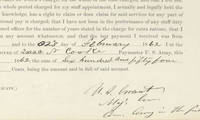
1862806901/03/1862. <blockquote><p>In it he also pays for his servants 3 of whom were black; An extreme rarity the first such document we can find having reached the market in a quarter century</p></blockquote><p>The battle of Fort Henry in Tennessee took place on February 6 1862 and an obscure and virtually unknown brigadier general named Ulysses S. Grant captured the fort and opened the Tennessee River to Union movements. This early in the war Union victories of any kind were scarce and this one was probably the most consequential of the war to date. Grant then moved directly on Fort Donelson entrapping the place both by land and sea from February 11-16. On the morning of February 15 the Confederate commander Simon B. Buckner sent a note to Grant requesting an armistice and asking terms of surrender. Buckner was expecting to give up the fort but get his soldiers paroled so they would not be prisoners of war. Grant refused to give terms but demanded unconditional surrender. The Confederates surrendered the next day the 16th. This victory opened the Cumberland River an important avenue for the invasion of the South to Union operations and Grant became instantly famous earning the nickname ""Unconditional Surrender"" Grant. President Lincoln took note of the fact that in Grant he had a general who could win. On February 20 1862 Lincoln promoted Grant to the rank of Major General a prerequisite to Grant's being able to command a large army.</p><p>However Grant’s very successes at Forts Henry and Donelson incurred the jealousy of his superior Gen. Henry Halleck who was in command of the whole Western Theater of war. Grant not yet realizing the peril Halleck's opposition placed him in knew Nashville was wide open with little in the way of defensive forces. Though Halleck had expressly forbade him to advance Grant ordered Union forces to enter Nashville. It fell on February 25 with Gen. Don Carlos Buell accepting the city's surrender. Nashville thus became the first Confederate state capital to fall into Union hands. Over the next week thousands of Union soldiers poured into the city and Grant took a boat upriver from Donelson to Nashville to confer with Buell. Halleck saw the taking of Nashville not as Grant recognizing and seizing an important opportunity but as willful disobedience of an order. And Grant's unauthorized trip to see Buell there only added to Halleck's anger.</p><p><img class=""alignnone wp-image-32063 size-post-window"" src=""https://cdn.raabcollection.com/wp-content/uploads/20240907140939/Grant-March-1-1862-1-1-1600x348.jpg"" alt="""" width=""1600"" height=""348"" /></p><p>So on March 1 1862 Halleck decided to tie Grant's hands by ordering him to return to Fort Henry and from there to launch an expedition up the Tennessee River to the state of Mississippi. The objective was the destruction of several key railroad bridges. Grant was to “avoid any general engagement with strong forces†and was told that it was “better to retreat than to risk a general battle.†Grant went to Fort Henry as ordered but did not communicate with Halleck directly. The next day Halleck complained to Gen. McClellan that he had heard no word from Grant for a week and that “his army seems to be as much demoralized by the victory of Fort Donelson as was that of the Potomac by the defeat of Bull Run.†On March 4 Halleck relieved Grant from his command writing him: “You will place Maj. Gen. C. F. Smith in command of expedition and remain yourself at Fort Henry.†Grant was shocked. “Thus"" say Grant's Memoirs ""in less than two weeks after the victory at Donelson the two leading generals Halleck and McClellan in the army were in correspondence as to what disposition should be made of me and in less than three weeks I was virtually in arrest and without a command.â€</p><p>Grant turned over command to Smith on March 5. Even as he did so he felt intensely frustrated and longed for action writing on the same day “I have not been well for the last ten days and don’t see that I will be much better until I can get to moving again.†Grant and Halleck exchanged letters after which Grant on March 11 demanded that Halleck relieve him from duty altogether in order to clear his name. ""There is such a disposition to find fault with me that I again ask to be relieved from further duty until I can be placed right in the estimation of those higher in authority.""</p><p>Perhaps this letter caused a change of mind or it may be that Halleck just could not risk loss of the popular Grant altogether. In any event surprisingly he refused and instead told Grant he would receive a new command writing him ""You cannot be relieved from your command. There is no good reason for it…Instead of relieving you I wish you as soon as your new army is in the field to assume the immediate command and lead it on to new victories."" Just four days later Grant was actually given a new command - he was placed in charge of Union forces in Tennessee. He proceeded to Pittsburg Landing Tennessee and arriving on the 17th established a wide camp with his forward units around Shiloh Church some 2.5 miles south of Pittsburg Landing. He wrote ""I at once put all the troops at Savannah in motion for Pittsburg Landing knowing that the enemy was fortifying at Corinth and collecting an army there under Johnston. It was my expectation to march against that army as soon as Buell who had been ordered to reinforce me with the Army of the Ohio should arrive; and the west bank of the river was the place to start from. Pittsburg is only about twenty miles from Corinth…When all reinforcements should have arrived I expected to take the initiative by marching on Corinth and had no expectation of needing fortifications though this subject was taken into consideration."" He reported to Halleck on his troop dispositions and imminently awaited reinforcements so he could move against Corinth. Halleck meanwhile continued to nitpick at Grant for supposed failure to discipline his troops properly.<br />The month of March was a significant one in Grant's career one that saw the tables turn twice on him. First in the flush of his great successes at Forts Henry and Donelson he was victimized by jealousy and relieved of command. Then when all seemed lost he was given an even greater command. And as he assumed that command and awaited reinforcements so he would move on Corinth he was unwittingly actually preparing for the Battle of Shiloh one of the most fateful of the war.</p><p><img class=""alignnone wp-image-32064 size-post-window"" src=""https://cdn.raabcollection.com/wp-content/uploads/20240907141021/Grant-March-1-1862-2-1600x657.jpg"" alt="""" width=""1600"" height=""657"" /></p><p><strong>Document signed</strong> Pittsburg Landing Tenn. April 2 1862 being a voucher for his own pay and expenses and those of his four private servants for the period from March 1 to March 31 1862. His pay was $220 per month and he received $52 per month for the pay of his servants. Forage for his seven horses came to $56 for the month. He received $10 per month as a clothing allowance and he was entitled to <em>""double rations for commanding army in the field""</em> which came to over 1000 rations for the month. The rations called ""<em>subsistence</em>"" cost $316.20. At the end the document recites that Grant has received a total of $654.20 from the paymaster and he has signed <em>""U.S. Grant Maj. Gen. Commanding Army in the field."" </em>Interestingly Grant's four servants are named and their skin color height and eye and hair color given. Frank was white; and Dan Jim and Sam were black. The voucher is docketed on the verso.</p><p>This is the first signed voucher for Grant's pay during the Civil War that we have seen. Research in public records going back 40 years discloses one previous monthly voucher having reach the market and that was a quarter century ago.</p><p>On April 6 1862 just four days after signing this document the Confederates commenced the Battle of Shiloh by bursting through Union lines and threatening to drive Grant's men back into the Tennessee River. Historians differ on whether Grant was at fault in being surprised but it is clear that Union forces only escaped being routed with the arrival of Buell's army. The next day the Union recaptured the initiative and drove the Confederates back in disorder. The battle was essentially a draw while also being the bloodiest battle yet to occur on the American continent. When the news reached the North where expectations had been high a storm of abuse broke out against Grant who was held responsible. He may well have not deserved the blame but he admitted reassessing the war after Shiloh. He wrote “Up to the battle of Shiloh I as well as thousands of other citizens believed that the rebellion against the Government would collapse suddenly and soon if a decisive victory could be gained over any of its armies. Donelson and Henry were such victories.But when Confederate armies were collected which not only attempted to hold a line farther south.but assumed the offensive and made such a gallant effort to regain what had been lost then indeed I gave up all idea of saving the Union except by complete conquest.â€</p><p><img class=""alignnone wp-image-25018 size-post-window"" src=""https://cdn.raabcollection.com/wp-content/uploads/20231204144051/Folder-site-11-1600x1327.jpg"" alt="""" width=""1600"" height=""1327"" /></p> hardcover
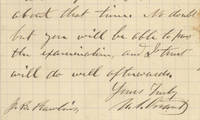
18752440305/06/1875. <blockquote><p>An uncommon handwritten letter as President showing Grant supporting Rawlins son after the General's death</p></blockquote><p>Ulysses S. Grant met John Rawlins in Galena Ill. where they both lived before the Civil War. Rawlins was a lawyer who did work for the Grant family business and the two men became close. When Grant was appointed brigadier general in August 1861 he immediately added Rawlins onto his staff as adjutant; Rawlins effectively acted as Grant’s chief of staff for the rest of the war. Rawlins rose to the rank of brevet major general by war’s end and during the conflict was Grant's chief defender. General James Harrison Wilson said of him ""John A. Rawlins all things considered was the most remarkable man I met during the Civil War…"" That is a remarkable statement from one who served under McClellan and Grant and was a cavalry leader in his own right. Some historians believe that without Rawlins Grant would not have soared to the heights he achieved in the war. He was appointed Secretary of War when Grant was elected President of the United States. He died in September 1869.</p><p>After Rawlins death Grant became guardian of his three children. Rawlins had a son James Rawlins who sought to follow his father's military footsteps deciding to go West Point where Grant himself had gone. Of the 39 West Point cadets who graduated in 1843 along with Grant four died in the Mexican-American War 15 became Union generals during the Civil War and 3 served as Confederate generals during the war. Ironically all three Confederate generals from the class of 1843 were from northern states. Young Rawlins entered the Military Academy.</p><p>On May 29 1875 Grant announced he would not run for a 3rd term a momentous announcement at the time.</p><p><strong>Autograph letter signed</strong> Long Branch NJ June 5 1875 to James Rawlins. <em>""Dear Jimmie Your letter of the 3rd instant was received yesterday. If I can go to West Point at all it will be about the 16th of this month. I do not know when your examination takes place but I think about that time. No doubt you will be able to pass the examination and I trust will do well afterwards.â€</em></p><p>Whether or not he passed the examination Rawlins decided on a different career path. Grant got him a job working for former New York governor Edwin Morgan.</p><p><img class=""alignnone wp-image-23729 size-post-window"" src=""https://cdn.raabcollection.com/wp-content/uploads/20231204152429/Folder-site-7-1600x1327.jpg"" alt="""" width=""1600"" height=""1327"" /></p> unknown
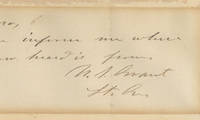
1864334181864. <blockquote><p>This letter has been for several generations in a private collection and is unpublished</p></blockquote><p>In January 1864 General Ambrose E. Burnside was asked to reorganize the IX Corps. He asked for and was granted permission by Secretary of War Edwin Stanton to form a division of “colored troops.†The 4th Division of the IX Corps infantry would be all black troops commanded by General Edward Ferrero.</p><p>The regiments were divided into two brigades; the first brigade was made up by the 27th 30th 39th and 43rd USCT. The second brigade was the 30th Connecticut Colored Infantry only 4 companies formed then consolidated into 31st USCT 19th 23rd 31st USCT. The 28th and 29th USCT regiments would be added to the second brigade. These regiments came from all across the North.</p><p>When the 4th Division of the IX Corps left Camp Stanton in Annapolis Maryland they were paraded in front of President Abraham Lincoln and General Burnside in Washington DC. The 23rd joined the division when the men marched across the bridge into Virginia.</p><p>In March 1864 Ulysses S. Grant was appointed by President Abraham Lincoln commander of the Union Armies. Grant developed a strategy to defeat the Confederacy by placing his army between the rebel capital of Richmond and Gen. Robert E. Lee’s Army of Northern Virginia. Grant moved southeast to try to create a wedge between Lee and Richmond but Lee's army successfully followed up the engagements by foiling that maneuver. Then Grant's assaults at Cold Harbor his most mistaken plan of the war and the one he most regretted resulted in a sharp defeat. Grant thus found that he was unable to take Richmond directly.</p><p>Next Grant focused on Petersburg due south of Richmond.</p><p>If Grant could take Petersburg then the Confederates would have to abandon Richmond. Grant's attempt to take it quickly failed so by mid-June 1864 Lee ended up in Petersburg with the Appomattox River protecting his back and surrounding the city below the river he built two lines of works that covered the entire area. Grant would besiege Petersburg and the IX corps played a part under General Ferrero.</p><p>The 23rd USCT became the first colored troops to fight in “directed combat†against Lee’s Army of Northern Virginia. The skirmish was fought at the intersection of Catharpin and Old Plank Roads originally Orange Plank Road on May 15 1864. The 23rd was at the Chancellorsville ruins when the Union 2nd Ohio Cavalry was chased by General Thomas Rosser’s Confederate Cavalry Brigade. The 2nd asked for assistance and the only soldiers nearby were General Edward Ferrero’s colored division. The 23rd USCT “double quicked†the two miles to the intersection and drove back Rosser’s cavalry as ordered by General Ferrero. The black soldiers were cheered by the 2nd Ohio who now gave chase to Rosser’s cavalry. This battle action proved to the white troops that black soldiers would fight against the Confederate army.</p><p>With the end of that campaign Grant ended up besieging the city and his Army of the Potomac built works from the river northeast of Petersburg down to south of the city as far as they could go. The Confederates controlled all the ground from Grant’s southern tip west up to the river. Grant’s main objective during the ten-month Siege of Petersburg was to extend his lines south and west to cut Lee’s railroad links and encircle him at the same time. Lee’s problem was that he was stuck in Petersburg and every Union successful extension west forced him to extend his lines. And every time he had to extend those lines became thinner.</p><p>In mid June as Grant prepared for his long assault on Petersburg Ferrero's black soldiers were now placed in the trenches with the other three divisions. The part of the line occupied by the IX Corps was very near the enemy's works and an incessant firing was kept up during the siege resulting in a daily loss of men killed or wounded. While there was a comparative quiet in front of the other corps positions the men of the IX Corps were subjected to the terrible strain of a constant watchfulness and deadly exposure. The enemy seemed to be excited to an undue activity by the presence of Ferrero's Colored Division.</p><p>In late July 1864 during the Battle of the Crater Ferrero's men had been trained for the attack on the Confederate line. However due to a last minute change by General George G. Meade the black soldiers were the last to enter the battle instead of the first. The three white divisions of the IX Corps did not follow General Burnside’s plan and delayed the attack. By the time the colored troops entered the battle the Confederates were ready to counterattack. Before being driven into the Crater the black troops advanced further than the white troops. The Confederate counterattack was a furious attack that won the day for the Confederate army. The black troops sustained the worst casualties. Ferrero initially accused of dereliction in this duty was cleared.</p><p><strong>Autograph letter signed</strong> no date but during the early siege perhaps mid to late June 1864 to General Ferrero. <em>""General Ferrero please inform me where the firing now heard is from.""</em></p><p>This letter has been for several generations in a private collection and is unpublished. We are not aware of another letter of Grant to Ferrero.</p><p><img class=""alignnone wp-image-25018 size-post-window"" src=""https://cdn.raabcollection.com/wp-content/uploads/20231204144051/Folder-site-11-1600x1327.jpg"" alt="""" width=""1600"" height=""1327"" /></p> unknown
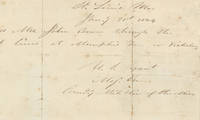
18643548131/01/1864. <blockquote><p>Written by Grant while on a visit to his family in St. Louis as he awaited his promotion to Lieutenant General</p></blockquote><p>His great victory at the Battle of Chattanooga in November 1863 made Major General Ulysses S. Grant the most prominent Union general. Soon legislation would be introduced in Congress to revive the rank of Lieutenant General—previously held only by George Washington and Winfield Scott—specifically to give Grant command of all Union armies. This Congress did on February 29 1864 and Grant would officially receive this promotion and the role of General-in-Chief on March 10.</p><p>In January 1864 Grant fresh from his victories in the West was still serving as the commander of the Military Division of the Mississippi overseeing Union operations in the Western Theater of the war. His activities that month focused on administrative and inspection tours of Kentucky and Tennessee and assessing supply lines. Finding the Cumberland Gap route for supplies unfeasible due to terrible road conditions he favored using the Nashville & Stevenson Railroad and the Tennessee River instead. More importantly he also concentrated on planning for the crucial 1864 spring campaign and the development of a grand strategy for the war. In a letter of January 19 to Gen. Henry Halleck demonstrating his proactive approach to ending the war Grant suggested a bold plan to invade North Carolina from New Bern to cut Confederate supply lines through Wilmington and capture Raleigh. Amidst all these activities Grant also took time to join his family in St. Louis for a short trip from January 27-February 3.</p><p><img class=""alignnone wp-image-35510 size-post-window"" src=""https://cdn.raabcollection.com/wp-content/uploads/20260125192231/Grant-Jan-31-1864-1-1600x664.jpg"" alt="""" width=""1600"" height=""664"" /></p><p>After his promotion Grant's subsequent strategy implemented from the field with the Army of the Potomac focused on simultaneous relentless pressure on Confederate forces leading to eventual victory.</p><p>Mrs. Bowen was the wife of Confederate general John Bowen a fine military commander who battled Grant and his armies in the final defense of Vicksburg. Bowen would die of disease just as the battle concluded in 1863. The Bowens were from St. Louis and when Gen. Bowen first left St. Louis to enter the war his wife Mary was by his side leaving their two young children at the family home to be cared for by Mary's mother. It is known that Mrs. Bowen passed through the lines after her husband’s demise and her passing back and forth to St. Louis and her access to Grant suggest this pass was almost certainly. for her.</p><p><strong>Autograph document signed</strong> St. Louis Mo. January 31 1864. <em>“Pass Mrs. John Bowen through the Federal lines at Memphis Tenn. or Vicksburg Miss.â€</em> It is signed <em>“U.S. Grant Maj. Gen. commanding Mil. Div. of the Miss.â€</em> Grant was known to be helpful to southern women so this would be consistent with his practice. This must be one of the few papers Grant signed while on the brief visit to his family.</p><p><img class=""alignnone wp-image-25018 size-post-window"" src=""https://cdn.raabcollection.com/wp-content/uploads/20231204144051/Folder-site-11-1600x1327.jpg"" alt="""" width=""1600"" height=""1327"" /></p> unknown
18952307180032Century Co. New York 1895. Hardcover. Good. Volume 2 only. Bound in publisher's blue cloth. Gilt lettering on spine. Top edge gilt. Hardcover. Library stamps and markings. Shelf wear. Corner chipped. Century Co., New York hardcover
1885309308Charles Webster 1885-86. Hardcover. Fair. Both volumes in the full sheep bindings red and black morocco spine labels. The front board of Vol. I is present but detached hinges cracked but text blocks still firmly bound quite a bit of scuffing to the leather on Vol. II moderate rubbing all around the boards of Vol. II are a bit bowed. The fold-out in Vol. I is without tears or separations; the facsimile in Vol. II has four closed tears. All other maps and illustrations present as called for. Charles Webster hardcover
1886SKU1174403Charles L. Webster & Company 1886. Hardcover. Good. New York 1886; TWO VOLUMES COMPLETE; DATED 1885 AND 1886; exterior and binding in acceptable to good condition; leather covered boards; edge and corner wear; joints slightly split; housed in Mylar covers with flaps taped to paste-downs; 8vo - over 7 3/4" to 9 3/4" tall; marbled end papers; ALL ILLUSTRATIONS AND MAPS PRESENT; partial split at front hinge vol. I and rear hinge split with back strip mostly detached from spine vol. II; interior pages in very good condition; Interior is clean and unmarked; 584 and 647 pages; Additional shipping charges may be required due to the size and weight of book. Charles L. Webster & Company hardcover
1885mon0003934922Charles L. Webster 1885-01-01. Hardcover. Good. 1.7000 9.0000 5.9000. 2-volume set. heavy wear and rubbing soiling staining on the covers. pages tanned. Charles L. Webster hardcover
1885mon0003989806Charles L. Webster 1885-01-01. Hardcover. Good. 1.7000 9.0000 5.9000. 2-volume set. covers show minor wear pages lightly tanned and clean. Charles L. Webster hardcover
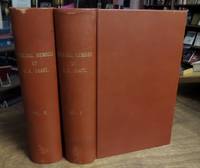
188547293New York: Charles L. Webster & Company 1885. Very Good. New York: Charles L. Webster & Company 1885 1886. First Edition. Two large octavo volumes; rebound in modern full brown morocco with leather labels and raised bands to spine; all edges marbled new marbled endpapers; 584pp. & 647pp. All maps illustrations and foldouts present including frontispieces with tissue guards. Mild shelfwear to boards; bindings sound; chipping to endpapers along margins with professional repair; light staining and toning; overall a Very Good and sound set in full leather.<br /> <br /> Nevins notes: "Written frantically while in a race with death these recollections rank with the best of the Civil War Period" Nevins II-59. Charles L. Webster & Company unknown
188598849Charles L. Webster 1885-01-01. Hardcover. Good. 9x5x1. 2 volume set 1885-1886 Webster volume one has tender binding and is missing the tissue guard for the frontis. Volume two intact. oversized and overweight. Please email for photos. Charles L. Webster hardcover
1885108071New York: Charles L. Webster & Co. 1885. First Edition. Full leather binding. Very Good. FIRST EDITION. Newly rebound In full polished brown calf bindings. Gold gilt lettering on spine. Leather has minor edge and surface wear. Very good plus condition. Pages all clean and bright with minimal toning. Marbled fore top and bottom edge of pages. Clean tight solid copy. Volume 1 584 pages. Volume 2 647 pages. ; 8vo - over 7¾" - 9¾" tall . Charles L. Webster & Co. hardcover
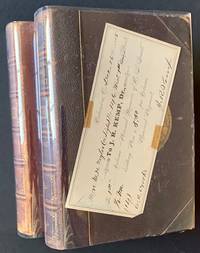
188620527New York: Charles L. Webster & Co 1886. 1/2 leather. Very Good. The 1885 1st edition in the publisher's less common 1/2 deluxe brown morocco over chocolate-brown boards. Complete in 2 volumes the first published in 1885 the second and final volume published in 1886. Both volumes solid and very presentable with lightly-rubbed gilt-titling along the spines and bright gilt-medallions at the front panels. A bit of light wear to the outer hinges and mild scuffing at the panels. Internally all plates present and no writing or markings to speak of save for 2 blank preliminary pages in Vol. II with light crayon. Thick uniform octavos matching edges pastedowns and endsheets. THIS COPY ALSO INCLUDES SOME VERY INTERESTING EPHEMERA such as the original 1885 printed receipt for the purchase of the set and a well-executed late 19th century pencil sketch of the set's "erudite" first owner a woman named Matilda Ziegler. Opposite the sketch is an original pasted-on memorial card of Matilda produced by the family. Charles L. Webster & Co unknown
1885mon0003244739Charles L. Webster 1885-01-01. Hardcover. Good. 1.7000 9.0000 5.9000. 2-volume set. Ex-library copies with usual markings. Green cloth covers with gilt show minor wear. Pages are tanned and clean. Charles L. Webster hardcover
1885233835Charles L. Webster & Co. 1885. First Edition. Hardcover. Poor. Yes it is the scarcest of the first editions. But I see only one or two online offerings of this work in worse condition than this one. The leather is heavily scuffed hinges are cracked although the bindings are still relatively firm the front gutter of Vol. II is split and the cloth is dampstained across the upper 10% to 20% of the covers and is separating from all four boards. The water damage affects the text blocks to a varying degree. On most pages it extends only an inch or so from the top. In a few cases including one of the plates the damage is to most of the page. Perhaps the only bright spot is that both of the fold-outs are intact and undamaged. Charles L. Webster & Co. hardcover
18693251406/04/1869. <p>The Dakota Territory was created by an Act of Congress on March 2 1861. Boundaries of the Dakota Territory changed on a number of occasions. Originally the territory comprised an area that included the present states of North Dakota South Dakota and much of Montana and Wyoming. From 1863 to 1864 the area of the territory was limited to the present day Dakotas. The territory included most of the present state of Wyoming and the Dakotas from 1864 to 1868. And from 1868 to 1889 the territory comprised the present states of North Dakota and South Dakota. The territorial capital was established in Yankton in 1861 and later removed to Bismarck in 1883.</p><p>When the final extent of the reduced territory was split and admitted to the Union as the states of North and South Dakota the Supreme Court of the Dakotas was abolished by operation of law and its function was taken over by the North Dakota Supreme Court and the South Dakota Supreme Court.</p><p><strong>Document signed</strong> Washington April 6 1869 appointing George W. French subject to the advice and consent of the Senate to be the Chief Justice of the Supreme Court of the Territory of Dakota.</p><p><img class=""alignnone wp-image-25018 size-post-window"" src=""https://cdn.raabcollection.com/wp-content/uploads/20231204144051/Folder-site-11-1600x1327.jpg"" alt="""" width=""1600"" height=""1327"" /></p> unknown