Ulysses S GrantBiblio.com
1 817 résultats
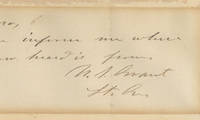
1864334181864. <blockquote><p>This letter has been for several generations in a private collection and is unpublished</p></blockquote><p>In January 1864 General Ambrose E. Burnside was asked to reorganize the IX Corps. He asked for and was granted permission by Secretary of War Edwin Stanton to form a division of “colored troops.†The 4th Division of the IX Corps infantry would be all black troops commanded by General Edward Ferrero.</p><p>The regiments were divided into two brigades; the first brigade was made up by the 27th 30th 39th and 43rd USCT. The second brigade was the 30th Connecticut Colored Infantry only 4 companies formed then consolidated into 31st USCT 19th 23rd 31st USCT. The 28th and 29th USCT regiments would be added to the second brigade. These regiments came from all across the North.</p><p>When the 4th Division of the IX Corps left Camp Stanton in Annapolis Maryland they were paraded in front of President Abraham Lincoln and General Burnside in Washington DC. The 23rd joined the division when the men marched across the bridge into Virginia.</p><p>In March 1864 Ulysses S. Grant was appointed by President Abraham Lincoln commander of the Union Armies. Grant developed a strategy to defeat the Confederacy by placing his army between the rebel capital of Richmond and Gen. Robert E. Lee’s Army of Northern Virginia. Grant moved southeast to try to create a wedge between Lee and Richmond but Lee's army successfully followed up the engagements by foiling that maneuver. Then Grant's assaults at Cold Harbor his most mistaken plan of the war and the one he most regretted resulted in a sharp defeat. Grant thus found that he was unable to take Richmond directly.</p><p>Next Grant focused on Petersburg due south of Richmond.</p><p>If Grant could take Petersburg then the Confederates would have to abandon Richmond. Grant's attempt to take it quickly failed so by mid-June 1864 Lee ended up in Petersburg with the Appomattox River protecting his back and surrounding the city below the river he built two lines of works that covered the entire area. Grant would besiege Petersburg and the IX corps played a part under General Ferrero.</p><p>The 23rd USCT became the first colored troops to fight in “directed combat†against Lee’s Army of Northern Virginia. The skirmish was fought at the intersection of Catharpin and Old Plank Roads originally Orange Plank Road on May 15 1864. The 23rd was at the Chancellorsville ruins when the Union 2nd Ohio Cavalry was chased by General Thomas Rosser’s Confederate Cavalry Brigade. The 2nd asked for assistance and the only soldiers nearby were General Edward Ferrero’s colored division. The 23rd USCT “double quicked†the two miles to the intersection and drove back Rosser’s cavalry as ordered by General Ferrero. The black soldiers were cheered by the 2nd Ohio who now gave chase to Rosser’s cavalry. This battle action proved to the white troops that black soldiers would fight against the Confederate army.</p><p>With the end of that campaign Grant ended up besieging the city and his Army of the Potomac built works from the river northeast of Petersburg down to south of the city as far as they could go. The Confederates controlled all the ground from Grant’s southern tip west up to the river. Grant’s main objective during the ten-month Siege of Petersburg was to extend his lines south and west to cut Lee’s railroad links and encircle him at the same time. Lee’s problem was that he was stuck in Petersburg and every Union successful extension west forced him to extend his lines. And every time he had to extend those lines became thinner.</p><p>In mid June as Grant prepared for his long assault on Petersburg Ferrero's black soldiers were now placed in the trenches with the other three divisions. The part of the line occupied by the IX Corps was very near the enemy's works and an incessant firing was kept up during the siege resulting in a daily loss of men killed or wounded. While there was a comparative quiet in front of the other corps positions the men of the IX Corps were subjected to the terrible strain of a constant watchfulness and deadly exposure. The enemy seemed to be excited to an undue activity by the presence of Ferrero's Colored Division.</p><p>In late July 1864 during the Battle of the Crater Ferrero's men had been trained for the attack on the Confederate line. However due to a last minute change by General George G. Meade the black soldiers were the last to enter the battle instead of the first. The three white divisions of the IX Corps did not follow General Burnside’s plan and delayed the attack. By the time the colored troops entered the battle the Confederates were ready to counterattack. Before being driven into the Crater the black troops advanced further than the white troops. The Confederate counterattack was a furious attack that won the day for the Confederate army. The black troops sustained the worst casualties. Ferrero initially accused of dereliction in this duty was cleared.</p><p><strong>Autograph letter signed</strong> no date but during the early siege perhaps mid to late June 1864 to General Ferrero. <em>""General Ferrero please inform me where the firing now heard is from.""</em></p><p>This letter has been for several generations in a private collection and is unpublished. We are not aware of another letter of Grant to Ferrero.</p><p><img class=""alignnone wp-image-25018 size-post-window"" src=""https://cdn.raabcollection.com/wp-content/uploads/20231204144051/Folder-site-11-1600x1327.jpg"" alt="""" width=""1600"" height=""1327"" /></p> unknown
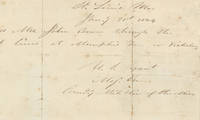
18643548131/01/1864. <blockquote><p>Written by Grant while on a visit to his family in St. Louis as he awaited his promotion to Lieutenant General</p></blockquote><p>His great victory at the Battle of Chattanooga in November 1863 made Major General Ulysses S. Grant the most prominent Union general. Soon legislation would be introduced in Congress to revive the rank of Lieutenant General—previously held only by George Washington and Winfield Scott—specifically to give Grant command of all Union armies. This Congress did on February 29 1864 and Grant would officially receive this promotion and the role of General-in-Chief on March 10.</p><p>In January 1864 Grant fresh from his victories in the West was still serving as the commander of the Military Division of the Mississippi overseeing Union operations in the Western Theater of the war. His activities that month focused on administrative and inspection tours of Kentucky and Tennessee and assessing supply lines. Finding the Cumberland Gap route for supplies unfeasible due to terrible road conditions he favored using the Nashville & Stevenson Railroad and the Tennessee River instead. More importantly he also concentrated on planning for the crucial 1864 spring campaign and the development of a grand strategy for the war. In a letter of January 19 to Gen. Henry Halleck demonstrating his proactive approach to ending the war Grant suggested a bold plan to invade North Carolina from New Bern to cut Confederate supply lines through Wilmington and capture Raleigh. Amidst all these activities Grant also took time to join his family in St. Louis for a short trip from January 27-February 3.</p><p><img class=""alignnone wp-image-35510 size-post-window"" src=""https://cdn.raabcollection.com/wp-content/uploads/20260125192231/Grant-Jan-31-1864-1-1600x664.jpg"" alt="""" width=""1600"" height=""664"" /></p><p>After his promotion Grant's subsequent strategy implemented from the field with the Army of the Potomac focused on simultaneous relentless pressure on Confederate forces leading to eventual victory.</p><p>Mrs. Bowen was the wife of Confederate general John Bowen a fine military commander who battled Grant and his armies in the final defense of Vicksburg. Bowen would die of disease just as the battle concluded in 1863. The Bowens were from St. Louis and when Gen. Bowen first left St. Louis to enter the war his wife Mary was by his side leaving their two young children at the family home to be cared for by Mary's mother. It is known that Mrs. Bowen passed through the lines after her husband’s demise and her passing back and forth to St. Louis and her access to Grant suggest this pass was almost certainly. for her.</p><p><strong>Autograph document signed</strong> St. Louis Mo. January 31 1864. <em>“Pass Mrs. John Bowen through the Federal lines at Memphis Tenn. or Vicksburg Miss.â€</em> It is signed <em>“U.S. Grant Maj. Gen. commanding Mil. Div. of the Miss.â€</em> Grant was known to be helpful to southern women so this would be consistent with his practice. This must be one of the few papers Grant signed while on the brief visit to his family.</p><p><img class=""alignnone wp-image-25018 size-post-window"" src=""https://cdn.raabcollection.com/wp-content/uploads/20231204144051/Folder-site-11-1600x1327.jpg"" alt="""" width=""1600"" height=""1327"" /></p> unknown
1342126351.Ghardcover. Good. Access codes and supplements are not guaranteed with used items. May be an ex-library book. hardcover
3838334310.Gpaperback. Good. Access codes and supplements are not guaranteed with used items. May be an ex-library book. paperback
9788589206457-11-09752HABERMANN. New. HABERMANN unknown
9786555268676-11-23486MIZUNO. New. MIZUNO unknown
9788578900847-11-09750Servanda. New. Servanda unknown
1981509897Houghton Mifflin 1981. First Edition. Hardcover with Dust Jacket. FINE/NEAR FINE. SIGNED and INSCRIBED by Elytis on half-title 'For Stathis and Ralph' in GREEK. First English Edition First Printing. 74pp. Orange speckled paper over boards with blue-gilt lettering to front cover backed in blue finished cloth with silver-gilt spine lettering red endpapers. An exceedingly clean and crisp copy. Dust jacket has some trivial rubbing to head and tail of spine entirely crisp and bright otherwise. Ralph Sylvester and Stathis Orphanos were publishers of the fine-press publishing company 'Sylvester & Orphanos.' Stathis was a noted photographer and born of Greek parents maintaining a residence on the island of Samos throughout his life. First published in Greece in 1978 the year before Elytis was awarded the Nobel Prize Maria Nefeli was a stark departure from the earlier work that had won him renown as the greatest Greek poet of his generation. Its novelty gave many early readers pause but 'despite the initial reservations voiced by some critics Maria Nefeli came to be regarded as the summa of Elytis's later writings.' Poetry Foundation. Houghton Mifflin hardcover
0395294657.Ghardcover. Good. Access codes and supplements are not guaranteed with used items. May be an ex-library book. hardcover
1981Q-0395294657Houghton Mifflin Co 1981-01-01. Hardcover. New. In shrink wrap. Looks like an interesting title! Houghton Mifflin Co hardcover
200987768Pediment Publishing; Museum. New. 2009. Paperback. 159725228X . FREE UPGRADE to Courier/Priority Shipping Upon Request - IN STOCK AND IMMEDIATELY AVAILABLE FOR SHIPMENT - Flawless copy brand new pristine never opened -- 120 pages; 164 illus. -- with a bonus offer-- . Pediment Publishing; Museum paperback
20161-3330738332Novas Edições Acadêmicas 2016. Paperback. New. 220 pages. Portuguese language. 8.66x5.91x0.50 inches. Novas Edições Acadêmicas paperback
1998Q-1888952954Cumberland House Publishing 1998-08-01. Paperback. New. New. In shrink wrap. Looks like an interesting title! Cumberland House Publishing paperback
20192-9402416536Springer Nature 2019. Paperback. New. reprint edition. 496 pages. 9.25x6.10x1.12 inches. Springer Nature paperback
2018x-9402415505Springer 2018. Hardcover. New. 486 pages. 9.25x6.25x1.25 inches. Springer hardcover
1930MASTER157342IPORTLAND OR.: KILHAM PRINTING. G IN WRAPS. WRAPS EDGEWORN & SOILED SMALL TEARS. Pages: 111. . 1930. TRADE PAPERBACK. PAGES LIGHTLY TONING. INTERIOR CLEAN & TIGHT. . KILHAM PRINTING paperback
19901-0940450585Library of America 1990. Hardcover. New. 1199 pages. 8.00x5.00x1.50 inches. Library of America hardcover
0267290071.Ghardcover. Good. Access codes and supplements are not guaranteed with used items. May be an ex-library book. hardcover
20142-8494864777HRM Ediciones 2014. Paperback. New. 100 pages. Spanish language. 8.46x5.51x0.63 inches. HRM Ediciones paperback
1876375056Washington D.C. 1876. 44th Congress 1st session Senate Ex. Doc. No. 81. 6pp. 8vo. Modern morocco backed marbled paper boards. 44th Congress 1st session Senate Ex. Doc. No. 81. 6pp. 8vo. Forwarding a report by General Terry this government document was the first official account Custer's defeat at the Little Big Horn. unknown
187610470Washington: Government Printing Office 1876. Hard Cover. Good binding. Octavo. 815 pp. First edition. In publisher cloth. Edgeworn with closed tear to the top of the spine; staining and discoloration to to the rear board as well as to the textblock edges; minor silverfishing to the front pastedown; contents evenly toned throughout. <br /> <br /> A fairly uncommon volume with General Alfred Terry's report of General Custer's defeat at the the Battle of Little Bighorn. Also reprinted is Major Marcus Reno's report. Both reports offer details related to the movement prior to the engagement information on which companies were involved and the losses. A larger than life individual Custer's mystique has been complicated and controversial in relation to the United States government's policies and actions related to the indigenous Americans throughout the 19th century. Government Printing Office unknown
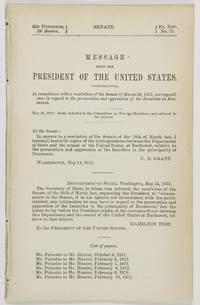
187255322Washington D.C.: United States Government Printing Office 1872. First edition. Softcover. vg. Octavo. 14pp. No wrappers with printed text starting on the first page.<br /> <br /> The printed text date May 14th 1872 relays an official Executive Communication from U.S President Ulysses S. Grant granting the United States Senate's Committee on Foreign Relations' previous request for information concerning the ongoing persecution of Jews in Romania and authorizing the transfer of said information from the U.S. State Department. The information here remitted to the Senate consists of a series of 14 pieces of correspondence dated October 6th 1871 - May 13th 1872 between the then U.S Consul to Romania Benjamin F. Piexotto 1834-1890 Second Assistant Secretary of State William Hunter Jr. 1805-1886 and U.S Secretary of State Hamilton Fish 1808-1893. The initial sections include the President's order the Secretary of State's introductory statement and a full list of correspondences included in chronological order.<br /> <br /> In the 1860s and 70s - following newly established autonomy from the Ottoman empire the unification of the Principalities of Moldavia and Wallachia and the ascendancy of the newly elected Prince Domnitor Alexandru Ioan Cuza - Romania saw a new extreme wave of anti-Semitic measures laws and attitudes. At the prompting of their respective Jewish citizens a number of countries in the international community voiced their opposition to these developments and sought to put pressure on the new Romanian government. In 1870 the United States entered the fray with the appointment of Jewish-American lawyer Benjamin F. Piexotto 1834-1890 as the new American consul in Bucharest. <br /> <br /> Piexotto served in Romania from 1871-1876 and was able to improve the conditions for Romania Jews during his tenure. He promoted the ideas of the Haskalah The Jewish Enlightenment and modernization to the community and among his numerous endeavors was responsible for improvements in modern Jewish education through the establishment of the Society for the culture of the Israelites in Roumania Societate Pentra Cultura Israelit Romania. Piexotto also funded the Roumänische Post in an effort to combat anti-Semitism in the Romanian Press. Ultimately his efforts are credited for strengthening Jewish community structures in the country and ultimately laying the groundwork for eventual Jewish emancipation as allowed for in the provisions of the 1878 Treaty of Berlin. <br /> <br /> Minor age toning and smudges to pages throughout. In overall very good condition. Protected in modern mylar. Full title: Message from the President of the United States Communicating In compliance with a resolution of the Senate of March 28th 1872 correspondence in regard to the persecution and oppression of Isrealites in Roumania.<br /> <br /> Resource: <br /> Gartner Lloyd P. Roumania America and World Jewry: Consul Peixotto in Bucharest 1870–1876. American Jewish Historical Quarterly Vol. 58 No. 1 September 1968 pp. 24-56 59-117. [United States Government Printing Office] unknown
1877101110<p>Washington D.C. Government Printing Office 1877. 1877. Fair. - Octavo 9 inches high by 5-3/4 inches wide. Softcover bound in printed self wraps. Once bound in with other pamphlets and removed the pamphlet is disbound with stab marks and remnants of stitching along the left edge. The cover pages are stained with chips along the edges. 49 pages. A fair complete copy of this RARE publication.</p><p>First edition.</p><p>President Ulysses S. Grant's message following the 1872 through 1876 joint boundary survey charting the U.S.-Canada border along the 49th parallel. The survey authorized by Congress was made up of both Canadian and U.S. surveyors who mapped the boundary placing monuments along the frontier line. The official report of the expedition was later compiled by U.S. Commissioner Archibald Campbell and the Chief Astronomer Captain William J. Twining.</p> Washington, D.C. Government Printing Office, 1877. paperback
187649942Washington: Government Printing Office 1876. 1876. First edition. First Edition. Disbound. 8pp. House of Representatives. 44th Congress 1st Session. Ex. Doc. No. 145. Merritt's report multiple causes starting with an under-allocation of actual needs combined with claims that the deficiency is caused by feeding visiting Indians who belong to other agencies and also some of the "northern wild tribes". Fine. [Government Printing Office], 1876. unknown
1875007280Washington: Government Printing Office 1875. Special Session Senate Ex. Doc. No. 2. March 17 1875.--Read and ordered to lie on the table and be printed. "Copies of papers relating to proposed emigration to the Black Hills country in the Sioux Indian reservation and measures taken by the military authorities in the matter." Discussion on background to the Little Big Horn massacre. 15 pp. Disbound government document. Spine edge is creased with chipping and small tears. Edges of document are darkened and last pages no text are quite brown and dark. Bottom edge is slightly rippled corners creased. Text is crisp and easily legible. Document in VG- condition. Paperbound. Very Good-. Size: Approx. 5 3/4" x 9". Native American. Government Printing Office Paperback