12 résultats
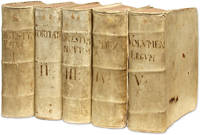
1598710761598. Venice: Giunta 1598. 6 vols in 5 bks. Venice: Giunta 1598. 6 vols in 5 bks. Impressive 1598 Edition of the Corpus Iuris Civilis Corpus Juris Civilis Justinian I 485-565CE Emperor of the East Accursius c.1182-c.1260 Glossator. Leconte Antoine 1517-1586 Commentary. Cujas Jacques 1522-1590 Commentary. Douaren Francois 1509-1559 Commentary. De Bottis Jacopo Anello 1524-1581 Commentary. Caravita Agostino d.1580 Commentary. D. Iustiniani Imperatoris Opus Prudentum Responsa Caesarumque Rescripta Complectens. Quinque Voluminibus Distinctum Multis Legibus Additis Ac Iuris Consultorum Cuiacii Dyonisii Gothofredi & Iacobi Anelli de Bottis Augustinque Caravitae Glossis Additionibus Atque Nonnullis Aliis Illustratum. Utieorum Omnium Elenchus Indicabit. Novissima Editio Juntarum. Venice: Apud Iuintas 1598. Six volumes in five books. Complete set. Main text in parallel columns with linear glosses. Each volume preceded by title page title page of Volume I preceded by general title page. Folio 9-1/2" x 6-3/4". Contemporary vellum early hand-lettered titles and volume numbers to spines speckled edges. Some spotting and staining light wear to extremities corners and spine ends bumped front joint of Book IV cracked a few small wear holes to front boards of Books IV and V early armorial bookplates to front pastedowns small early owner stamp to front free endpapers vellum beginning to crack through pastedowns of a few volumes front free endpaper lacking from Book I. General title page is a copperplate with an architectural border volume title pages each with large woodcut Giunta device printed in red and black. Light to moderate toning faint dampstaining and light foxing in places early repair to leaf a1 in Book II with content replaced in manuscript chipping and edgewear to general title page with some loss to image early owner signatures to title pages of each volume except Volume VI. $4500. Commissioned by the Emperor Justinian I the body of works known as the Corpus Iuris Civilis reformed restated and preserved Roman law. The Code is the reformed legal system. The Novels is a compilation of additional laws and amendments. The Institutes is an elementary textbook about it. And the Digest is a collection of commentary by leading jurisconsults. unknown books
1562710271562. Paris 1562. Interleaved and annotated. Paris 1562. Interleaved and annotated. Interleaved Copy Annotated by a French Nobleman Justinian I 485-565 CE Emperor of the East. Hotman Francois 1524-1590 Editor. Digestorum seu Pandectarum Libri Quinquaginta ex Pandectis Florentinis Nuper in Lucem Emissis Quoadeius Fieri Potuit Repraesentati & In Septem Partes Justiniani Sententia Distincti Adjectis Brevibus Francisci Hotomanni Parisiensis I.C. Clarissimi Summariis. Paris: Apud Guilielmum Merlin in ponte nummulariorum et Guilielmum Desboys 1562. civ 258 pp. Interleaved. Octavo 6-1/2" x 4-1/4". Contemporary vellum armorial devices to boards lettering piece to spine. Soiling and a few stains and minor nicks some wear to spine ends pastedowns loose a few chips to vellum along fore-edge of front board early owner bookplate to front pastedown early owner signature dated 1729 to front free endpaper crack in text block between front free endpaper and title page. Moderate toning to text light foxing to a few leaves occasional faint dampstaining to foot of text block. Annotations in neat contemporary hand some quite extensive to several leaves and about a third of the interleaves occasional early underlining. $750. This volume is first of a seven-volume edition of the Novels one of the four components of the Corpus Juris Civilis. It belonged to a French noble Charles Du Ruisseau "in supremo senatu Patroni." Excepting one page in Latin in a different hand the annotations most likely by Du Ruisseau are in French. Mostly analytical they reflect considerable engagement with the text. Several include cross-references and references to other sections of the Corpus Juris Civilis. unknown books
1572D4701Venice: F. Rampazeto 1572. Hardcover. Very Good. 8vo 175 x 120mm. 48 366pp. Signatures: a-f 8; A-YY 8; ZZ 8 -ZZ7-8 blank. Woodcut printers device on title of basilisk fighting a bird with motto Terrena coelestibus obsunt; in an architectural frame and woodcut historiated headpiece woodcut vignette beginning book of the Institutiones; on leaf 212r a full-page representation of the arbor civilis. Text is all-around gloss; printed in black and red. Dedicatory letter of H. Messaggius to Senator Federicus Baduarius prelim. leafs 2 is dated 1558. Period vellum three raised bands; leaves slightly offset slightly browned; hinge cracked at rear some quires loose rear pastedown glue-stained. The Corpus Iuris Civilis or the Justinian Code was the result of Emperor Justinians desire that existing Roman law be collected into a simple and clear system of laws or code. Tribonian a legal minister under Justinian lead a group of scholars in an effort to codify existing Roman law. The result was the first Justinian Code completed in 529. This code was later expanded to include Justinians own laws as well as two additional books on areas of the law. In 534 the Justinian Code made up of the Code the Digest and the Institutes was completed. Justinians collections were in ancient times always copied separately and afterwards they were printed in the same way. This part of the Institutiones falls under the whole Corpus Iuris Civilis is an early example before the unification under this heading. The present name of Justinians codification was only adopted in the 16th century when it was printed in 1583 by Dionysius Gothofredus. The legal thought behind the Corpus Juris Civilis served as the backbone of the single largest law reform of the modern age the Napoleonic Code which marked the abolition of feudalism. <br/><br/> [F. Rampazeto] hardcover books
1501707701501. Venice: Per Paganinum de Paganinis May 25 1501. Venice: Per Paganinum de Paganinis May 25 1501. 1501 Venetian Edition of the Institutes in a Contemporary Binding Justinian I 485-565 CE Emperor of the East. Accursius Accorso Francisco c.1182-c.1260 Glossator. Gradibus Johannes de active 15th-16th c. Instituta cum Summariis. Venice: Per Paganinum de Paganinis May 25 1501. 152 i.e. 140 ff. Text in parallel columns with linear gloss. Octavo 6-3/4" x 4-3/4". Contemporary calf blind frames and ornaments to boards raised bands to spine clasps lower clasp lacking strap and buckle endpapers renewed inner margins of title page and leaf s1 fol. 137 reinforced. Light rubbing to boards light gatoring to spine rubbing and light wear to spine ends rubbing with heavier wear to corners. Printed throughout in red and black "I" of "Instituta" on title page colored red. Moderate toning faint in some places very faint dampstaining some edgewear to preliminaries and final three leaves annotations in early hand to title page and its verso the verso of final leaf and some leaves of the text. $7500. Commissioned by the Emperor Justinian in 530 CE the body of writings known collectively as the Corpus Juris Civilis restated all existing Roman law. It has four components: the Code Novels Institutes and Digest. Intended for students the Institutes is a synopsis of the reformed legal system. Rediscovered during the late middle ages it became the standard textbook of Roman law. The main text of our 1501 imprint is accompanied by Accorso's great Glossa Ordinaria or Magistralis. A Professor of Law at Bologna and a leading figure in the revival of classical jurisprudence Accorso examined every extant note and commentary when he prepared his epochal edition of Justinian's Institutes Digest and Code. This massive effort eliminated much of the obscurity and contradiction introduced by earlier writers. His editions which superseded all previous attempts remained definitive until the 1583 revision by Denis Godefroy. OCLC locates 3 copies 1 in North America Library of Congress. Not in Adams. Censimento Nazionale delle Edizioni Italiane del XVI Secolo CNCE 14113. unknown books
1505707811505. 1505 Paris Edition of the Institutes Justinian I 485-565 CE Emperor of the East. Accursius Accorso Francisco c.1182-c.1260 Glossator. Chappuis Jean Editor. Institutiones Imperiales: Ordinate Glosis Textuales Divisiones Habentur. Patescit Grecum Utile cum Expositione Succincta. Universi Tituli Alphabetico Ordine Ponuntur. Summaria Rubra Multis Adiectis Sunt Textibus Immixta. Orbibus Variis Vallata Civilis Arbor hic exaratur fo. cxvij. Plurima et Textuum et Glosarum Turpis Menda Expurgatur. Tituli Continuatione Patenti Redduntur Clari. Involute Materie Nectuntur Tabula Singulari. Medulle Glosarum Omnibus in Marginibus Sunt Extracte. Versibus Rubrice Iuris Cesarei Leguntur Aperte. Multiplices bone Glose plerisque Locis Sunt Apposite. Paris: Per Udalricum Gering et Magistrum Bertholdum Rembolt December 5 1505. xii 117 ff. Text in parallel columns with linear gloss. First letters of the verses that follow Institutiones Imperiales on title page from an anagram "opus optimum." Two-page table of descents. Folio 10" x 7". Contemporary blind-stamped calf raised bands to spine clasps lacking hasps present. Moderate rubbing and a few minor scuffs to boards heavier rubbing to extremities corners and spine ends worn calf worn away from two spine bands a few cracks to text block signature n ff. 97-104 detached and moderately edgeworn. Printed throughout in red and black large crible printer device and decorative borders to title page crible initials and table of descents. Moderate toning and occasional light soiling and foxing early annotations to endleaves and title page additional early annotations and underlining to some leaves in the text. $5000. Commissioned by the Emperor Justinian in 530 CE the body of writings known collectively as the Corpus Juris Civilis restated all existing Roman law. It has four components: the Code Novels Institutes and Digest. Intended for students the Institutes is a synopsis of the reformed legal system. Rediscovered during the late middle ages it became the standard textbook of Roman law. The main text of our 1501 imprint is accompanied by Accorso's great Glossa Ordinaria or Magistralis. A Professor of Law at Bologna and a leading figure in the revival o. unknown books
1561709811561. Basel: Per Ioannem Hervagium 1561. First edition. Basel: Per Ioannem Hervagium 1561. First edition. Edited by a "Reformed" Lawyer and Dedicated to Queen Elizabeth I Justinian I 485-565CE Emperor of the East. Haloander Gregor 1501-1531 Translator and Editor. Agylaeus Henricus 1532 or 1533-1595 Editor. Iustiniani Principis Novellae Constitutiones Latine Ex Gregorii Haloandri et Henrici Agylaei Interpretatione Ad Grecum Scrimgeri Exemplar Nunc Primum Edite. Quibus Suis Locis Interferiter Quicquid Vetus Versio Amplius Habet Atque Proximis Editionib. Ex Vetustis Libris Ac Iuliani Epitme Aspersum Est. In qua Editione Henrici Agylaei Opera Diligentem tum Variarum Lectionum Annotationem Tum Haloandrice Versionis Castigationem Invenire est. Item Eiusdem Iustiniani Edicta Iustini Tiberii Leonis Philosophi Constitutiones; & Una Zenonis Quae ad Titulum Codicis de Privatis Aedificiis Pertinet: Henrico Aegylaeo Interprete. Postremo Canones Sanctorum Apostolorum per Clementem in Unum Congesti Gregorio Haloandro Interprete. Basel: Per Ioannem Hervagium 1561. xxxii 598 2 pp. Quarto 9-1/4" x 6-1/2". Contemporary limp vellum early hand-lettered title to spine ties lacking. Minor soiling a few small stains and few tiny worm holes some wear to corners a few minor tears to spine ends front joint starting at ends front pastedown worn and partially detached text block somewhat loose vellum beginning to crack though rear pastedown. Faint dampstaining to head of text block moderate toning foxing and light browning in places mild edgewear to corners of preliminaries recent early owner inscription to front free endpaper. $2500. First edition. This collection of legal texts begins with the first appearance of a revised edition with original commentary by teh Dutch jurist Agylaeus of Gregor Haloander's complete translation of the Novels one of the four components of the Corpus Juris Civilis. This is followed by a group legal texts from other sources edited with commentary by Agylaeus Including: De Indulgentia Tributariorum Reliquorum Tiberii Imperatoris de Divinis Domibus Constitutio Imperatoris Leonis Augusti Novellae Constitutiones Imperatoris Leonis Augusti Novellae Constitutiones and Zenonis Imperatoris de Novis Operibus Constituio Eodem Interprete. He also includes Haoloander's version of the Apostolic Canons of Pope Cleme. unknown books
1547WB17559Paris: Vivant Gaultherot 1547. Hardcover. Very Good. 16mo 113 x 80mm. Gaultherots woodcut printers placard and cherub head Avec Privilege on title page. Pagination: 8 332pp. Signatures: dagger8 a-z8 A-S8 T4. Later French calf embossed with heraldic lion passant on covers gilt tooled cornerpieces and five gilt fleurons on spine four raised bands still with manuscript binders waste; good compact copy of this cornerstone publication for 16th century French legal education a rare survival; some light edgewear: headcap slightly chipped corners lightly bumped; internally clean though some minor marginal worming at times in text altogether solid. Title inscribed with former owners initials and dated 1702 possibly von Clodh suggesting German ownership by the early 18th century. <br/><br/>Rare pocket edition of the Institutes of Justinian known as the Institutions impériales in French and printed in Paris by Vivant Gaultherot in 1547; following two earlier editions in 1543 and 1544. There were at least five more editions of this French translation printed between 1547 and 1558. As early as the 12th century French legal students began to refine their study and practice of law toward a perfected Justinian system. This interest was largely owed to the spread of the scientific study of pure Roman law initiated at the University in Bologna. The Bologna revival as it was known made its way first to the law university at Montpellier and then spread elsewhere in France. Over the following centuries demands for new translations of the Justinian Institutes were doubtless tied to the foundation of several new French universities. Nicolaus de LEscut d. 1580 editor and translator of the Institutions impériales was an early modern jurist diplomat and secretary to Antoine the Good Duke of Lorraine. LEscuts translators note states he took grosse peine or great trouble in this undertaking so the reader would understand the text plus facilement. The Bologna revival at medieval universities across Europe and the growing interest in new translations of the Justinian Institutes introduced ideas of Roman law to the provinces. See Sherman Roman Law in the Modern World pp. 227-228. Rare OCLC locates one copy held in the US by the LC no. 77227442. See also Bibliographie des éditions parisiennes du 16e siècle no. BP16_112725. Vivant Gaultherot hardcover books
1562709451562. Paris 1562. Paris 1562. A Respected Edition of the Novels Justinian I 483-565 CE Emperor of the East. Holoander Gregor 1501-1531 Translator and Editor. Scrimger Henry 1506-1572 Editor and Annotator. Novellarum Constitutionum DN. Iustiniani Principis Volumen Quod Authenticon Vocant Gregorio Haloandro Interprete Ad Scrimgerianam Editionem Diligenter Collatum Ac Sedulo Emendatum: Cui Accesserunt Canones Apostolorum. Feudorum Libri Duo. Constitutiones Lothari III. & Friderichi II. Impp. Extravagantes Henrici VII. Imp. Tractatus de Pace Constantiae: Et Nunc Recens Iustiniani Imperatoris Edicta Henrico Agylaeo Interprete. Paris: Apud Gulielmum Merlin 1562. viii 332 4 ff. Last leaf blank. Octavo 6-1/4" x 4-1/4". Contemporary vellum blind panels enclosing large blind arabesques to boards pastedowns renewed. Negligible light soiling boards slightly bowed spine ends bumped owner signature clipped from upper corner of front free endpaper later owner annotation to following endleaf early owner signature to head of title page. Moderate toning to text a few chips and some edgewear to front endleaves. $1250. Along with the Institutes Code and Digest the Novels is one of the writings known collectively as the Corpus Juris Civilis. The first three books were commissioned by the Justinian I in 530CE. The Code is the restated code of law the Digest is a compilation of legal opinions and the Institutes is an introductory textbook on the Code. The Novels is a compilation of laws enacted after the publication of the Code. The subsequent influence of these books on European jurisprudence is difficult to overestimate. Haloander was one of the great sixteenth-century authorities on Roman law. His edition of the Novels includes the Peace of Constantine Edict of Milan the act that recognized the legitimacy of Christianity in the Roman Empire edicts of the Holy Roman Emperors Henry VII reigned 1165-1197 and Frederick II reigned 1194-1250 and a collection of papal legislation falsely attributed to Pope Clement I reigned 88-99CE the so-called "False Decretals." Adams A Catalogue of Books Printed on the Continent of Europe J685. unknown books
1588715191588. Cologne: Apud Ioannem Gymnicum 1588. Cologne: Apud Ioannem Gymnicum 1588. Influential Commentaries Code and Digest Cujas Jacques 1522-1590. Justinian I 483-565 CE Emperor of the East. Paratitla in Libros Quinquaginta Digestorum Seu Pandectarum Item in Libros Novem Codicis Imperatoris Iustiniani. Ex Postrema Auctoris Recognitione. Cologne: Apud Ioannem Gymnicum Sub Monocerote 1588. xxviii 195 1; xxxvi 541 i.e. 521 pp. Two parts each with title page and individual pagination second part has title beginning Paratitla in Libros IX. Codicis Iustiniani. Bound with Cujas Jacques. Africanus Sextus Caecilius 2nd C. Ad Africanum Tractatus VIIII. Quibus Difficillimae Iuris Quaestiones Enodantur. Ex Postrema Auctoris Recognitione Castigate Editi. Accesserunt Indices Duo Copiosi Quorum Prior est Legum Africani Alter Materiarum. Cologne: Apud Ioannem Gymnicum Sub Monocerote 1588. xlviii 622 i.e. 624 pp. Octavo 6-1/4" x 4". Elaborately blind-tooled half blind-stamped pigskin over vellum with horizontal vertical and diagonal rules binding dated 1592 raised bands and faint early hand-lettered title to spine. Moderate soiling some rubbing to boards heavier rubbing to extremities with wear to corners spine ends bumped front hinge cracked front free endpaper lacking. Moderate toning light browning in places brief early annotations to a few leaves and title pages later owner stamps and markings to front pastedown and title page of Paratitla in Libros Quinquaginta Digestorum. $2500. Later editions. Cujas a professor of law at the universities of Cahors Bourges Valencia and Turin was the preeminent authority on Roman law in his day. The author of several commentaries he was also an important philologist who recovered and published the Codex Theodosianus and the Basilica. The first work in this volume contains important commentaries on first nine books of the Code the twelve-book legal code established by Justinian I and the 50th book of the Digest a 50-volume collection of judicial commentary that were originally published separately in 1569 and 1570. Both remained standard works into the nineteenth century. Ad Africanum Tractatus VIIII. is a commentary on the Quaestiones of Sextus Caecilius Africanus a collection of legal cases included in the. unknown books
1530691021530. Paris 1530. A Pocket Edition. Paris 1530. A Pocket Edition. Handsomely Printed Pocket-Sized Edition with Commentaries by Sassoferrato Justinian I 483-565 CE Emperor of the East. D'Aurigny Gilles Editor. Sassoferrato Bartolo de 1313-1357 Glossator. Textus Infortiati: Domini Justiniani Imperatoris Sacratissimi. Cum Summariis. Paris: Francois Regnault c.1530. 290 24 ff. Main text in parallel columns. Octavo 5-1/2" x 3-3/4". Recent three-quarter cloth over paper-covered boards contemporary thumb-tabs to fore-edge of text block early hand-lettered title to top-edge endpapers renewed. Light soiling light rubbing to extremities. Title page and text printed in red and black handsome woodcut title-page vignette of Justinian and his court repeated on verso of third leaf and recto of final leaf large Regnault elephant device to verso of leaf preceding "Tabula Legum" and verso of final leaf crible initials. Light toning light soiling and small stain to title page library stamp to its verso and to a few other leaves. A handsomely printed edition. $1500. This is a pocket-sized volume of the Infortiatum of Justinian's Digest surrounded by commentaries chiefly by Bartolo de Sassoferrato the preeminent early expositor of Roman law. These are printed within the text columns and distinguished from the main text by pointing hands. Summaries of the titles are included as well. The medieval glossators divided the Digest into three sections or Volumina: the Digestum Vetus the Digestum Novum and the Infortiatum. Comprising Books XXIV Title 2 to XXXVIII the Infortiatum addresses donations between husband and wife divorce curatorship wills and testaments and trusts and legacies. OCLC locates 11 copies 4 in North America 1 in a law library University of Georgia. Not in Adams. Universal Short-Title Catalogue 181299. unknown books
15601503081Venice 1560. 1st Edition. Hardcover. Very Good. A very rare 16th century printing of what is considered the first text book every published for first year law students. Lacks title page but appears otherwise complete. Contains publication information on last page identifying as being published in Venice Italy in 1560. The Institutes was part of the Corpus Juris Civilis Roman/Byzantine Emperor Justinian's Sixth Century codification and reform of Roman law but in particular this part the Institutes was intended as a textbooks for starting law students Very good in very early boards. First edition thus. Housed in a custom-made collector's slipcase. Venice hardcover books
1551710331551. 2 vols. in 1 book. Lyon: Hugo a Porta 1551. 2 vols. in 1 book. Lyon: Hugo a Porta 1551. An Attractive Collection of Texts from the Corpus Juris Civilis with Contemporary Annotations Justinian I 483-565 CE Emperor of the East. La Porte Hugues de Compiler. Vincent Antoine Compiler. Volumen: Complectitur hoc Volumen Sic Enim Peculiari Vocabulo Vocant Novellas Constitutiones Iustiniani Principis Post Repetitam Codicis Prelectionem Editas Authentica Vulgo Appellant Tres Item Posteriores libros Codicis Feudorum seu Beneficiorum Duos Constitutiones Friderici II. Imper. Extravagantes Duas Henrici II. Imper. & Tractatum de Pace Constantiae. Lyon: Apud Hugonem a Porta & Antonium Vincentium 1551. xx 359 1 226 2 145 3 pp. Main text in parallel columns glosses in margins. Bound with La Porte Hugues de Compiler. Vincent Antoine Compiler. Institutiones: Imperatoris Semper Maximi Divi Iustiniani Elementa Civilis Facultatis Prima ac Velut Iuris Ipsius Candidatorum Nutritiae Cunae Cum his Haud Dubie Omnibus Quae Etiamnum Coeundi Simulque Excudi Contigit. Diectis Praeterea ad Marginem Observationibus Annotationibusque. Lyon: Apud Hugonem a Porta & Antonium Vincentium 1551. xxxviii 2 383 1 pp. Woodcut folding table of consanguinity. Main text in parallel columns glosses in margins. Folio 9-1/2" x 6-1/2". Seventeenth-century speckled sheep gilt spine with raised bands and lettering piece gilt tooling to board edges speckled edges to text block marbled pastedowns. Light rubbing and light scuffing to boards minor worming to rear board moderate rubbing to extremities small chip to head of spine corners bumped and lightly worn hinges cracked. Title page and text printed in red and black. Light to moderate toning occasional faint dampstaining to margins light foxing to a few places annotations in miniscule early hand to 40 pp. of Institutiones legibility of some affected by trimming. An attractive volume. $950. Often purchased individually these titles are part of an edition of the Corpus Juris Civilis in six unnumbered and bibliographically distinct volumes compiled and issued by the Lyon printers Hugues de la Porte and Antoine Vincent. The Volumen contains the Authentica a selection from the Novels that was believed be intended for Italy the Code the legal system esta. unknown books


