Rizescu, OanaAntiquariat.de

10 résultats
200867911Bucuresti: Ed. Notarom 2008. 548 Seiten. 8° (20,5 x 14,5 cm). Orig.-Broschur. [Softcover / Paperback].
199226866Paris Fayard 1992 In-8
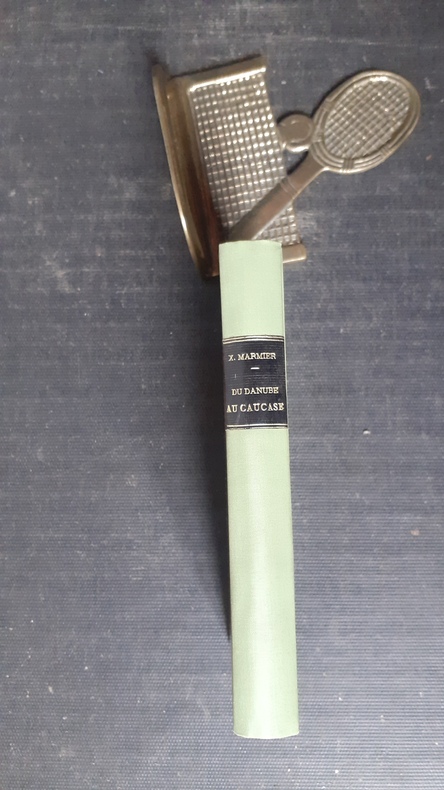
QWA-20094Garnier Frères, 1854, in-8 rel. 1/2 percal. Verte brad. ( 12 x 19,5), 385 p., 1ère édition, trace de mouillure en bordure des 5 premiers feuillets (sans atteinte au texte), ex-libris, bonne reliure d'époque, pièce de titre, bon état.
1333877560.Gpaperback. Good. Access codes and supplements are not guaranteed with used items. May be an ex-library book. paperback
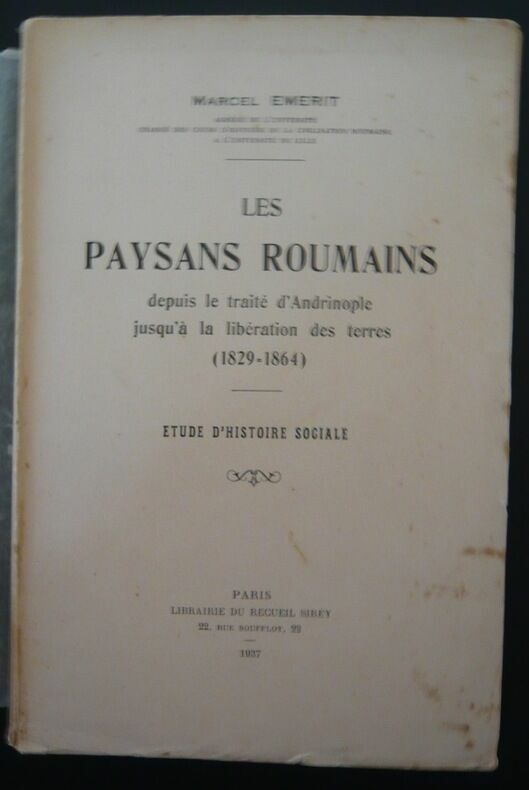
193731371937. Paris Librairie du Recueil Sirey 1937 - Broché 17 cm x 25 cm 577 pages - Texte de Marcel Emerit - Non coupé - Bon état
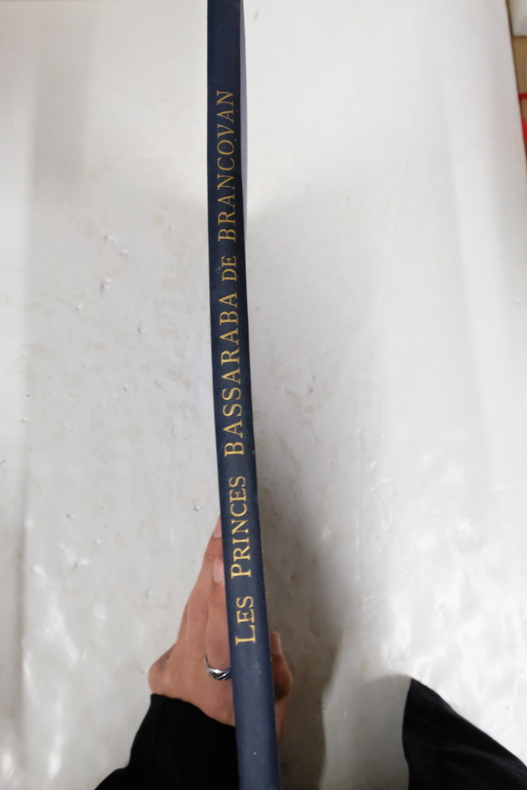
8886Berlin, Ernst Wasmuth, Editeur, 1926. 1 fort volume in-4, reliure pleine toile, 34 pp. de texte et 96 planches en couleurs avec texte explicatif, très bon état.
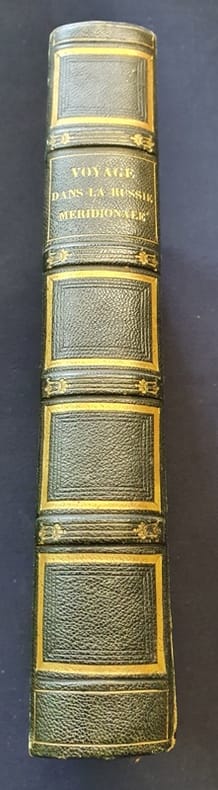
1840123BtParis Bourdin et Cie 1840 In4 ( 27 X 18 cm ) - demi basane - dos a nerfs - titres dorés - 621 pages - Complet des 24 hors texte tiré sur chine ( dont la partition valaque qui manque souvent ainsi que de la dédicace au Tzar qui manque également souvent )- Rousseurs éparses - le 1er feuillet est presque détaché du corps de l'ouvrage - coins fortement rognés - tranches avec manque de papier - mors i,férieur touché sur 3 cm .
1840123BtParis Bourdin et Cie 1840 In4 ( 27 X 18 cm ) - demi basane - dos a nerfs - titres dorés - 621 pages - Complet des 24 hors texte tiré sur chine ( dont la partition valaque qui manque souvent ainsi que de la dédicace au Tzar qui manque également souvent )- Rousseurs éparses - le 1er feuillet est presque détaché du corps de l'ouvrage - coins fortement rognés - tranches avec manque de papier - mors i,férieur touché sur 3 cm .
1889HIS5847MRelié en toile bleu électrique, légèrement émoussée à la tête, bon état de conservation. 43 pages, paru en 1889 chez Jules-Guillaume Fick, Genève. Exemplaire 121 sur 300.
Very Good Turkish, Ottoman (1500-1928) Paperback. Chipped on margins. Some owner notes. Otherwise a good copy. Roy. 8vo. (24 x 18 cm). In Ottoman script. 32 p. This rare book includes the royal travel of Sultan Abdülmecid in 1262 AH [1846 AD] to Roumelia. From Edirne, Abdülmecid proceeded to Eski Zagra (Stara Zagora), Kizanlik (Kazanluk), Gabrova (Gabrovo), Tirnova (Turnovo), Rusçuk (Ruse), Silistre (Silistra), and Varna. The route of the 1846 tour followed closely, except in reverse order, Mahmud II's tour of 1837. According to witness accounts, along the way, the sultan was greeted everywhere with poetic recitations and songs of praise and prayer, both in Ottoman and Bulgarian. The pride of place among welcoming parties invariably fell on students, of all creeds, most clad in white uniforms, some in solemn church-going attire, with flowers and green branches in their hands. At every stop, ceremonial cannon salvos were fired during the day and elaborate firework illuminations were performed at night. In the town of Kizanlik, known then as now for the most fragrant roses and the best rose oil, the sultan's visit coincided, possibly by design, with the rose harvesting season. So the locals sprinkled rose water and poured rose oil before the sultan's cavalcade. According to Hristo Stambolski, in the three days of the sultan's stay in town, no rose harvesting was done so that the whole area would be exquisitely scented in his honor. For his part, the sultan had doctors vaccinate all children against smallpox in public before sending each one off with a small gift of money. Even people with rare diseases were, on occasion, summoned to the sultan's presence so his doctors could cure them. The sublime visit caused the locals, who were unaccustomed to direct contact with the center of power, quite a stir. The most detailed account, albeit from a hostile source, relates the sultan's visit to Rusçuk, which, at four days, may have also been the longest. According to Nayden Gerov, the greeting ceremonies proceeded on a communal basis, with the Jews being placed closest to the town walls, next to them the Armenians, then the Bulgarians, and finally, the Muslims, situated the farthest from town, yet being the first to see and welcome the sultan. As the sultan approached, each group of youngsters would in turn sing for him, everyone else bowing profusely. Based on Gerov's description, it seems that Abdülmecid was dressed in a slightly more luxurious fashion than during state ceremonies in Istanbul. ((Source: Sultan Abdülmecid's Tour of Rumelia and the Trope of Love by Stephanov). The sultan began to travel by the way of the gate of Yedikule in Istanbul in May 6, 1846. He followed the way of Ayastefanos, Silivri, Çorlu, Burgaz, Edirne, Zagra-i Atik, Kizanli, Trnova, Rusçuk, Silistre, Rusçuk, Shumnu, and Varna and came back to Istanbul by way of the sea on June 14, 1846. During this travel, the Sultan listened to people's problems and ordered the authorities to be solved with those problems. He received successful military and administrative authorities in settlements on the way of travel and rewarded them. He also received the governors of Serbia, Eflak and Bogdan, and the representatives of foreign states. With this travel, the Sultan aimed to strengthen the connection to the center of people and administrators in provinces. Özege 17910. First Edition.