Livre Rare Book

1 019 résultats
1990ABE-1717262601442206 PAGES-20 CM X 20 CM-1 PETIT ACCROC EN COIFFE DE TETE SINON ETAT NEUF-(4C)
1977014043Paris Place 1977 In-4 Broché
1994EEzz7448f(Mürzzuschlag, Kunsthaus Mürzzuschlag 1994; Druck: Stiepandruck Leobersdorf). 2°. 54(2) S. Mit farb. Abb. OKart. Ordentlicher Zustand.
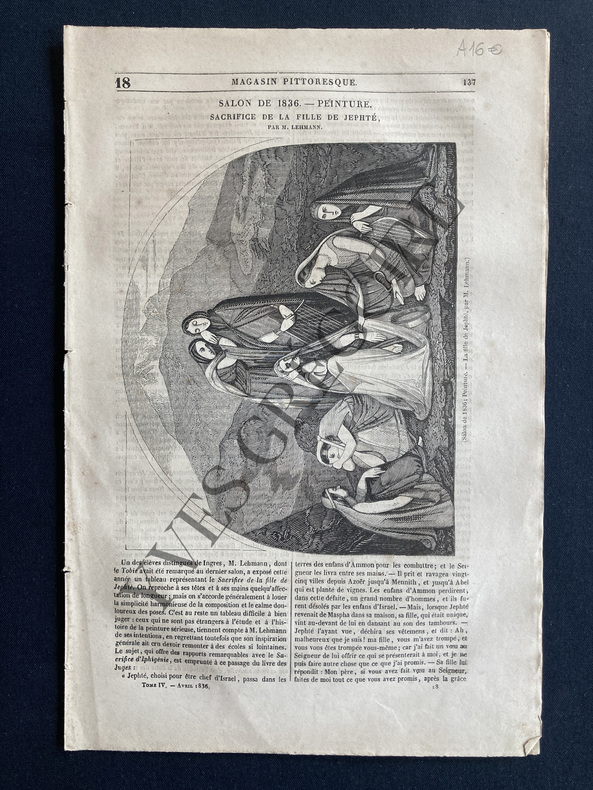
1836ABE-88088111358 PAGES FORMAT IN 4-SALON DE 1836-FABRICATION DES VERROTERIES A VENISE-LA CORNE A BOIRE D'ATTILA A JASZ BERENY, EN HONGRIE/2P/2 ILLUSTRATIONS-LES NIEBELUNGEN/2P-JERSEY/2P/GRAVURE "VUE DU CHATEAU D'ELISABETH"
1966011277Paris Musée d'Art Moderne 1966 In-4 agrafé, couverture illustrée Edition originale
In-4°, 127cc, (3) cc, grandi capilettera figurati incisi su legno. Legatura in piena pergamena coeva con titolo manoscritto al dorso e tagli in azzurro. Edizione originale molto rara. Copia Fletcher. Si tratta della prima traduzione in prosa della prima parte del poema epico cavalleresco di Niccolò da Casola, redatta a partire da un celebre manoscritto databile nei primi decenni della seconda metà del Trecento. L’Attila di Barbieri è al contempo una grande opera filologica di studio della lingua provenzale, un affresco storico dell’Italia contemporanea riletto attraverso la leggenda delle invasioni barbariche, un quadro della vita cortigiana del tempo e, soprattutto, la celebrazione della famiglia estense, cui l’autore doveva personalmente molto per essere stato accolto alla corte di Ferrara, e che grazie a un illuminato mecenatismo si era conquistata la riconoscenza di letterati e uomini d’arte. Giovanni Maria Barbieri, erudito e filologo modenese (1519-1574), apprese il provenzale durante il suo soggiorno alla corte di Francesco I d’Este, e ne promosse gli studi; rientrato a Modena divenne amico di Castelvetro ed entrò a far parte della corte di Alfonso II d’Este che gli affidò il compito di tradurre questo antico poema provenzale, il cui manoscritto era conservato presso la Biblioteca Estense. Gamba 1160; G. Stendardo, G. Bertoni, Niccolò da Casola. La guerra d’Attila poema franco-italiano, Società tip. Modenese, 1941. In-4 °, 127cc, (3) cc, large figured woodcut letterheads . Full parchment coeval binding with handwritten title on the spine and cuts in blue. Very rare original edition. Fletcher copy. This is the first prose translation of the first part of Niccolò da Casola's epic chivalric poem, drawn up from a famous manuscript datable to the first decades of the second half of the fourteenth century. Barbieri's Attila is at the same time a great philological work of study of the Provencal language, a historical fresco of contemporary Italy reinterpreted through the legend of the barbarian invasions, a picture of the courtly life of the time and, above all, the celebration of the Este family, to which the author personally owed much for having been accepted at the court of Ferrara, and who, thanks to an enlightened patronage, had won the recognition of writers and men of art. Giovanni Maria Barbieri, a scholar and philologist from Modena (1519-1574), learned Provençal language during his stay at the court of Francesco I d’Este, and promoted his studies; back in Modena he became a friend of Castelvetro and joined the court of Alfonso II d’Este who entrusted him with the task of translating this ancient Provençal poem, whose manuscript was kept in the Estense Library. Leg 1160; G. Stendardo, G. Bertoni, Niccolò da Casola. The war of Attila Franco-Italian poem, Society tip. Modenese, 1941.
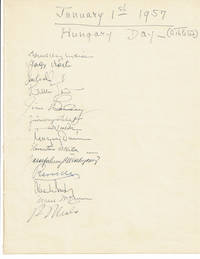
195795783New York NY: The Dakota January 1st 1957. 1957. Fine. - One page with 14 autographs penned on a gilt-edged cream-colored sheet measuring 10-3/4 inches high by 8-3/4 inches wide removed from the guest book of Grace Bristed Jackson and C. D. Jackson. Dated "January 1st 1957" the signatures are identified along the top as those of guests present at the "Hungary Day - Athletes" dinner held at the Dakota in New York City prior to their departure on the "Hungarian Freedom Tour" of 59 cities organized by Sports Illustrated magazine. Near fine. <p>The dinner was held in New York City prior to the athletes' departing on the Hungarian Freedom Tour of 59 cities.<p>Charles Douglas Jackson known as "C.D." and his wife Grace Bristed Jackson hosted parties and events at their apartment in the Dakota. Jackson worked on and off at Time magazine in an administrative capacity for many years and was made vice president of Time Inc. in 1940. He was periodically sent on various diplomatic missions by Eisenhower. He also found time to serve on the boards of several organizations including the Boston Symphony Orchestra the Free Europe Committee and Lincoln Center for the Performing Arts.<p>Of the 14 signatures we've been able to identify the following which are listed in the the order in which they appear on the page:<p>The first to sign is Lidia Domolky the Hungarian fencer who won an individual World title at Rome in 1955. She competed in the 1956 1960 1964 and 1968 Olympics winning one gold and two silver medals. She and her husband fellow fencer Jozsef Sakovics defected during the Sports Illustrated tour. However they both returned to Hungary after a year.<p>Signing next is gymnast Marta Nagy who defected and enrolled at Colorado. There she continued competing in and coaching gymnastics.<p>The fourth signature is that of the fencer Jeno Eugene Hamori who won a gold medal in the team event at Melbourne. He was on the U.S. team in Tokyo in 1964.<p>Tour manager Jim Belsey is the next to sign.<p>The sixth autograph is that of the rowing coxswain Robert Zimonyi who defected and became a U.S. citizen in 1962. With American teams he won an Olympic gold medal in 1964 and a gold medal in the 1967 Pan American games.<p>The eighth autograph is that of the Olympic and World championship gold medal sabre fencer Daniel Magay. In the 1956 Melbourne Olympics he was a member of the Olympic gold medal winning team in the Saber team competition. After the Olympics he defected to the U.S. where he continued his success winning gold medals in the 1957 1958 and 1961 U.S. Individual Championships.<p>The ninth signature is that of the fencer Attila Keresztes who won a gold medal in the 1956 Melbourne Olympics in the sabre team competition. After defecting he represented the U.S. in the 1964 Tokyo Olympics.<p>Following Keresztes is the signature of Gyorgy Jekelfalussy-Piller 1899-1960. In the 1932 Los Angeles Olympics he won 2 gold medals in the individual and team sabre fencing events. In a period of only six years he won 10 Hungarian Championships six with the sabre and four with the foil. After coaching the Hungarian fencing team at the Melbourne Olympics in 1956 he defected to the United States.<p> In theThe fencer Bela Rerrich is the eleventh to sign the guest book. He won a silver medal in the team epee event at the 1956 Melbourne Olympics. He defected and eventually settled in Sweden.<p>The last signature we've been able to identify is that of Marie McCrum secretary to C.D. Jackson.<p>The Hungarian Revolution of 1956 started as a nationwide popular uprising against the Soviet controlled government of the Hungarian People's Republic. Starting as a student protest the uprising lasted from October 23 to November 10 1956. On November 4th 1956 Soviet tanks rolled into the streets supported by Soviet troops who killed thousands in the brutal repression of the revolt. A headline in a Darwin Australia newspaper was the first thing which Hungarian athletes competing in the Melbourne Olympics heard about the Soviet Union's brutal invasion of their country. Supported by a strong Hungarian community living in Australia 48 athletes defected many making their way to the U.S. Water polo-ists and swimmers were part of the 30 athletes who participated in the "Hungarian Freedom Tour" organized by Sports Illustrated magazine which was owned by Time Inc. During the tour there was open rebellion by 11 of the athletes against their tour sponsor Sports Illustrated magazine and tour manager Jim Belsey. As they toured the 59 cities athletes spend most nights sleeping on the bus though they had been promised hotel rooms.<p>UNIQUE. New York, NY: The Dakota, January 1st, 1957. hardcover
21731Nicht hinauslehnen. [Internationale Situationniste, fevrier 1962]. Un depliant de papier couché fort 9,7 x 14 cm à trois volets, impression noire et rouge sur fond blanc, reproduction du Radeau de la Méduse en illustration centrale. Edition originale de ce tract édité en français et en allemand qui rend publique l'exclusion des membres du groupe Spur et annonce la création d'une nouvelle revue en langue allemande : " il est démontréque l'activité fractionniste de ce groupe a été fondée sur une incompréhensionsystématique des thèses situationnistes; et que ce groupe a gravement négligé la discipline de l'I.S. pour s'engager dans la voie de l'arrivisme artistique... " Très bon état.
2006057097Solar Jaquette en très bon état reliure Rigide Décorative 2006 143 pages en format 26 - 31 cm - photographies en couleurs - reliure rigide en percaline 2-263-04017-X
1975056736Gallimard - L' Air Du Temps broché Bristol illustré Paris 1975 239 pages en format 15 - 20 cm
16123New York 1870s. Without printer or date. 31pp. 8vo. Drophead title. In good condition lightly-aged no wraps disbound. Excessively scarce: two copies on COPAC at Lambeth Palace and the London School of Economics and only one more copy apart from surrogates on OCLC WorldCat at the Ohio History Convention. This copy like the two on COPAC lacking the title leaf which according to the WorldCat entry gives the place of publication as New York and the full title as 'No female suffrage! Attila: theology logic anatomy physiology and philology united to establish the truism that the woman is no human being'. From the style not written by a native English speaker. The author names himself as 'Attila' on the first page and the work is on the outer reaches of misogyny. Final paragraph p.31: 'However much indignation this our work may provoke we believe to have conscientiously acted according to our motto: "Every being must be instrumental in the progress of truth." And we really believe to have told the truth. The woman is no human being like man she has therefore no claims to "usurp power over man" and claim female suffrage. Let her remain the helpmate of man attend to her domestic duties and she will from her beginning to her end be man's blessing.' [New York, 1870s.] Without printer or date. paperback
1990LFA-126740200N° 259 Juillet-août 1990) : 78 pages, format 215 x 285 mm, illustré, broché couverture couleurs, bon état
1985LFA-126746864N° 206 (Octobre 1985) : 86 pages, format 215 x 285 mm, illustré, broché couverture couleurs, bon état
200618558Bruxelles, Dupuis, 1969 ; in-4, 48 pp., broché, couverture illustr (ptes usures).
13921P., NRF, Gallimard (Vies des Hommes Illustres), 1928, in 12 broché, 261pp. ; rares annotations marginales au crayon ; couverture légèrement fanée.
200620113Paris, Dargaud, 1970 ; in-4, cartonnage de l'éditeur. N° 2.
54117Paris: Galerie des jeunes nd. First edition. 23 1/2 x 15 3/4 inch poster. What appear to be deliberate light burn marks and one unintentional stain and crease to one upper corner. In all very good plus. Paris: Galerie des jeunes unknown
1978LFA-126722760Revue de 136 pages, format 155 x 240 mm, illustrée, brochée couverture couleurs, publiée en 1978, bon état
2021LFA-126738526N° 894 - Juin 2021 : 98 pages, format 240 x 270, illustré, broché couverture couleurs, bon état
2007LFA-126741560Revue de 68 pages, format 215 x 285 mm, illustrée, brochée couverture couleurs, bon état
2002LFA-126746751N° 60 (Juin-Juillet 2002) : revue de 66 pages, format 215 x 285 mm, illustrée, brochée couverture couleurs, bon état
1995LFA-126739920N° 125 (Septembre 1995) 66 pages, format 220 x 295 mm, illustré, broché couverture couleurs, bon état
9889DOCUMENTS INTERNATIONAUX DE L'ESPRIT NOUVEAU. Paris (23, rue des Morillons). Direction : Paul Dermée, Enrico Prampolini et Michel Seuphor. In-4° broché. Un seul numéro a paru, au printemps 1927. (Admussen, 81) (Destribats, 259) /// Cette revue programmatique vise à l'unification de tous les mouvements d'avant-garde sous le terme générique d' " Esprit Nouveau ". En page 2 de couverture se trouve cette déclaration-manifeste : " Le futurisme, l'expressionisme, le cubisme, le dadaïsme, le purisme, le constructivisme, le néo-plasticisme, le surréalisme, l'abstractivisme, le babilisme, le soporifisme, le mécanisme, le simultanéisme, le suprématisme, l'ultraïsme, le panlyrisme, le primitivisme - et tous les -ismes à venir (jusqu'à concurrence d'un -isme réactionnaire ravageur des grandes conquêtes de notre temps) - VALENT UN SEUL ESPRIT NOUVEAU ". /// Un papillon précise : " Cette revue n'est ni la suite ni la contrefaçon d'aucune autre ". Il est évidemment fait allusion à la revue l'Esprit Nouveau, dirigée par Paul Dermée - que l'on retrouve à la direction des Documents internationaux de l'Esprit Nouveau. Néanmoins, les Documents internationaux de l'Esprit Nouveau paraissent quand cesse la publication de l'Esprit Nouveau, dont ils reprennent (outre le titre) la typographie et les code chromatiques. Il était donc très nécessaire de nier la parenté de ces deux revues, tant leur même lignée est évidente.
200612115, Edition du collectionneur , 2001 ; grand in-4, 251 pp., broché, couverture illustr.
Mm 160x240 Annuario dell'Accademia d'Ungheria in Roma, Istituto storico "Fraknoi". Brossura editoriale di 548 pagine. Esemplare in ottime condizioni. SPEDIZIONE IN 24 ORE DALLA CONFERMA DELL'ORDINE.