Antiquariat.de

116 résultats
178897191CB[London?], 1788. 1 Blatt: 53,5 x 75,2 cm. [2 Warenabbildungen]
177934022London: Printed for the Editor; and sold by J. Bew 1779. First edition. Pp. iii-57. Lacking half-title. 1 vols. 8vo. Red morocco-backed green cloth spine lettered in gilt. Rubbed some light spotting. Bookplate of John Carter Brown ex-library with stamp on title else very good. First edition. Pp. iii-57. Lacking half-title. 1 vols. 8vo. A satire. Often attributed to Richard Tickell as it imitates the tone of Tickell's "Anticipation" published the year before. Purports to contains speeches made in the Houses responding to the King's speech on the war in America and his need for more monies to pay for it. Adams "American Controversy" 79-3a; Sabin 1685 Printed for the Editor; and sold by J. Bew unknown
182010251820. Mezzotint frontis. port. of George III a little foxed arms on each title & two engraved views of the library serving as head- & tailpieces. Five vols. Large folio cont. red straight-grained morocco minor scuffing panelled & tooled in gilt with centerpiece stamped monogram "GR" surmounted by a crown on covers spines gilt dentelles gilt a.e.g. London: W. Bulmer & W. Nicol 1820-29.<br/> <br/> The catalogue "sumptuously printed" by Bulmer of the magnificent library of King George III 1738-1820 donated to the nation by his son George IV. This is a royal copy having belonged to Ernest Augustus Duke of Cumberland and the fifth son of George III who became King of Hanover in 1837. It is superbly bound in red straight-grained morocco and printed on paper superior to other sets. <br/> <br/> "The kings of England had from the end of the fifteenth century always shown a certain taste for fine books especially for the handsomer volumes of their own day.A new library was started in 1765 by King George III when he purchased for 10000 pounds the valuable collection of incunabula with a few manuscripts brought together by Joseph Smith 1682-1770 the British Consul at Venice. <br/> <br/> "George III continued adding to his library for nearly fifty years buying with considerable discrimination at all the notable sales of the period; he secured the best books at the West Ratcliffe and Askew auctions built up a magnificent collection of English plays and kept on right up to the Roxburghe sale 1812. His usual agents were Messrs Nicol the booksellers but he seems to have obtained from the Continent some extremely valuable incunabula by the assistance of one Horn of Ratisbon a great despoiler of the German convents. <br/> <br/> "There is a sumptuously printed but hastily compiled catalogue of which copies are seldom met with."-De Ricci pp. 55-56. <br/> <br/> "As a boy George III had received an excellent education. He learned Latin well enough to be able to read the classics; French and German; history geography and the British political system; mathematics and elementary science; art architecture and music. After he left the schoolroom he continued his education under the Earl of Bute an inspiring if somewhat pedantic tutor.Under his tuition the King developed wide cultural interests a reverence for scholarship and the instinct of a collector. <br/> <br/> "The King's aim was.to acquire a library which contained every book which an eighteenth-century scholar could desire. It was a library to be used not simply to be admired.It was as far as it could be in the eighteenth century a universal library.It is rich in library catalogues. In addition to the catalogues of British libraries there are catalogues from France Italy Spain Portugal Germany Belgium Switzerland Sweden Poland and Russia. There are over five hundred sale catalogues most British and most with the prices marked. <br/> <br/> "It was the King's wish that a catalogue should be published but he postponed this as long as possible. When it became clear after 1812 that the King would never recover Queen Charlotte and the Prince Regent urged the preparation of a catalogue. It was compiled by Barnard and published between 1820 and 1829 in five folio volumes.It was never offered for sale but copies were presented to heads of state and the great libraries in the United Kingdom and on the Continent. It is today an extremely rare book."John Brooke "The Library of King George III" in The Yale University Library Gazette Vol. 52 No. 1 July 1977 pp. 33-45. <br/> <br/> "Frederick Barnard had begun the catalogue of the books and manuscripts of the King's Library while it was at Buckingham House. The catalogue was completed.by Barnard and his staff for the Trustees of the British Museum and printed in five volumes between 1820 and 1829.Very few copies were printed none for sale and they are now very rare."-Paintin The King's Library p. 22. <br/> <br/> This copy lacks the engraved frontispiece portrait of Bernard. A sixth volume issued separately in 1829 and not present here describes the maps prints and drawings. <br/> <br/> A magnificent set. From the library of Prince Ernest Augustus Duke of Cumberland and the subsequent Kings of Hanover. <br/> <br/> Miller That Noble Cabinet p. 125"one of the finest libraries ever created by one man.By the time of the King's death the collection amounted to 65250 volumes besides 19000 unbound tracts. unknown
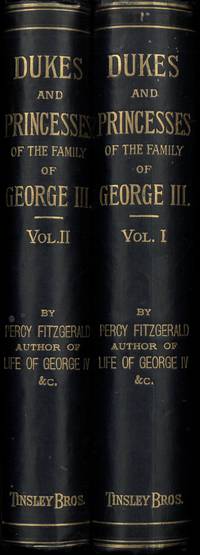
188264247London 1882. 8vo. Originalbind med gulldekor på rygg. xiv 384 s ; x 341 s. . Tinsley Brothers Engelsk. <br/><br/><em>Ex libris. </em> unknown
1790AQ12371London: Printed by Charles Eyre and Andrew Strahan Printers to the King's most Excellent Majesty 1790. 2 1303-1370 2. With a final blank leaf. Issued separately with a general title page as here and also as part of: Anno Regni Georgii III. Regis Magnæ Britanniae Franciae & Hiberniae tricesimo. At the Parliament begun and holden at Westminster the eighteenth day of May Anno Domini 1784.And from thence continued by several prorogations and adjournments to the twenty-first day of January 1790; being the seventh session of the sixteenth Parliament of Great Britain. Later stitching through original stab-holes. A trifle dusty. A rare survival in original state of a Georgian act 'for paving cleansing lighting watching and regulating the streets lanes ways and publick passages and places within the city of Durham'. ESTC records a single copy in the British Isles Lincoln's Inn and one further in North America Kansas. ESTC N58976. Folio. Printed by Charles Eyre and Andrew Strahan, Printers to the King's most Excellent Majesty unknown
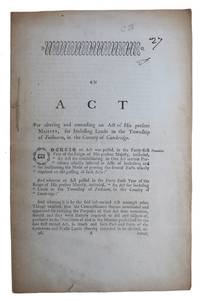
1812AQ24031London: s.n. 1812. 27pp 1. Docket title to verso of final leaf. Stitched as issued. A trifle browned and dusty. A Georgian act for the appropriation and privatisation of common land in the parish of Toft Cambridgeshire for agricultural purposes. . First edition. Folio. [s.n.] unknown
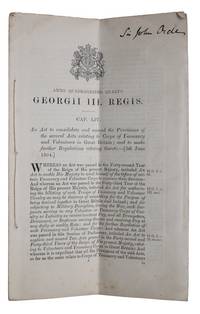
1848AQ21537Edinburgh: William Blackwood and Sons 1848. 32pp. Stitched as issued. Central horizontal fold lightly dust-soiled inked ownership inscription of Sir John Orde to head of title page. A Georgian Act issued to consolidate and amend several late eighteenth- early nineteenth-century acts relating to the establishment maintenance and regulation of yeomanry and volunteer corps and reissued in the early Victorian years. Many such civilian forces had been raised during the French Revolutionary Wars though they had been disbanded following the conclusion of the conflict. Under the provision of the Volunteer Act of 1804 fresh corps were raised for local particularly coastal defence in response to the beginning of the Napoleonic Wars. COPAC records a single copy of this reprint National Museums Scotland OCLC adds no further. The original 1804 printing is apparently unrecorded. . 8vo. [William Blackwood and Sons] unknown
1793AQ21534London: Printed by Charles Eyre and Andrew Strahan 1793. 2 2871-2942pp 2. Uncut stitched as issued. Lightly marked and spotted some occasional chipping to margins inked ownership inscription to title page. A rare survival of a Georgian Act for making and maintaining a navigable canal from Loch Gilp to Loch Crinan in the Shire of Argyll 8th May 1793. ESTC records a single copy Lincoln's Inn. ESTC N59414. Folio. Printed by Charles Eyre and Andrew Strahan unknown
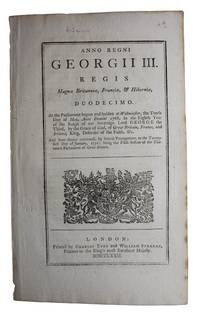
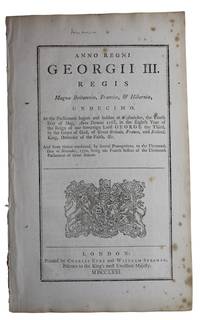
1772AQ29286London: Printed by Charles Eyre and William Strahan 1772. 2 1127-1131pp 1. Disbound. Scattered spotting. A rare survival of a Georgian act both continuing and amending earlier legislation primarily relating to the importation of goods to Britain from American colonies notably sugar. ESTC records a single copy in the British Isles Lincoln's Inn and a further six copies in North America Brown Huntington Minnesota North Carolina Society of the Cincinnati and Virginia. ESTC N57304. Folio. Printed by Charles Eyre and William Strahan unknown
1808AQ24070London: s.n. 1808. 6pp 2. Docket title to verso of final leaf. Stitched as issued. A trifle browned and dusty. An apparently unrecorded Georgian act amending previous legislation regarding the appropriation and privatisation of common land in the town of Fulbourn Cambridgeshire for agricultural purposes. . First edition. Folio. [s.n.] unknown
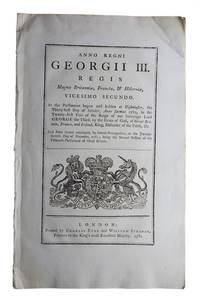
1782AQ27195London: Printed by Charles Eyre and William Strahan 1782. 2 163-214pp. Issued separately with a general title page as here and also as part of: ‘Anno Regni Georgii III….vicesimo secundo. At the Parliament begun and holden at Westminster the thirty-first day of October anno Domini 1780…’ Imprint taken from general title. Disbound. A remarkably rare survival of a public general act renewing the terms of the previous Mutiny Act as well as the articles relating to the quartering of British Army troops in Foreign territories. ESTC records a single copy in the British Isles Lincoln’s Inn and further copies at two locations in North America Harvard and Tulane. ESTC N58108. First edition. Folio. [Printed by Charles Eyre and William Strahan] unknown
1772AQ24244London: Printed by Charles Eyre and William Strahan 1772. 2 775-776pp. Disbound. Stab-stitch holes to gutter scattered spotting. A rare survival of a Georgian act temporarily relieving duties on corn imports in order to combat grain shortages. ESTC records a single copy in the British Isles Lincoln's Inn and two further in North America Brown and Virginia. ESTC N57272. Folio. Printed by Charles Eyre and William Strahan unknown
1771AQ24231London: Printed by Charles Eyre and William Strahan 1771. 2 1227-1234pp 2. With a final blank leaf. Disbound. Stab-stitch holes to gutter scattered spotting. A rare survival of a Georgian act regarding the acquisition of oak staves for use in the manufacture of casks for brewers from American vessels that dock in British ports. ESTC records a single copy in the British Isles Lincoln's Inn and further four copies in North America Library and Archives of Canada Minnesota Virginia and Yale. ESTC N57209. Folio. Printed by Charles Eyre and William Strahan unknown
1763AQ24239London: Printed by Mark Baskett 1763. 2 383-398pp 2. With a final blank leaf. Disbound. Stab-stitch holes to gutter scattered spotting. A remarkably rare survival of a Georgian act relating to duties payable by British subjects for importing their goods from territories surrendered to France and Spain at the conclusion of the Seven Years' War. ESTC records a single copy in North America Huntington and none elsewhere. ESTC N54579. Folio. Printed by Mark Baskett unknown
1766AQ24233London: Printed by Mark Baskett 1766. 2 755-760pp. Disbound. Stab-stitch holes to gutter scattered spotting. A rare survival of a Georgian act both continuing and amending earlier legislation relating to import and export duties on a variety of goods in particular those materials associated with ship building and the simulation of the growth of coffee on American plantations. ESTC records a single copy in the British Isles Lincoln’s Inn and two further copies in North America both held at John Carter Brown. ESTC N56929. Folio. Printed by Mark Baskett unknown
1772AQ24232London: Printed by Charles Eyre and William Strahan 1772. 2 1127-1131pp 1. Disbound. Scattered spotting. A rare survival of a Georgian act both continuing and amending earlier legislation primarily relating to the importation of goods to Britain from American colonies notably sugar. ESTC records a single copy in the British Isles Lincoln's Inn and a further six copies in North America Brown Huntington Minnesota North Carolina Society of the Cincinnati and Virginia. ESTC N57304. Folio. Printed by Charles Eyre and William Strahan unknown
1766AQ24234London: Printed by Mark Baskett 1766. 2 715-734pp. Disbound. Stab-stitch holes to gutter scattered spotting. ESTC records a single copy in the British Isles Lincoln’s Inn and one further in North America Virginia. ESTC N56926. Folio. Printed by Mark Baskett unknown
1764AQ24240London: Printed by Mark Baskett 1764. 2 235-236pp. Disbound. Stab-stitch holes to gutter scattered spotting. A scarce Georgian act both continuing and amending earlier legislation relating to the trade of sail cloth and gunpowder particularly between Britain and her American colonies. ESTC records a single copy in the British Isles Lincoln’s Inn and a further eight copies in North America Boston Athenaeum Huntington Historical Society of Pennsylvania Library Company of Philadelphia Minnesota North Carolina Society of Cincinnati and Virginia. ESTC N56796. Folio. Printed by Mark Baskett hardcover
1770AQ24243London: Printed by Charles Eyre and William Strahan 1770. 2 691-694pp. Disbound. A rare survival of a Georgian act both continuing and amending earlier legislation encouraging the growth of indigo plants on British plantations in America. ETSC records a single copy in the British Isles Lincoln's Inn and a further five copies in North America Brown Kansas Minnesota Museum of American Textile History and Virginia. ESTC N57137. Folio. Printed by Charles Eyre and William Strahan unknown
1803AQ18908London: Printed by George Eyre and Andrew Strahan 1803. 1 910-916pp. Stitched as issued. Lightly creased small hole to gutter of first leaf slight chipping to margins. A Georgian act for the provision of a weekly allowance for the families of non- commissioned officers drummers and private militiamen in Scotland; likely issued in response to the emergent conflict with Napoleonic forces on the Continent. . Folio. [Printed by George Eyre and Andrew Strahan] unknown
560232 hand-coloured woodcuts copied from the illustrations in The Universal Magazine for October and November 1761 the first taken as the Archbishop of Canterbury places the Crown on the King's head is lettered with explanations of the crowded scene including at h 'The Dukes of Normandie and Acquitain and other great officers' the second similarly explained shows the King's Champion flanked by the Earl Marshal and Lord High Constable riding up the centre between the long tables watched by the diners and the others present in the galleries printed within a 'Greek Key' border both referring to 22nd September 1761 laid down on two separate album leaves 10" x 7¾" with other items on the versos the two prints no date circa edges worn and border trimmed in places without loss to text or image The original articles of 1761 explain the role at the Dinner of the King's Champion who challenged any one to assert that George III was not their lawful sovereign and the 'Dukes of Normandy and Aquitaine' at the Coronation. The French King had anciently a council of twelve great Peers 6 lay and 6 ecclesiastic. Long after the council ceased to function the ecclesiastics attended at Reims but the lay peerages had became vested in the crown. So the King appointed people to represent his lay peerages. Henry II liked this idea which was last used in 1761 given that in 1801 Great Britain renounced all claims to France and the use of the lilies on her coat of arms. On the versos are 1 a pleasing engraving of Bouverie Hall Chart next Sutton Valence Kent and 2 a number of cuttings including temperance verses and the monument to Captain Charles Colby of the 98th Dragoons killed by a tiger at 'Rawal Pinde' 27th March 1852. unknown
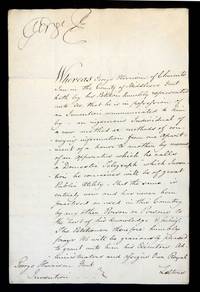
18092120802<i>Folio 4pp. with docket on fourth page "George Harrison Gent. Not stamped. Mr. Solicitor declines at present signing the Bill for this patent. S.G. Wyatt"; </i><i>folded and unbound as issued in very good state of preservation.</i><br /><br />A fascinating document which seems however not after all to have ended in a grant for a patent. George Harrison claims that "he is in possession of an invention communicated to him by an ingenious individual of a new method or methods of conveying information from one apartment of a house to another by means of an apparatus which he calls a "Domestic Telegraph" which invention he conceives will be of great public utility. That the same is entirely new and has never been practised or used in this country by any other person or persons to the best of his knowledge & belief". George Harrison not only does not disclose the name of the inventor he also petitions for the patent to be in his own name. No such patent in Harrison's name is included in Woodcroft's definitive Alphabetical Index. It is possibly that Harrison was trying to be a bit too clever as the award of a patent was conditional on Harrison producing "a particular description of the nature of the said invention and in what manner the same is to be performed".<br /><br />George III's signature here seems in some way to illustrate both his mental illness and his approaching blindness. Little more than a year after signing this document he became dangerously ill and finally accepted the need for the 1811 Regency Act. In 1809 Lord Liverpool was Home Secretary in the Duke of Portland's government.
503685May 25 1801. Appointment of "Peter Ogier Gentleman as Clerk in the Office of Our Secretary." Signed by 3 officials and a witness November 24 1801. Printed document completed in a secretarial hand. Full vellum 16" x 15" with 2 blue wax seals and hand-colored portrait of George III folds and slight stains. Rare with seals. 22" x 20". Signed by Authors. F. Soft cover. hardcover
750Light rubbing and soiling. Very good. JJA-750. <p>George III County of York Indenture of Conveyance in the amount of £150 from Dorothy Temple to Henry Haldor and William Spencelay both of York and dated May 21 1776.</p> <br /> <p>Measures approx. 11 x 31.5 inches. Manuscript on vellum sealed and stamped. Docketed to verso.</p> . unknown
1820AQ26129London: Published by R. Miller 1820. 64pp. With an engraved portrait frontispiece and one further engraved plate a portrait of George IV. Uncut. Later stitched into original publisher’s printed buff wrappers with the edition of a 2pp publisher's advertisement announcing the publication of the present work. Extremities worn loss to spine. Plates foxed. The second edition printed in the same year as the first of a rather obsequious biography eulogising George III; to which is appended numerous official announcements of the monarch's death. Both editions are remarkably scarce OCLC records a single copy of the second Texas; COPAC adds no further. . Second edition. 8vo. Published by R. Miller unknown