Siotto Pintor MLivre Rare Book
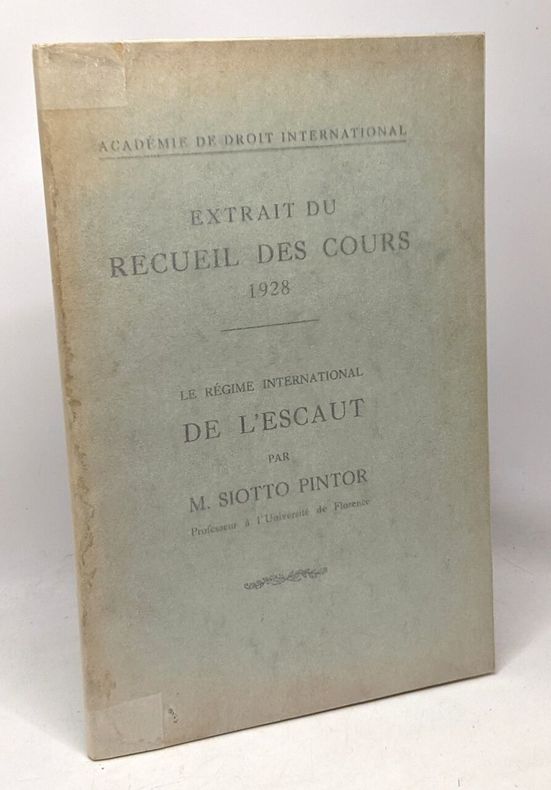
Extrait du recueil des cours 1928 - le régime international de l'escaut - académie du droit international
100069583Non renseigné 78 pages in8. Sans date. Broché. 78 pages.
Un Autre Monde · Val Couoesnon, France25,00 €
6 936 résultats
19280Gibraltar 1892 and 1901. . Thirteen items from the Harington family papers. Sir Richard Harington of Ridlington 12th Baronet was educated at Eton and Christ College Cambridge. Called to the Bar in 1886 he practised as a barrister on the Oxford Circuit before taking up an appointment as a Puisne Judge in the High Court of Justice at Fort William in Bengal in 1899 serving in that capacity until returning home in 1913. In later years he acted as Justice of the Peace and Deputy Lieutenant for Herefordshire. The collection is in fair condition aged and worn. ONE: Printed document completed in manuscript signed by the Governor of Gibraltar Sir Robert Biddulph 1839-1918 docketed by Harington 'Letters patent appointing Sir R. Harington temporarily Chief Justice of Gibraltar' dated 8 May 1892. The document with damaged seal of Queen Victoria under paper appoints 'His Honour Sir Richard Harington Baronet Judge of the County Court of Worcester … to act as Chief Justice of Gibraltar during the absence on leave of His Honour Sir Henry James Burford Burford Hancock Knight Companion of Our Most Distinguished Order of Saint Michael and Saint George'. TWO: Typed document signed by Colonial Secretary of Gibraltar Henry More Jackson 1849-1908 docketed 'letters Patent appointing Sir Richard Harington Bt acting Chief Justice of Gibraltar' dated March 1901. With seal of Edward VII under paper. Appointing Harington to the position 'during the absence on leave of His Honour Stephen Herbert Gatty'. 2pp. folio. THREE: Autograph 'Draft letter to Sir H Jackson in draft ordinance as to assessors' by Harington dated 16 May 1901. 4pp 8vo. On letterhead of the Supreme Court Gibraltar Judges' Chambers. The letter is headed 'Presentment of the Grand Jury in the matter of Assessors.' FOUR: Typed Letter Signed to Harington from Jackson 'H. Jackson'. On letterhead of the Colonial Secretary's Office Gibraltar 3 April 1901. 1p. 8vo. Informing him of the Easter closure of the 'Public Offices'. FIVE: Printed grey-paper 'Pass to Sketch or Photograph' in Gibraltar issued to Harington. Signed by Major Crawford Assistant Adjutant General stamped and dated 30 June 1901. SIX: Printed pink-paper 'Officer's Pass' made out to Harington and giving him 'permission to pass along the roads but not off them nor along the footpaths comprised in the triangle – Willis's Signal Station and Windmill Hill Gate'. Signed by Crawford and dated 31 March 1901. SEVEN and EIGHT: Two duplicated letters in facsimile manuscript from the Assistant Military Secretary. 14 and 15 March 1901; the first from Government House the second from 'The Convent'. Each 1p. 12mo. The two relating to a visit by 'the Duke and Duchess of Cornwall and York'. The first with the names of 'Sir R. and Lady Harington' added an invitation to 'the Dinner to be given by His Royal Highness on board the “Ophir†on the 21st. March. The second with 'The Acting Chief Justice' added inviting Harington to 'the Landing Stage on H. M. Dock … to receive Their Royal Highnesses'. NINE: Eastern Telegraph Company telegram from 'Nicolson' inviting Harington and his wife to dinner. 4 April 1901. TEN: Notebook with waxed black cloth cover containing itemised manuscript account of expenditure on food. No evidence of author or place but compiled during Harington's second tenure between 5 March and 19 May 1901 by Lady Harington's household. 118pp. 12mo with 2pp. 12mo on leaves loosely inserted. Good English fare from 'Sponge Cake' to 'Mutton Cutlets' with prices. Compiled by or for Lady Harington. ELEVEN and TWELVE: Two printed cards relating to the 'Royal Fusiliers Races' on Gibraltar. First an invitation completed in manuscript to the 'Regimental Races North Front.' from 'Lieut. Col: Briggs and the Officers Royal Fusiliers' to 'Sir J. sic Lady & Miss Harrington sic'. THIRTEEN: Printed 'List of Passengers outwards by P. & O. Company's Steamer' 'Per P. & O. S.s. EGYPT CAPTAIN G. L. LANGBORNE R.N.R. from LONDON Feb. 28; from MARSEILLES Mar. 7. For GIBRALTAR MARSEILLES PORT SAID ISMAILIA ADEN and BOMBAY.' [ Gibraltar, 1892 and 1901. ] hardcover
22113No place or date. November 1827. Tindal is notable for defending Queen Caroline in her 1820 adultery trial and for introducing the special verdict 'Not Guilty by reason of insanity' in the case of Daniel M'Naghten. The letter is undated but Tindal states that it was a written a week after the death of Rev. John Kirk Rector of Thwing which took place on 6 November 1827 see Kirk's death notice Gent. Mag. November 1827. 3pp. 4to. Bifolium. In fair condition aged and worn. Folded four times. Tindal begins his letter: 'My dear Lord Chancellor I am requested by my friend the Revd. T. Foord Bowes who I believe is not altogether unknown to your Lordship to use what Interest I may have with you in his favour as an applicant for the Living of Thwing in the County of York which became vacant by the sudden death of the late Incumbent in the course of last week.' He proceeds to describe Bowes's attainments: 'Mr. Foord Bowes is a Master of Arts of Trinity College Cambridge who has lived from the time of his quitting the University in a House belonging to a small property of his own in the immediate Vicinity of the parish. His Father was the Rector of this Living some years since and he himself has performed the Duty as Curate for the last 20 years to the greatest satisfaction of the Parishioners. During this time he has been an active Magistrate of the West Riding of the County of York.' A change in Bowes's circumstances has 'made this Living a very great and important Object to him independely of the Value which he sets upon it from his long and early association with it'. Lyndhurst has endorsed the letter in faint pencil on the reverse of the second leaf the writing being difficult to decipher. In the event the living being presented to William Joseph Butler. For the subject of the letter Timothy Fysh or Fish Foord Bowes 1777-1861 see Alum. Cantab. He was Chaplain to King George IV Deputy Clerk of the Closet to King William IV and Chaplain to Queen Victoria. In 1845 he was successfully sued by a former groom for criminal conversation. No place or date. [November 1827,] unknown
20180Croydon. 19 August 1843. 1p. 12mo. In fair condition lightly aged. Laid down on a piece of card cut from an album. Reads 'The Lord Chief Justice Tindal returns to Mr J. L. Adolphus the proof Sheet of the judgment of the Court of Exchequer Chamber in Wilson v. Fuller. He has made no other alteration therein than the addition of a word thinking the Judgment expresses very clearly and faithfully what was delivered by the Court'. See both men's entries in the Oxford Dictionary of National Biography. Croydon. 19 August 1843. unknown
183690010-Paris, Bureau de l'observateur des tribunaux, 1836. une brochure de 80 p., dim14x21,5. Etat moyen (manques au premier plat, sans atteinte eu texte, mouillures).
2549114 November 1885. On letterhead of 5 The Grove Highgate London. See his entry in the Oxford DNB. From the Piffard papers. 1p 12mo. On first leaf of bifolium. In good condition lightly aged. Folded twice. Reads: 'Lord Justice Fry would be obliged if Mr Piffard would send him a Micro-slide of Conidia bearing Hyphae of Eurotium repens isolated & stained by a new application of Iodine Vapour. He encloses 2/- in stamps.' 14 November 1885. On letterhead of 5 The Grove, Highgate [London]. unknown
2407425 February 1911. On letterhead of Failand House Failand near Bristol. See Fry’s entry in the Oxford DNB. Dickinson was an influential proponent of the League of Nations. The present item concerns the London Declaration concerning the Laws of Naval War an international code of maritime law following on from the second Hague Conference. Great Britain as the world’s chief naval power had felt that such a court should be governed by defined principles and had convened an international concerence in London in 1908. The Declaration that was issued three years later comprised 71 articles. 3pp 12mo. Bifolium. In good condition lightly aged. Folded once. Signed ‘Edw: Fry’ and addressed to ‘W. H. Dickinson Esq MP’. He begins by expressing a willingness to ‘join the General Committee to promote the ratification of the Declaration of London’ feeling that ‘if both it & the Convention for the prize Court be not satisfied our Governt. will stand in a sad position amongst the nations. We proposed the International Court at the Hague we carried it through we called the Conference of London we got what we were contented with - & if now we withdraw who will take the trouble to negociate with us’ Were Britain’s ‘food supply’ being ‘placed in peril’ then of course ‘we would withdraw & accept our disgrace - but I do not think that this is so’. 25 February 1911. On letterhead of Failand House, Failand, near Bristol. unknown
13442Monmouth. 30 Ocotber 1843. 2pp. 12mo. 29 lines of neatly-written text. In very good condition on lightly-aged paper. Addressing his letter to 'J: S: Buckingham Esqre.' Pollock writes that Buckingham's letter 'enclosing the Rules &c. of the British and Foreign Institute' has been forwarded to him in Monmouth where he is 'engaged on a long Circuit professionally which comprehends all South Wales and the West and South of England'. He is 'on the move continually' without 'time or opportunity to give sufficient consideration to the subject'. He will 'return to Town' in December when he will 'take an early opportunity of making my appearance as a member of the Committee' and will 'confer' with Buckingham: 'I see you have had to answer an attack as some one has taken the trouble to send me a Copy of the "Times" of the 25th. inst. which accompanied a Letter from you . You need not complain as you have evidently a triumph upon all the points started.' According to Buckingham's entry in the Oxford DNB in 1844 he was 'instrumental in the foundation of the British and Foreign Institute in Hanover Square. This literary and social club of which he was appointed resident director drew the ridicule of Punch which persisted in calling it the ‘Literary and Foreign Destitute’. The institute was closed in 1846.' Pollock was appointed Chief Justice of Bombay in 1846 and knighted in the same year. Monmouth. 30 Ocotber 1843. unknown
107796 June 1862. On one side of a piece of vellum 34.5 x 42.5 cm. Folded into a docketed 9 x 21 cm packet. In good condition lightly-aged. Signed by 'A. E. Cockburn' and by two witnesses: 'J H Brewer' of Curzon Street Mayfair and 'Henry William Frayling Clerk to the said Sir A E. Cockburn' with remains of his red wax seal. Also signed at foot by the Queen's Remembrancer 'W H Walton'. 'I The Right Honourable Sir Alexander James Edmund Cockburn Baronet Lord Chief Justice of Her Majesty's Court of Queens Bench and also Chief or Primary Justice of our Lady the Queen . Do give and grant unto Frank Cockburn of No. 3 Tanfield Court Temple in the City of London Esquire the Offices of Clerk of the Assizes and Clerk of the Crown within the said Counties of Northampton Rutland Lincoln Notttingham Derby Leicester and Warwick and in the County of the City of Lincoln Town of Nottingham and Borough of Leicester'. The relationship between the two men is unclear. Frank Cockburn retained this office until 1876. WITH: Autograph Statement Signed by Frank Cockburn appointing Spencer Murch Cox of Honiton as "Associate for the said Midland Circuit from this day ." 30 Sept. 1863. 6 June 1862. hardcover
10780'A. E. Cockburn Temple Decr. 16. 1841.'. On both sides of a piece of paper 25.5 x 41 cm. 44 lines. Fair on aged paper. The upper part of the first page laid down on card resulting in loss of text. Begins 'I am of opinion that no partnership was created between Mr. H. D. Kingdon & Mr. Newman by the Indenture of 1838 sufficient to bar the former on an action upon that deed.' The document dates from the year in which Cockburn took silk. H. D. Kingdon was author of 'The Old English Mastiff' London 1873. 'A. E. Cockburn | Temple | Decr. 16. 1841.' unknown
22220Without date or place. On one side of an 8 x 10 cm piece of paper. Aged and worn with light offsetting from another document. The two signatures both 'A. E. Cockburn' are at the right hand corners. The verdict and sentence 'Guilty 6 Mo. Imprisonment' are written between two lines centred at the left-hand margin. The purport of the document is unclear: it may be that the judge was required to record the verdict and sentence in this way for the clerk of the court. Without date or place. unknown
5604Letter dated 5 April 1846; Castle Taunton. Photograph undated. Letter: four pages folio. Good with a little aging and staining to verso of second leaf of bifolium. In Cruttwell's absence Cockburn has taken it upon himself 'to settle Richardson & <Sumsun>. Taylor has communicated the result of his interview with Hellings the previous evening. 'He informed me that he had seen certain letters written by the Defendants to Mrs. Richardson in which he solicited her to leave her husband and to bring away with her money and goods belonging to the husband'. Taylor recommends that Hellings' offer of £50 be accepted. Cockburn has seen the letters and 'they fully bear out Mr. Taylor's account. I thought the correspondence so discreditable to the Defendant that especially as he must necessarily have called witnesses andn so the Plaintiff's cause wd. have had a reply - I thought it very likely the Jury wd. give connsiderable damages - to say nothing of the disgrace .' Discusses Cruttwell's reluctance to have his 'name mixed up with the defence'. He is certain his opinion would have been shared by Cruttwell had he 'seen these letters'. After consulting 'Mr. Phinn' he has reached a verdict of '50£ including the goods the property in which is to remain in the Defendant'. In a postscript describes how the plaintiff's husband has 'not only denied her to bring away money & furniture but articles of jewellery such as a gold shirt pin of the husbands which he sd. would become him better'. The sepia photograph roughly 9 x 5.5 cms is of Cockburn's head and shoulders. Beneath the image he has written 'Yours truly A. E. Cockburn'. Printed details of Dixon's studio on reverse which bears traces of previous mounting. Also included is an attractive piece of paper with a blind-stamped decorative border somewhat like a doily within which in a contemporary hand 'A letter written by Sir Alexander Cockburn Lord Chief Justice of England'. Letter dated 5 April 1846; Castle Taunton. Photograph undated. unknown
100069583Non renseigné 78 pages in8. Sans date. Broché. 78 pages.
Gonon éditeur, 1959. In-8 relié plein cartonnage illustré éditeur, rhodoïd, de 229 pages. Illustrations couleurs de Siné. Petit accroc sur le haut du dos, sinon Très bon état
1st edition. 8vo, 118 pages, not illustrated. Very good condition hardback in very good condition dust jacket. 40615 eng
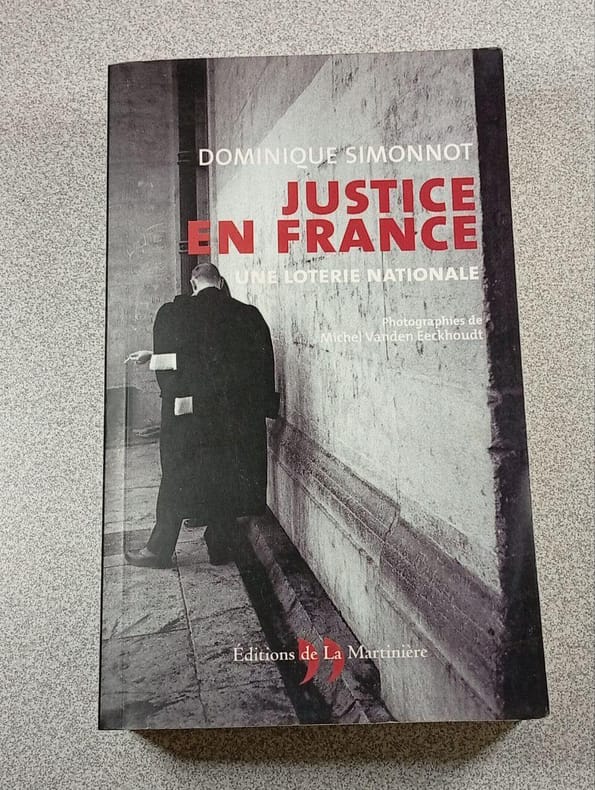
2003500300711Editions de La Martinière 2003 11 6x3 6x17 6cm. 2003. Broché.
20133137Editions de Fallois 2013 333 pages in8. 2013. broché. 333 pages.
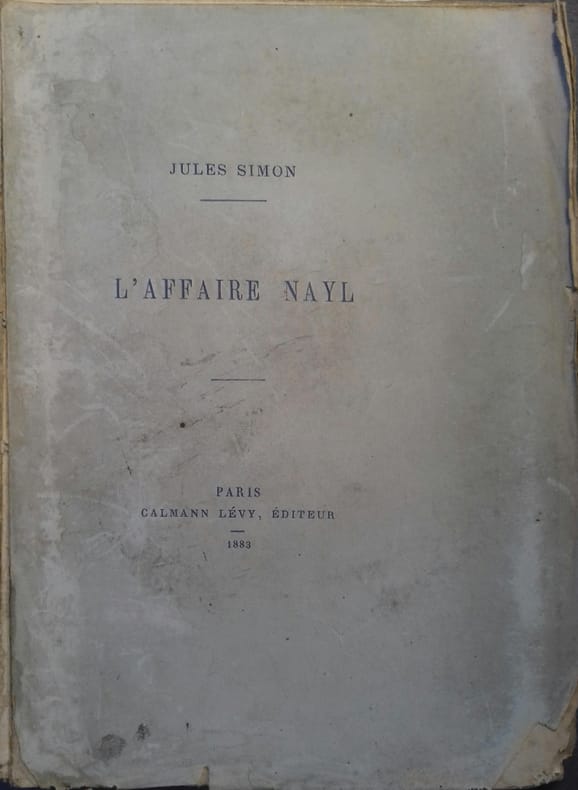
19419Paris Calmann - Lévy 1883 in 12 (19x14) 1 volume reliure à la bradel demi maroquin bleu, dos lisse, couverture conservée, 190 pages [1], exemplaire imprimé sur beau papier vergé à toutes marges. Reliure signée de V. Champs. Hommage autographe signée de l'auteur. Cet exemplaire est en outre enrichi d'une lettre autographe insérée signée de Jules Simon remerciant l'auteur pour son article paru dans la Liberté (lettre à l'en-tête du Sénat, daté du 22 septembre 1883, contenu relatif à la publication de l'Affaire Nayl). Le curé d'Auray, Le crime, La Cour d'assise, Le Pourvoi, Marion, La mère du supplicié. Très bel exemplaire, très bien relié ( Photographies sur demande / We can send pictures of this book on simple request )
19421Paris Calmann - Lévy 1883 in 12 (19x14) 1 volume reliure demi chagrin foncé de l'époque, dos à nerfs soulignés de filets dorés, 190 pages [1], exemplaire imprimé papier vergé. Le curé d'Auray, Le crime, La Cour d'assise, Le Pourvoi, Marion, La mère du supplicié. Bel exemplaire, bien relié ( Photographies sur demande / We can send pictures of this book on simple request )
188373443Couverture souple. Broché. 190 pages. Couverture défraîchie. Manque au dos. Marge légèrement tachée.
A clean, unmarked book with a tight binding. 250 pages. Light wear to cover.
195383680Couverture rigide. Couverture cartonnée de l'éditeur. Coiffes fatiguées. 274 pages.
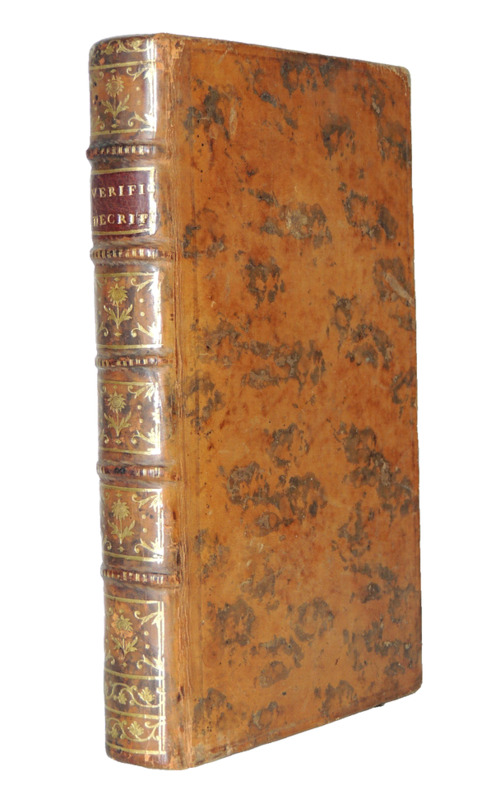
CZC-12242Ouvrage dédié à M. le Président de Bailleul volume relié in12, 180x100, relié pleine basane époque, bon état intérieur, 318pp,très rare exemplaire. A Paris, Chez Guillaume Cavelier, MDCXCIX Il était le frère du médecin et chirurgien Nicolas de Blégny. Il a été reçu en la Communauté des maîtres écrivain jurés en 1666, et exerçait à Paris dans le dernier tiers du XVIIe siècle. On a de lui un portrait gravé par Voligny en 1691. À l'occasion de la parution de Les Elémens... en 1691, il est cité comme maître écrivain dans le recueil d'adresses publié par son frère le médecin Nicolas de Blégny en 1692 sous le pseudonyme d'Abraham Du Pradel1. À cette époque, il habitait à l'entrée de la rue Saint-André [des Arcs], devant le pont Saint-Michel. Il est mort en février 1700. Il est très probablement lié à François-Étienne de Blégny, papetier, né vers 1662, demeurant également rue Saint-André-des-Arts, impliqué dans des affaires politiques et embastillé. On remarque dans ses œuvres qu'il a travaillé non seulement dans la mouvance pédagogique (écriture, arithmétique, grammaire), mais aussi dans la mouvance judiciaire, comme "juré expert établi pour vérifier les écritures". Paillasson indique que son Traité de 1699 est resté utile jusqu'à l'ordonnance de 1737 qui réforma les principes de la vérification judiciaire. ref/30
CZC-12242Ouvrage dédié à M. le Président de Bailleul volume relié in12, 180x100, relié pleine basane époque, bon état intérieur, 318pp,très rare exemplaire. A Paris, Chez Guillaume Cavelier, MDCXCIX Il était le frère du médecin et chirurgien Nicolas de Blégny. Il a été reçu en la Communauté des maîtres écrivain jurés en 1666, et exerçait à Paris dans le dernier tiers du XVIIe siècle. On a de lui un portrait gravé par Voligny en 1691. À l'occasion de la parution de Les Elémens... en 1691, il est cité comme maître écrivain dans le recueil d'adresses publié par son frère le médecin Nicolas de Blégny en 1692 sous le pseudonyme d'Abraham Du Pradel1. À cette époque, il habitait à l'entrée de la rue Saint-André [des Arcs], devant le pont Saint-Michel. Il est mort en février 1700. Il est très probablement lié à François-Étienne de Blégny, papetier, né vers 1662, demeurant également rue Saint-André-des-Arts, impliqué dans des affaires politiques et embastillé. On remarque dans ses œuvres qu'il a travaillé non seulement dans la mouvance pédagogique (écriture, arithmétique, grammaire), mais aussi dans la mouvance judiciaire, comme "juré expert établi pour vérifier les écritures". Paillasson indique que son Traité de 1699 est resté utile jusqu'à l'ordonnance de 1737 qui réforma les principes de la vérification judiciaire. ref/30
19408Les Productions de Paris. 1959. In octavo dans une reliure demi toile avec son étiquette de titre en maroquin rouge, 388 pages, illustrations hors texte - Excellent état.