4 résultats
18151264604London: Printed for Sherwood Neely and Jones 1815. Fist Edition. Hardcover. 8vo. viii 341pp. 3pp. ads; VG; spine paneled brown leather green label with gilt lettering; 1/4 bound brown leather grey cloth boards rebound; spare label tipped in rear; minor age marks and staining on ads at rear; small tipped-in bookplate on ffep labeled 'Henry Hodgson / July 1822; interior clean; shelved case 0. 1264604. Shelved Dupont Bookstore. Printed for Sherwood, Neely, and Jones hardcover books
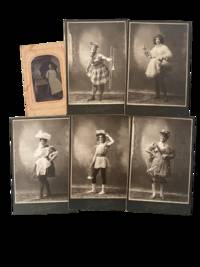
1880230281880. Cross-dressing Archive of six 19th century photographs of cross-dressing performers Springfield Illinois capturing early American drag performance during a period when public cross-dressing outside performance contexts could provoke not only social but legal backlash. These cross dressing portrait photographs created in Springfield Illinois during the late nineteenth century document early visual culture of gender nonconforming performance in the United States decades before modern LGBTQ identities were publicly articulated. The photographs show male individuals posed in women's clothing and adopting stylized feminine presentation part of a broader nineteenth century culture in which gender impersonation circulated in entertainment spaces private gatherings and visual novelty photography while remaining socially and legally sensitive in everyday life. Public cross dressing outside stage contexts could provoke moral condemnation and in many cities legal sanction under emerging anti cross dressing ordinances that appeared in the late nineteenth century. Portraits such as these therefore preserve rare visual evidence of early drag presentation and gender play at a moment when photographic studios documented identities and performances that existed at the margins of accepted social norms such portraits illuminate early emerging cross-dressing long before twentieth century drag entertainment or even the articulation of modern LGBTQ identities.<br /> <br /> Six original photographs produced in Springfield Illinois ca. 1880s to 1890s consisting of five cabinet cards and one tintype depicting cross dressing individuals posed in elaborate women's attire. The cabinet cards bear the imprint of Kessberger and Georg Studio of Springfield. Subjects appear against painted studio backdrops typical of commercial portrait photography of the period. Costumes include knee length dresses with lace trim aprons bows bonnets stockings and heeled shoes with attention given to wigs coiffure and accessories. Several figures hold musical instruments including trombone cornet and clarinet suggesting coordinated presentation or group identity among the sitters. Gestures emphasize stylized femininity including a figure lifting a skirt in exaggerated pose and another standing with hand placed at the hip. Also includes one smaller tintype photograph shows a similarly costumed man with a tick mustache in women's nightgown and holding a parasol. Cabinet card mounts show moderate edge wear and minor corner bumping with light surface scratches typical of late nineteenth century albumen studio photography. Images remain clear with strong contrast and well preserved costume detail. Overall Very good condition. Together the photographs form a cohesive visual archive documenting late nineteenth century cross dressing and early drag presentation in the American Midwest preserving rare photographic evidence of gender non conforming identity and performance practices that circulated in American culture long before twentieth century LGBTQ communities began to organize publicly. unknown
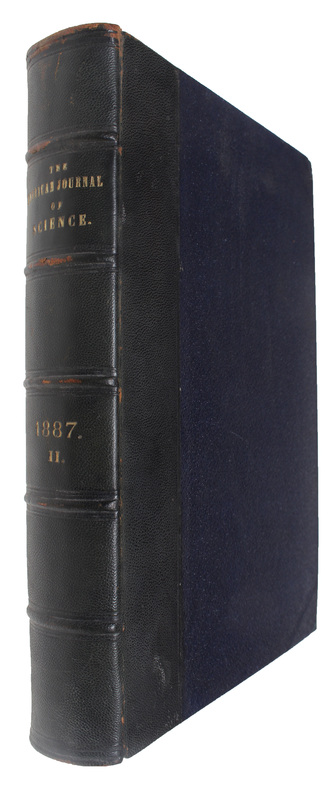
188747165New Haven, Conn., J.D. & E.S. Dana, 1887. 8vo. Contemporary half calf. Gilt lettering to spine. A small stamp to top of title-page. In: ""The American Journal of Science. Editors James D. and Edward S. Dana"", Third series Vol. XXXIV (July to December, 1887). VIII,500 pp., textillustr. and 10 plates. (Entire volume offered). The joint paper: pp. 333-345 and textillustr. (Apparatus). A few faint brownspots to titlepage, otherwise clean and fine.
188747165New Haven Conn. J.D. & E.S. Dana 1887. 8vo. Contemporary half calf. Gilt lettering to spine. A small stamp to top of title-page. In: "The American Journal of Science. Editors James D. and Edward S. Dana" Third series Vol. XXXIV July to December 1887. VIII500 pp. textillustr. and 10 plates. Entire volume offered. The joint paper: pp. 333-345 and textillustr. Apparatus. A few faint brownspots to titlepage otherwise clean and fine. <br/><br/><em>First appearance of this classic paper which announced one of the most celebrated experiments in the history of physics and eventually led Einstein to his Relativity Theory.The experiment was expected to show the rate of the earth's movement through the ether; they looked in vain for a difference between the speed of light in the direction of the earth's motion around the sun and the direction perpendicular to it. The failure of this experiment was a serious blow to classical scientific theories because it cast doubts on the existance of the universal ether which had been a basic principleof for example the Newtonian theories of the universe. Vide PMM: 378 401 408.The paper appeared first in the "American Journal of Science" in November as offered here and was published a month later in "Philosophical Magazine" in a slightly modified form."Michelson trained at the U.S. Naval Academy and Morley minister turned chemist began a series of experiments to determine the relation of ether drift and the velocity of light effects of extremely minute values. They used a slightly silvered glass set angular to a ray of sunlight so that a part ofthe ray was transmitted a part reflected out and again returned thereby providing two paths one perpendicular to the other. If drift existed the superimposed rays would produce interference. None was observed showing that the earth's motion did not affect the light's speed. The negative result held revolutionary implications which led directly thru Lorentz and Einstein to the acceptance of new standards of reference of time and space from geometry and cosmometry."DibnerIn 1919 Einstein met Michelson in California. At a dinner given in honor of them both Einstein said in a speech "You Michelson uncovered an insidious defect in the ether theory of light as it existed and stimulated the ideas of H.A. Lorentz and Fitzgerald out of which the Special Theory of Relativity developed. Without your work this theory would today be scarcely more than an interesting speculation." In an interview in 1842 Einstein said: "It is no doubt that Michelson's experiment was of considerably influence upon my work insofar as it strengthened my conviction concerning the validity of the Principle of relativity.On the other side I was pretty much convinced of the validity of the principle before I did know this experiment and its result. In any case Michelson's experiment removed practically any doubt about the validity of the principle in optics and showed that a profound change of the basic concepts of physics was inevitable."Michelson was awarded the 1907 Nobel Prize "for his optical precision instrument the inteferometer and the spectroscopic and metrological investigations he has carried on."Dibner: Heralds of Science: 161 lising the later version from "Philosophical Magazine" - Norman 1505.- Magee "A Source Book in Physics" pp. 369 ff. the later paper.The volume contains another paper by Michelson and Morley "On a method of Making the Wave-lenght of Sodium Light the actual and practical Standard of Lenght" pp. 427-430. </em> unknown