[Drag, Transgender]Biblio.com
12 résultats
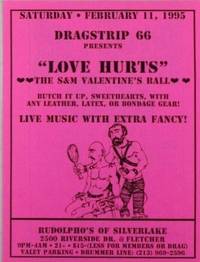
1995021719Silver Lake CA: VDragstrip 66 Publisher 1995. Unbound. Near Fine. Single sheet 5 ½ by 4 inches. Pink paper stock. Promo for Dragstrip 66 a LGBTQ club founded in 1993 and known for its embrace of the alternative and punk scene as well as drag. Founded by Paul Vitagliano and his friend Mr. Dan the bar focused on drag when it was still an outlier even within the gay community. Part of their strategy was to adopt an underground punk edge to drag where everything from booger drag to its glamorous counterparts were welcome. The club closed in 2013 and reopened again in 2023. see LA ist online article for previous history and information. An advertisement for an S&M Valentine's Ball suggesting people "Butch it up sweethearts with any leather latex or bondage gear!" Reverse of the leaflet advertises the Plush Life "LA's Only Weekly Sitcom Serial Soap Opera!" NEAR FINE with light edgewear. VDragstrip 66, Publisher unknown
1969460867Farnborough Hants : Gregg 1969. Facsimile Edition. Hardcover. Very good copy in the original silver-blocked cloth. Spine bands and panel edges slightly dust-toned and rubbed as with age. Remains well-preserved overall; tight bright clean and strong. Physical description; 16 990 pages ; 24 cm. Notes; Facsimile reprint of the first edition originally published: Paris : Apud R. Thierry & S. Cramoisy 1619. Edited by William Bishop. Only volume 1 published. Subjects; Catholic Church England History. Catholics England Biography. Great Britain History Sources. Great Britain Church history 16th century. Great Britain Church history 17th century. Christian martyrs England Biography. Farnborough, Hants : Gregg hardcover
19812111902160604795Shueisha 1981. Soft Cover. Fine. The book is in fine condition. Shueisha paperback
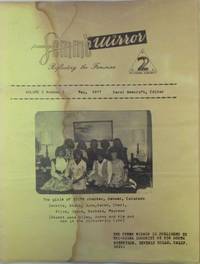
1977022334Beverly Hills: Tri-Sigma Sorority Publisher 1977. Wraps. Good. Yellow wraps roughly 8 ½ by 11 inches. 16 pp. including covers. Early issue of this zine devoted to heterosexual crossdressing. It originated in a more zine-like format in the late 1970s before adopting a more polished magazine-style look in the 1980s. The zine served as the official publication of the Tri-Ess Society an organization founded by Virginia Prince to destigmatize crossdressing. Prince held anti-trans and sometimes homophobic views that excluded the transgender community. Under the leadership of Carol Beecroft the organization became more inclusive forming alliances with LGBTQ groups and helping to form the Southern Comfort Conference a gathering of transgender people. This issue edited by Carol Beecroft. Includes make up tips and an article describing the trouble faced by a teenage "transvestite" in their household. GOOD condition. Large dampstain affecting most of the zine resulting in brownish discoloration and some rippling to the paper. Minor soiling and staining. Tri-Sigma Sorority, Publisher unknown
1939279532Moscow Leningrad : State Art Publisher 1939. First Edition. Hardcover. Poor copy with wear tear and dust-dulling as with age. Text remains clear and without blemish. Physical description; 15 1 p. 24 col. pl. ; 36 cm. Subject; Painting Russian. Moscow, Leningrad : State Art Publisher hardcover
1991x-0792310209Kluwer Academic Pub 1991. Hardcover. New. 173 pages. 9.13x6.57x1.11 inches. Kluwer Academic Pub hardcover
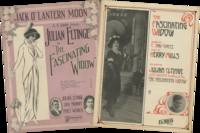
1917List3648New York City: Leo. Feist Inc. and others 1917. Five pieces of sheet music see full inventory below. Overall very good plus. Julian Eltinge 1881–1941 was the most commercially successful and popular female impersonator of his time. Beginning with drag performances in his adolescence he developed a convincing portrayal of female characters—shocking audiences at the end of shows by revealing that he was in costume—and had a successful career on the vaudeville circuit and on Broadway followed by appearances in several silent films and as mores around crossdressing changed in nightclubs.<br /> <br /> Offered here are five pieces of sheet music written for Eltinge three of which are from the 1910 musical comedy The Fascinating Widow. A New York Times review of the Widow remarks that “once over the initial unpleasantness of the idea of female impersonation which is not easy for people of delicate sensibilities there is nothing especially displeasing about Mr. Eltinge’s efforts at femininity†and notes Eltinge’s popularity and ability to draw crowds.1<br /> <br /> Titles Included:<br /> “In the Land of Wedding Bells.†Howard Johnson and Geo. W. Meyer. New York: Leo. Feist Inc. 1917. 4 pp. Very good plus.<br /> “The Crinoline Girlâ€. Julian Eltinge and Percy Wenrich. New York: Leo. Feist 1914. 6 pp. Very good.<br /> “The Fascinating Widowâ€. E. Ray Goetz and Kerry Mills. New York: F.A. Mills Inc. 1911. 8 pp. Near Fine.<br /> The Fascinating Widow “Jack-O-Lantern Moonâ€. Julian Eltinge Jack Mahoney and Percy Wenrich. New York: The Wenrich-Howard Co. 1913. 6 pp. Very good.<br /> The Fascinating Widow “With Down-Cast Eyeâ€. Otto Hauerbach and Karl Hoschna. New York Chicago San Francisco London and Paris: M. Witmark & Sons 1910. 6 pp. Excellent.<br /> <br /> 1 “Eltinge in Musical Play. Female Impersonator Seen at the Liberty in ‘The Fascinating Widow.’†The New York Times September 12 1911. Leo. Feist Inc. and others unknown
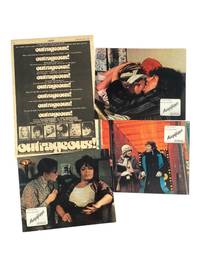
1977214451977. LGBTQCross-Dressing Archive of four items relating to the 1977 film "Outrageous!". Includes three original German lobby cards bearing the film's German title "Ausgeflippt!" and a 1977 Variety trade advertisement for this groundbreaking Canadian LGBTQ film starring Craig Russell and Hollis McLaren. The film directed by Richard Benner was one of the first North American movies to portray a drag performer as a fully realized protagonist with Russell playing Robin Turner a struggling female impersonator who supports his schizophrenic best friend. The film's bold depiction of queer identity mental health struggles and chosen family relationships resonated deeply with LGBTQ audiences and remains a cult classic.<br /> <br /> The Variety advertisement dated May 11 1977 features the film's title in a bold stylized font interspersed with key quotes from the movie. Beneath the text are photographic stills of Craig Russell in various drag personas showcasing his celebrated impersonations of Judy Garland Bette Davis and Mae West. The three lobby cards released for the German market under the title Ausgeflippt include vibrant full-color stills: one of Turner and his friend Liza sharing an intimate moment another capturing a tense domestic exchange and a third depicting Turner in flamboyant costume outside a theater emphasizing the film's themes of performance and identity. Overall very good condition. An uncommon survival of original promotional material from a pivotal LGBTQ film reflecting the 1970s era of independent queer cinema and the growing visibility of crossdressing and drag culture in mainstream media. unknown
1966mon0000496986Collins 1966T. hardcover. Good. in x in x in. This is the 1970 Collins reprint. NOT an ex-library book. Clean copy in good condition. Collins hardcover
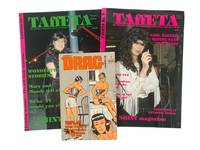
1982218171982. Various editors group of LGBTQ magazines 1982-circa 1993 documenting transgender transvestite and crossdressing subcultures in the United States and United Kingdom. The material operates in Cultural/Representational Mode illustrating how gender-variant individuals created print-based communities articulated identity and shared aesthetic and social practices through independently produced publications. These magazines combine personal narratives photography fiction and practical guidance offering insight into transfeminine self-expression coded communication and community-building prior to widespread digital connectivity.<br /> Various editors. Group of three magazines. Hollywood CA and Leighton Buzzard: J. Jordan Associates and Natural Leisure 1982-circa 1993. Archive includes: 1 Drag Digest No. 2 1982 featuring photo essays illustrated covers and articles on figures including Coccinelle and Robin Roberts alongside columns such as "A Dark Closet" and editorial content on personal advertisements; black-and-white images depict individuals applying makeup posing in lingerie and presenting in feminine attire. 2 Taffeta: The Lifestyle Magazine for Transvestites and Those That Love Them No. 7 circa 1993 including articles such as "Trannie Fun in Birmingham" and "Dressing Up Stepping Out" with photo spreads of nightlife fashion and social gatherings as well as directories of clubs and support networks; includes themed features such as motorcyclists in feminine presentation. 3 Taffeta No. 9 circa 1993 expanding coverage to discussions of gender identity relationships and fashion with articles such as "Do You Really Want to Change Sex" and narrative pieces describing personal relationships and experiences alongside full-color photographic content and listings of social venues and resources.<br /> <br /> These publications document the formation and maintenance of gender-variant communities through print media during a period when public representation remained limited and often stigmatized. The combination of lifestyle content personal testimony and visual imagery demonstrates how readers navigated identity visibility and social interaction within constrained cultural environments. The inclusion of both American and British publications highlights transnational parallels in subcultural development and communication. Light wear and minor handling marks; overall very good condition. A focused grouping preserving the print culture of transgender and crossdressing communities in the late twentieth century. unknown
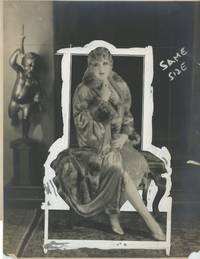
1920List2734Unknown location 1920. Approximately 10 x 13 inches. Some tears and chips at edges very good contrast editorial overpainting on recto overall very good. Marks on verso reading “Julian Eltinge Hippodrome March 12â€. Very good. Julian Eltinge 1881/1883–1941 was an American actor and “female impersonatorâ€â€”in today’s terms a drag performer—from Newtonville Massachusetts. Eltinge’s drag career began at age ten and by the early 1900s he was touring internationally performing a vaudeville act wherein the “audience was completely deceived as to Eltinge’s sex until he removed his wigâ€1. This portrait shows Eltinge seated in costume. On the reverse is written “Julian Eltinge Hippodrome March 12†and the front is signed “Herold Brown†this signature does not appear to belong to commercial photographer Harold M. Brown. A stamp is legible that dates the photograph to the 1920s though the exact year is not legible. Eltinge has been described as “without question the most famous female impersonator of all time†ibid.<br /> <br /> 1 Slide Anthony “Julian Eltinge†in The Vaudevillians: A Dictionary of Vaudeville Performers Westport Connecticut: Arlington House 1981 46. unknown
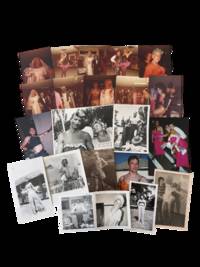
1960234611960. Gender nonconforming and drag performance photo archive documenting queer social gatherings costume performance pageantry and private queer community life from the 1960s through the 1990s. The photographs preserve a period when drag culture existed simultaneously in nightlife informal house parties outdoor gatherings and small community events often outside mainstream visibility. Long before drag became widely commercialized through television and corporate entertainment circuits queer performers and gender nonconforming individuals built their own social spaces through costume parody theatricality and communal celebration.<br /> <br /> Photo archive of 22 color and silver gelatin photographs ranging from small vernacular snapshots to larger prints United States circa 1960s-1990s. Several images center on a recurring bridal drag performer wearing lace wedding dresses veils floral bouquets wigs and exaggerated makeup while posing beside guests in tuxedos theatrical costumes and evening attire. Other photographs depict individuals in burlesque-inspired outfits feather boas crop tops wigs and handmade dresses posed indoors and outdoors at parties picnics and performance-like gatherings. One outdoor scene shows two figures in matching feminine costumes smiling arm in arm while additional images record staged poses beside vehicles improvised dance or performance gestures and casual snapshots emphasizing glamour and gender transformation. The archive repeatedly shifts between formal costume display and relaxed social interaction grounding drag not only as stage entertainment but as an everyday form of queer expression and community-making.<br /> <br /> The photographs align with broader developments in post-Stonewall queer culture when drag performance expanded from underground bars and private parties into increasingly visible forms of social and artistic expression. During much of this period openly gender nonconforming presentation still carried substantial social and legal risk especially outside major urban nightlife districts. This archive preserves the social fabric surrounding drag culture through intimate portrayals of friendships amateur performance gender experimentation and private community environments that sustained queer life across several decades. Light handling wear scattered creasing and occasional fading consistent with vernacular snapshot use. Overall in good condition. unknown