160 résultats
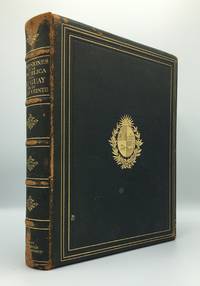
19121080Londres etc.: Lloyds Greater Britain Publishing Company Limited. 1912. First edition. Large quarto. Publisher's original full dark-green morocco; the upper board triple-ruled in gilt and with the Uruguayan crest in gilt; the spine with five raised bands compartments ruled and decorated in gilt and with titles in gilt. All edges gilt. Marbled endpapers. Title page contents page introduction and first text page with gilt borders and embellishments. Illustrated profusely throughout with black and white photographs and one map. Ownership inscription of the Australian writer Mary Gilmore to the head of the title page: "Mary Gilmore / Her book / 16. 3. 26". A very good copy the binding square and firm with a few small marks and scuffs to the boards rubbing to the spine and joints and wear to the corners. The contents with scattered foxing to the endpapers are otherwise in very good order and clean throughout. An interesting association copy of this comprehensive extensively illustrated and luxuriously produced survey of the people culture history politics economy industry agriculture geography and natural history of Uruguay at the beginning of the twentieth-century belonging to the influential Australian author journalist and poet Dame Mary Gilmore 1865-1962. </p><p>A prolific contributor to Australian literature and the broader national discourse during the first half of the twentieth-century Gilmore wrote for a number of leading newspapers and journals of the period serving as the editor of the women's section of The Australian Worker 1908-1931 as well as The Bulletin The Sydney Morning Herald and the Communist Party's Tribune becoming known as a campaigner for the welfare of the disadvantaged. Her first volume of poetry was issued in 1910 thereafter publishing prodigiously for the ensuing half-century coming to be regarded as one of Australia's most popular and widely read poets. Her poetry essays and memoirs covered a wide variety of themes although public imagination was particularly captured by her evocative views of country life with her best known work - 'No Foe Shall Gather Our Harvest' - serving as a morale booster during the Second World War.</p><p>A political progressive Gilmore gained a reputation as a 'fiery radical' - a champion of the workers and the oppressed. Involving herself with the burgeoning labour movement early in her life she had become a devotee of the utopian socialism of William Lane 1861-1917. In 1896 Gilmore and two hundred others followed Lane to Paraguay where they established a communal settlement called New Australia. She started a family there with William Gilmore whom she married in 1897 but the colony was ultimately short-lived with Gilmore leaving in 1900 living in Buenos Aires for six months followed by a period in Patagonia returning to Australia in 1902 after having saved enough money for a return passage.</p><p>Gilmore maintained a strong interest in Latin American politics culture and literature for the rest of her life. Indeed she also engaged in translation projects bringing Latin American literature to a wider audience notably endeavouring to produce a 'Uruguayan anthology' for which she corresponded with friends and associates in the country. This was perhaps also the origin of the present volume which itself forms a pleasing representation of Gilmore's wide-ranging ambitions.</p><p>By her later years Gilmore was a doyenne of the Sydney literary world and became something of a national icon making frequent appearances in the new media of radio and television and maintaining a significant literary output into old age publishing her last book of verse in 1954 aged 89. She died at the age of 97 and was accorded a state funeral a rare honour for a writer and has featured on the reverse of the Australian ten-dollar note since 1993. Londres [etc.]: Lloyds Greater Britain Publishing Company, Limited. hardcover
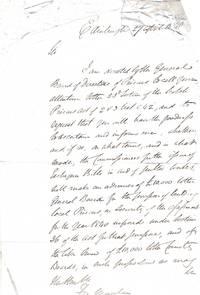
26425Edinburgh 27 April 1840 final number "40" and its reverse detached requiring repair. Two pages folio main text clear poor condition top edge and bottom corners fragile requiring attention closed tear at middle requires attention minor loss of text. Text: "I am directed by the General Board of Directors of Prisons to call your attention to the 53rd Section of the Scotch Prisons Act of 3 & 3 Vict. C42 and to request that you will have the goodness to ascertain and inform me whether and if so on what terms and in what mode the Commissioners for the isseu of Exchequer Bills in aid of public works will make an advance of £10000 to the General Board for the purpose of building local Prisons on security of the assessment for the year 1840 imposed under Section 36 of the Act for that purpose and of the like sum of £10000 to the Courts Boards in such proportions as may hereafter - word partly detached determined for the purpose of defraying the current Expenses of local Prisons on Security of the assessments to be imposed on the several Counties under Section 38 - In case such Loans should be entered into it is probable that half the amount of each would be required in the middle of June next and the other half towards the end of the year. Your early attention to this matter will be very obliging as the General Board desut=re to give information on the Subject to the County Boards in 10 or 12 days from this date ." Scan on both pages scanner loses an inch with small currently detached scrap available. Edinburgh, 27 April 1840 [final number "40" and its reverse detached, requiring repair] hardcover
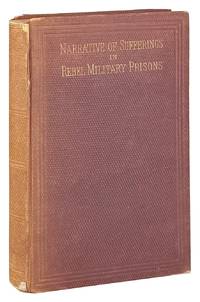
186447074Philadelphia: Printed for the U.S. Sanitary Commission by King & Baird Prs 1864. Very Good. Philadelphia: Printed for the U.S. Sanitary Commission by King & Baird Prs. 1864. First Edition. Octavo; purple cloth stamped in gilt; 283pp. Four plates map. Ex-library though with no external institutional markings. Boards worn at extremities with chipping to spine ends and brief exposure to joints and corners; spine faded. Binding sound; ca. 1900 library plate to front pastedown; stamp to title; top portion of the title page torn away not affecting text; else unmarked; still a Very Good copy; includes the four plates of starved soldiers; images available upon request. <br /> <br /> Sabin 51791. Printed for the U.S. Sanitary Commission, by King & Baird, Prs unknown
191273780Jeffersonville IN: Reformatory Press 1912. First edition. Octavo. 8 ll. printed on rectos only and bound at the top. Publisher's string-tied brown wrappers with printed paper title label on front. Excellent.This pamphlet lauds the fact that one of the very first psychological laboratories in the country was opening at the Reformatory at Jeffersonville preceded by New York and Boston. This was a huge step forward in penal reform and reflects the growing importance of psychology in preparing inmates for the outside world. "The new laboratory was endorsed by academics and reformers across the country including sociologist Hasting Hart of the Russell Sage Foundation Charles Henderson from the University of Chicago Zebulon Brockway and Maude Ballington Booth. Warden Peyton explained how the lab would disseminate knowledge and significantly advance prison reform. He also emphasized that both heredity and environment played a role in crime. Interestingly Governor Thomas Marshall rejected this view because he said it would be necessary to reject the religious doctrine of original sin" P. R. Clark; Barred Progress 2008. Earlier it was commonly believed that the best course of action for the health of society was to sterilize the insane and "feeble-minded" inmates. But Dr. Petyton was of the new school of though and pushed for psychological reform rather than physical. "Fortunately for inmates the big push for sterilization fizzled and was replaced by a more sophisticated and nuanced approach to crime and the treatment of criminals. In the summer of 1912 prison officials and the scientific community collaborated to create a department of research at the Indiana Reformatory. The psychology laboratory paralleled the commencement of the research department but other sub-departments soon followed including those dedicated to medical and sociological research. The research department took individual testing classification and treatment to a new level. Using relatively new techniques such as the Binet-Simon IQ test researchers tested inmates for perception association memory reason orientation fatigue mental activity motor control moral appreciation the ability to profit by experience attention the ability to carry on a conversation and the ability to plan. Researchers further classified the inmates by the kinds of criminal activity in which they participated. These categories included habitual criminal born criminal criminal through passion criminal by chance accidental" Ibid. The Laboratory seemed to have functioned as both a guidance counselor and a low-skill trade school. David Peyton was a doctor prison warden and a champion of prison reform and published Psychology and Crime 1915; Principles of Prison Reform 1915; The Differential Diagnosis of Crime 1912; Crime as an Expression of Feeble-Mindedness 1913 and many others. He once risked his entire career when he decided to allow the inmates at the Reformatory to fight a local fire.OCLC only locates 2 copies and incorrectly gives the page count as 12. {Reformatory Press] unknown
18474980Troy: Published and Sold by L. Willard 1847. First Edition. 1 - 44 pp. 1 vols. 8vo. Original printed wrappers uncut and unopened; some chipping at margins sporadic foxing. First Edition. 1 - 44 pp. 1 vols. 8vo. Contains: The Condemned: A Chapter from Our City Prison: A Tale of Truth and Horror. Wright I 2444 Published and Sold by L. Willard unknown
193176467Moundsville: Work & Hope 1931. First edition for this year OCLC records no holding for this year but does for 1927 4 1930 3 1932 3 1935 2 1937 1. Octavo. 48 pp. Extensively illustrated from photographs. Publisher's teal wrappers with red lettering and a large decorated border. Some finger soiling to rear wrapper else a very good copy.The publishers Work & Hope and printers and writers were all inmates of the Moundsville Penitentiary in West Virginia. Likely they worked in the hope of getting released as for a time the Moundsville Penitentiary ranked on the United States Department of Justice's Top Ten Most Violent Correctional Facilities list. The photographs herein present a different story of course. We see a beautiful chapel clean and tidy cells and prisoners at work in the shirt shop the broom shop and the whip shop. There are also photographs of the gothic prison itself. When it was built it was outside the town but by the time of closing it was right in the middle of a residential zone One of the countries most famous pre-historic mounds lent its name to the town.'The West Virginia Penitentiary in Moundsville was built in 1876 and closed in 1995. During its working history it was deemed as one of the most violent prisons in the U.S.A. seeing its fair share of riots murders and executions. Conditions were less than adequate and humane with the cells and rooms crawling with vermin and cockroaches.During its operation there were 36 reported murders and 94 executions. This does not take into account the suicides and accidents which take the total number of deaths to nearly 1000" A. Oborn 2019 Work & Hope unknown
183339519Paris: Au Dépôt de Lois Chez Gustave Pissin Imprimerie de P. Dupont et Laguionie 1833. Pp. 1-32 49-128 lacking part of "Nouvelle lois actes rendues en Angleterre" and much of Victor Foucher's "Code pénal de la république de Bolivia". 1 vols. 8vo. Disbound accompanied by upper cover some light spotting inked underlining of a few pages else very good. Pp. 1-32 49-128 lacking part of "Nouvelle lois actes rendues en Angleterre" and much of Victor Foucher's "Code pénal de la république de Bolivia". 1 vols. 8vo. Intended to provide the readers with recent changes or papers in the international legal and economic fields. Includes Mittermaier's paper on the British Penal System "Renseignemens nouveaux et récens sur l'efficacité du systeme pénal des Anglais et spécialement de la transportation" pp. 7-24 a section on "Nouvelle Publications" the "Chronique" M. Pinnheiro-Ferreira former minister of Portugal's "Observations sur la loi belge du 1er Octobre 1833 concernant l'extridition des réfugiés" pp. 65-80 an extract of the article by M. Wagener on "De l'Administration de la Justice criminelle en Autriche" pp. 113-122. Au Dépôt de Lois, Chez Gustave Pissin [Imprimerie de P. Dupont et Laguionie unknown
a26244Dec 29 1939. 4to. 87pp. charts blue stapled wraps. Mimeographed typescript. Good backstrip reinforced tips of a few pages chipped off no loss of text at all. . paperback
a26243May 14 1937. 4to. 69 leaves mimeo on rectos charts blue stapled wraps. Good several corners bumped. . paperback
188232544Richmond VA: W. A. Mountcastle 1882. Lithograph. Ca. 9" X 8". Very good. Well-known lithograph of the notorious Confederate prison in Richmond second in infamy only to Georgia's Andersonville Prison. A clean and handsome example of this famous image of this prison with six large tents in the middle ground. One soldier stands sentry in the foreground another stands with arm in a sling and a handful of others military and civilian mill about near the tents and along the large brick structure; interestingly three male civilians stand as a group in the foreground one of them clutching the hand of a young girl clearly posing for the photograph upon which this lithograph has been based. A front corner of the building still retains its original large "Libby & Son / Ship Chandlers & Grocers" sign. An attractive and highly detailed image. Housed in a modern ca. 1970s single cream matte and a simple ½" wooden frame with non-glare glass overall dimensions 12" X 11½". A simple but suitable presentation. W. A. Mountcastle unknown